

Qubit vs Bit: Understanding the Core Difference in Computing
 Suyash Raizada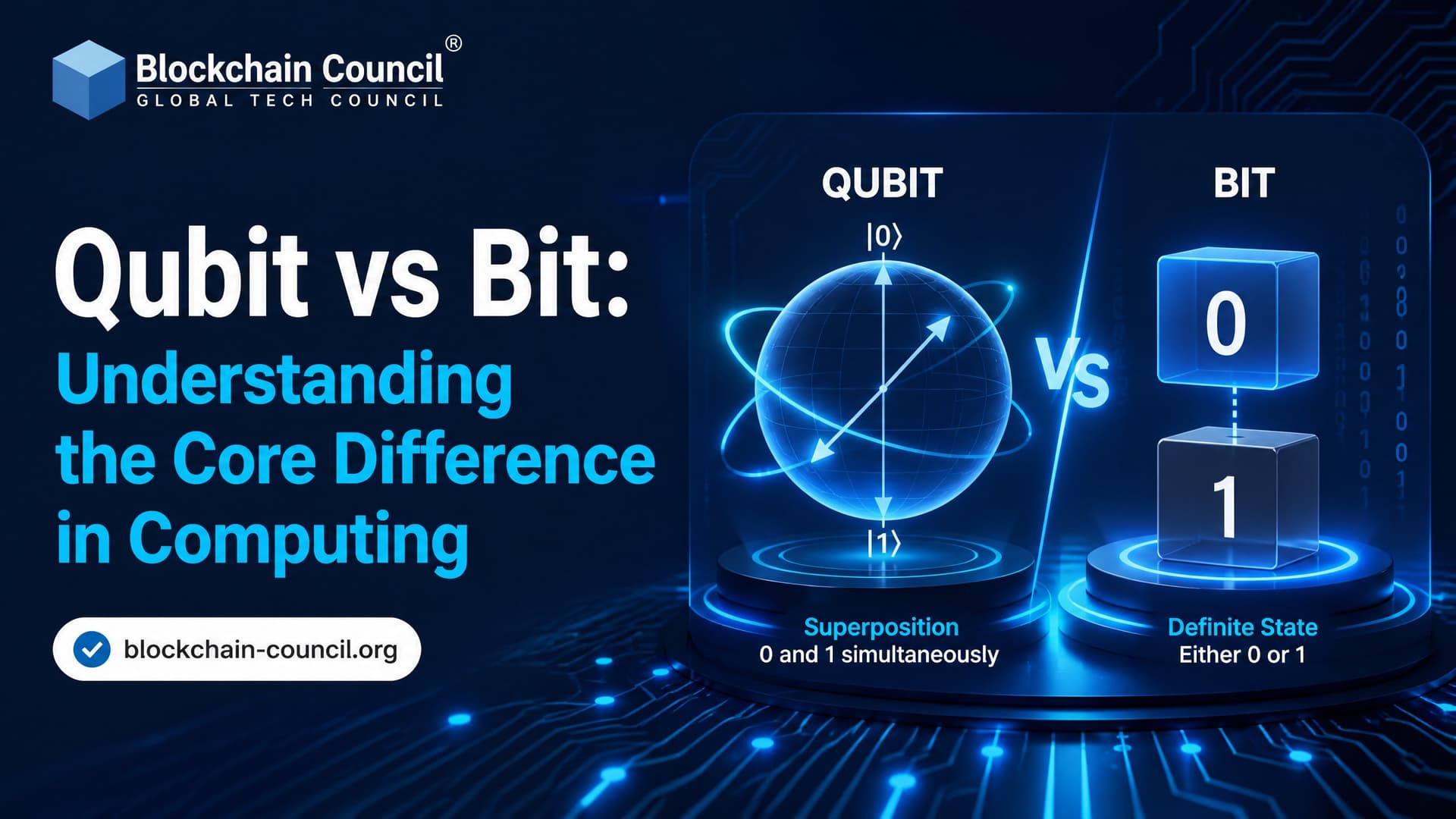
Qubit vs bit is the shortest way to describe the boundary between classical computing and quantum computing. A bit stores one clear value, either 0 or 1. A qubit, or quantum bit, can be represented as a combination of 0 and 1 until it is measured. That one difference changes how information is stored, processed, and read. Readers who want to move past the surface-level explanation often start with a Certified Quantum Computing Expert credential to build the technical foundation properly.
If you work in software, cybersecurity, data science, or enterprise architecture, you do not need to treat quantum computing as science fiction. But you should also avoid the common myth that qubits are simply faster bits. They are not. They follow different physics, demand different programming models, and solve only certain classes of problems better than classical systems.

What Is a Bit?
A bit is the basic unit of classical information. It has two possible states:
0
1
Inside conventional hardware, those states are usually represented by voltage levels in transistors. A high voltage may represent 1. A low voltage may represent 0. Modern processors use billions of transistors to store and manipulate these binary values through logic gates such as AND, OR, NOT, XOR, and NAND.
The key point is certainty. When a classical bit is stored as 0, it is 0. When it is stored as 1, it is 1. Reading the bit does not normally destroy it. Your laptop, phone, cloud servers, databases, blockchains, and AI training clusters all depend on this reliable binary behavior.
What Is a Qubit?
A qubit is the basic unit of quantum information. Like a bit, a qubit returns either 0 or 1 when measured. Before measurement, however, its state can be a quantum superposition of both outcomes. Professionals working where quantum computing meets machine learning, such as quantum-assisted optimization or hybrid quantum-classical pipelines, often pair this reading with a Certified Artificial Intelligence (AI) Expert credential, since the two fields are increasingly studied together.
A common mathematical form is:
|psi> = alpha|0> + beta|1>, where |alpha|^2 + |beta|^2 = 1
Here, alpha and beta are complex amplitudes. Their squared magnitudes define the probabilities of measuring 0 or 1. The phases of those amplitudes also matter, because quantum algorithms use interference to increase the chance of useful answers and reduce the chance of wrong ones.
This is where beginners often get misled. A qubit is not just a hidden 0 or 1 waiting to be revealed. Nor does it let you read two answers at once. When you measure it, you get one classical result. The value of a quantum computer comes from how it manipulates amplitudes before that measurement.
Qubit vs Bit: The Core Difference
The main qubit vs bit distinction is not size, speed, or storage density. It is state behavior.
1. Definite state vs superposition
Bit: Always holds one definite value, either 0 or 1.
Qubit: Can exist in a coherent combination of 0 and 1 before measurement.
That coherence is fragile. Noise, heat, vibration, unwanted electromagnetic interaction, or poor calibration can disturb the qubit state. This is why many quantum processors operate at extremely low temperatures and require specialized control electronics.
2. Deterministic reading vs measurement collapse
Bit: Reading the value usually leaves the stored value unchanged.
Qubit: Measurement collapses the quantum state into a classical 0 or 1.
Once a qubit has been measured, the previous superposition is gone. You cannot inspect the full alpha and beta values directly in hardware. You estimate behavior by running the same circuit many times, often called shots, and observing the distribution of results.
A practical detail: in Qiskit, if you set shots=1024 on a simulator or backend, you receive counts such as {'0': 517, '1': 507}, not the qubit's hidden state. Also, older tutorials that use from qiskit import execute may break in Qiskit 1.x with an import error, because the SDK removed that function. Small version details matter when you move from theory to actual circuits.
3. Boolean logic vs unitary operations
Classical computers use Boolean gates. For example, an AND gate maps two input bits to one output bit based on a fixed truth table.
Quantum computers use quantum gates. These gates apply unitary transformations to amplitude vectors. Common gates include:
X gate: Similar to a classical NOT for basis states.
Hadamard gate: Creates superposition from |0> or |1>.
CNOT gate: Helps create entanglement between qubits.
Phase gates: Change relative phase, which affects interference.
The logic is reversible at the gate level until measurement. That is very different from most classical logic, where information can be overwritten freely.
How State Space Scales
This is the part that makes quantum computing powerful, and also easy to exaggerate.
With n classical bits, there are 2^n possible binary patterns, but the machine holds one pattern at a given instant. For example, 3 bits can represent one of 8 patterns: 000, 001, 010, 011, 100, 101, 110, or 111.
With n qubits, the quantum state is described by 2^n complex amplitudes. Three qubits have amplitudes over all 8 basis states at once. Ten qubits require 1,024 amplitudes to describe the full state. Thirty qubits require more than one billion amplitudes.
That exponential state space is why quantum systems become difficult to simulate on classical machines. It is also why quantum algorithms can, in specific cases, outperform known classical algorithms.
But be careful. This does not mean 30 qubits give you one billion readable answers in a single run. Measurement still returns one bit string. A useful quantum algorithm must shape the probability distribution so the right answers appear more often.
Entanglement: The Feature Bits Do Not Have
Classical bits can be correlated. If one database field says approved=true, another field may say risk_score=low. That is ordinary correlation.
Qubits can be entangled, which creates correlations that cannot be explained by classical probability alone. In an entangled two-qubit state, the system must be treated as one combined quantum state rather than two independent objects.
Entanglement is central to many quantum algorithms and quantum communication protocols. It is also one reason quantum hardware is hard to scale. Maintaining entanglement across many noisy qubits is an engineering problem, not just a math problem.
Where Qubits Can Help
Quantum computers are not general-purpose replacements for classical computers. To be blunt, most business applications do not need qubits today. Email, payroll, web services, ERP systems, analytics dashboards, and blockchain nodes run better on classical infrastructure.
Qubits are promising for narrower problem areas, including:
Quantum simulation: Modeling molecules, materials, and quantum systems that are naturally hard for classical computers.
Cryptanalysis research: Shor's algorithm is relevant to factoring and discrete logarithms, which affects RSA and elliptic curve cryptography in a future fault-tolerant setting.
Search and optimization: Grover's algorithm gives a quadratic speedup for unstructured search, though practical advantage depends on data loading and hardware limits.
Sampling problems: Some quantum devices can generate distributions that are hard to reproduce classically.
The current practical model is hybrid. Classical computers prepare inputs, control the quantum processor, collect measurement results, and post-process outputs. The quantum chip acts more like a specialized accelerator than a standalone computer. Making sense of that hybrid stack often draws on skills beyond quantum theory alone, which is one reason engineers rounding out their background sometimes add a general Tech Certification covering the classical infrastructure, control systems, and software layers that sit around any quantum accelerator.
Generative AI in Serialized Storytelling
Qubits are not the only area where probabilistic, feedback-driven systems are finding new applications. One emerging application is AI microdrama, where generative AI helps bring serialized stories, characters, and fictional worlds to life. It sits far from quantum hardware, but it is a useful reminder that specialized computation, quantum or classical, tends to find its footing in narrow, well-defined problem spaces rather than as a general-purpose replacement for everything else.
Why Qubits Are Hard to Build
Classical bits are stable because transistors are mature, cheap, and reliable. Qubits are delicate. They must preserve coherence long enough to perform useful operations. That is difficult because real hardware is noisy.
Different platforms use different physical qubits, including superconducting circuits, trapped ions, photons, neutral atoms, and spin qubits. Each approach has trade-offs in gate speed, connectivity, error rate, operating temperature, and manufacturability.
This is why error correction matters. Physical qubits are error-prone, so future fault-tolerant quantum computers will need many physical qubits to create one reliable logical qubit. That overhead is one of the biggest gaps between impressive demonstrations and broad production use.
Qubit vs Bit Comparison Table
Feature | Bit | Qubit |
Basic states | 0 or 1 | Measured as 0 or 1 |
Before reading | Definite value | Can be in superposition |
Read operation | Usually nondestructive | Collapses the state |
Logic model | Boolean gates | Unitary quantum gates |
Correlations | Classical correlation | Can include entanglement |
Hardware maturity | Highly mature | Early, noisy, specialized |
Best use | General computing | Specific quantum algorithms |
What This Means for Professionals
If you are learning quantum computing for work, start with the difference between probability and amplitude. Many certification candidates can repeat the phrase "superposition of 0 and 1," but struggle when asked what measurement returns. The answer is simple: a classical bit value, sampled from a probability distribution.
For developers, the best learning path is hands-on:
Build a one-qubit circuit with a Hadamard gate.
Run it for 1,024 shots and inspect the counts.
Add a CNOT gate to create a Bell state.
Change the measurement basis and observe how outcomes shift.
Compare simulator results with real hardware noise when access is available.
If your background is blockchain or cybersecurity, pay attention to post-quantum cryptography as well. Quantum computers do not break Bitcoin or Ethereum tomorrow, but large fault-tolerant machines would change the risk model for public-key systems. That is a serious long-term architecture issue.
For structured learning, consider Blockchain Council's Certified Quantum Computing Expert™ as a starting path. If you work at the intersection of AI, cryptography, and distributed systems, pairing it with Blockchain Council programs in blockchain, cybersecurity, or AI can help you connect quantum concepts to real enterprise decisions.
The Practical Takeaway
The qubit vs bit difference comes down to how information behaves. Bits are definite, stable, and ideal for deterministic digital systems. Qubits are probabilistic quantum systems that use superposition, phase, interference, and entanglement.
Do not frame quantum computers as faster laptops. Frame them as specialized machines for problems where quantum mechanics is an advantage. Your next step: run a basic quantum circuit, measure it many times, and compare the results with the theory. That small experiment teaches more than a dozen slogans about qubits. If part of your work involves explaining that distinction to customers, leadership, or the wider market, a Marketing Certification helps translate the technical nuance covered here into language a non-technical audience can actually use.
FAQs
1. What Is a Bit in Computing?
A bit, short for binary digit, is the basic unit of classical digital information. A bit can have one of two values, typically represented as 0 or 1, and classical computers use combinations of bits to represent and process information.
2. What Is a Qubit in Quantum Computing?
A qubit, or quantum bit, is the basic unit of quantum information. Unlike a classical bit, a qubit can exist in a quantum superposition of the basis states |0⟩ and |1⟩ until it is measured.
3. What Is the Main Difference Between a Qubit and a Bit?
A classical bit has a definite binary value of 0 or 1, while a qubit can be represented by a combination of |0⟩ and |1⟩. Qubits can also exhibit quantum properties such as superposition, entanglement, and interference.
4. How Does a Bit Store Information?
A classical bit stores information using one of two distinguishable states. Large collections of bits can be combined into bytes and larger data structures to represent numbers, text, images, programs, and other forms of digital information.
5. How Does a Qubit Store Information?
A qubit stores quantum information in the physical state of a quantum system. A general single-qubit state can be represented as |ψ⟩ = α|0⟩ + β|1⟩, where α and β are complex probability amplitudes satisfying the normalization condition |α|² + |β|² = 1.
6. Can a Qubit Be 0 and 1 at the Same Time?
A qubit in superposition can be described as a combination of the |0⟩ and |1⟩ states. However, when measured in the computational basis, it produces a definite classical result, either 0 or 1.
7. What Is Superposition in a Qubit?
Superposition allows a qubit to have a quantum state that combines multiple basis states. Quantum algorithms manipulate these components before measurement, using interference to influence the probabilities of different outcomes.
8. What Is Entanglement Between Qubits?
Entanglement is a quantum property in which multiple qubits share a joint state that cannot be described as independent states for each qubit. Entangled qubits can exhibit strong correlations between measurement outcomes.
9. Do Classical Bits Have Superposition?
No. Classical bits are represented by definite classical states in ordinary digital computing. Classical systems can represent uncertainty using probabilities, but this is different from quantum superposition because quantum states also contain phase information that can produce interference.
10. How Do Quantum Gates Affect Qubits?
Quantum gates manipulate the state of one or more qubits using reversible quantum operations. Gates such as Hadamard, Pauli-X, and CNOT can create superposition, change phases, and generate entanglement.
11. How Are Classical Bits Processed?
Classical computers use logic gates and electronic circuits to manipulate bits. Operations such as AND, OR, NOT, and XOR are combined to build processors, memory systems, and digital applications.
12. How Are Qubits Processed?
Quantum computers manipulate qubits using quantum gates arranged into quantum circuits. These operations change the amplitudes and phases of quantum states before measurements produce classical information.
13. Is One Qubit Equal to Many Classical Bits?
Not in a direct information-storage sense. Although an n-qubit quantum state can contain amplitudes associated with 2ⁿ computational basis states, measuring the system does not provide all of those amplitudes as classical data.
14. Why Can Quantum Computers Process Information Differently?
Quantum computers exploit superposition, entanglement, and interference to manipulate quantum states. Carefully designed quantum algorithms can use these properties to provide computational advantages for certain problems.
15. Are Qubits Faster Than Bits?
A qubit itself is not simply a faster version of a bit. Quantum speedups arise from specific algorithms and quantum effects that can reduce the computational resources required for certain problems compared with known classical approaches.
16. What Are Physical Examples of Qubits?
Qubits can be implemented using different physical systems, including superconducting circuits, trapped ions, neutral atoms, photons, semiconductor-based quantum systems, and other quantum platforms. Each approach has different engineering characteristics and trade-offs.
17. Why Are Qubits Difficult to Build and Maintain?
Qubits are sensitive to environmental noise and imperfections in quantum operations. Decoherence, gate errors, measurement errors, crosstalk, and control challenges can reduce the reliability of quantum computations.
18. What Is the Role of Quantum Error Correction for Qubits?
Quantum error correction protects logical quantum information by encoding it across multiple physical qubits and using additional measurements to detect error syndromes. This approach aims to reduce the effective error rate of logical qubits.
19. Where Are Bits and Qubits Used?
Bits are used in virtually all conventional digital technologies, including computers, smartphones, servers, and embedded systems. Qubits are primarily used in quantum computing research and emerging quantum applications involving areas such as simulation, optimization, cryptography, and scientific computing.
20. Why Is Understanding Qubits vs Bits Important?
Understanding the difference between bits and qubits provides a foundation for learning how classical and quantum computers process information. The distinction also helps explain why quantum computers are not general replacements for classical computers but specialized systems designed to solve particular computational problems.
Related Articles
View All
Quantum Computing
Quantum Computing and Artificial Intelligence: Understanding the Connection
Quantum Computing and Artificial Intelligence are converging through Quantum AI, where quantum processors assist selected AI tasks and AI improves quantum systems.

Quantum Computing
What Is a Qubit? The Building Block of Quantum Computing Explained
A clear explanation of what a qubit is, how it differs from a classical bit, and why superposition, entanglement, and error rates matter.

Quantum Computing
Quantum Computing Certification: Benefits, Career Value, and How to Choose One
Learn how quantum computing certification supports career growth, what employers value, and how to choose a credential with real technical depth.
Trending Articles
AWS Career Roadmap
A step-by-step guide to building a successful career in Amazon Web Services cloud computing.
How Blockchain Secures AI Data
Understand how blockchain technology is being applied to protect the integrity and security of AI training data.

Can DeFi 2.0 Bridge the Gap Between Traditional and Decentralized Finance?
The next generation of DeFi protocols aims to connect traditional banking with decentralized finance ecosystems.