

Quantum Computing vs Traditional Computing: What Businesses Need to Know
 Suyash Raizada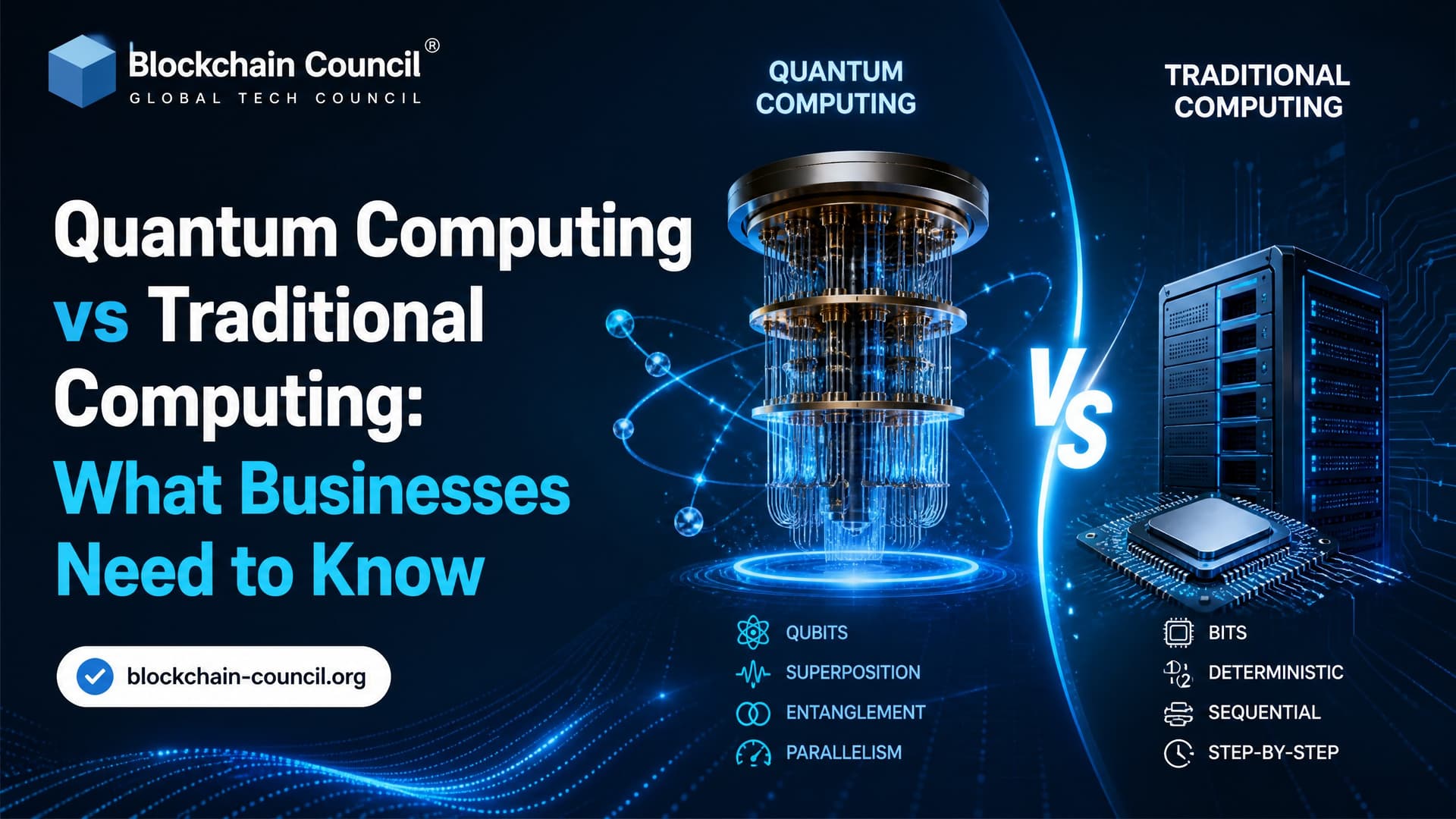
Quantum Computing vs Traditional Computing is not a contest where one replaces the other. For businesses, the practical answer is simpler: traditional computing runs your core systems today, while quantum computing is becoming a specialized tool for simulation, optimization, and long-term security planning. Leaders who want a grounded starting point before evaluating vendor claims often begin with a Certified Quantum Computing Expert credential.
That distinction matters. A bank should not move risk systems to quantum hardware in 2026. A pharma company, though, may be right to test quantum methods for molecular simulation. A retailer with standard demand forecasting workloads will usually get more value from better data engineering and classical AI. Context decides.

Quantum Computing vs Traditional Computing: the basic difference
Traditional computers use bits. A bit is either 0 or 1. Everything from databases to ERP systems, cloud applications, mobile apps, and most AI inference runs on this model. It is reliable, measurable, and mature. Teams weighing quantum pilots against classical AI investment often pair quantum literacy with a Certified Artificial Intelligence (AI) Expert credential, since most near-term enterprise value still comes from the classical AI side of that comparison.
Quantum computers use qubits. A qubit can exist in a superposition of states, and multiple qubits can become entangled. That lets quantum systems represent certain probability patterns in ways that are extremely hard for classical machines to reproduce efficiently.
Here is the business translation. Classical computers are general-purpose workhorses. Quantum computers are narrow-purpose accelerators. They are expected to help most where the problem itself has quantum structure, a vast search space, or a difficult sampling component.
So, no, quantum computing will not replace traditional computing. It will more likely sit beside it as a co-processor in hybrid quantum-classical workflows. Your classical stack will still handle data ingestion, APIs, storage, orchestration, security controls, and reporting.
Where quantum computing stands in 2026
Most quantum systems are still in the NISQ era, short for Noisy Intermediate-Scale Quantum. That phrase is not marketing. It means the devices have limited qubit counts, short coherence times, and error rates that make long calculations difficult.
Current systems often contain tens to a few hundred physical qubits. IBM has run advanced work on 127-qubit processors, and research teams have reported meaningful speedups on benchmark problems such as variants of Simon's problem. IBM and collaborators have also shown quantum advantage on specific theoretical simulation tasks. Impressive? Yes. Directly useful for a shipping route optimization dashboard? Not yet.
Boston Consulting Group estimated enterprise quantum computing spending at roughly 550 million US dollars in 2025. McKinsey's Quantum Technology Monitor has pointed to growing activity in chemicals and life sciences, especially for material and molecular simulation. Analysts have suggested that thousands of quantum computers could be operational by 2030, while the most complex commercial problems may need hardware and software maturity closer to 2035 or later.
That is the uncomfortable middle ground. The field is real. The value is early. The timelines are uneven.
Best-fit use cases for quantum computing
1. Chemistry and materials simulation
This is the strongest near to mid-term case. Molecules and materials behave according to quantum mechanics, so quantum computers may eventually model them more naturally than classical approximation methods.
Chemicals, battery research, catalyst design, and pharmaceutical discovery are active areas. McKinsey has reported that companies in chemicals and life sciences are already running exploratory quantum simulations. Quantinuum has reported trapped-ion simulations of the Fermi-Hubbard model, a foundational condensed-matter physics problem connected to high-temperature superconductivity research.
To be blunt, this does not mean a quantum computer will design your next drug candidate this quarter. It means R&D teams should start learning where quantum simulation could cut expensive trial-and-error cycles.
2. Optimization problems
Optimization is the use case every executive hears about first: routes, portfolios, factory schedules, grid balancing, warehouse layouts, capital allocation.
Some of these problems may benefit from quantum approaches, especially hybrid methods where a classical optimizer calls a quantum processor for a specific subproblem. But classical solvers are very strong. Gurobi, CPLEX, OR-Tools, simulated annealing, and modern heuristics are hard to beat in production.
If your optimization problem is small, clean, and already solved quickly by classical software, quantum is the wrong tool. If it is huge, expensive, and strategically important, a pilot may be justified.
3. Finance and risk modeling
Finance teams are exploring quantum methods for portfolio optimization, Monte Carlo-style sampling, capital allocation, anomaly detection, and stress testing. KPMG has identified finance as one of the sectors with meaningful quantum interest.
The catch is data. Quantum processors do not magically load terabytes of market data. You still need classical systems to prepare features, encode problem states, validate results, and meet audit requirements. In heavily regulated finance, explainability and governance matter as much as raw speed.
4. Security and cryptography planning
This is the most urgent strategic issue, even if the technical threat is not immediate. Shor's algorithm could, in theory, break RSA and related public-key cryptography once sufficiently powerful fault-tolerant quantum computers exist.
Most experts do not expect such machines at scale right away. Estimates often sit in the 10 to 15 year range for broadly useful fault-tolerant systems. Still, sensitive data may need to stay confidential for decades. That creates a harvest-now, decrypt-later risk.
You should begin crypto-agility work now: inventory cryptographic assets, track post-quantum cryptography standards, and plan migration away from vulnerable public-key schemes. The US National Institute of Standards and Technology has already standardized post-quantum algorithms including ML-KEM for key encapsulation and ML-DSA for digital signatures.
What traditional computing still does better
Traditional computing remains the default for almost every business workload. That includes:
Transactional databases and payment systems
Enterprise resource planning and CRM
Web and mobile applications
Cloud-native workloads and containers
Most machine learning training and AI inference
Business intelligence and reporting
Cybersecurity monitoring and incident response
Classical infrastructure is also cheaper to operate, easier to hire for, better supported, and easier to audit. That matters. A CIO does not get credit for experimental elegance if payroll fails.
Quantum computing is not a faster laptop. It is a different computational model with overheads, noise, specialist tooling, and unusual development patterns.
Generative AI applications are growing alongside quantum research
Quantum computing is one specialized frontier among several emerging technologies businesses are watching right now, and not all of them involve hardware at all. One emerging application is AI microdrama, where generative AI helps bring serialized stories, characters, and fictional worlds to life. It has no direct link to qubits or cryptography, but it is a useful reminder that new computational capabilities, whether quantum or purely generative, tend to prove themselves in narrow, well-defined use cases before broader adoption follows.
Hybrid quantum-classical systems are the realistic model
The practical future is hybrid. A classical system will prepare data, send a circuit or optimization task to a quantum processor, receive measurement results, and update the next step. This loop may repeat thousands of times.
If your team experiments with Qiskit, expect normal software friction. A very common issue appears when older tutorials meet Qiskit 1.x: ImportError: cannot import name 'execute' from 'qiskit'. That usually means the example was written for an older API. In newer workflows, developers use primitives such as Sampler and Estimator, or transpile circuits and call backend.run directly. Small detail. Big time sink. Debugging this kind of friction is a general software skill as much as a quantum one, which is why a broad Tech Certification can be a practical complement for engineers supporting these hybrid pipelines.
This is why internal literacy matters. Quantum pilots are not only physics projects. They are software engineering projects with versioning, cloud access, cost controls, data pipelines, and reproducibility problems.
How businesses should evaluate quantum projects
Use a disciplined filter before funding a pilot.
Define the business bottleneck. Do not start with quantum. Start with the expensive problem.
Benchmark classical methods first. If classical tools solve it well, document that and move on.
Look for quantum fit. Good candidates involve molecular simulation, complex optimization, sampling, or cryptographic planning.
Use cloud access before buying anything. IBM Quantum, Amazon Braket, Microsoft Azure Quantum, and other services let teams test without owning hardware.
Set value gates. Measure cost, runtime, quality of result, and integration effort. Scientific novelty is not the same as business value.
Include security teams early. Post-quantum migration affects PKI, certificates, vendor contracts, compliance, and long-lived data.
BCG has advised CEOs to identify high-impact quantum opportunities early rather than wait for general-purpose speedups. That is sensible. Waiting until the market matures can leave a skills gap. Spending heavily before the use case is clear is just as risky.
Skills your teams need
Your organization does not need every developer to become a quantum physicist. You do need a small group that can speak both business and technical language.
Useful skills include:
Linear algebra and probability
Basics of qubits, gates, circuits, superposition, and entanglement
Quantum algorithms such as Grover's algorithm and Shor's algorithm
Hybrid workflow design
Classical optimization and high-performance computing fundamentals
Post-quantum cryptography and crypto-agility planning
For structured learning, Blockchain Council's Certified Quantum Computing Expert™ gives professionals a grounded view of quantum concepts, algorithms, and business applications. Security teams may pair this with cybersecurity-focused training, while blockchain teams should track how post-quantum cryptography could affect wallets, signatures, and protocol design.
What businesses should do next
If you are comparing Quantum Computing vs Traditional Computing, the right move is not to choose one. Keep investing in classical cloud, data, AI, and cybersecurity capabilities. That is where most returns still come from.
At the same time, create a small quantum readiness plan. Pick one high-value problem, run a classical benchmark, test a limited quantum or hybrid approach through cloud access, and document what you learned. Separately, ask your security team for a cryptographic inventory and a post-quantum migration roadmap.
Start with people, not hardware. Train a small cross-functional group first: one domain expert, one software engineer, one data or optimization specialist, and one security lead. Give them 90 days to assess use cases and report back with evidence. That beats a vague innovation program every time. If your rollout plan also needs to win over customers or the board, a Marketing Certification helps that same group explain quantum readiness in terms a non-technical audience will actually trust.
FAQs
1. What Is the Difference Between Quantum Computing and Traditional Computing?
Traditional, or classical, computers process information using bits represented as 0 or 1. Quantum computers use qubits that can be manipulated in quantum states, allowing certain algorithms to exploit superposition, interference, and entanglement.
2. How Does Quantum Computing Work Differently From Traditional Computing?
Classical computers use logic gates and conventional processors to manipulate bits. Quantum computers use quantum gates to manipulate qubits and execute quantum circuits, with measurement used to obtain classical results.
3. Is Quantum Computing Faster Than Traditional Computing?
Quantum computers are not universally faster than classical computers. They are designed to provide computational advantages for certain problems when appropriate quantum algorithms and sufficiently capable hardware are available.
4. Can Quantum Computers Replace Traditional Computers?
Quantum computers are not expected to replace classical computers for everyday computing tasks. They are better understood as specialized computational systems that may work alongside classical infrastructure to address particular complex problems.
5. Why Should Businesses Care About Quantum Computing?
Quantum computing could eventually affect industries that rely on complex optimization, simulation, cryptography, and certain forms of computational analysis. Businesses can benefit from understanding potential use cases and the implications of quantum technology before large-scale adoption becomes practical.
6. What Business Problems Could Quantum Computing Solve?
Potential applications include portfolio optimization, supply-chain optimization, molecular simulation, materials discovery, scheduling, risk analysis, and certain cryptographic tasks. The practical advantage of quantum computing for these applications remains dependent on future hardware and algorithmic progress.
7. How Can Quantum Computing Help Financial Services?
Quantum computing research is exploring applications in areas such as portfolio optimization, risk analysis, option pricing, and fraud-related modeling. Businesses should distinguish experimental or research applications from commercially proven quantum solutions.
8. How Could Quantum Computing Affect Supply Chain Management?
Supply chains often involve complex optimization problems involving routes, inventory, scheduling, capacity, and resource allocation. Quantum optimization algorithms may eventually help address some of these problems, although classical optimization methods remain important and widely used today.
9. Can Quantum Computing Benefit Healthcare and Pharmaceuticals?
Quantum computers are being researched for simulating molecular and chemical systems that can be difficult to model accurately using classical methods. Potential applications include drug discovery, molecular modeling, and materials research, but many of these use cases remain under active development.
10. How Does Quantum Computing Affect Cybersecurity?
A sufficiently capable fault-tolerant quantum computer could threaten some widely used public-key cryptographic algorithms, particularly those based on integer factorization or discrete logarithms. This is why organizations are evaluating and adopting post-quantum cryptographic standards designed to resist attacks from both classical and quantum computers.
11. What Is Post-Quantum Cryptography?
Post-quantum cryptography (PQC) refers to cryptographic algorithms designed to remain secure against attacks from both classical and sufficiently capable quantum computers. Businesses can evaluate their cryptographic systems and migration requirements as part of long-term cybersecurity planning.
12. Is Quantum Computing Available to Businesses Today?
Businesses can access quantum computing through cloud platforms, research partnerships, developer tools, and quantum hardware providers. However, today's quantum systems have limitations involving noise, error rates, scale, and the types of problems they can solve effectively.
13. What Are the Main Limitations of Quantum Computing for Businesses?
Current limitations include hardware complexity, error rates, limited numbers of high-quality qubits, specialized programming requirements, and the difficulty of demonstrating practical advantage for many business workloads. Quantum computing also requires substantial research and engineering investment.
14. Is Quantum Computing More Expensive Than Traditional Computing?
Quantum computing infrastructure is generally more specialized and difficult to operate than conventional computing infrastructure. For many business workloads, classical cloud or on-premises computing remains more practical and cost-effective, while quantum computing is mainly being explored for specialized problems.
15. Do Businesses Need Quantum Computers to Experiment With Quantum Computing?
No. Businesses and developers can experiment with quantum algorithms using cloud-accessible quantum processors and classical simulators. This allows organizations to explore potential applications without necessarily owning or operating quantum hardware.
16. What Skills Do Businesses Need for Quantum Computing?
Organizations exploring quantum computing may need expertise in quantum algorithms, quantum programming, mathematics, physics, optimization, cybersecurity, and relevant industry domains. Partnerships with quantum technology providers and research institutions can also help businesses build specialized capabilities.
17. How Can a Business Prepare for the Quantum Computing Era?
Businesses can begin by identifying computationally intensive problems that could potentially benefit from quantum algorithms and monitoring developments in relevant technologies. They can also assess cryptographic dependencies and begin planning for post-quantum security where appropriate.
18. How Do Quantum and Traditional Computers Work Together?
Quantum computers can operate as specialized accelerators alongside classical systems. A hybrid workflow may use classical computers for data preparation, control, optimization, and result processing while a quantum processor performs a specific quantum computation.
19. Which Industries Could Be Most Affected by Quantum Computing?
Potentially relevant sectors include finance, pharmaceuticals, chemicals, logistics, manufacturing, energy, materials science, cybersecurity, and telecommunications. The actual impact will depend on whether quantum hardware achieves sufficient scale, reliability, and cost-effectiveness for specific industry problems.
20. What Should Businesses Know About the Future of Quantum Computing?
Quantum computing is an emerging technology rather than a universal replacement for classical computing. Businesses can prepare by understanding realistic use cases, tracking hardware and algorithm developments, developing relevant skills, experimenting where appropriate, and evaluating post-quantum cybersecurity requirements.
Related Articles
View All
Quantum Computing
Quantum Computing Certification: Benefits, Career Value, and How to Choose One
Learn how quantum computing certification supports career growth, what employers value, and how to choose a credential with real technical depth.

Quantum Computing
Best Quantum Computing Courses in India for Students and Professionals
Explore the best quantum computing courses in India, including IIT, NPTEL, AICTE aligned, C-DAC, and regional programmes for students and professionals.

Quantum Computing
Quantum Computing Jobs: Skills, Roles, Salaries, and Career Paths
Explore quantum computing jobs, salaries, key skills, and career paths across software, hardware, research, security, product, and applied roles.
Trending Articles
The Role of Blockchain in Ethical AI Development
How blockchain technology is being used to promote transparency and accountability in artificial intelligence systems.
What is AWS? A Beginner's Guide to Cloud Computing
Everything you need to know about Amazon Web Services, cloud computing fundamentals, and career opportunities.

Can DeFi 2.0 Bridge the Gap Between Traditional and Decentralized Finance?
The next generation of DeFi protocols aims to connect traditional banking with decentralized finance ecosystems.