

How Does Quantum Computing Work? Key Concepts Explained Simply

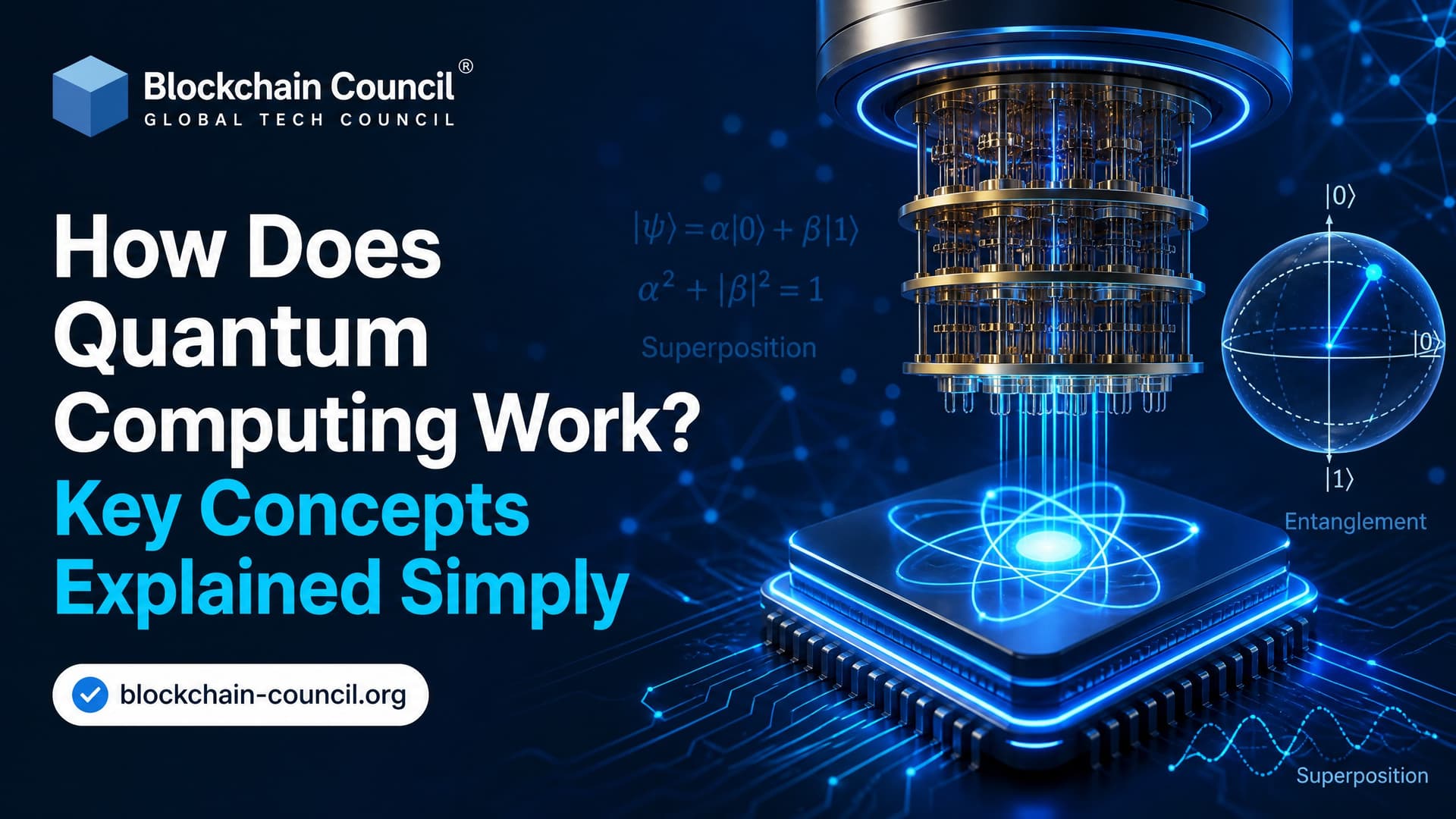
How quantum computing works makes more sense once you stop comparing it to a faster laptop. A quantum computer is not a smaller or quicker classical machine. It uses quantum physics to represent information, control probabilities, and solve a narrow set of problems that become painful for classical systems.
Here is the short version. Classical computers use bits. Quantum computers use qubits. Qubits can hold probability-based states, interact through entanglement, and use interference to raise the chance of measuring a useful answer. That sounds strange because it is. But the mechanics are logical once you break them down.

Bits vs qubits: the starting point
A classical bit is simple. It is either 0 or 1 at any given moment. Every file, app, database, and smart contract ultimately runs on long strings of those binary values.
A quantum bit, or qubit, is different. It can be built from physical systems such as superconducting circuits, trapped ions, neutral atoms, or photons. Instead of being only 0 or only 1 before measurement, a qubit is described by probability amplitudes. Those amplitudes tell you the likelihood of measuring 0 or 1 later.
This is called superposition. Be careful with the popular phrase "0 and 1 at the same time." It is catchy, but not quite right. A qubit is not secretly storing two classical answers. It evolves according to quantum rules until you measure it, and measurement gives you a single classical result.
The three ideas that make quantum computing different
Superposition
Superposition lets a quantum system represent a combination of possibilities. With one qubit, that is already unusual. With many qubits, the mathematical state space grows fast. Two qubits require four amplitudes. Three require eight. Fifty qubits already describe a state space too large to casually track on a normal computer.
That does not mean a 50-qubit machine automatically beats a supercomputer. You still need the right algorithm. Random quantum activity is not useful computation. The trick is to shape the probabilities toward the answer you want.
Entanglement
Entanglement is a correlation between qubits with no classical equivalent. When qubits are entangled, measuring one affects what you can say about the others, even when they are separated.
For computation, entanglement helps represent complex relationships between variables. This is one reason quantum computers look promising for chemistry, materials science, and certain optimization problems. Molecules are quantum systems already, so simulating them on quantum hardware is a natural fit.
Interference
Interference is the part beginners often miss. Quantum algorithms are not just about trying many answers at once. They use gates to make wrong paths cancel out and useful paths reinforce each other.
Think of it as probability engineering. You initialize qubits, apply gates, entangle selected qubits, and arrange interference so measurement is more likely to produce the result you want.
How a quantum computation actually runs
Most gate-based quantum programs follow the same pattern:
- Initialize qubits, usually in the 0 state.
- Apply quantum gates, such as Hadamard, CNOT, phase, and rotation gates.
- Create entanglement where the algorithm needs linked behavior between qubits.
- Use interference to amplify useful outcomes.
- Measure the qubits, which turns the quantum state into classical bits.
If you have used IBM's Qiskit, you have probably seen this in circuit diagrams. One practical detail: many older Qiskit tutorials broke after the legacy execute workflow was removed from the top-level package in Qiskit 1.0. The common error is ImportError: cannot import name 'execute' from 'qiskit'. Current workflows use primitives or explicit transpilation and backend execution. Small tooling changes like that matter a lot when you move from theory to real experiments.
Why quantum computers are powerful, but only for some problems
Quantum computers are not universally faster. They will not make your spreadsheet open instantly. They are also the wrong tool for most web apps, databases, and blockchain node operations.
They can be very strong in specific areas:
- Factoring and cryptanalysis, especially through Shor's algorithm against RSA-style public-key cryptography, once fault-tolerant machines become large enough.
- Quantum simulation for molecules, catalysts, batteries, and materials.
- Optimization in selected logistics, finance, energy, and engineering problems.
- Sampling and linear algebra tasks that may support future AI and machine learning methods.
The key term is quantum advantage. It means a quantum computer performs a useful or scientifically meaningful task better than the best known classical methods. Researchers now prefer verifiable advantage over older supremacy claims, because usefulness and independent checking matter.
The hardware race: where quantum computing stands in 2026
Quantum computing has moved past lab curiosity, but it is still early. MIT has reported that more than two dozen manufacturers offer over 40 quantum processing units across superconducting, trapped-ion, neutral atom, and photonic platforms. That is real industrial capacity, not science fiction.
Several milestones show the direction of travel:
- Google Willow: Google's 105-qubit superconducting chip demonstrated below-threshold error reduction, a key requirement for scalable error correction. Google also reported a Quantum Echoes simulation running roughly 13,000 times faster than a leading classical supercomputer for that specific task.
- IBM Nighthawk: IBM announced a 120-qubit processor with 218 tunable couplers, aimed at higher connectivity and better gate performance. IBM's roadmap points toward a fault-tolerant Starling system with about 200 logical qubits by 2029.
- Quantinuum H2: Quantinuum's trapped-ion H2 system reached Quantum Volume values of 2^23 and later 2^25, reflecting progress in fidelity, connectivity, and usable circuit depth.
- IonQ and Ansys: IonQ reported a 36-qubit trapped-ion workflow with Ansys that improved a medical device simulation by about 12 percent over classical high-performance computing.
- Neutral atom and photonic systems: Large neutral atom arrays and CMOS-compatible photonic chips are gaining attention, because scaling and manufacturing will decide who survives.
To be blunt, qubit count alone is a weak scoreboard. A noisy 1,000-qubit device can be less useful than a smaller machine with cleaner gates and better connectivity.
Noise, decoherence, and why error correction is the hard part
Qubits are fragile. Heat, vibration, stray electromagnetic fields, imperfect control pulses, and material defects can all corrupt quantum states. This loss of quantum behavior is called decoherence.
Today's machines are often called NISQ devices, meaning noisy intermediate-scale quantum systems. They can run meaningful experiments, but they are not yet reliable general-purpose quantum computers.
Fault-tolerant quantum computing needs quantum error correction. Instead of storing information in one physical qubit, systems encode one logical qubit across many physical qubits. Error-correcting codes detect and repair mistakes without directly measuring the protected quantum information.
This is expensive. Some useful future algorithms may require thousands or millions of physical qubits after error-correction overhead. That is why advances in coherence time, gate fidelity, magic state preparation, and logical qubit operations matter so much. NIST-supported SQMS researchers have reported superconducting qubit coherence times up to 0.6 milliseconds, while Google Quantum AI has reported around 99.99 percent fidelity in magic state preparation on superconducting hardware.
Real-world applications taking shape
Chemistry and materials
This is the strongest near-term story. Classical computers struggle as molecular quantum states grow. Quantum processors can model quantum behavior directly, which could help with drug discovery, catalysts, semiconductor design, and battery materials.
Engineering and optimization
Early pilots are appearing in engineering simulation, routing, portfolio analysis, and energy grid planning. Do not assume every optimization problem benefits. Many classical solvers are excellent. Start with benchmarking, not belief.
Healthcare and life sciences
Researchers are testing quantum methods for molecular modeling and biomedical data analysis. Wellcome Leap funded University of Chicago-led work on quantum computing for cancer biomarker discovery, showing how life sciences groups are beginning to test practical workflows.
Cybersecurity
Quantum computing is a future threat to widely used public-key cryptography. That is why post-quantum cryptography matters now. If you work in blockchain, identity, banking, or government systems, start tracking migration plans built on NIST post-quantum cryptography standards.
What skills should you learn?
You do not need a PhD to start, but you do need the basics: linear algebra, probability, Python, quantum gates, circuit models, and realistic benchmarking. If your background is blockchain or AI, quantum will feel different, because the programming model is probabilistic and hardware-aware.
Useful tools include IBM Qiskit, PennyLane, Cirq, Amazon Braket, and vendor cloud platforms. Learn on simulators first, then run small circuits on real hardware so you see noise in practice.
For structured learning, consider Blockchain Council's Certified Quantum Computing Expert™. Professionals working near AI, cryptography, or Web3 may also pair it with Certified AI Expert™, Certified Blockchain Expert™, or cybersecurity-focused training to understand where quantum risk and opportunity intersect.
What professionals and enterprises should do next
If you are planning for quantum computing, take a practical route:
- Identify one problem class where quantum may matter to your sector.
- Build a small team that can read quantum benchmarks critically.
- Use cloud quantum services for experiments, not production assumptions.
- Track vendor roadmaps, but compare fidelity, logical qubits, and error rates, not only qubit counts.
- Start post-quantum cryptography planning for systems with long data lifetimes.
Quantum computing is not ready to replace classical computing. It is becoming a specialized accelerator for problems where quantum mechanics, huge search spaces, or complex correlations dominate. Your best next step is simple: learn the circuit model, run a few noisy experiments, and map one business or research problem to a quantum algorithm candidate before you invest heavily.
Related Articles
View All
Quantum Computing
Advantages and Disadvantages of Quantum Computing Explained
Understand the advantages and disadvantages of quantum computing, including speed, optimization, simulation, cryptography risks, hardware limits, and enterprise use cases.

Quantum Computing
What Is Quantum AI? How Quantum Computing and AI Work Together
Quantum AI combines quantum computing and artificial intelligence for optimization, sampling, simulation, and better quantum hardware control.

Quantum Computing
Qiskit Explained: A Beginner's Guide to IBM's Quantum Computing Framework
A beginner-friendly explanation of Qiskit, IBM's open source quantum framework, covering circuits, transpilation, recent updates, use cases, and learning steps.
Trending Articles
The Role of Blockchain in Ethical AI Development
How blockchain technology is being used to promote transparency and accountability in artificial intelligence systems.

Can DeFi 2.0 Bridge the Gap Between Traditional and Decentralized Finance?
The next generation of DeFi protocols aims to connect traditional banking with decentralized finance ecosystems.
Claude AI Tools for Productivity
Discover Claude AI tools for productivity to streamline tasks, manage workflows, and improve efficiency.