

What Are Quantum States? A Practical Guide to Quantum Information
 Suyash Raizada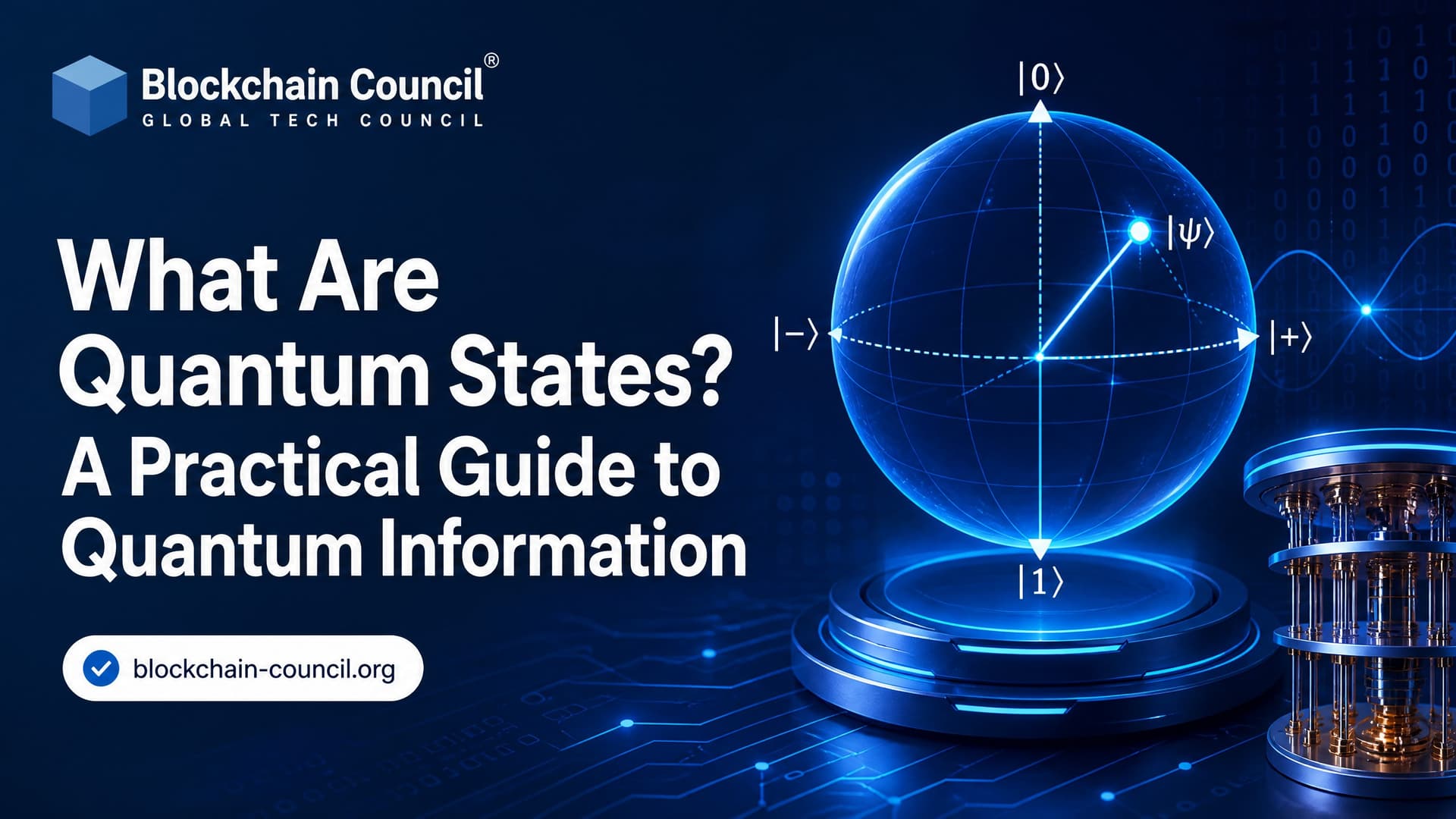
Quantum states are the objects that hold quantum information. If you want to understand quantum computing, quantum cryptography, or quantum sensing, start here. A quantum state tells you what outcomes are possible when a system is measured, and with what probabilities. If you want to build real depth in this area rather than picking up scattered definitions, a structured path like the Certified Quantum Computing Expert program is a solid place to start, since it works through exactly this kind of foundational material.
That sounds abstract. It is. But it is also practical. Every quantum algorithm is a recipe for preparing a state, changing it with gates, and measuring it before noise destroys the useful information.

What Is a Quantum State?
In quantum physics, a quantum state is a mathematical description of a physical system. It contains all physically accessible information about that system. Once you know the state and the measurement being performed, quantum theory tells you the probabilities of possible results. If your interest in quantum states comes from the direction of quantum machine learning or AI-driven optimization, it is worth pairing this material with a Certified Artificial Intelligence (AI) Expert credential, since the two fields are increasingly studied together.
For a pure state, the notation usually looks like this:
|ψ⟩
This is called ket notation, or Dirac notation. The state is a vector in a complex Hilbert space. Its entries are complex amplitudes, not ordinary probabilities. To get measurement probabilities, you square the absolute value of those amplitudes. This rule is known as the Born rule.
For noisy or partially known systems, quantum information theory usually uses a density operator, written as ρ. A valid density operator must be positive semidefinite and have trace equal to 1. Pure states are a special case, written as ρ = |ψ⟩⟨ψ|.
Qubits: The Simplest Useful Quantum States
A qubit is the quantum version of a bit. A classical bit is either 0 or 1. A qubit can be in a state built from two basis states, |0⟩ and |1⟩:
|ψ⟩ = α|0⟩ + β|1⟩
Here, α and β are complex numbers, and they must satisfy:
|α|² + |β|² = 1
If you measure this qubit in the computational basis, the probability of seeing 0 is |α|². The probability of seeing 1 is |β|².
Small mistake, big consequences: many beginners treat amplitudes as probabilities. They are not. If α = 1/√2 and β = i/√2, both outcomes still have probability 50 percent, even though one amplitude carries an imaginary phase. That phase can later affect interference.
Superposition Is Not Just Being Half 0 and Half 1
Superposition means a quantum state is a coherent combination of basis states. The word coherent matters. A fair coin hidden under your hand is not in quantum superposition. You just do not know whether it is heads or tails. A qubit in superposition has phase relationships that can produce interference when gates are applied.
This is why a Hadamard gate is so central. Applied to |0⟩, it creates an equal superposition:
H|0⟩ = (|0⟩ + |1⟩)/√2
Applied again, it returns the state to |0⟩. That second step is interference, not random guessing.
Pure States vs Mixed States
A pure state represents the maximum knowledge quantum theory allows. A mixed state represents uncertainty, noise, or the state of a subsystem that is entangled with something else.
Here is an example. A qubit may look random because it was prepared from a classical lottery: 50 percent |0⟩ and 50 percent |1⟩. That is a mixed state. A different qubit may be in the pure state (|0⟩ + |1⟩)/√2. Both give 50-50 results if measured directly in the computational basis, but they behave differently under later gates.
This distinction shows up constantly in real devices. Decoherence turns carefully prepared pure states into mixed states. The off-diagonal entries in the density matrix, the entries that carry phase relationships, shrink as the system interacts with its environment.
Entanglement: When States Stop Being Local
Composite systems are described using tensor products. Two qubits live in a four-dimensional space with basis states |00⟩, |01⟩, |10⟩, and |11⟩.
An entangled state cannot be written as a product of independent states for each qubit. A standard example is the Bell state:
(|00⟩ + |11⟩)/√2
Measure the first qubit and the second is perfectly correlated with it. No signal travels faster than light, but the joint state holds correlations stronger than any classical shared-randomness model can explain. Entanglement powers quantum teleportation, superdense coding, device-independent cryptography, and many quantum networking designs.
Practical note: if you simulate Bell states in Qiskit, watch the bit ordering. Qiskit uses a little-endian convention in several displays, so a state that reads as |01⟩ can trip you up if you expect the leftmost bit to map to qubit 0. This is one of those details that makes a perfectly correct CNOT circuit look wrong during debugging.
How Quantum States Are Manipulated
Quantum information systems use three main operations:
State preparation: Initialize qubits or photonic modes into known states.
Unitary evolution: Apply gates such as Hadamard, CNOT, phase gates, or hardware-native pulses.
Measurement: Extract classical information from the state, usually with repeated shots to estimate probabilities.
Quantum algorithms are built around this loop. Shor's algorithm, Grover's search, variational quantum eigensolvers, and QAOA all depend on preparing states whose measurement statistics reveal useful structure. This loop is also roughly the midpoint of the concepts covered here, and a good point to note that if quantum information theory is just one part of a wider technical skill set you are building, a general Tech Certification can help you connect it to the broader software and hardware landscape.
Hardware limits shape everything. On noisy intermediate-scale quantum devices, or NISQ devices, state fidelity, gate error, connectivity, and coherence time often matter more than raw qubit count. John Preskill popularized the term NISQ in 2018 to describe processors with enough qubits to be scientifically interesting, but too much noise for full fault tolerance.
Why Quantum States Matter in Real Technologies
Quantum Computing
Quantum processors use states to encode and process information. In chemistry, a multi-qubit state can approximate the electronic structure of a molecule. In optimization, parameterized circuits prepare candidate solution states, then classical feedback adjusts the circuit parameters.
Near-term systems are not magic optimization boxes. To be blunt, many business optimization pilots can still be beaten by strong classical heuristics. Quantum methods make the most sense when the problem has natural quantum structure, difficult sampling behavior, or a clear path to fault-tolerant algorithms.
Quantum Communication and Cryptography
Quantum key distribution uses the fact that measuring unknown non-orthogonal quantum states disturbs them. That disturbance can reveal eavesdropping. Deployed and planned QKD networks use single-photon and entangled photonic states across fiber and free-space links.
This does not replace all cryptography. Post-quantum cryptography is classical software designed to resist quantum attacks, while QKD uses quantum physics to distribute keys. You need to understand both if you work in cybersecurity, blockchain infrastructure, or long-life data protection.
Quantum Sensing
Quantum sensors use states such as squeezed states and entangled states to improve sensitivity. Squeezed light, common in continuous-variable quantum optics, reduces uncertainty in one measurement quadrature at the cost of increasing it in another. That trade-off is useful in precision measurement, imaging, and fundamental physics experiments.
Current Industry Signals
The activity around quantum states is no longer confined to university labs. The Quantum Economic Development Consortium reported that quantum computing and sensing revenue approached 1.5 billion dollars in 2024, with quantum computing contributing about 1.07 billion dollars. It also identified more than 6,000 organizations active in quantum technologies, including 513 pure-play quantum companies.
McKinsey has estimated cumulative global public funding for quantum technologies at roughly 42 billion dollars. MIT's 2024 analysis reported more than 40 commercially available quantum processing units from about two dozen manufacturers, along with a fivefold rise in quantum technology patents from 2014 to 2024.
These numbers point to a simple reality. Demand is growing for people who can reason about state preparation, error correction, measurement, and hardware constraints, not just people who know the headlines.
Skills You Need to Work With Quantum States
If you are a developer, architect, researcher, or cybersecurity professional, focus on these skills first:
Linear algebra: Learn vectors, matrices, eigenvalues, tensor products, and complex numbers.
State representation: Practice converting between state vectors, density matrices, and measurement probabilities.
Quantum circuits: Understand gates as unitary transformations on states.
Noise models: Learn how decoherence, depolarizing noise, and amplitude damping change ideal states.
Measurement statistics: Work with shot counts, basis changes, confidence intervals, and error mitigation.
Security impact: Study how fault-tolerant quantum computers could threaten RSA and elliptic curve cryptography, and where quantum-safe migration fits.
Professionals working with Web3 systems should pay special attention to quantum-safe cryptography, because public-key exposure on blockchains creates long-term risk. Once a public key is visible on-chain, a future quantum attacker only needs to break it once.
How to Build Intuition
Do not start by memorizing algorithms. Start by simulating small states.
Create |0⟩, then apply a Hadamard gate and measure it.
Prepare a Bell state and compare independent measurements with joint correlations.
Change the measurement basis and observe how probabilities shift.
Represent the same system as a density matrix and add simple noise.
Track what happens to coherence after repeated noisy operations.
This is the fastest route from textbook definitions to working intuition. Once you can predict the output of a two-qubit circuit before running it, larger topics like error correction and variational algorithms become far less mysterious.
Generative AI in a Different Direction: AI Microdrama
Quantum states sit at the foundation of one of the most physics-heavy corners of computing, but generative AI is expanding in a very different, more creative direction at the same time. One emerging application is AI microdrama, where generative AI helps bring serialized stories, characters, and fictional worlds to life. It is a useful contrast: the same wave of AI progress that touches quantum simulation and research tooling is also quietly reshaping entertainment and storytelling for everyday audiences.
Final Takeaway
Quantum states are the working material of quantum information. Computing uses them to process amplitudes. Communication uses them to detect interference and distribute keys. Sensing uses them to measure tiny physical effects with better precision.
Your next step is practical. Build and simulate a one-qubit superposition, a two-qubit Bell state, and a noisy density matrix. Then connect that practice to a structured quantum computing or cybersecurity certification path through Blockchain Council, especially if your work touches blockchain infrastructure, AI systems, or long-term data security. Once you can explain these ideas clearly outside a technical audience, a Marketing Certification can help you communicate why quantum-ready skills matter to clients, employers, or investors who care about outcomes more than amplitudes.
FAQs
1. What Is a Quantum State?
A quantum state is a mathematical description of the condition of a quantum system. It contains the information needed to calculate the probabilities of different measurement outcomes and can describe properties such as superposition and entanglement.
2. What Is a Qubit State?
A qubit state describes the quantum information stored in a qubit. A general single-qubit pure state can be written as a combination of the computational basis states |0⟩ and |1⟩, with complex probability amplitudes that determine measurement probabilities.
3. How Is a Quantum State Different From a Classical State?
A classical bit has a definite value of either 0 or 1 at a given time. A quantum state can be a superposition of basis states, allowing its behavior to involve probability amplitudes and phase information that have no direct classical equivalent.
4. What Is Superposition in a Quantum State?
Superposition means that a quantum state can be represented as a combination of multiple possible basis states. For a qubit, the state can contain both |0⟩ and |1⟩ components until a measurement is performed.
5. What Are Probability Amplitudes in Quantum Mechanics?
Probability amplitudes are mathematical quantities used to describe the likelihood of measurement outcomes. Their squared magnitudes determine probabilities, while their phases influence how different components interfere with one another.
6. How Is a Qubit Represented Mathematically?
A common representation of a single-qubit pure state is |ψ⟩ = α|0⟩ + β|1⟩, where α and β are complex amplitudes. For a normalized state, the probabilities satisfy |α|² + |β|² = 1.
7. What Happens to a Quantum State During Measurement?
Measurement produces a classical outcome according to the probabilities associated with the quantum state. In the standard measurement framework, the state is projected onto the measurement outcome, so the original superposition generally does not remain available in the same form.
8. What Is the Computational Basis?
The computational basis is the standard basis used to represent qubit states in many quantum computing systems. For a single qubit, the two computational basis states are |0⟩ and |1⟩.
9. What Is an Entangled Quantum State?
An entangled state is a multi-qubit state that cannot be expressed as independent states for each individual qubit. Measurements on entangled systems can exhibit correlations that cannot be explained by treating the qubits as completely separate systems.
10. What Is the Bloch Sphere?
The Bloch sphere is a geometric representation of the state of a single qubit. It provides an intuitive way to visualize the qubit's amplitudes and relative phase, with the north and south poles commonly representing |0⟩ and |1⟩.
11. Can Quantum States Be Changed?
Yes. Quantum states can be transformed using quantum gates or other physical quantum operations. In a quantum computer, gates such as the Hadamard, Pauli-X, and rotation gates change the amplitudes and phases of qubit states.
12. What Is a Pure Quantum State?
A pure quantum state represents a system with the maximum possible specification of its quantum state. It can be described by a state vector or ket, such as |ψ⟩, whereas a mixed state represents statistical uncertainty over different possible quantum states.
13. What Is a Mixed Quantum State?
A mixed quantum state describes a statistical mixture of possible quantum states rather than a single pure state. Mixed states are commonly represented using a density matrix and can arise from classical uncertainty or interactions with an environment.
14. What Is a Density Matrix in Quantum Information?
A density matrix, or density operator, is a mathematical representation that can describe both pure and mixed quantum states. It is particularly useful for analyzing noisy systems, entanglement, measurements, and quantum channels.
15. How Do Quantum Gates Affect Quantum States?
Quantum gates apply mathematical transformations to quantum states. These operations can change probability amplitudes and relative phases, create superposition, generate entanglement, or perform other transformations required by a quantum algorithm.
16. What Is Quantum State Collapse?
Quantum state collapse is a traditional description of what happens to a quantum state after a measurement produces a particular outcome. In the standard measurement framework, the state is updated to the state associated with the observed result.
17. Can Quantum States Be Copied?
An unknown arbitrary quantum state cannot be perfectly copied, a result known as the no-cloning theorem. This fundamental property distinguishes quantum information from ordinary classical information and has important consequences for quantum communication and computing.
18. Why Are Quantum States Important in Quantum Computing?
Quantum states are the fundamental carriers of information in quantum computing. Quantum algorithms manipulate these states using gates and measurements to perform computations that can exploit superposition, interference, and entanglement.
19. How Are Quantum States Used to Store Information?
Quantum information is encoded in the physical states of quantum systems such as superconducting circuits, trapped ions, neutral atoms, or photons. The amplitudes and phases of these states can represent information that quantum operations can manipulate.
20. Why Is Understanding Quantum States Important for Beginners?
Understanding quantum states provides the foundation for learning about qubits, quantum gates, quantum circuits, algorithms, and quantum error correction. Once the concepts of superposition, amplitudes, phase, measurement, and entanglement are clear, many fundamental ideas in quantum computing become easier to understand.
Related Articles
View All
Quantum Computing
Qiskit Explained: A Beginner's Guide to IBM's Quantum Computing Framework
A beginner-friendly explanation of Qiskit, IBM's open source quantum framework, covering circuits, transpilation, recent updates, use cases, and learning steps.

Quantum Computing
Quantum Computing With Python: A Beginner's Guide to Building Quantum Programs
Learn quantum computing with Python using Qiskit, simulators, cloud hardware, and beginner workflows for building real quantum programs.

Quantum Computing
How Do Quantum Algorithms Work? A Beginner's Guide
Learn how quantum algorithms use qubits, gates, entanglement, interference, and measurement to solve selected problems faster than classical methods.
Trending Articles
The Role of Blockchain in Ethical AI Development
How blockchain technology is being used to promote transparency and accountability in artificial intelligence systems.

Top 5 DeFi Platforms
Explore the leading decentralized finance platforms and what makes each one unique in the evolving DeFi landscape.
How Blockchain Secures AI Data
Understand how blockchain technology is being applied to protect the integrity and security of AI training data.