

What Is Quantum Tunneling? A Simple Explanation for Beginners
 Suyash Raizada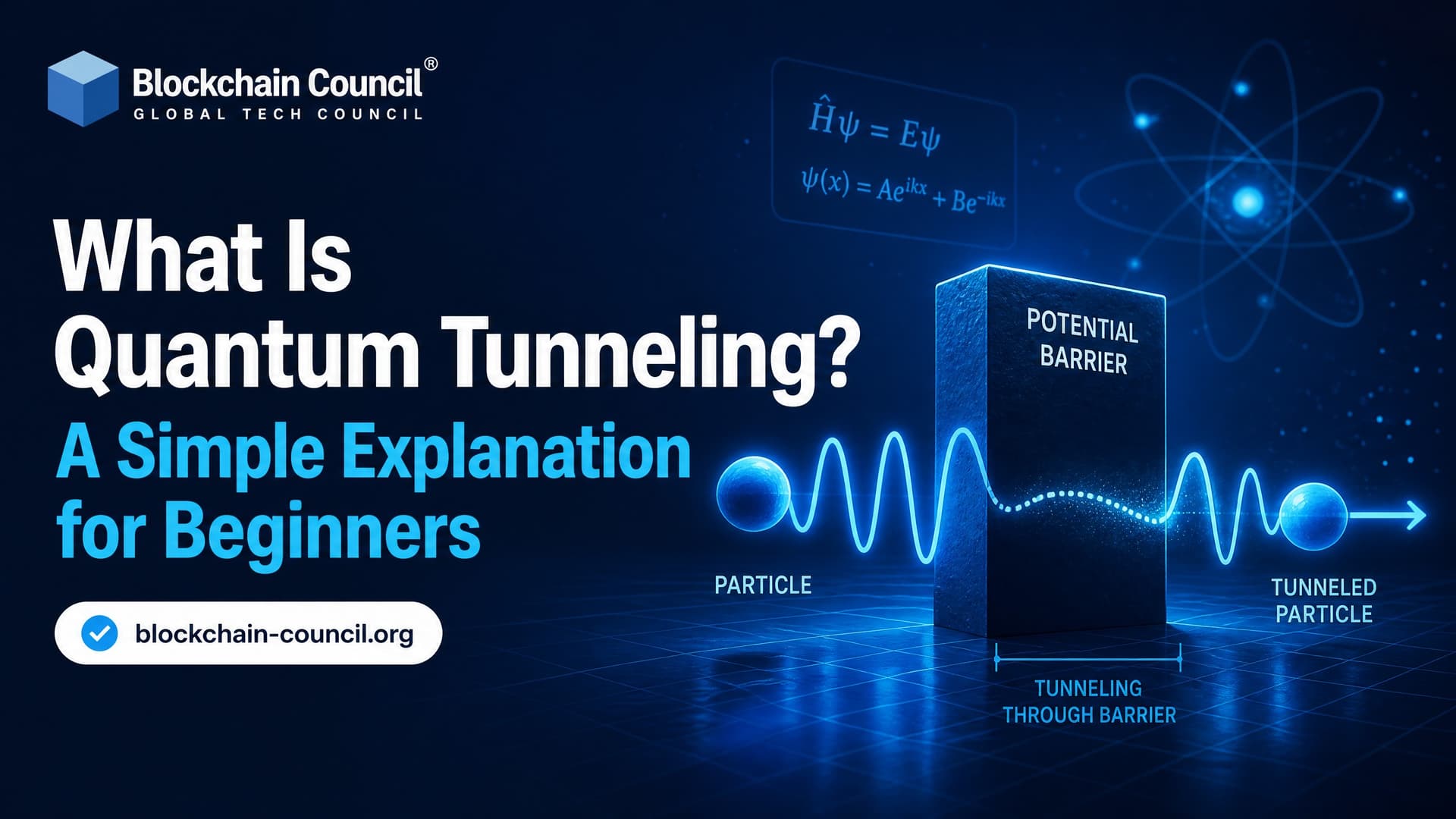
Quantum tunneling is the effect that lets a tiny particle cross an energy barrier even when classical physics says it should not have enough energy to get over it. Sounds strange. It is. But it is also measurable, useful, and central to technologies you already depend on, from flash memory to quantum computing hardware. If you want to understand effects like this at a level deeper than pop-science explanations, a structured path like the Certified Quantum Computing Expert program is a solid place to start, since it builds the physics up from first principles rather than just describing the headline result.
The core idea is simple. Electrons, protons, and other microscopic particles do not behave only like tiny balls. They also behave like waves. Because of that wave behavior, there is a small but real probability that a particle can be detected on the other side of a barrier that looks impossible in everyday terms.

Quantum Tunneling Explained with a Simple Example
Picture a ball rolling toward a hill. If the ball does not have enough energy, it rolls partway up, stops, and comes back down. That is the classical view. If you are approaching this topic from an AI or computational science background rather than a physics one, it can help to pair this material with a Certified Artificial Intelligence (AI) Expert credential, since more and more scientific computing work sits right at the overlap of the two fields.
Now shrink the problem down to an electron near a barrier. The electron is described by a wave function, which gives the probability of finding it in different places. When that wave reaches a barrier, it does not drop to zero instantly. It fades inside the barrier and may extend beyond it.
If the wave function still has a nonzero value on the far side, there is a chance the electron will be detected there. It has not drilled a tunnel like a miner. The word tunneling is a metaphor for probability leaking through a forbidden region.
That is quantum tunneling in plain language.
Why Quantum Tunneling Happens
In classical mechanics, a particle with energy E cannot cross a barrier of height V if E is less than V. End of story.
Quantum mechanics changes the story because particles have wave properties. The wave function can penetrate a finite barrier. Since the probability of finding the particle depends on the square of that wave function, even a tiny wave on the far side means a tiny chance of detection there.
A common approximation for tunneling probability through a simple barrier is:
P approximately exp[-(4πa/h) sqrt(2m(V - E))]
Here, a is barrier width, m is particle mass, V is barrier height, E is particle energy, and h is Planck's constant. Do not worry about memorizing it on day one. Notice the pattern instead. Tunneling probability drops exponentially when the barrier gets thicker, when the barrier gets higher, or when the particle gets heavier.
This is why electrons can tunnel in nanoscale devices, while a tennis ball cannot tunnel through a wall in any realistic sense. The probability for large objects is so absurdly small that you can treat it as zero.
Beginner Rules That Make Tunneling Easier to Understand
Tunneling is probabilistic. A particle does not always cross. It has a calculable chance of crossing.
Thin barriers matter. Make the barrier slightly thicker and the tunneling current can drop by orders of magnitude.
Light particles tunnel more easily. Electrons tunnel far more readily than heavier particles.
The barrier must be finite. An infinitely high or infinitely wide barrier is not the usual tunneling case taught in introductory quantum mechanics.
Scale is everything. Quantum tunneling matters at atomic and nanometer scales, not in normal human-scale motion.
Where Quantum Tunneling Appears in the Real World
Radioactive Alpha Decay
In alpha decay, an atomic nucleus emits an alpha particle, which is made of two protons and two neutrons. Classically, the alpha particle often lacks enough energy to escape the nuclear potential barrier. Quantum tunneling explains how it still escapes with a certain probability.
This is not a side note in physics. It is one of the standard examples showing why quantum mechanics was needed in the first place.
Nuclear Fusion in Stars
The Sun works partly because of tunneling. Protons repel each other because they are positively charged. Classically, many of them would not have enough energy to overcome that electrostatic repulsion. Quantum tunneling gives them a chance to get close enough for fusion to occur.
Without tunneling, stellar fusion rates would look very different. So yes, quantum tunneling is involved in sunlight.
Flash Memory and Transistor Leakage
Quantum tunneling is both useful and annoying in electronics. In flash memory, electrons can tunnel through thin insulating layers to store charge. That helps your device remember data even after power is removed.
But in modern MOSFETs, very thin oxide layers can also allow unwanted tunneling currents. That leakage wastes power and creates reliability issues. As chip features moved into nanometer dimensions, engineers could no longer ignore quantum behavior.
To be blunt, tunneling is one reason transistor scaling became harder. It is not the only reason, but it is a serious one. This section sits roughly at the midpoint of the topics covered here, and it is worth noting that quantum effects like this rarely stay confined to physics alone. A general Tech Certification can help connect device-level physics like tunneling to the broader engineering picture that includes electronics, materials, and software.
Scanning Tunneling Microscopes
A scanning tunneling microscope, or STM, uses tunneling current between a sharp conducting tip and a conducting surface. The gap is often around a nanometer. Move the tip by a fraction of a nanometer and the current changes sharply.
Practitioners learn this fast. Set the feedback loop poorly and the STM tip can crash into the sample before you get a usable atomic image. That sensitivity is exactly what makes STM powerful. It can image individual atoms on suitable surfaces.
Josephson Junctions and Quantum Computing
In superconducting circuits, a Josephson junction consists of two superconductors separated by a very thin insulating barrier. Cooper pairs, which are paired electrons, can tunnel through that barrier. This effect is used in superconducting qubits, one of the leading hardware approaches in quantum computing.
If you are studying quantum technologies, this is where the topic stops being abstract. Tunneling affects qubit design, coherence, noise, and device stability. IBM, Google, Rigetti, and academic labs all deal with these engineering details in different ways.
For a structured learning path, Blockchain Council's Certified Quantum Computing Expert™ connects concepts like tunneling, superposition, qubits, and quantum algorithms. Developers moving from software into deeptech may also pair this with Certified Artificial Intelligence (AI) Expert™ when working on AI-assisted scientific computing.
Chemistry, Biology, and Single-Molecule Sensors
Tunneling also appears in chemistry and biology, especially with light particles such as electrons and hydrogen nuclei. It can influence electron transfer, proton transfer, enzyme reactions, and low-temperature chemical processes.
Research literature describes charge transfer by tunneling as one of the most common elementary processes in nature, with examples across enzymes, metal-electrode interfaces, and nuclear decay. That is a broad footprint.
Electrochemical tunneling sensors take advantage of the same sensitivity. Place two electrodes only a few nanometers apart, put a molecule in the gap, and the tunneling current changes. This is one route toward single-molecule analysis for DNA, RNA, proteins, and nanoscale electrochemistry.
Common Misconceptions About Quantum Tunneling
The Particle Breaks Through the Barrier
Not quite. The particle is described by a wave function. Part of that wave function penetrates the barrier and can exist beyond it. When measured, the particle may be found on the other side.
Tunneling Violates Energy Conservation
It does not. The quantum state and boundary conditions allow a nonzero probability across the barrier. Energy conservation is still respected in proper quantum mechanical treatment.
Tunneling Means Anything Is Possible
No. Probability matters. A human tunneling through a wall has a probability so tiny that it is physically irrelevant. An electron crossing a nanometer-scale barrier is a different situation entirely.
Tunneling and Entanglement Are the Same
They are not. Tunneling is about crossing a classically forbidden barrier. Entanglement is about correlations between quantum systems. In certification exams and beginner interviews, this confusion shows up often. Keep the definitions separate.
Why Quantum Tunneling Matters for Quantum Computing
Quantum computing is not built on one quantum effect. It uses several, including superposition, interference, entanglement, measurement, and in many hardware platforms, tunneling.
Superconducting qubits depend on Josephson junction physics. Semiconductor quantum dots can use controlled tunneling between confined electron states. Some annealing systems use tunneling as part of their search process through an energy landscape.
There is a trade-off. Tunneling can help create useful quantum behavior, but unwanted tunneling can also cause leakage, decoherence, or readout errors. Good hardware engineering is often the art of allowing tunneling where you need it and suppressing it where you do not.
A practical note for software learners. Do not expect Qiskit or Cirq simulations to show tunneling automatically unless the Hamiltonian or circuit model represents the physics you intend to study. Also, if you follow older Qiskit tutorials, you may hit ImportError: cannot import name 'execute' from 'qiskit' after Qiskit 1.0 changed common imports. That is not a tunneling issue, but it is the kind of version detail that trips up beginners in quantum labs.
Generative AI in a Different Direction: AI Microdrama
Quantum tunneling sits deep in the physics of atoms, barriers, and probability waves, but generative AI is moving in a very different, more creative direction at the same time. One emerging application is AI microdrama, where generative AI helps bring serialized stories, characters, and fictional worlds to life. It is a useful contrast to keep in mind: the same broad wave of AI progress that is starting to touch quantum research and simulation work is also quietly reshaping entertainment and storytelling for everyday audiences.
Latest Research Directions
Quantum tunneling is a mature theory, but measurement and control keep improving.
Attosecond physics: The 2023 Nobel Prize in Physics recognized experiments that generate attosecond pulses, helping scientists observe electron dynamics at time scales of 10^-18 seconds. These tools are used in research on ultrafast tunneling behavior.
Tunnel field-effect transistors: TFETs use band-to-band tunneling and are studied as low-power alternatives for some switching applications.
Molecular electronics: Researchers study tunneling through single molecules as possible circuit elements and as probes of molecular structure.
Quantum hardware: Better materials, cleaner interfaces, and lower noise are central goals for devices where tunneling is part of qubit operation.
How to Learn Quantum Tunneling Without Getting Lost
Start with waves. Understand wavelength, amplitude, and probability density before jumping into equations.
Study the finite square barrier. It is the cleanest first model for tunneling.
Connect the math to devices. Look at STM, flash memory, tunnel diodes, and Josephson junctions.
Then move to quantum computing. Learn how tunneling appears in superconducting and semiconductor qubit systems.
If you want a career-focused route, start with the core math and physics, then map it to hardware. The Certified Quantum Computing Expert™ path from Blockchain Council is a good next step if you want a structured program rather than scattered videos and papers. After that, build a small simulation of a finite barrier. Seeing the wave function decay inside the barrier makes the idea stick. And once you can explain tunneling clearly to a non-technical audience, a Marketing Certification can help you turn that understanding into a story that clients, employers, or investors can actually connect with.
FAQs
1. What Is Quantum Tunneling?
Quantum tunneling is a quantum mechanical phenomenon in which a particle has a probability of passing through a potential energy barrier that it would not be able to cross according to classical physics. This happens because quantum particles are described by wavefunctions that can extend into and beyond the barrier.
2. How Does Quantum Tunneling Work?
In quantum mechanics, a particle is described by a wavefunction rather than simply as a classical point with a definite path. When the wavefunction encounters an energy barrier, part of it can extend through the barrier, giving the particle a nonzero probability of being detected on the other side.
3. Why Does Quantum Tunneling Happen?
Quantum tunneling occurs because quantum particles exhibit wave-like behavior. The probability of tunneling depends on factors such as the particle's energy, the height and width of the barrier, and the particle's mass.
4. Can Particles Really Pass Through a Wall?
At the quantum level, particles can have a measurable probability of appearing on the other side of a sufficiently thin or low energy barrier. This does not mean that everyday objects can routinely pass through solid walls, because the tunneling probability for macroscopic objects is extraordinarily small.
5. What Is a Quantum Tunneling Barrier?
A tunneling barrier is a region where a particle's potential energy is higher than its available kinetic energy in the classical picture. Quantum mechanics allows a nonzero probability of finding the particle beyond the barrier even when classical physics would predict that it cannot cross it.
6. What Factors Affect Quantum Tunneling Probability?
Tunneling probability is strongly affected by the barrier's width and height, as well as the mass and energy of the particle. Generally, a thinner or lower barrier and a lighter particle result in a greater tunneling probability.
7. Does Quantum Tunneling Break the Laws of Physics?
No. Quantum tunneling is a consequence of quantum mechanics and is supported by both theoretical predictions and experiments. It appears unusual from a classical perspective, but it is a well-established quantum phenomenon.
8. What Is an Example of Quantum Tunneling in Nature?
Nuclear fusion in stars provides an important example. Quantum tunneling allows some atomic nuclei to overcome the electrostatic repulsion between them, contributing to the fusion reactions that power stars.
9. How Does Quantum Tunneling Help the Sun Produce Energy?
Inside the Sun, positively charged nuclei repel each other because of the electromagnetic force. Quantum tunneling gives some nuclei a probability of getting close enough for the strong nuclear interaction to enable fusion, contributing to the Sun's energy production.
10. What Is Alpha Decay and How Is It Related to Quantum Tunneling?
Alpha decay is a radioactive process in which an unstable nucleus emits an alpha particle. Quantum tunneling allows the alpha particle to escape the nuclear potential barrier even though a classical particle with the same energy would remain confined.
11. How Is Quantum Tunneling Used in Electronics?
Quantum tunneling is important in several electronic and nanoscale technologies. Examples include tunnel diodes, flash memory, scanning tunneling microscopes, and certain semiconductor structures.
12. What Is a Scanning Tunneling Microscope?
A Scanning Tunneling Microscope (STM) uses quantum tunneling to image surfaces at extremely small scales. When a very sharp conducting tip is brought close to a conducting or semiconducting surface, a tunneling current can flow across the gap and provide information about the surface.
13. How Does Quantum Tunneling Work in a Tunnel Diode?
A tunnel diode is designed so that electrons can tunnel through a semiconductor junction. This tunneling behavior contributes to its distinctive electrical characteristics and allows it to operate differently from conventional semiconductor diodes.
14. Is Quantum Tunneling Used in Quantum Computing?
Yes. Quantum tunneling can play a role in some quantum computing and quantum optimization approaches. Certain quantum systems can exploit tunneling to transition between states separated by energy barriers, although not all quantum computers rely on tunneling as their primary computational mechanism.
15. What Is Quantum Tunneling in Quantum Annealing?
In quantum annealing, quantum fluctuations and tunneling can help a system explore different configurations of an optimization problem. The goal is to find low-energy states corresponding to good or optimal solutions under the chosen problem formulation.
16. How Is Quantum Tunneling Different From Classical Physics?
Classically, a particle with insufficient energy cannot cross a potential barrier without gaining additional energy. Quantum mechanics instead assigns a probability amplitude to the particle's state, allowing a nonzero probability of detection beyond certain barriers.
17. Does Quantum Tunneling Happen Instantly?
Quantum tunneling should not be understood as a particle simply traveling through a barrier at an ordinary speed. Questions about tunneling time are subtle in quantum mechanics, and different experimental and theoretical definitions can produce different interpretations.
18. Can Quantum Tunneling Be Controlled?
In many physical systems, tunneling rates can be influenced by changing parameters such as barrier height, barrier width, electric or magnetic fields, temperature, or the properties of the materials involved. This ability to control tunneling is useful in several quantum and nanoscale technologies.
19. Why Is Quantum Tunneling Important?
Quantum tunneling helps explain important physical processes ranging from radioactive decay and stellar fusion to nanoscale electronic behavior. It is also relevant to technologies that operate at quantum and atomic scales.
20. Why Should Beginners Learn About Quantum Tunneling?
Quantum tunneling is one of the clearest examples of how quantum mechanics differs from classical physics. Understanding it provides a foundation for learning about quantum mechanics, quantum computing, semiconductor technology, nuclear physics, and other areas of modern science.
Related Articles
View All
Quantum Computing
Qiskit Explained: A Beginner's Guide to IBM's Quantum Computing Framework
A beginner-friendly explanation of Qiskit, IBM's open source quantum framework, covering circuits, transpilation, recent updates, use cases, and learning steps.

Quantum Computing
Quantum Computing With Python: A Beginner's Guide to Building Quantum Programs
Learn quantum computing with Python using Qiskit, simulators, cloud hardware, and beginner workflows for building real quantum programs.
Quantum Computing
Grover's Algorithm Explained: Quantum Search Made Simple
Grover's Algorithm explained for professionals: quantum search, quadratic speedup, oracle design, crypto risks, and real limits on current hardware.
Trending Articles
The Role of Blockchain in Ethical AI Development
How blockchain technology is being used to promote transparency and accountability in artificial intelligence systems.
How Blockchain Secures AI Data
Understand how blockchain technology is being applied to protect the integrity and security of AI training data.
What is AWS? A Beginner's Guide to Cloud Computing
Everything you need to know about Amazon Web Services, cloud computing fundamentals, and career opportunities.