

World's most expensive NFT
 Noora
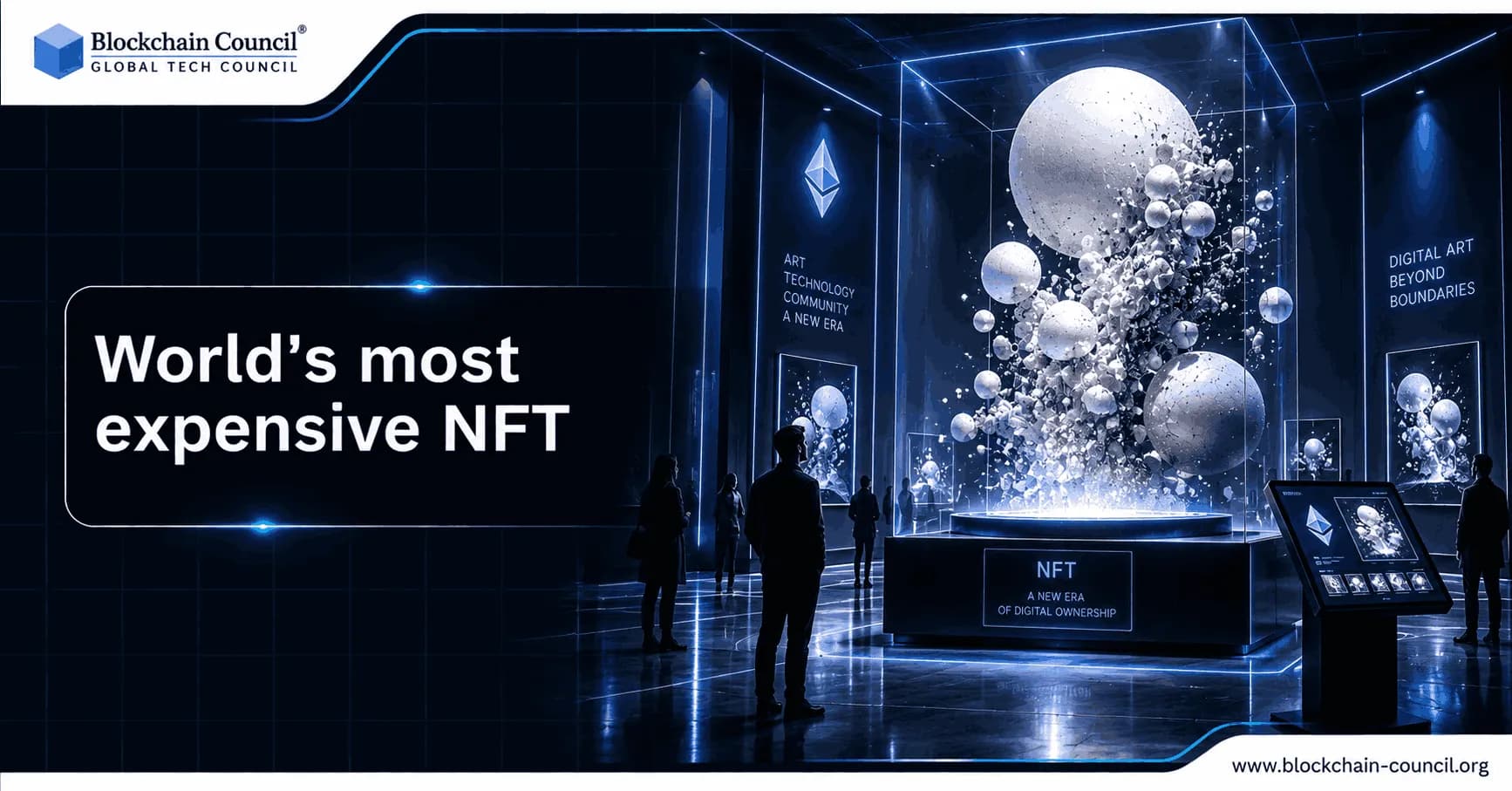
The Record That Has Stood For Over Four Years
Digital ownership has produced some genuinely staggering price tags since NFTs first broke into mainstream attention, and as of 2026, one sale still sits unmatched at the very top. The Merge by the anonymous digital artist Pak remains the most expensive NFT ever sold, reaching a combined total of $91.8 million back in December 2021, a record that has now held for more than four years despite the market's significant ups and downs since. What makes this record even more interesting heading into 2026 is how the underlying market has matured around it, total NFT market capitalization now sits near $2.6 billion, and single blue-chip sales like CryptoPunk #1563 trading for roughly $12 million in late 2025 show that top-tier NFTs still command serious money even in a calmer, less speculative market. Understanding what actually drove these record sales, and what separates a genuinely valuable NFT from a forgettable one, is where a Certified NFT Expert credential becomes genuinely useful for collectors, creators, and investors trying to make sense of this space.
What Actually Determines An NFT's Value
Before ranking the sales themselves, it helps to understand why some NFTs reach eight-figure prices while millions of others trade for fractions of a cent. A handful of factors consistently separate record-breaking NFTs from the rest of the market.

Extreme scarcity drives much of the market's highest valuations, with collections like CryptoPunks featuring only nine Alien-trait pieces in existence out of the full ten-thousand-piece set.
Historical or cultural significance adds a premium beyond visual appeal alone, particularly for pieces tied to a defining moment in the NFT market's own history.
Smart contract innovation has driven genuinely unique sales structures, including fractionalized ownership models that let thousands of collectors jointly own a single work.
Charitable or political causes have pushed certain NFTs to record prices well beyond what the artwork alone might otherwise command.
Provenance and creator reputation matter enormously, with pieces by well-known digital artists consistently outperforming anonymous or lesser-known creators at auction.
Grasping how these value drivers actually work at the technical level, particularly how smart contracts enable unusual ownership structures like fractionalization, is where a broader Certified Blockchain Expert background pays off, since evaluating an NFT's true value requires understanding the blockchain mechanics underneath it, not just its visual appeal.
The Most Expensive NFTs Ever Sold
Based on confirmed sales data through 2026, these remain the highest-value NFT transactions in the market's history.
The Merge by Pak, $91.8 million (December 2021). Rather than selling to a single buyer, Pak released the piece as collectible "mass" units on Nifty Gateway, purchased by nearly 29,000 collectors whose combined totals reached $91.8 million, making it the largest cumulative NFT sale by a living artist and still the record holder heading into 2026.
Everydays: The First 5000 Days by Beeple, $69.3 million (March 2021). Sold at Christie's auction house, this collage of 5,000 daily images created over thirteen years by artist Mike Winkelmann was the first purely digital NFT sold by a major traditional auction house, a moment widely credited with bringing NFTs into mainstream art world legitimacy.
Clock by Pak and Julian Assange, sold for roughly $52.7 million worth of ETH (February 2022). Purchased collectively by AssangeDAO, a coalition of crypto supporters, the piece displays a live counter of Assange's days spent in prison, with proceeds directed toward his legal defense, showing how political and charitable causes can drive NFT prices well beyond typical market valuations.
CryptoPunk #5822, $23.7 million (February 2022). One of only nine Alien-trait CryptoPunks in existence, this sale set the benchmark for the CryptoPunks collection specifically and remains one of the clearest examples of how extreme scarcity within a fixed-supply collection drives outsized value.
HUMAN ONE by Beeple, roughly $28.9 million (November 2021). A hybrid physical-digital sculpture paired with an evolving NFT component, this piece demonstrated early on that NFTs could extend beyond purely digital formats into physical installations tied to a blockchain-verified token.
What Changed In The NFT Market Between 2021 And 2026
The eye-popping numbers above almost all trace back to late 2021 and early 2022, and that timing matters for understanding where the market actually stands today.
Overall NFT transaction volume declined significantly after the initial 2021 hype cycle faded, with many speculative projects losing most or all of their value.
Blue-chip collections have shown real resilience, with CryptoPunks alone exceeding $92 million in trailing 30-day sales volume during periods of renewed interest in 2025.
New use cases have expanded the category well beyond static digital art, into gaming assets, digital fashion, music royalties, and loyalty programs that businesses now use to engage customers directly.
Distribution channels have shifted too, with collectible drops embedded directly into messaging platforms like Telegram generating tens of millions of dollars in sales within minutes, a genuinely different sales model from a traditional auction house.
Making sense of this shift, from speculative art collecting toward NFTs as functional digital assets embedded in everyday platforms, requires genuine range across blockchain infrastructure, digital marketplaces, and emerging consumer technology. That breadth is exactly where a broader Tech Certification becomes valuable, helping professionals in this space understand not just NFT mechanics in isolation but the wider technology ecosystem these assets increasingly plug into.
Where NFT Technology Is Heading Next
NFTs are no longer confined to static digital art or collectible profile pictures. One emerging application is AI microdrama, where generative AI helps bring serialized stories, characters, and fictional worlds to life, a format that points toward NFTs functioning as verified ownership stakes in ongoing, AI-assisted creative universes rather than single, unchanging images. As generative tools make it easier to produce rich, evolving digital content at scale, blockchain-based ownership records become an increasingly natural way to establish who actually holds rights to a character, a story arc, or a piece of a larger fictional world as it continues to expand.
Turning NFT Knowledge Into A Real Opportunity
Understanding what makes an NFT valuable is one thing, successfully creating, marketing, or investing in one is another skill entirely. The gap between a forgettable NFT drop and a genuinely successful one often comes down to how well a creator or collection communicates its value to the right audience, building anticipation, explaining scarcity and utility clearly, and reaching collectors who actually care about what's being offered. That kind of positioning and audience-building work is a distinct skill from understanding blockchain mechanics, which is why creators and businesses entering this space increasingly pair their technical NFT knowledge with a Marketing Certification, building the communication skills needed to turn a well-built NFT project into one collectors actually notice and value.
The Bottom Line
The Merge's $91.8 million record has now stood for over four years, a genuinely long time in a market that has otherwise cooled significantly since its 2021 peak. But the fundamentals behind that record, extreme scarcity, cultural significance, innovative smart contract design, and strong provenance, continue to drive value across the NFT market even as total transaction volume has settled into a calmer, more sustainable range. As NFTs keep expanding into gaming, music, AI-driven storytelling, and everyday consumer platforms, the underlying question that made The Merge and Beeple's Everydays so valuable in the first place, what genuinely makes a digital asset worth owning, remains just as relevant heading into the next chapter of this market as it was during its record-setting peak.
FAQs
1. What is the world's most expensive NFT?
The Merge by Pak generated approximately $91.8 million in sales during its December 2021 open-edition release. However, it was not a conventional single NFT sold to one buyer. Nearly 29,000 buyers purchased units of the artwork, which were subsequently represented by individual dynamic NFTs.
2. Who created the world's most expensive NFT?
Pak, a pseudonymous digital artist, created The Merge. The artwork used a dynamic NFT structure in which buyers acquired "mass" units rather than purchasing one traditional, indivisible NFT.
3. How much did The Merge NFT sell for?
The Merge generated $91,806,519 during its December 2 to December 4, 2021 sale, according to Guinness World Records. The total came from purchases by 28,983 buyers.
4. Was The Merge one NFT?
Not in the conventional sense. The original sale involved hundreds of thousands of "mass" units, with buyers receiving NFTs representing their accumulated mass after the sale. This unusual structure is why some NFT rankings distinguish The Merge from single-owner NFT sales.
5. What is the most expensive single NFT sold to one buyer?
Beeple's Everydays: The First 5000 Days is widely cited as the highest-priced single NFT artwork sold to one buyer, with a $69.346 million sale at Christie's on March 11, 2021. CoinGecko lists it as the highest-priced NFT artwork under the single-work auction category.
6. What is Everydays: The First 5000 Days?
It is a digital collage created by artist Beeple, whose real name is Mike Winkelmann. The work combines 5,000 individual images that Beeple created as part of his daily-art project.
7. Who bought Everydays: The First 5000 Days?
The NFT was purchased by Vignesh Sundaresan, also known by the pseudonym MetaKovan. The $69.3 million Christie's auction helped establish NFTs as a significant category in the mainstream art market.
8. Why was Everydays so expensive?
Several factors contributed to its price, including Beeple's established digital-art reputation, the scale of the 5,000-image work, NFT scarcity, the Christie’s auction, and the growing interest in digital ownership during the 2021 NFT boom.
9. What is the second-most expensive major NFT artwork?
Pak's Clock sold for approximately $52.7 million in February 2022. The work was associated with Pak and Julian Assange and was acquired by AssangeDAO.
10. What is the most expensive CryptoPunk?
CryptoPunk #5822 is the highest-priced CryptoPunk in documented sales, selling for approximately $23.7 million in February 2022. It is one of only nine Alien CryptoPunks in the 10,000-piece collection.
11. Why was CryptoPunk #5822 so valuable?
Its rarity was an important factor. It is an Alien Punk, one of the collection's rarest character types, and it also has a bandana trait. Collectors placed substantial value on the combination of scarcity, historical importance, and CryptoPunks' cultural significance.
12. What is Beeple's HUMAN ONE NFT?
HUMAN ONE is a hybrid physical-digital artwork by Beeple. It combines a physical kinetic sculpture with a digital component that can be updated over time.
It sold at Christie's for approximately $28.985 million in November 2021.
13. What are some of the most expensive NFTs ever sold?
Some major documented sales include:
NFT | Artist/Creator | Approx. sale value |
|---|---|---|
The Merge | Pak | $91.8M* |
Everydays: The First 5000 Days | Beeple | $69.35M |
Clock | Pak | $52.7M |
HUMAN ONE | Beeple | $28.99M |
CryptoPunk #5822 | CryptoPunks | $23.7M |
*The Merge represents an aggregate open-edition sale rather than a conventional single-buyer NFT transaction.
14. What makes an NFT extremely valuable?
NFT prices can be influenced by factors such as rarity, provenance, artist reputation, historical importance, cultural significance, collector demand, scarcity, and the reputation of the marketplace or auction house.
However, a previous high sale does not guarantee that the NFT could be sold again for the same price.
15. Does NFT rarity determine its price?
Rarity can influence demand, but it does not automatically determine market value. CryptoPunks provide a useful example because rare traits such as Alien characteristics contributed to the appeal of certain pieces.
16. Are the most expensive NFTs always digital images?
No. NFTs can represent different forms of digital or hybrid assets.
For example, Beeple's HUMAN ONE combines a physical sculpture with a dynamic digital component, while Pak's The Merge used a dynamic NFT structure rather than a conventional static image.
17. Why did NFT prices become so high in 2021 and 2022?
The period saw rapid growth in NFT adoption, cryptocurrency wealth, digital-art collecting, celebrity interest, and speculation. Major auction houses such as Christie's also brought NFTs to traditional art collectors.
Beeple's $69.3 million sale became one of the defining events of this period.
18. Are expensive NFT sales the same as their current market value?
No. A historical sale price represents what a particular buyer paid at a particular time. NFT markets can be highly volatile and illiquid, meaning another buyer might not be willing to pay the same amount later.
Therefore, record sale price and current market value are different concepts.
19. Is The Merge officially the most expensive NFT?
It depends on the definition.
Guinness World Records recognizes The Merge as the most expensive NFT artwork sold through an open-edition auction at $91.8 million. For a single NFT artwork purchased by one buyer, Everydays: The First 5000 Days is the commonly cited benchmark at $69.346 million.
20. What is the world's most expensive NFT in simple terms?
The answer depends on the sale category:
The Merge by Pak: approximately $91.8 million in aggregate sales, making it the record holder under the open-edition/collective-sale definition.
Everydays: The First 5000 Days by Beeple: $69.346 million for a single NFT artwork sold to one buyer, making it the clearer benchmark for the most expensive individual NFT artwork sale.
Related Articles
View All
NFT
RMRK Marks The Launch OF The Most Advanced NFT System The World Has Ever Seen
The era of the first wave of the next generation NFTs has been ushered in through the release of an advanced Non-Fungible Token (NFT) known as the Kanaria bird project. The initiative has been launched by the advanced NFT project, which goes by the name RMRK. An early backer of the project, known…
NFT
How to create nft and sell on opensea
Learn how to create and sell NFTs on OpenSea with a step-by-step guide for beginners and digital creators.
NFT
Nft marketplace UAE how to start
Learn how to start an NFT marketplace in the UAE, including platform setup, legal considerations, and business strategies.
Trending Articles
AWS Career Roadmap
A step-by-step guide to building a successful career in Amazon Web Services cloud computing.
How to Install Claude Code
Learn how to install Claude Code on macOS, Linux, and Windows using the native installer, plus verification, authentication, and troubleshooting tips.

Claude Code Vs Cursor
Claude Code vs Cursor compares two AI coding tools based on features, automation, and developer workflows.