

Store NFT Assets Safely
 Suyash Raizada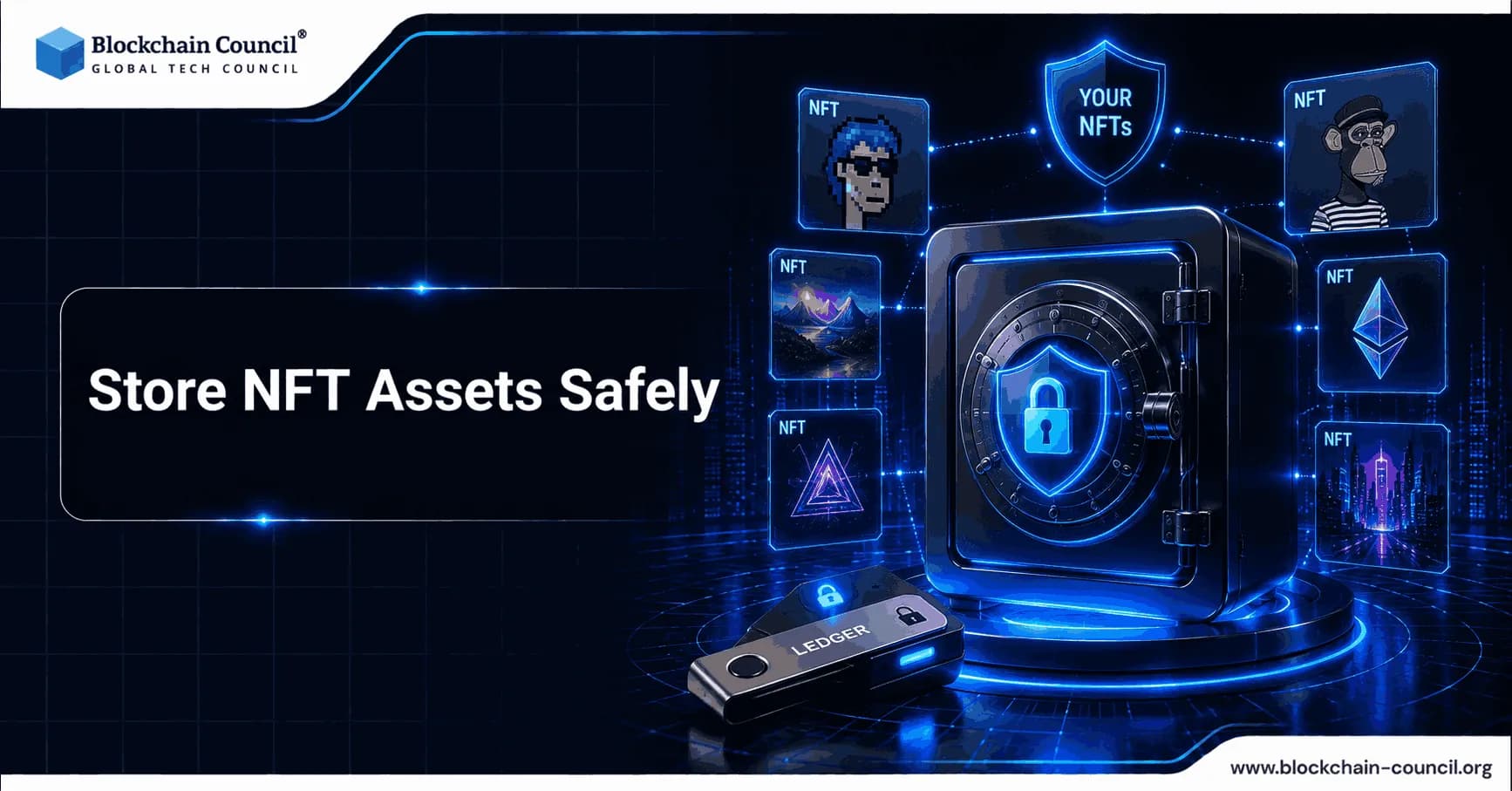
Have you ever wondered what you would do if you owned a physical collectible an original artwork, a rare vinyl pressing, a limited-edition design worth millions of dollars? The first instinct with any valuable collectible is to store it somewhere secure. Now swap the word "physical" for "digital," and the underlying concern is exactly the same. The difference is that a digital asset can't be locked in a safe-deposit box. Protecting it takes a different kind of storage system altogether, and getting that system right is the difference between owning a valuable NFT and losing access to it forever. This guide walks through everything you need to know about storing NFTs securely in 2026.
If you'd like to go deeper into NFTs and digital assets, a Blockchain Council NFT certification is a solid next step.

NFT
NFT stands for Non-Fungible Token. An NFT is a blockchain-recorded record of ownership over a unique digital or digitally-linked asset artwork, music, collectibles, gaming items, tokenized memberships, and increasingly, real-world assets like tickets and property records. Unlike a stack of identical dollar bills, each NFT is unique and cannot be exchanged one-for-one with another. Some are worth relatively little; others have sold for tens of millions of dollars, which is exactly why secure storage matters so much. Before blockchain, digital ownership records lived in centralized databases that a single company controlled and could alter, lose, or shut down. Blockchain replaced that with a public, immutable ledger, letting creators and collectors prove ownership and provenance without relying on a middleman.
The Growth of the NFT Market
NFTs have moved well past their speculative 2021 boom. Market analysts now put the global NFT market at somewhere in the $18-60 billion range for 2026 depending on methodology, with most forecasts pointing toward continued double-digit annual growth through the early 2030s as adoption broadens beyond profile-picture art. Ethereum still anchors the majority of NFT activity, but lower-fee networks like Solana, Polygon, and Base have captured a growing share of trading volume. Gaming NFTs alone now represent roughly a quarter to a third of total NFT trading volume, and real-world-asset tokenization tying NFTs to physical items, tickets, or property has emerged as one of the fastest-growing use cases. OpenSea remains the dominant marketplace by volume, though competition from newer, chain-specific marketplaces has increased.
The takeaway: the market has matured, but the total value at stake and therefore the incentive for attackers has only grown. Become an NFT expert today with a Blockchain Council lifetime-valid NFT certification.
Why should you always store NFTs with optimum privacy?
NFTs remain high-value targets for both investors and hackers. Some people assume blockchain technology alone makes NFTs un-hackable it doesn't. The blockchain ledger itself is extremely difficult to tamper with, but the keys that control access to your NFTs are a different story entirely. Whoever holds the private key controls the asset, full stop. Early incidents like the Nifty Gateway account breaches showed this clearly: the marketplace's core infrastructure wasn't compromised; individual users' storage and credential practices were. That pattern has only accelerated. In 2026, the more common attack isn't a hacked exchange; it's a "wallet drainer" , a malicious site or contract that tricks a user into signing a transaction that quietly hands an attacker permission to move their NFTs. The old crypto saying still applies, and applies just as much to NFTs: if you don't hold the keys, you don't really own the asset.
Types of storage for NFTs
NFT storage deserves the same seriousness as cryptocurrency storage, because the underlying risk is identical. Leaving NFTs sitting in a marketplace account is convenient, but it concentrates risk in a single custodial system. Decentralized, self-custody storage gives you full ownership and removes that single point of failure. It's worth repeating a common point of confusion: your wallet doesn't actually "hold" your NFT. It holds the private key that proves and controls ownership of a cryptographic address, and that address is where the NFT is recorded on-chain. Because that key is vulnerable whenever it's connected to the internet, the safest long-term option is cold storage, keeping the key on a device that never touches the internet, even during use. Cold hardware wallets add further protection with a PIN, and in most modern models, a certified secure-element chip that isolates the key from the rest of the device.
Get in-depth, certified knowledge of Web3 and blockchain technology by becoming a Web3 expert with Blockchain Council Certifications.
Steps for preserving NFT's privacy
Here's an updated step-by-step guide to protecting your NFTs in 2026:
Step 1: Use offline, long-term (cold) storage for anything of meaningful value.
Step 2: Your wallet's 12-24 word recovery seed phrase is the master key. Never enter it into a website, app, or chat window, and never share it with anyone, including someone claiming to be "support."
Step 3: Use every available layer of protection app-based two-factor authentication (not SMS, which is vulnerable to SIM-swap attacks), a strong unique passcode, and PIN protection on your hardware device.
Step 4: Never let anyone else access your credentials, and be skeptical of unsolicited DMs on Discord or Telegram offering "help" legitimate teams don't message you first.
Step 5: Keep your seed phrase and passwords off any internet-connected device. Write them on paper (or engrave them on metal for durability) and store them securely offline.
Step 6: Stay away from unfamiliar or unverified sites, especially those tied to "free" NFT giveaways or urgent-sounding airdrops these are among the most common phishing vectors in 2026.
Step 7: Read every transaction before signing it. Modern wallet drainers rely on victims approving a transaction without checking exactly what permissions they're granting.
Step 8: Periodically review and revoke old token/NFT approvals using a blockchain explorer's approval tool. Forgotten permissions from projects you no longer use are a common way attackers gain access later.
Before choosing your NFT storage setup, check that it supports the blockchains and marketplaces you actually use, and make sure it balances strong security with an interface you'll actually use correctly.
Common ways of storing NFTs
Software Wallets
Software (hot) wallets remain the easiest entry point for newcomers. MetaMask is still the most widely used option, securing access with a 12-24 word seed phrase and password, and now offering deeper integration with hardware wallets for users who want extra protection without giving up MetaMask's interface. Because software wallets stay connected to the internet, they remain more exposed to phishing, malicious browser extensions, and wallet-drainer scripts than cold storage. Popular alternatives include Phantom (strong on Solana), Coinbase Wallet, and Rabby, alongside long-standing options like Enjin. Coinbase has continued expanding its self-custody NFT tools, allowing users to buy, manage, and display digital assets alongside their broader portfolio.
Interplanetary Filing System
The InterPlanetary File System (IPFS) remains the leading way to store an NFT's underlying file the actual image, audio, or video off-chain, since blockchains aren't practical for storing large files directly. IPFS uses content-based addressing instead of the location-based addressing used by ordinary web URLs. When a file is added, it's broken into pieces, cryptographically hashed, and given a unique fingerprint called a content identifier (CID), which is what an NFT's metadata actually links to. This makes stored files tamper-evident and resistant to the "broken link" problem that plagued early NFT collections when a centralized server disappeared. Pinata continues to be one of the most widely used pinning services built on IPFS, helping ensure content stays available across a distributed network of nodes. It's important to note that IPFS protects your NFT's file, not the private key that controls who owns the token those are two separate security concerns.
Hardware Wallet
A cold, offline hardware wallet is still the strongest storage option available for NFTs in 2026. Private keys are generated and stored on a dedicated physical device that never exposes them to an internet-connected computer, even while you're using it every transaction is verified and signed directly on the device's own screen. This makes it effectively impossible to steal the keys remotely; an attacker would need physical possession of the device itself, and typically the PIN as well. Ledger and Trezor remain the two most popular brands, now joined by strong newer options like Keystone and ELLIPAL for collectors who want a fully air-gapped, cable-free device. Current-generation models from both major brands use certified secure-element chips the same class of hardware used in passports and payment cards and several now support native NFT display, letting you view your collection directly on the device.
Conclusion
NFTs continue to grow in both value and use case, and with that growth comes an evolving set of threats from classic phishing to sophisticated wallet-drainer operations and even attempts to manipulate AI trading agents. In nearly every major NFT theft, the root cause isn't a broken blockchain; it's improper key storage or a moment of inattention during a transaction approval. As the market matures, more organizations are building solutions to raise the security bar, and staying informed is the single best defense any collector has. Blockchain Council's NFT certification offers a complete, up-to-date look at these threats and how to guard against them. Get certified today and put yourself in a strong position to work with leading organizations as a certified NFT expert. Plenty of NFT courses exist online, but Blockchain Council continues to offer some of the best-in-class NFT training available, backed by lifetime-valid certification.
If you want to keep up with the latest blockchain industry trends, join our communities on Discord, Reddit and Telegram.
FAQs
1. What are NFT assets?
Non-fungible tokens (NFTs) are unique blockchain-based digital assets that can represent ownership of artwork, collectibles, music, gaming items, domain names, memberships, and tokenized real-world assets. Ownership is recorded on a blockchain, while associated media may be stored on decentralized or centralized storage systems.
2. Why is secure NFT storage important?
NFTs can have financial, artistic, or personal value, making them attractive targets for hackers, scammers, and phishing attacks. Proper storage helps protect ownership credentials, private keys, and access to digital wallets that hold NFT assets.
3. Where are NFTs actually stored?
The NFT itself is represented by a token on the blockchain, while the associated digital content may be stored on decentralized networks such as IPFS, centralized servers, or other storage solutions. Wallets store the private keys that allow owners to control and transfer the NFTs, not the artwork itself.
4. What is the safest way to store NFTs?
For many users, hardware wallets are considered one of the most secure options because they keep private keys offline. Combining a hardware wallet with strong operational security practices can significantly reduce exposure to online threats.
5. What is a hardware wallet?
A hardware wallet is a physical device designed to securely generate and store private keys offline. Transactions are signed within the device, helping reduce the risk of private key exposure to malware or compromised computers.
6. Can software wallets safely store NFTs?
Software wallets provide convenient access to NFTs and decentralized applications but generally remain connected to internet-enabled devices. Users should carefully secure their devices, enable available security features, and understand that online wallets may face greater exposure to cyber threats than offline storage.
7. How should private keys and recovery phrases be protected?
Private keys and recovery phrases should be stored securely offline and never shared with anyone. Many security professionals recommend keeping multiple protected offline backups in physically secure locations to reduce the risk of loss or theft.
8. What is a seed phrase?
A seed phrase, also known as a recovery phrase, is a sequence of words that can restore access to a digital wallet. Anyone who gains access to the recovery phrase may be able to control the associated digital assets, making its protection critically important.
9. How can users avoid NFT phishing scams?
Users should verify website URLs, avoid clicking unsolicited links, confirm wallet connection requests, download software only from official sources, and never disclose recovery phrases or private keys. Many NFT thefts result from phishing rather than technical vulnerabilities.
10. Should NFTs be stored in multiple wallets?
Using separate wallets for different purposes can improve security. For example, users may keep high-value NFTs in a hardware wallet while using another wallet for everyday transactions and decentralized applications, helping limit exposure if one wallet is compromised.
11. What role does multi-factor authentication (MFA) play?
Although blockchain wallets themselves may not always support MFA for private key access, users should enable MFA wherever available for related services such as exchanges, email accounts, cloud backups, and NFT marketplace accounts. This adds another layer of protection against unauthorized access.
12. How can users protect NFTs from malware?
Maintaining updated operating systems, installing reputable security software, avoiding suspicious downloads, verifying browser extensions, and using dedicated devices for digital asset management can reduce malware-related risks. Regular security hygiene is essential for protecting wallet credentials.
13. Are NFT marketplaces responsible for wallet security?
NFT marketplaces generally facilitate buying and selling digital assets but typically do not control users' private keys in self-custody wallets. Users remain responsible for securing their wallets, recovery phrases, and authentication credentials.
14. What should businesses consider when storing NFT assets?
Organizations managing NFT assets should establish governance policies, secure custody procedures, access controls, key management processes, audit logs, disaster recovery plans, and employee security training. Enterprise-grade custody solutions may also be appropriate depending on the organization's needs.
15. How does blockchain improve NFT security?
Blockchain provides transparent ownership records, cryptographic verification, and tamper-evident transaction histories. While the blockchain helps protect ownership records, users must still secure the private keys that control access to their NFT assets.
16. What are common mistakes when storing NFTs?
Common mistakes include storing recovery phrases digitally without protection, sharing private keys, approving malicious smart contracts, using weak passwords, ignoring software updates, connecting wallets to fraudulent websites, and failing to verify transaction details before signing.
17. What trends are shaping NFT security in 2025-2026?
Key trends include hardware wallet improvements, multi-party computation (MPC) wallets, AI-powered fraud detection, decentralized identity integration, institutional custody services, enhanced wallet recovery mechanisms, improved smart contract auditing, and stronger cybersecurity standards.
18. Can AI help protect NFT assets?
Artificial intelligence can assist by identifying phishing attempts, detecting suspicious wallet activity, analyzing blockchain transactions, monitoring smart contract risks, and supporting fraud detection. AI tools should complement, not replace, sound security practices and human oversight.
19. What are NFT storage best practices?
Best practices include using hardware wallets for valuable assets, protecting recovery phrases offline, separating long-term holdings from active trading wallets, enabling available security features, reviewing wallet permissions regularly, verifying transaction details, monitoring account activity, and keeping software up to date.
20. What is the future of NFT asset security?
NFT security is expected to improve through advances in wallet technology, cryptography, decentralized identity, institutional custody, AI-assisted threat detection, and stronger industry security standards. As digital assets become more widely adopted, effective security will continue to rely on a combination of robust technology, informed users, and disciplined operational practices. The blockchain can remember every transaction forever, but it still cannot rescue a recovery phrase that was taped to the side of the monitor.
Related Articles
View All
NFT
Coca Cola gets the taste of the NFT trend in charity auction for digital assets
Coca-Cola is about to host an auction for one-of-a-kind, special edition virtual loot boxes of Non Fungible Tokens or NFTs, and for that they have teamed up with the 3D creators at Tafi. The profits that will be generated from the auction will be donated to the Special Olympics, an event that is…
NFT
How to create nft and sell on opensea
Learn how to create and sell NFTs on OpenSea with a step-by-step guide for beginners and digital creators.
NFT
Nft marketplace UAE how to start
Learn how to start an NFT marketplace in the UAE, including platform setup, legal considerations, and business strategies.
Trending Articles
AWS Career Roadmap
A step-by-step guide to building a successful career in Amazon Web Services cloud computing.

Top 5 DeFi Platforms
Explore the leading decentralized finance platforms and what makes each one unique in the evolving DeFi landscape.
How Blockchain Secures AI Data
Understand how blockchain technology is being applied to protect the integrity and security of AI training data.