

Certified Smart Contract Developer
 Toshendra Kumar Sharma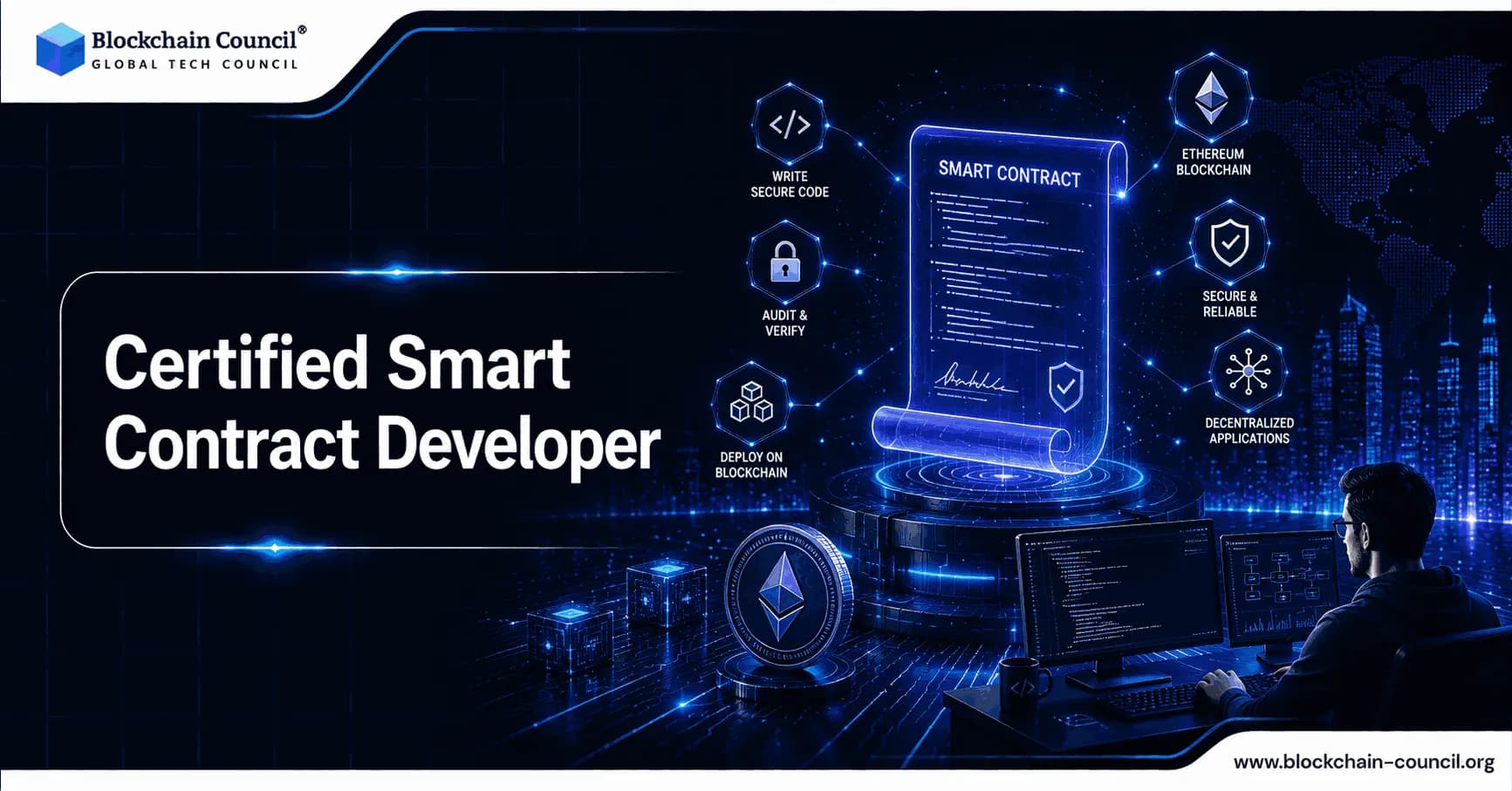
Smart contracts now power everything from decentralized finance platforms to supply chain tracking systems and digital identity verification. As more industries move critical processes onto blockchain networks, the demand for developers who can write secure, efficient, and audit ready smart contract code has grown far faster than the talent pool available to fill those roles. This is exactly why becoming a Certified Smart Contract Developer has become one of the most direct paths into a high demand technical career, giving developers a structured way to prove they understand not just how to write code, but how to write code that will hold real financial value without failing.
Why This Certification Stands Out From General Blockchain Training
Smart contract development is a narrower and more specialized skill than general blockchain knowledge. It requires a deep understanding of languages like Solidity or Vyper, gas optimization, common attack vectors such as reentrancy and integer overflow, and the testing frameworks needed to catch bugs before a contract ever touches mainnet. Many developers start with a broader Certified Blockchain Developer credential to build foundational knowledge of distributed systems, consensus mechanisms, and blockchain architecture, then move into smart contract specialization once they have that groundwork in place. This layered approach tends to produce developers who understand both the bigger picture of how blockchain networks operate and the fine details of contract level security.

What the Certification Actually Covers
A well structured smart contract certification typically walks developers through the full lifecycle of contract development. This includes writing and deploying contracts on test networks, understanding gas costs and how to reduce them, using tools like Hardhat or Truffle for testing, and learning how to read a security audit report and fix the issues it flags. Many programs also cover how smart contracts interact with decentralized applications, oracles, and other on chain systems, since real world projects rarely involve an isolated contract working in a vacuum.
Beyond the blockchain specific material, developers who round out their profile with a broader Tech Certification tend to have an easier time landing roles at companies where smart contracts are just one piece of a larger technology stack that includes cloud infrastructure, backend APIs, and data security systems. Employers building production grade decentralized applications need developers who can work across that entire stack, not just within an isolated Solidity file.
Building the Right Mindset Early
The problem solving skills that make a strong smart contract developer, careful attention to detail, logical thinking, and comfort with iterative testing, often start developing years before someone writes their first line of code professionally. Structured technology competitions for students play a real role in building that foundation early. The World Tech Olympiad (WTO) is a global technology competition for students from Class 2 to Class 12. Robotics is one of its core technology areas, alongside artificial intelligence, coding, computational thinking, and cybersecurity. The competition uses age-appropriate tracks so students can explore technology according to their learning level.
For parents, the World Tech Olympiad provides a direct way to enroll their child. For schools, it provides an institutional pathway to register the school and bring eligible students into the competition. Early exposure to structured technical challenges like these builds exactly the kind of disciplined thinking that later supports careers in specialized fields like smart contract development.
Turning Certification Into a Sustainable Career
Technical certification opens the door, but building a lasting career in smart contract development usually requires more than writing clean code. Freelance and consulting work is common in this field, which means developers frequently need to pitch their services, explain technical risk to non technical clients, and build visibility in a crowded market. Pairing technical training with a Marketing Certification gives developers the added ability to position themselves clearly, communicate the value of secure contract development to potential clients, and stand out in a space where technical skill alone is becoming increasingly common. As blockchain adoption keeps expanding across industries, developers who combine deep technical expertise with strong communication and continuous certification are the ones most likely to build careers that keep growing year after year.
FAQs
1. What Is a Certified Smart Contract Developer?
A Certified Smart Contract Developer is a technical professional who has completed structured training in designing, developing, testing, deploying, and securing blockchain-based smart contracts and has passed an associated certification assessment. The credential can validate knowledge of areas such as Ethereum, Solidity, the Ethereum Virtual Machine (EVM), token standards, decentralized applications, and smart contract security.
2. How Can I Become a Certified Smart Contract Developer?
Start with programming and blockchain fundamentals before learning Ethereum, Solidity, EVM concepts, smart contract development, testing, deployment, and security. After building this foundation, complete a reputable smart contract developer certification and pass its assessment. Learners seeking structured blockchain training can explore current programs from Blockchain Council.
A practical path is:
Programming → Blockchain → Ethereum → Solidity → EVM → Smart Contracts → Testing → Security → Certification
3. What Does a Certified Smart Contract Developer Do?
A smart contract developer designs and writes programs that execute on blockchain networks. Responsibilities can include developing smart contracts, creating token systems, integrating contracts with dApps, writing automated tests, optimizing contract execution, managing deployments, reviewing vulnerabilities, and maintaining deployed applications.
Experienced developers may work on DeFi protocols, tokenization platforms, DAOs, Layer 2 applications, decentralized exchanges, or blockchain infrastructure.
4. What Skills Does a Certified Smart Contract Developer Need?
Important skills include Solidity, Ethereum, EVM, blockchain architecture, JavaScript or TypeScript, Git, smart contract testing, token standards, dApp integration, cryptography fundamentals, and cybersecurity.
Advanced developers should also understand DeFi architecture, oracle security, access control, proxy patterns, upgradeability, fuzz testing, invariant testing, gas optimization, Layer 2 networks, and smart contract auditing.
5. Do I Need Coding Skills for Smart Contract Developer Certification?
Yes. A developer-focused smart contract certification generally requires or strongly benefits from programming knowledge.
Complete beginners should first learn programming fundamentals, variables, functions, object-oriented concepts, data structures, Git, APIs, and basic software development. Smart contracts are software programs controlling blockchain state and sometimes substantial financial assets. This is not an especially forgiving place to discover what a function does.
6. Which Programming Language Should a Smart Contract Developer Learn?
For Ethereum and EVM-compatible networks, Solidity is the primary language to learn. Developers should also know JavaScript or TypeScript for dApp integrations and development tooling.
Depending on the ecosystem and career path, Rust, Move, Vyper, Go, Python, and C++ can also be valuable. Rather than learning every blockchain language simultaneously, developers should become proficient in one ecosystem before expanding.
7. What Topics Are Covered in Smart Contract Developer Training?
A comprehensive smart contract development course may cover blockchain fundamentals, Ethereum, Solidity, EVM, accounts, transactions, gas, smart contract architecture, token standards, contract deployment, testing, dApp integration, and security.
Advanced curricula can include upgradeable contracts, proxies, DeFi protocols, oracles, multisignature systems, Layer 2 networks, auditing, fuzz testing, and common smart contract vulnerabilities.
8. What Is the Best Smart Contract Developer Certification in 2026?
The best certification depends on your experience and intended blockchain ecosystem. Beginners should prioritize programming fundamentals, Solidity, Ethereum, contract development, testing, and security. Experienced developers should look for deeper coverage of auditing, DeFi, EVM behavior, advanced testing, and secure architecture.
Learners can compare current professional blockchain programs through Blockchain Council certifications and evaluate the curriculum, assessment structure, practical exercises, and credential requirements.
9. Is Smart Contract Developer Certification Worth It?
It can be worthwhile when certification provides structured technical learning and complements hands-on development experience. A credential can demonstrate that a candidate has formally studied smart contract development, but employers also want evidence of practical ability.
A stronger professional profile is:
Certification + Solidity + EVM + Testing + Security + GitHub Portfolio + Real Projects
A certificate can get attention. A well-tested repository tends to survive technical interviews rather better.
10. How Long Does It Take to Become a Certified Smart Contract Developer?
The time required depends on prior programming experience and the certification curriculum. An experienced software developer may learn Solidity and blockchain concepts relatively quickly, while a complete beginner needs more time to develop programming fundamentals.
Formal certification may take weeks or months. Becoming professionally competent takes longer because developers need experience building, testing, debugging, and securing contracts.
11. Can I Get a Smart Contract Developer Certification Online?
Yes. Smart contract and blockchain developer certifications can be completed online through self-paced or instructor-supported programs. Online training allows developers in India, the USA, UK, Canada, Europe, and other regions to learn without attending a physical classroom.
Blockchain Council provides online blockchain certification and training programs that learners can compare according to their technical goals.
12. What Is the Difference Between a Smart Contract Developer and a Blockchain Developer?
A Smart Contract Developer specializes primarily in programs deployed to blockchain networks. Their work typically involves Solidity or another contract language, contract architecture, testing, deployment, security, and dApp integration.
A Blockchain Developer can have broader responsibilities involving nodes, wallets, APIs, backend systems, distributed infrastructure, consensus, protocols, and blockchain architecture.
Smart contract development is therefore a specialization within the broader blockchain engineering field.
13. What Is the Difference Between a Smart Contract Developer and a Solidity Developer?
The roles overlap heavily, but they are not identical. A Solidity Developer specifically specializes in Solidity, while a Smart Contract Developer can work with Solidity, Vyper, Rust, Move, or other languages depending on the blockchain platform.
A professional smart contract developer also needs skills beyond language syntax, including architecture, testing, deployment, integration, vulnerability analysis, and security.
14. What Tools Should a Smart Contract Developer Learn?
Ethereum-focused developers commonly work with development and testing tools such as Foundry and Hardhat.
Developers should also understand wallets, RPC endpoints, block explorers, version control, automated testing, contract verification, debugging, and security-analysis tools. The exact stack changes over time, so learning the underlying development workflow matters more than becoming emotionally attached to one framework.
15. What Smart Contract Security Skills Should Developers Learn?
Security should be treated as a core development skill rather than an advanced optional module. Developers should understand reentrancy, access-control vulnerabilities, oracle manipulation, front-running and MEV-related risks, signature vulnerabilities, arithmetic and precision issues, denial-of-service risks, unsafe external calls, and upgradeability risks.
Developers should also learn unit testing, integration testing, fuzzing, invariant testing, static analysis, code review, and secure deployment practices.
16. What Jobs Can a Certified Smart Contract Developer Apply For?
Depending on skills and experience, potential roles include Smart Contract Developer, Solidity Developer, Ethereum Developer, Blockchain Developer, Web3 Developer, DeFi Developer, Blockchain Engineer, Smart Contract Auditor, or Blockchain Security Engineer.
Senior developers can progress toward Smart Contract Architect, Protocol Engineer, Security Researcher, Technical Lead, or Blockchain Architect roles.
17. Can Smart Contract Developer Certification Help Me Get a Job?
Certification can strengthen a résumé, particularly for conventional developers transitioning into blockchain. It demonstrates structured learning, but employers generally place substantial weight on coding ability, security awareness, and practical projects.
Candidates should maintain a portfolio demonstrating contracts, automated tests, dApp integrations, and secure development practices. For technical hiring, “I built and tested this” tends to be considerably stronger evidence than “I watched all the modules.”
18. What Projects Should a Certified Smart Contract Developer Build?
Useful portfolio projects include a token system, multisignature wallet, decentralized voting application, escrow contract, crowdfunding application, NFT contract, staking system, DAO prototype, decentralized exchange prototype, or tokenization application.
Projects should demonstrate:
Contract Architecture → Testing → Security → Documentation → Deployment → Frontend/Backend Integration
Developers should use development environments and test networks where appropriate rather than involving valuable assets in educational experimentation. Production funds make exceptionally expensive debugging tools.
19. How Should I Prepare for a Certified Smart Contract Developer Exam?
Follow the certification provider's official curriculum and study progressively:
Blockchain Fundamentals → Ethereum → Transactions → EVM → Solidity → Smart Contracts → Tokens → Testing → Deployment → Security
For technical preparation, write contracts rather than relying entirely on theory. Practice Solidity syntax, events, errors, modifiers, inheritance, interfaces, contract interactions, token standards, and automated testing.
For advanced preparation, study reentrancy, access control, oracles, signatures, proxies, fuzz testing, invariant testing, and gas considerations.
20. What Is the Best Roadmap to Become a Certified Smart Contract Developer?
Start with conventional development:
Programming → Data Structures → Git → JavaScript/TypeScript → APIs → Testing
Build the blockchain foundation:
Blockchain → Ethereum → Transactions → Wallets → Gas → EVM
Learn smart contract development:
Solidity → Contract Architecture → Token Standards → Foundry/Hardhat → Automated Testing → Deployment → dApp Integration
Then develop security expertise:
Access Control → Reentrancy → Oracle Security → Signature Security → Proxy Security → Fuzz Testing → Invariant Testing → Auditing
Progress into advanced blockchain development:
DeFi → Layer 2 → Account Abstraction → Cross-Chain Systems → Zero-Knowledge Technology → Protocol Engineering
Finally, establish professional credibility:
Structured Training → Certification → GitHub Portfolio → Projects → Open-Source Contributions → Security Practice → Professional Experience
Learners seeking structured blockchain education can explore current programs through Blockchain Council and compare certification options with their intended development path.
The strongest career formula is:
Software Engineering + Smart Contract Certification + Solidity/EVM + Testing + Security + Real Projects + Continuous Learning
A Certified Smart Contract Developer credential can validate structured technical education. Professional value comes from being able to build contracts that behave correctly not only during a demonstration, but also when real users, real money, and highly motivated attackers arrive.
Because on-chain code has one particularly charming feature: your mistakes can become permanent before your coffee gets cold.
Related Articles
View All
Info
Smart Contracts in Healthcare Compliance
Smart contracts are transforming healthcare compliance by automating drug authentication, regulatory validation, and audit processes across pharmaceutical ecosystems. Blockchain-powered compliance systems improve transparency, reduce administrative overhead, enhance patient safety, and enable real-time regulatory oversight through secure and immutable automation.
Info
AWS CEO AI Developer Replacement Comments
AWS CEO comments on AI highlight how automation and coding tools are changing developer roles and software development workflows.

Info
VeChain Price Prediction: Supply Chain Adoption and What It Means for VET
VeChain's future price potential depends on enterprise adoption, supply chain activity, and developments in its dual-token ecosystem. Explore VET's tokenomics, StarGate staking, Galactica upgrades, technical price levels, and the key factors that could influence its long-term outlook.
Trending Articles

Top 5 DeFi Platforms
Explore the leading decentralized finance platforms and what makes each one unique in the evolving DeFi landscape.
How Blockchain Secures AI Data
Understand how blockchain technology is being applied to protect the integrity and security of AI training data.
What is AWS? A Beginner's Guide to Cloud Computing
Everything you need to know about Amazon Web Services, cloud computing fundamentals, and career opportunities.