

Blockchain Developer Salary in Germany
 Toshendra Kumar Sharma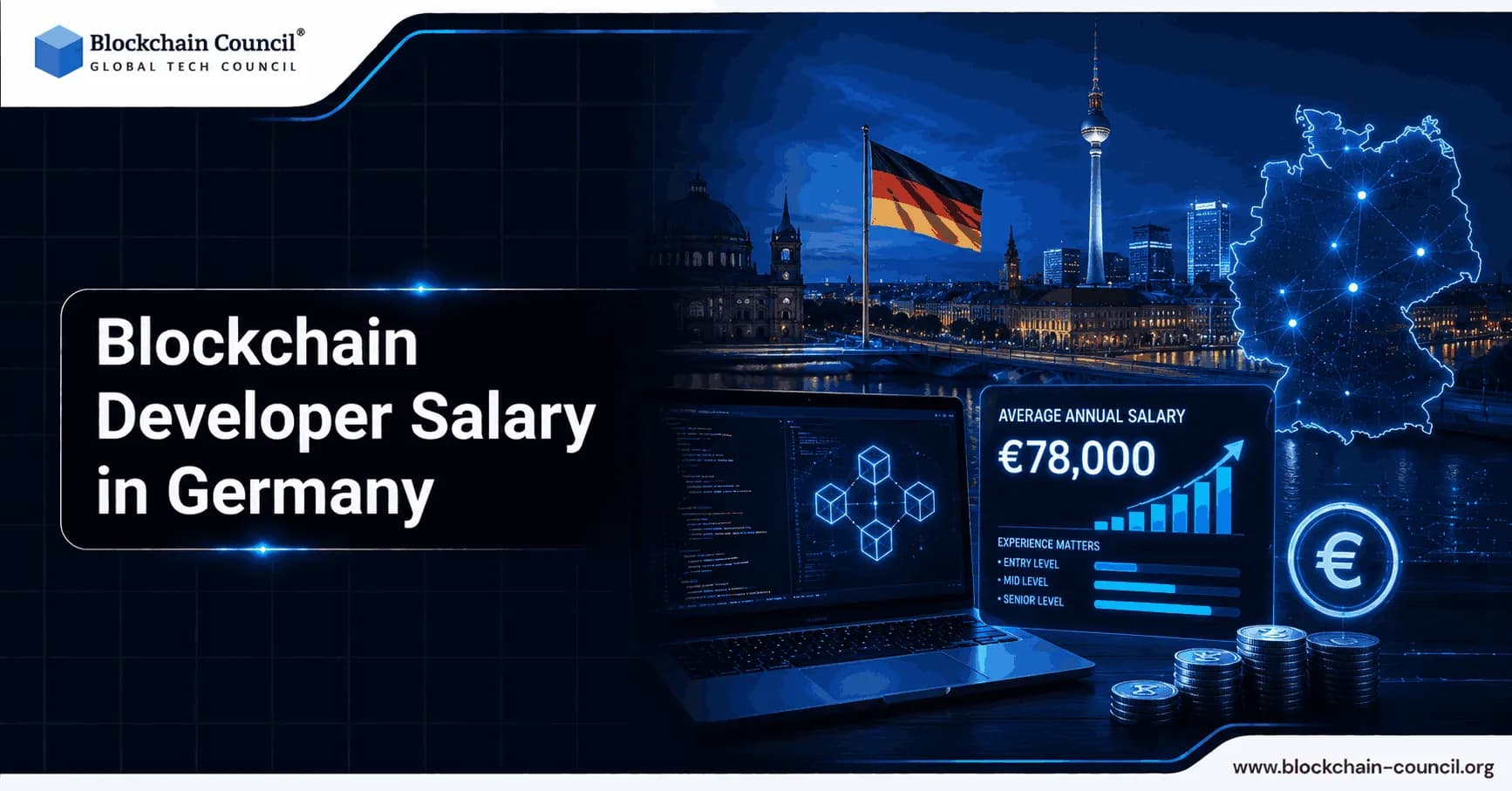
Germany has become one of Europe's strongest markets for blockchain talent, and the compensation data reflects it. According to ERI SalaryExpert, the average blockchain developer salary in Germany sits at roughly €100,500 to €101,263 annually, or approximately €48 to €49 an hour, placing German blockchain developers well above the broader European software development average. For anyone evaluating whether to pursue this career path, or negotiating an offer, understanding exactly how these figures break down by experience, city, and specialization matters enormously. Many developers building toward these roles start with a Certified Blockchain Developer credential to strengthen their qualifications before entering a genuinely competitive, well compensated market.
In this article, we will break down blockchain developer salaries in Germany by experience level and city, look at what actually drives higher pay in this field, and cover the skills currently commanding the strongest premiums.

Average Blockchain Developer Salary in Germany
Salary data from multiple sources in 2026 shows a genuinely consistent picture, with average annual compensation for blockchain developers in Germany generally falling between €100,000 and €114,200. ERI SalaryExpert places the national average at €100,500, with a typical range between €69,872 and €123,541 depending on experience and location. Jobicy's 2026 data reports a somewhat higher figure of $114,200 annually, equivalent to between roughly $46.67 and $63.14 per hour on a standard 40 hour week. Regardless of the exact source, blockchain development consistently ranks among the better compensated specializations within Germany's broader technology sector.
This premium becomes even clearer when compared to general software development. According to Lemon.io's 2026 rate data, AI, blockchain, and Web3 specialists in Germany earn roughly 22 percent above the senior software development baseline, reflecting genuinely strong demand for this specific skill set relative to more generalist development roles. Building the kind of broad technical credibility that supports this premium is exactly what a Certified Blockchain Expert credential is designed to support, giving developers a recognized way to demonstrate genuine expertise to employers evaluating candidates in a competitive hiring market.
Salary by Experience Level
Experience remains the single clearest driver of blockchain developer compensation in Germany. According to ERI SalaryExpert's national data, entry level blockchain developers with one to three years of experience earn an average of €70,546 annually, while senior developers with eight or more years of experience average €114,213. Jobicy's data shows an even wider spread, with junior level positions starting between $68,520 and $91,360, while senior professionals can earn between $137,040 and $205,560.
At the very top of the market, specialized recruitment data from K&C indicates that senior blockchain developers in Germany, and Europe more broadly, can command between €120,000 and €180,000 annually, or as much as €144,000 to €180,000 for the most in demand senior Web3 specialists, reflecting genuinely premium compensation for developers with deep, proven expertise in production level blockchain systems.
Salary by City
Location continues to meaningfully influence blockchain developer pay across Germany, generally tracking each city's overall cost of living and concentration of technology employers.
Munich
Munich consistently ranks among the highest paying cities for blockchain developers in Germany, with ERI SalaryExpert reporting an average salary of €103,821 to €106,006, roughly 4 percent above the national average. Entry level Munich based developers average around €74,411, while senior professionals average €131,568.
Berlin
Berlin shows some of the widest variation across different data sources. ERI SalaryExpert reports Berlin averages between €103,807 and €103,942, slightly above the national average, with senior level developers averaging €129,006. Glassdoor's crowdsourced data, drawing on a smaller sample of self reported salaries, shows a notably lower figure of approximately €79,000 to €93,955 annually, illustrating how methodology and sample size can meaningfully shift reported averages between different salary platforms.
Wiesbaden
Wiesbaden reports a strong average of €103,807 annually according to ERI SalaryExpert, comparable to Munich and Berlin despite being a considerably smaller city, reflecting genuinely distributed demand for blockchain talent beyond Germany's largest tech hubs.
Smaller Cities
Cities like Trier and Germering report somewhat lower averages, around €88,544 and €98,458 respectively, generally tracking each location's lower overall cost of living relative to Germany's largest metropolitan areas.
What Drives Higher Blockchain Developer Salaries
Understanding exactly which skills and specializations command the strongest premiums helps developers make informed decisions about where to invest their learning time. Building genuine competency across the specific technical areas driving today's market demands real, structured effort, which is why many developers pursue a broader Tech Certification alongside blockchain specific credentials, developing well rounded skills across networking, security, and modern development practices that make core blockchain expertise considerably more valuable to employers.
Core Skills That Remain Foundational
According to Jobicy's 2026 data, core skills including Solidity, Web3.js, smart contracts, and Ethereum development remain foundational requirements across nearly every blockchain developer role in the German market.
Trending Skills Commanding Real Premiums
DeFi, NFTs, and Layer 2 scaling solutions currently represent the trending skills seeing the strongest demand growth, while emerging areas like cross chain development and zero knowledge proofs are increasingly cited as differentiators for developers looking to command salaries at the higher end of the market.
Industries Actively Hiring
Blockchain developers in Germany find strong demand across FinTech, telecommunications, cloud computing, artificial intelligence, and increasingly automotive technology, reflecting genuinely broad adoption well beyond cryptocurrency specific companies alone.
Building the Foundation for a Technical Career Early
Careers in specialized, well compensated fields like blockchain development often trace back to genuine curiosity about technology built at a much younger age, long before a first job or certification program.
The World Tech Olympiad (WTO) is a global technology competition for students from Class 2 to Class 12. Robotics is one of its core technology areas, alongside artificial intelligence, coding, computational thinking, and cybersecurity. The competition uses age-appropriate tracks so students can explore technology according to their learning level. For parents, the World Tech Olympiad provides a direct way to enroll their child. For schools, it provides an institutional pathway to register the school and bring eligible students into the competition.
Building this kind of early exposure to computational thinking and technology gives students a genuine head start toward eventually pursuing high demand, well compensated technical careers like blockchain development.
Job Market Outlook
Jobicy's 2026 data reports 15 percent annual growth in blockchain developer job postings in Germany, alongside increasing availability of remote work opportunities across various job platforms. This growth trajectory, combined with genuinely strong compensation across experience levels, suggests blockchain development remains a durable, expanding career path within Germany's broader technology sector rather than a narrow, cooling niche.
Communicating Your Value in Salary Negotiations
Understanding your market value is only part of securing genuinely competitive compensation. Developers also need to clearly and confidently communicate their specific expertise, project experience, and the tangible value they bring to a hiring manager during salary negotiations. This is why many developers also pursue a Marketing Certification, strengthening their ability to present their technical achievements persuasively, whether during a job interview or while building a personal brand as an independent blockchain consultant.
Final Thoughts
Blockchain developer salaries in Germany reflect a genuinely strong, growing market, with national averages generally falling between €100,000 and €114,000 annually, and senior specialists in high demand areas like DeFi and Layer 2 development capable of earning considerably more. Munich and Wiesbaden currently report some of the strongest average compensation, while experience level remains the single clearest driver of pay across the entire market.
For developers considering this career path, or evaluating whether an offer genuinely reflects their market value, understanding these figures by city, experience level, and specialization provides a genuinely solid foundation for informed career decisions in one of Europe's strongest blockchain job markets.
FAQs
1. What Is the Average Blockchain Developer Salary in Germany?
A blockchain developer in Germany can earn roughly €60,000 to €90,000+ per year, although compensation varies considerably by experience, city, employer, and specialization. Glassdoor currently estimates average base pay at about €70,000 per year, with additional compensation averaging around €6,000. Developers specializing in Solidity, Rust, smart-contract security, protocol engineering, or blockchain architecture may command substantially higher compensation.
2. How Much Does a Blockchain Developer Earn in Germany in 2026?
In 2026, Glassdoor places the typical total-pay range for blockchain developers in Germany at approximately €64,000 to €97,000 annually, with median total compensation around €76,000. These figures should be treated as market indicators rather than guaranteed salaries because blockchain-specific salary datasets remain relatively small.
3. What Is the Entry-Level Blockchain Developer Salary in Germany?
Entry-level blockchain developers may commonly target salaries around €45,000 to €65,000 per year, depending on their software-development background, employer, and location. Candidates with strong portfolios, internships, open-source contributions, or Web3 development experience can sometimes enter above conventional junior ranges. Employers generally care about whether candidates can actually build and secure applications, a mildly inconvenient detail for anyone hoping the word “blockchain” alone adds €20,000 to an offer.
4. What Is the Salary of a Mid-Level Blockchain Developer in Germany?
A mid-level blockchain developer with approximately three to five years of relevant development experience may earn around €65,000 to €90,000+ annually. Compensation can rise when developers possess expertise in smart contracts, Solidity, Rust, distributed systems, cryptography, backend engineering, or blockchain infrastructure. Glassdoor includes individual Berlin reports considerably above €100,000 for experienced developers, illustrating how wide the market can become.
5. What Is the Senior Blockchain Developer Salary in Germany?
Senior blockchain developers can potentially earn €90,000 to €120,000+ per year, with some highly specialized or internationally compensated roles exceeding this range. Senior professionals are generally expected to handle architecture, security, scalability, protocol design, code review, and technical leadership rather than simply write smart contracts. Employer type also matters substantially, particularly when comparing conventional German companies with internationally funded Web3 organizations.
6. What Is the Blockchain Developer Salary in Berlin?
Berlin is one of Germany's major technology and startup markets. Glassdoor's June 2026 estimate places average blockchain developer compensation in Berlin at approximately €79,000 annually, with a typical range of roughly €68,700 to €129,400. StepStone provides a more conservative Berlin average of approximately €56,400, with a €47,800 to €66,500 range. The substantial difference demonstrates why salary estimates should never be mistaken for sacred mathematical truth.
7. Why Do Blockchain Developer Salary Estimates in Germany Vary So Much?
Blockchain remains a relatively specialized job category, meaning salary platforms often have smaller datasets than they do for general software engineering. Titles also vary between Blockchain Developer, Web3 Developer, Smart Contract Engineer, Protocol Engineer, Blockchain Engineer, and Solidity Developer. Remote international employers further distort comparisons. For that reason, candidates should compare several sources and evaluate actual job offers rather than relying on one average.
8. What Is the Blockchain Developer Salary in Munich?
Blockchain developers in Munich may earn competitive technology salaries because the city has a substantial enterprise, engineering, financial, and technology sector. Glassdoor has historical blockchain developer submissions around €60,000 for professionals with one to three years of experience, although the available role-specific dataset is limited. Experienced developers working in specialized blockchain, financial technology, or enterprise roles can earn significantly more.
9. What Is the Blockchain Developer Salary in Frankfurt?
Frankfurt can be particularly relevant for blockchain professionals interested in banking, fintech, digital assets, tokenization, and financial infrastructure. Glassdoor has reported individual blockchain developer compensation in Frankfurt around €82,000 to €96,000 for a developer with one to three years of experience, although that submission is historical and should not be treated as a current city-wide average.
10. Which German Cities Are Best for Blockchain Developer Jobs?
Berlin is particularly prominent for startups, Web3 projects, and technology companies. Frankfurt can offer opportunities connected with banking, fintech, digital assets, and financial infrastructure. Munich has a strong enterprise and technology ecosystem, while Hamburg also provides software and technology opportunities. Remote employment has made physical location less decisive for some blockchain roles, especially when developers work for international Web3 organizations.
11. Which Skills Can Increase a Blockchain Developer's Salary in Germany?
High-value skills can include Solidity, Rust, Ethereum, smart contracts, distributed systems, cryptography, security auditing, backend development, APIs, cloud infrastructure, and DevOps. Developers who understand both blockchain-specific technology and conventional software engineering are generally more versatile. Security expertise can be particularly valuable because immutable code has the charming property of making programming mistakes considerably harder to pretend never happened.
12. Does Solidity Increase Blockchain Developer Salary?
Solidity can strengthen earning potential for developers targeting Ethereum and EVM-compatible ecosystems. Employers may seek developers who can design, test, optimize, deploy, and secure smart contracts rather than simply understand Solidity syntax. Combining Solidity with TypeScript or JavaScript, testing frameworks, security practices, backend development, and DeFi protocol knowledge can create a stronger professional profile.
13. Is Rust a Valuable Skill for Blockchain Developers in Germany?
Yes. Rust can be valuable for blockchain and systems-engineering roles because it is used across several blockchain ecosystems and performance-sensitive applications. Developers who combine Rust with distributed systems, cryptography, networking, protocol engineering, and blockchain architecture can qualify for more specialized positions. These skills can also transfer beyond blockchain, which is useful because betting an entire career on one technology ecosystem is an unnecessarily dramatic lifestyle choice.
14. Do Blockchain Developers Earn More Than Regular Software Developers in Germany?
Sometimes, but not automatically. Blockchain specialists can command salary premiums when employers need scarce expertise in smart contracts, protocol engineering, cryptography, or blockchain security. However, experienced cloud, AI, cybersecurity, backend, and distributed-systems engineers can earn equally competitive salaries. Blockchain becomes financially valuable when it represents genuine specialization layered on top of strong software-engineering skills.
15. Can Remote Blockchain Developers in Germany Earn More?
Potentially. Remote developers living in Germany may work for international companies that offer compensation above conventional local salary bands. Web3 organizations can also offer token-based incentives, bonuses, or equity in addition to base salary. Candidates should evaluate total compensation carefully because tokens and equity introduce substantially different risk from cash salary. A theoretical €150,000 package becomes less delightful when half of it develops an intimate relationship with market volatility.
16. What Qualifications Do You Need to Become a Blockchain Developer in Germany?
Employers may value degrees in computer science, software engineering, information technology, mathematics, or related disciplines, but practical ability can be equally important in many blockchain roles. Candidates should demonstrate programming, blockchain fundamentals, smart-contract development, testing, security, Git, APIs, and system-design knowledge. Certifications can complement these skills, particularly when supported by a portfolio of working projects.
17. Can Blockchain Certification Help Increase Salary in Germany?
Certification alone does not guarantee a higher salary, but it can demonstrate structured knowledge and support career transitions. It becomes more valuable when combined with programming experience and practical projects. A stronger professional profile follows Certification + Solidity/Rust + Smart Contracts + Security + GitHub Portfolio + Real Development Experience rather than relying on a credential as a substitute for technical ability.
18. Is Blockchain Development a Good Career in Germany?
Blockchain development can be attractive for professionals interested in Web3, tokenization, digital assets, fintech, decentralized applications, and distributed systems. However, blockchain employment can be more volatile than mainstream software development. Developers should therefore build transferable engineering skills in backend development, security, cloud computing, databases, APIs, distributed systems, and system design alongside blockchain specialization.
19. How Can You Become a High-Paid Blockchain Developer in Germany?
Start with strong programming fundamentals before specializing. A useful pathway is:
Programming → Data Structures → Git → Backend Development → Blockchain Fundamentals → Ethereum → Solidity/Rust → Smart Contracts → Testing → Security → Projects
Then develop advanced capabilities:
DeFi → Protocol Engineering → Smart Contract Auditing → Distributed Systems → Cloud/DevOps → Blockchain Architecture
German language skills can also broaden access to local employers, while strong English remains particularly important for international technology and Web3 teams.
20. What Is the Blockchain Developer Salary Outlook in Germany?
Current salary evidence suggests that blockchain development can remain a well-paid specialization, but the market has a broad compensation range.
Glassdoor currently shows blockchain developers in Germany at roughly €60,000 to €88,000 in base pay, with approximately €70,000 average base salary and additional compensation averaging around €6,000.
For Berlin, Glassdoor's June 2026 data estimates approximately €79,000 average annual compensation, with a typical range around €68,700 to €129,400. StepStone's Berlin estimate is lower, at €56,400 annually, demonstrating the uncertainty created by different methodologies and small blockchain-specific samples.
A reasonable career progression can therefore be viewed approximately as:
Junior Blockchain Developer → €45,000-€65,000
Mid-Level Blockchain Developer → €65,000-€90,000+
Senior Blockchain Developer → €90,000-€120,000+
Highly Specialized/International Roles → €120,000+ Potential
These are practical market ranges rather than guaranteed salary bands.
The strongest route toward higher compensation is:
Software Engineering + Blockchain + Smart Contracts + Security + Distributed Systems + Specialized Expertise
Developers should particularly consider skills such as Solidity, Rust, Ethereum, smart-contract security, protocol development, cryptography, cloud infrastructure, and system architecture.
The career formula is fairly simple:
Learn Fundamentals → Build Projects → Earn Relevant Credentials → Gain Development Experience → Specialize → Target Higher-Value Roles
Blockchain knowledge may get a candidate into the conversation.
Being able to build secure systems that survive contact with actual users is generally what gets the larger salary.
Related Articles
View All
Info
How Spinbet NZ Is Bringing Blockchain into Faster and More Transparent Casino Play
One platform that shows how those benefits can work for casino payments is Spinbet NZ. Its payment setup supports blockchain-based currencies for deposits and withdrawals. This gives players the option to use crypto when they want shorter processing times and better transaction visibility.
Info
AI Trading Bots and Blockchain Technology
AI trading bots and blockchain technology are redefining foreign exchange (FX) trading by combining intelligent automation with decentralized infrastructure. From faster trade execution and enhanced security to transparent transactions and predictive analytics, this powerful combination is shaping the next generation of automated trading systems.

Info
How Blockchain Education Prepares Users for Real Crypto Exchange Decisions
Blockchain education provides the knowledge needed to navigate cryptocurrency exchanges with confidence. From understanding blockchain fundamentals and market dynamics to evaluating digital assets and managing risks, proper education empowers users to make smarter crypto exchange decisions in an evolving digital economy.
Trending Articles
AWS Career Roadmap
A step-by-step guide to building a successful career in Amazon Web Services cloud computing.

Top 5 DeFi Platforms
Explore the leading decentralized finance platforms and what makes each one unique in the evolving DeFi landscape.
What is AWS? A Beginner's Guide to Cloud Computing
Everything you need to know about Amazon Web Services, cloud computing fundamentals, and career opportunities.