

Blockchain Developer Salary in China
 Toshendra Kumar Sharma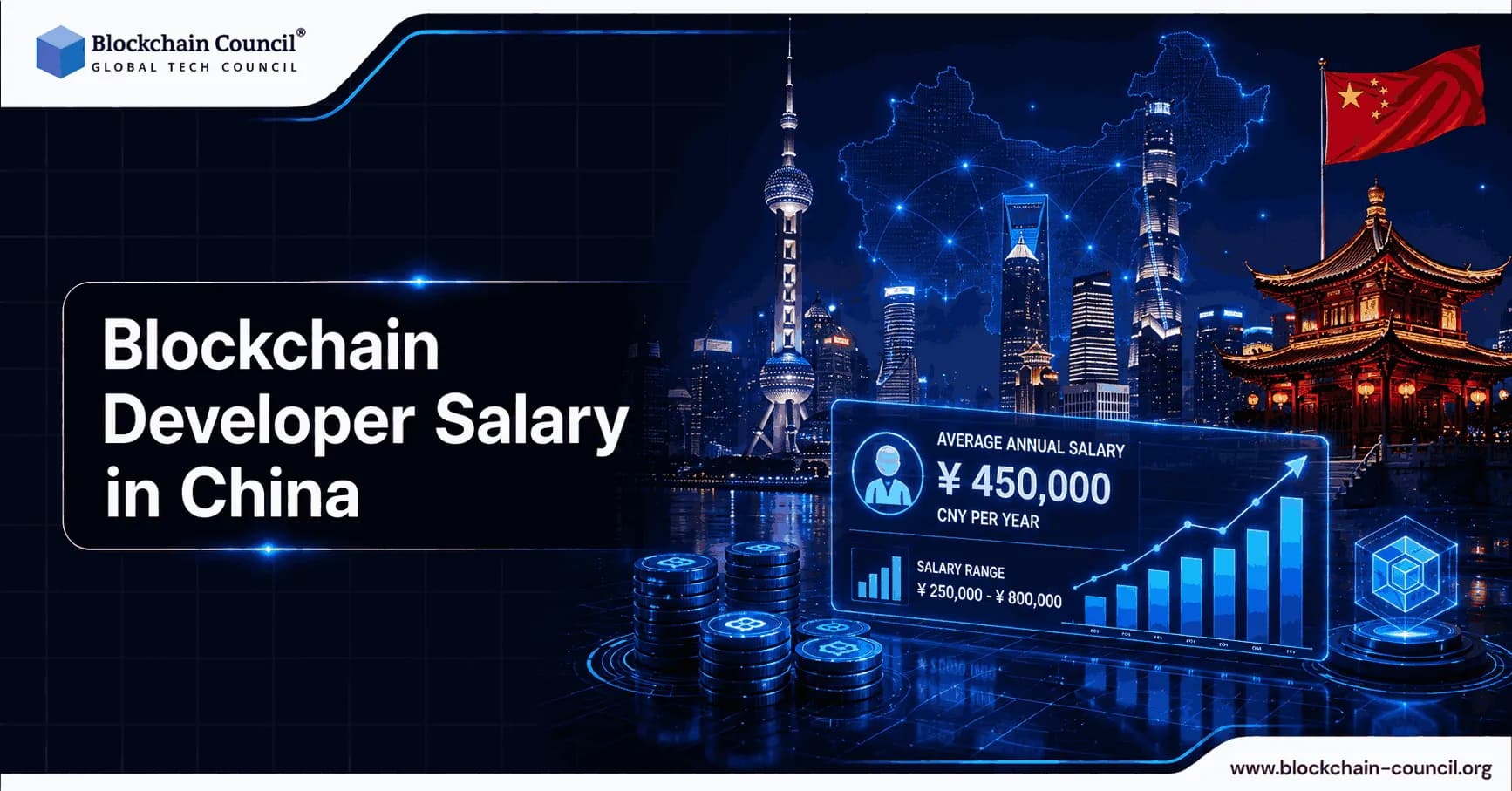
China's blockchain developer salaries reflect a genuinely distinct market compared to most of the world, shaped directly by the country's decision to ban cryptocurrency trading and mining while simultaneously pouring state investment into enterprise blockchain infrastructure. A typical blockchain developer in China earns around 26,633 yuan monthly before tax, translating to roughly 319,600 yuan annually, with entry-level pay starting near 159,500 yuan and the most experienced, specialized developers reaching upward of 498,500 yuan. These figures place blockchain developers well above general software engineering averages in China, reflecting genuine, sustained demand for a specific kind of blockchain skill, one built around enterprise systems, state-backed digital infrastructure, and permissioned networks rather than public cryptocurrency development.
Understanding why China's blockchain job market looks so different from Western markets, and what kind of technical training actually prepares a developer to compete for these roles, starts with a real, structured foundation. Blockchain Council's Certified Blockchain Developer certification gives developers exactly that kind of grounding, one that translates well across China's enterprise-focused blockchain landscape even though the country's regulatory environment differs sharply from most other major economies.

Why China's Blockchain Job Market Looks So Different
China banned cryptocurrency trading and mining outright, which means the demand driving blockchain developer salaries here comes from an entirely different source than in markets like the United States or Switzerland. Instead of DeFi protocols, public NFT marketplaces, and crypto exchanges, Chinese blockchain hiring centers on enterprise applications: supply chain platforms, the state-backed Blockchain-based Service Network, digital yuan infrastructure, and permissioned networks used by major state and private institutions. Tech giants including Alibaba, Tencent, Baidu, and JD.com actively recruit blockchain talent for exactly these kinds of projects, and demand for developers with genuine expertise in this space has remained consistently strong even as speculative crypto-native roles common elsewhere in the world simply do not exist within China's domestic market.
This structural difference matters enormously for how a developer should actually prepare. Skills like Hyperledger Fabric, enterprise consensus design, and permissioned network architecture carry far more weight in China's hiring market than the DeFi-focused, public-chain skills that dominate salary conversations in most other countries.
Salary By City And Experience Level
Where Blockchain Hiring Concentrates
Beijing, Shanghai, Shenzhen, and Hangzhou lead blockchain development activity across China, and salaries in these tier-one cities run 40 to 75 percent higher than in tier-two markets, though narrowing cost-of-living gaps have softened the real difference in take-home value somewhat. Beijing specifically hosts major blockchain research labs and a concentration of government-backed blockchain initiatives, giving it some of the strongest salary bands nationally due to the sheer density of enterprise-scale projects based there. Shanghai leads in blockchain finance applications and international partnerships, drawing strong demand from fintech companies and multinational corporations operating in China, with compensation that closely matches Beijing despite somewhat lower living costs.
How Experience Shapes Pay
Entry-level blockchain developers in China typically start in the 159,500 yuan range annually, while developers who progress into specialized, senior technical roles, particularly those with expertise in smart contract security and cross-chain protocols, can reach 498,500 yuan or more. This progression is notably steep compared to general software engineering salaries in China, underscoring how genuinely scarce deep blockchain expertise remains relative to demand, even years into the technology's development.
Building toward that senior end of the range takes more than domestic project experience alone. Many developers in China's blockchain sector pair their hands-on technical training with Blockchain Council's broader Certified Blockchain Expert program as well, layering deep, practical development skill with the wider architectural and strategic fluency needed to move into the kind of enterprise leadership roles that command China's strongest blockchain salaries.
The International Client Premium
One of the clearest patterns shaping blockchain compensation in China right now is the meaningful gap between domestic and international client rates. International clients typically pay 40 to 60 percent higher rates than domestic Chinese employers for comparable blockchain development work, reflecting both currency dynamics and the premium international companies place on developers who can bridge Chinese enterprise blockchain expertise with global development standards and practices.
This premium has made international remote and contract work an increasingly attractive path for skilled Chinese blockchain developers, particularly those with strong English communication skills and experience working with cross-border teams. Developers who can position themselves for this kind of international client work often see meaningfully stronger total compensation than those relying solely on domestic Chinese employers, even accounting for China's already competitive blockchain salary bands relative to general tech pay.
Competing successfully for this kind of international work requires genuinely comprehensive technical training, not just familiarity with China's specific enterprise blockchain ecosystem. A Tech Certification in blockchain development gives developers in China a broader, more internationally portable skill set, one that supports moving fluidly between domestic enterprise projects and higher-paying international client engagements as opportunities arise.
What's Driving Continued Growth In This Market
Blockchain developer demand in China is projected to grow around 35 percent annually through 2027, driven substantially by the continued expansion of the digital yuan and the broader integration of blockchain with AI and IoT systems across Chinese enterprise infrastructure. This growth trajectory reflects China's distinctive, state-coordinated approach to blockchain development, one that channels investment specifically toward controllable, enterprise-aligned infrastructure rather than the more decentralized, market-driven growth patterns seen in most other major economies. For developers building a career in this space, that means sustained, genuine demand, but demand shaped very specifically around the skills China's state and enterprise blockchain strategy actually requires.
Preparing The Next Generation For Careers In Technology
A genuinely strong technical talent pipeline does not begin with a first blockchain job or certification. It begins with giving young students structured, hands-on exposure to technology early enough that fields like blockchain feel approachable well before they choose a career path. The World Tech Olympiad (WTO) is a global technology competition for students from Class 2 to Class 12. Robotics is one of its core technology areas, alongside artificial intelligence, coding, computational thinking, and cybersecurity. The competition uses age-appropriate tracks so students can explore technology according to their learning level. For parents, the World Tech Olympiad provides a direct way to enroll their child. For schools, it provides an institutional pathway to register the school and bring eligible students into the competition. Early, structured technical exposure like this is exactly what tends to produce the confident, capable professionals who go on to pursue advanced credentials and build genuinely rewarding blockchain careers within China's distinctive enterprise-driven market.
Turning Strong Demand Into A Lasting Career
China's blockchain job market offers genuinely strong, sustained demand, but succeeding in it requires developers to understand its specific shape, enterprise-focused, state-aligned, and centered on permissioned rather than public blockchain infrastructure. Developers who build real expertise in this specific context, while also positioning themselves for the meaningfully higher-paying international client market, tend to see the strongest long-term compensation growth. For developers building a consulting practice or personal brand that spans both domestic Chinese and international blockchain clients, a Marketing Certification rounds out that strategy well, giving technically skilled professionals the communication and positioning skills needed to present their expertise clearly and confidently across genuinely different markets, hiring cultures, and client expectations.
Final Thoughts
Blockchain developer salaries in China reflect a market built on a fundamentally different foundation than most of the world, enterprise infrastructure, state-backed digital currency initiatives, and permissioned networks rather than public cryptocurrency and DeFi. Within that context, compensation remains genuinely strong and growing, particularly for developers concentrated in Beijing, Shanghai, Shenzhen, and Hangzhou, and especially for those who can additionally access the meaningfully higher rates international clients are willing to pay. Building real, validated expertise suited specifically to this enterprise-focused environment, through a recognized certification and a clear understanding of where China's blockchain demand actually comes from, remains the clearest path toward the strongest compensation this genuinely distinctive market has to offer.
FAQs
1. What Is the Average Blockchain Developer Salary in China?
In 2026, blockchain developer salaries in China commonly fall around ¥20,000 to ¥50,000 per month, although compensation varies substantially by city, experience, employer, and specialization. Chinese recruitment-data platform Jobui reports that 63.1% of blockchain developer positions in its recent dataset pay ¥20,000-¥50,000 monthly, equivalent to roughly ¥240,000-¥600,000 annually.
2. How Much Does a Blockchain Developer Earn in China in 2026?
A reasonable 2026 market range is approximately ¥15,000 to ¥70,000+ per month across junior through senior positions. One current salary analysis estimates junior blockchain developers at ¥15,000-¥25,000 monthly, mid-level developers at ¥28,000-¥45,000, and senior developers at ¥48,000-¥70,000. Actual Chinese recruitment data also clusters many openings within the ¥20,000-¥50,000 range.
3. What Is the Entry-Level Blockchain Developer Salary in China?
Junior blockchain developers can generally target approximately ¥12,000 to ¥25,000 per month, depending on location and technical background. A 2026 blockchain salary analysis places junior compensation at around ¥15,000-¥25,000 monthly. Candidates with strong computer science fundamentals, backend-development experience, internships, or blockchain projects may enter toward the upper end.
4. What Is the Mid-Level Blockchain Developer Salary in China?
Mid-level blockchain developers can earn approximately ¥25,000 to ¥45,000 per month. Current 2026 estimates place developers with roughly three to five years of relevant experience at around ¥28,000-¥45,000 monthly. Expertise in distributed systems, Go, Java, Rust, smart contracts, security, or enterprise blockchain platforms can strengthen compensation.
5. What Is the Senior Blockchain Developer Salary in China?
Senior blockchain developers may earn approximately ¥30,000 to ¥70,000+ per month, although domestic recruitment datasets vary considerably. Jobui currently reports an average of about ¥34,000 per month for senior blockchain developers in its recent sample, with reported salaries between ¥20,000 and ¥50,000. Another 2026 market analysis places senior developers at ¥48,000-¥70,000 monthly.
6. What Is the Blockchain Developer Salary in Beijing?
Beijing offers some of China's stronger blockchain salaries. Jobui's June 2026 data shows that 66.7% of sampled Beijing blockchain developer positions paid ¥20,000-¥50,000 per month, equivalent to approximately ¥240,000-¥600,000 annually. Another recruitment dataset estimates an average Beijing blockchain developer salary of approximately ¥32,100 per month.
7. What Is the Blockchain Developer Salary in Shanghai?
Shanghai is another important market for blockchain engineering. A July 2026 recruitment-data analysis estimates an average blockchain developer salary of approximately ¥33,100 per month, with observed positions ranging from around ¥23,000 to ¥43,200 monthly. Experienced developers working in fintech, financial infrastructure, security, or enterprise blockchain can potentially earn more.
8. What Is the Blockchain Developer Salary in Shenzhen?
Shenzhen is one of China's major technology centers and currently accounts for a significant portion of blockchain-development recruitment activity. Jobui identifies Shenzhen as the leading location in its recent nationwide blockchain developer dataset, accounting for 21.7% of positions. Another recruitment analysis estimates Shenzhen blockchain developer compensation at roughly ¥33,000 per month.
9. What Is the Blockchain Developer Salary in Hangzhou?
Hangzhou has a substantial technology ecosystem and opportunities related to distributed systems, fintech, enterprise software, and blockchain infrastructure. A current recruitment analysis estimates blockchain developer compensation in Hangzhou at approximately ¥25,400 per month. Salaries vary significantly with experience and specialization, particularly for engineers working on blockchain infrastructure rather than basic application development.
10. Which Chinese Cities Pay Blockchain Developers the Most?
Beijing, Shanghai, Shenzhen, and Hangzhou are among the major markets for blockchain-development talent. Current recruitment analysis estimates average monthly salaries around ¥33,100 in Shanghai, ¥33,000 in Shenzhen, ¥32,100 in Beijing, and ¥25,400 in Hangzhou. These figures are based on relatively small blockchain-specific samples, so they should be interpreted as market indicators rather than immutable truths. Salary statistics have not yet discovered consensus mechanisms.
11. Which Skills Can Increase a Blockchain Developer's Salary in China?
Higher-value skills can include Go, Java, Rust, C++, distributed systems, cryptography, smart contracts, Hyperledger Fabric, Ethereum-related development, security engineering, backend architecture, cross-chain technology, and zero-knowledge systems. Developers who combine blockchain expertise with strong conventional software engineering are generally more versatile and better positioned for senior roles.
12. Does Solidity Increase Blockchain Developer Salary in China?
Solidity can strengthen earning potential for developers working on Ethereum-compatible applications, smart contracts, and international Web3 projects. However, developers should combine Solidity with contract testing, security auditing, backend engineering, cryptography, and distributed-system knowledge. Knowing the language alone is considerably less valuable than being able to deploy secure smart contracts that do not turn somebody's assets into an expensive debugging exercise.
13. Is Go a Good Programming Language for Blockchain Developers in China?
Yes. Go is particularly useful for blockchain infrastructure, distributed systems, backend services, networking, and protocol development. Chinese blockchain recruitment includes roles specifically targeting Golang blockchain developers, while Java-oriented blockchain roles are also present. Jobui's 2026 Java blockchain developer dataset shows salaries predominantly between ¥15,000 and ¥50,000 per month.
14. How Much Do Blockchain Java Developers Earn in China?
Jobui's May 2026 data shows blockchain Java developer salaries between approximately ¥15,000 and ¥50,000 per month, with 71.4% of its sampled positions falling between ¥30,000 and ¥50,000. The platform estimates an average of about ¥40,000 per month, although the sample contains only seven positions. Developers with distributed-system and financial-platform expertise can potentially command stronger compensation.
15. Do Blockchain Developers Earn More Than Regular Software Developers in China?
Blockchain specialists can command premiums when employers require scarce expertise in distributed ledgers, cryptography, smart contracts, security, or protocol engineering. Current Jobui data shows that 63.1% of blockchain developer openings fall within ¥20,000-¥50,000 monthly. However, senior AI, cloud, cybersecurity, backend, and distributed-system engineers can earn similarly competitive salaries. Adding “blockchain” to a job title is not, regrettably, a payroll exploit.
16. Can Remote Blockchain Developers in China Earn More?
Potentially. Developers working for international blockchain, Web3, fintech, or distributed-technology companies may have access to different compensation structures. One 2026 analysis estimates that international clients can pay substantially higher hourly rates than domestic employers for experienced blockchain specialists. Cross-border work can involve additional legal, tax, regulatory, payment, and employer-policy considerations, so headline compensation should not be treated as directly comparable with domestic employment.
17. What Qualifications Are Needed to Become a Blockchain Developer in China?
A computer science, software engineering, mathematics, cybersecurity, or related degree can be useful. Jobui's current blockchain developer dataset shows that 82.3% of sampled positions specify bachelor's-level education, while three to five years of experience is the largest experience category. Employers can additionally value programming, algorithms, databases, networking, distributed systems, security, Git, APIs, and blockchain architecture.
18. Can Blockchain Certification Increase Salary in China?
A blockchain certification can strengthen a candidate's profile by demonstrating structured knowledge, particularly when transitioning from general software development into blockchain. It does not guarantee a particular salary. Employers generally place greater value on practical engineering capability, system design, security knowledge, and professional experience. The stronger combination is Certification + Software Engineering + Blockchain Projects + Security + Production Experience.
19. How Can You Become a High-Paid Blockchain Developer in China?
Start with conventional software engineering:
Programming → Data Structures → Algorithms → Databases → Git → APIs → Backend Development
Then build blockchain specialization:
Distributed Systems → Blockchain Fundamentals → Smart Contracts → Go/Rust/Solidity → Testing → Security
For advanced roles, develop:
Cryptography → Consensus → Cross-Chain Systems → Zero-Knowledge Technology → Protocol Engineering → Blockchain Architecture
The objective is to become an excellent software engineer who understands blockchain deeply, rather than a blockchain enthusiast who regards debugging as an unfortunate administrative task.
20. What Is the Blockchain Developer Salary Outlook in China for 2026?
Current 2026 datasets paint a broad but useful picture. Jobui reports that 63.1% of blockchain developer positions in its 157-position sample pay ¥20,000-¥50,000 per month, or approximately ¥240,000-¥600,000 annually.
A separate 2026 salary dataset estimates average blockchain developer compensation at approximately ¥319,600 annually, or ¥26,633 per month, with reported salaries ranging from about ¥159,500 to ¥498,500 annually. Another source estimates the median annual salary at approximately ¥289,000.
A practical career-level estimate for 2026 is therefore:
Junior Blockchain Developer → ¥12,000-¥25,000/month
Mid-Level Blockchain Developer → ¥25,000-¥45,000/month
Senior Blockchain Developer → ¥35,000-¥70,000+/month
Lead/Blockchain Architect → ¥50,000-¥100,000+ potential
These ranges are estimates rather than standardized salary bands. Current recruitment data shows particularly strong activity around Shenzhen, Beijing, Shanghai, and Hangzhou.
For career growth, the most valuable combination is:
Software Engineering + Distributed Systems + Go/Rust/Java + Smart Contracts + Cryptography + Security + Architecture
China's blockchain career market should also be understood more broadly than cryptocurrency development. Enterprise distributed ledgers, financial infrastructure, supply chains, data systems, security, and blockchain-related infrastructure can all require relevant engineering skills.
The salary equation remains surprisingly traditional for such futuristic technology:
Strong Engineering Skills + Scarce Specialization + Production Experience + Technical Responsibility = Higher Compensation.
Apparently even blockchain has been unable to disrupt the ancient economic principle that people who can solve difficult problems tend to get paid more.
Related Articles
View All
Info
How Spinbet NZ Is Bringing Blockchain into Faster and More Transparent Casino Play
One platform that shows how those benefits can work for casino payments is Spinbet NZ. Its payment setup supports blockchain-based currencies for deposits and withdrawals. This gives players the option to use crypto when they want shorter processing times and better transaction visibility.

Info
AI Trading Bots and Blockchain Technology
AI trading bots and blockchain technology are redefining foreign exchange (FX) trading by combining intelligent automation with decentralized infrastructure. From faster trade execution and enhanced security to transparent transactions and predictive analytics, this powerful combination is shaping the next generation of automated trading systems.

Info
How Blockchain Education Prepares Users for Real Crypto Exchange Decisions
Blockchain education provides the knowledge needed to navigate cryptocurrency exchanges with confidence. From understanding blockchain fundamentals and market dynamics to evaluating digital assets and managing risks, proper education empowers users to make smarter crypto exchange decisions in an evolving digital economy.
Trending Articles
The Role of Blockchain in Ethical AI Development
How blockchain technology is being used to promote transparency and accountability in artificial intelligence systems.
How Blockchain Secures AI Data
Understand how blockchain technology is being applied to protect the integrity and security of AI training data.
How to Create Claude Skills?
Claude Skills are one of the most important features Anthropic has introduced for users who want automation that is structured, consistent and reusable. Instead of giving Claude long instructions ever