

What Is Solidity Programming Language?
 Toshendra Kumar Sharma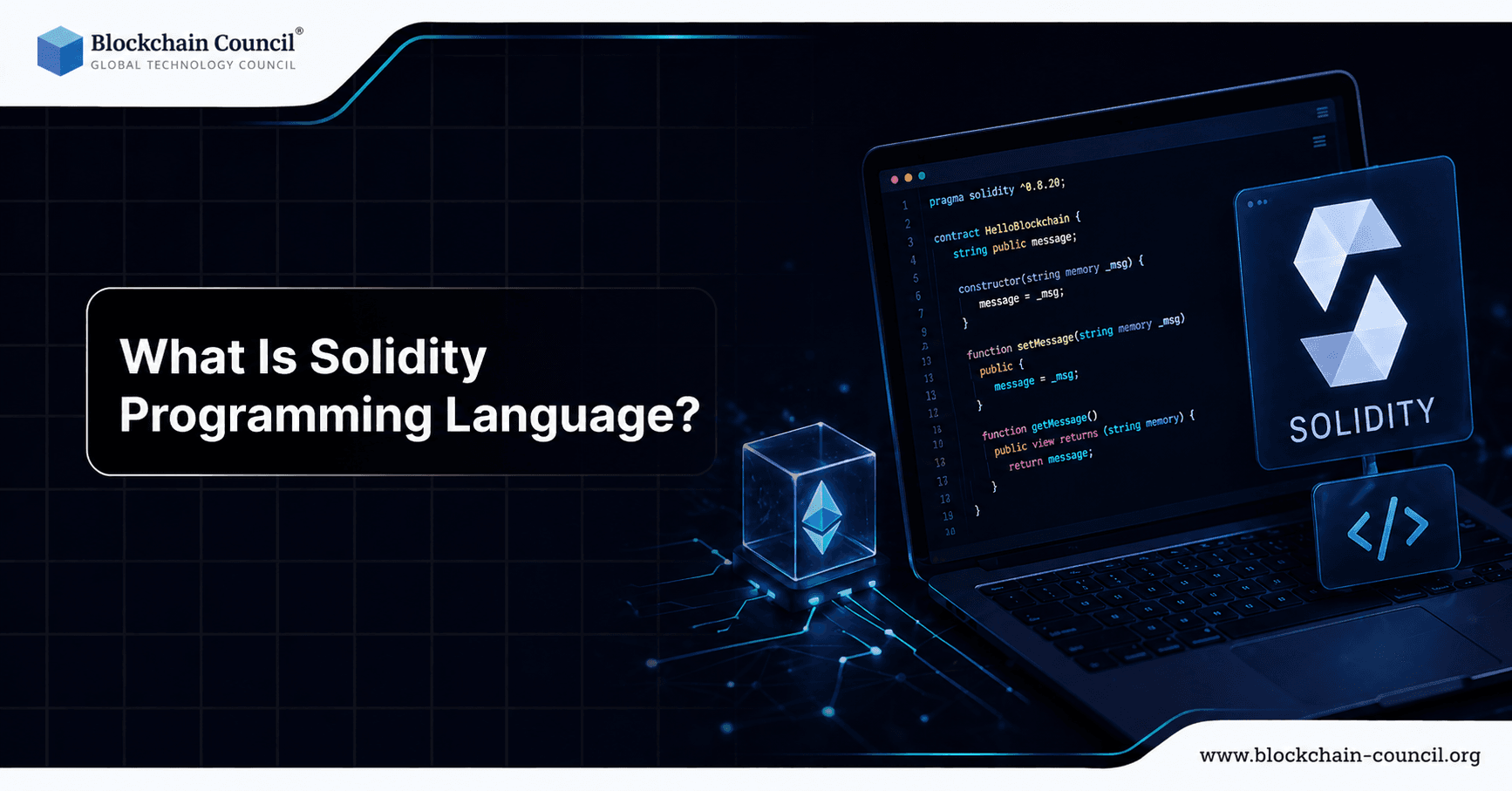
Solidity is a high-level, contract-oriented programming language used to write smart contracts on blockchain platforms, primarily Ethereum. It is designed to run on the Ethereum Virtual Machine, enabling developers to build decentralized applications.
Since its introduction, Solidity has become the most widely used language for blockchain development. In 2026, it continues to evolve with improved security features, better tooling, and broader adoption across Ethereum Layer 2 networks and other EVM-compatible blockchains like Polygon, Arbitrum, and Avalanche. Learn Solidity to write smart contracts for Ethereum-based applications including DeFi and NFTs by building expertise through a Certified Blockchain Expert, testing contracts using a Python certification, and showcasing your projects using a Digital marketing course.

What Is Solidity?
Solidity is a statically typed programming language specifically created for writing smart contracts. Smart contracts are self-executing programs that run on a blockchain and automatically enforce rules without intermediaries.
The syntax of Solidity is similar to JavaScript, C++, and Python, making it relatively easy for developers with prior programming experience to learn. Its static typing ensures that variables are checked at compile time, reducing runtime errors and improving code reliability.
Key Features of Solidity
Contract-Oriented Programming
Solidity is built around the concept of contracts. A contract contains data and functions that define how the data can be modified or accessed.
Static Typing
Solidity enforces type checking during compilation. This helps catch errors early and ensures safer execution of smart contracts.
Ethereum Virtual Machine Compatibility
Solidity code is compiled into bytecode that runs on the Ethereum Virtual Machine. This allows smart contracts to be executed across Ethereum and other compatible blockchains.
Object-Oriented Features
Solidity supports inheritance, allowing developers to create reusable and modular code. Contracts can inherit properties and functions from other contracts.
Built-in Security Features
Modern versions of Solidity include safeguards such as overflow checks, improved error handling, and safer function calls to reduce vulnerabilities.
How Solidity Works
Solidity is used to write smart contracts, which are then deployed to a blockchain.
Writing the Contract
Developers write Solidity code to define rules and logic for decentralized applications, including variables, functions, and access controls.
Compiling the Code
The Solidity compiler converts the code into bytecode that can run on the Ethereum Virtual Machine.
Deployment
The compiled contract is deployed to the blockchain using tools like Hardhat, Foundry, or Remix.
Execution
Once deployed, the contract executes automatically when triggered by transactions. The results are recorded on the blockchain and cannot be altered.
Example of a Simple Solidity Contract
A basic Solidity contract might store and retrieve a number using a state variable and simple functions. This demonstrates how data is stored on-chain and accessed globally.
Although simple, this forms the foundation for building more advanced applications like decentralized finance platforms and NFT systems.
Use Cases of Solidity
Decentralized Finance
Solidity powers DeFi applications such as lending platforms, decentralized exchanges, and staking systems.
Non-Fungible Tokens
It is widely used to create and manage NFTs, including digital art, collectibles, and gaming assets.
Token Creation
Developers use Solidity to create cryptocurrencies and tokens using standards like ERC-20 and ERC-721.
Voting Systems
Smart contracts enable transparent and tamper-proof voting mechanisms.
Multi-Signature Wallets
Solidity allows the creation of wallets that require multiple approvals for transactions, improving security.
Advantages of Solidity
Solidity enables decentralized and trustless applications, reduces reliance on intermediaries, supports automation through smart contracts, offers a strong ecosystem, and provides compatibility across EVM-based networks.
Challenges and Limitations
Smart contract bugs can be costly and irreversible. Solidity also requires security auditing, understanding of gas fees, and knowledge of blockchain concepts.
Developers must follow best practices to reduce risks and ensure reliability.
Solidity in 2026
Solidity remains the dominant language for smart contract development. It continues to improve with better tools, enhanced security, Layer 2 support, and a growing developer ecosystem.
It plays a central role in Web3, decentralized finance, and digital asset innovation.
Conclusion
Solidity is a foundational technology for blockchain development. Its contract-oriented design, strong ecosystem, and ongoing improvements make it essential for building decentralized applications. Master Solidity development for creating secure and efficient smart contracts by advancing your skills through a Certified Blockchain Expert, integrating dApps using a Node JS Course, and promoting your blockchain portfolio using an AI powered marketing course.
As blockchain adoption increases, Solidity will remain a key skill for developers working in Web3 and digital asset systems.
Frequently Asked Questions
1. What is Solidity programming language?
Solidity is a high-level programming language used to write smart contracts on Ethereum and other EVM-compatible blockchains. It enables decentralized application development.
2. What is Solidity used for?
It is used to create smart contracts for applications like DeFi platforms, NFTs, token systems, and decentralized voting.
3. Is Solidity similar to JavaScript?
Yes, Solidity syntax is similar to JavaScript and C++, making it easier for developers with those backgrounds to learn.
4. What is a smart contract in Solidity?
A smart contract is a self-executing program stored on the blockchain that automatically enforces rules and agreements.
5. What is the Ethereum Virtual Machine?
The Ethereum Virtual Machine is the runtime environment that executes Solidity smart contracts on the blockchain.
6. Is Solidity statically typed?
Yes, Solidity is statically typed, meaning variables are checked at compile time to reduce errors.
7. Can Solidity be used outside Ethereum?
Yes, it is also used on EVM-compatible blockchains like Polygon, Binance Smart Chain, and Avalanche.
8. What are ERC-20 tokens?
ERC-20 is a standard for creating fungible tokens on Ethereum using Solidity.
9. What are ERC-721 tokens?
ERC-721 is a standard for creating non-fungible tokens, commonly used for NFTs.
10. Is Solidity hard to learn?
It is relatively easy for developers familiar with programming, but blockchain concepts can take time to understand.
11. What tools are used with Solidity?
Common tools include Remix, Hardhat, Foundry, and Truffle for development and testing.
12. What are gas fees in Solidity?
Gas fees are transaction costs required to execute smart contracts on the Ethereum network.
13. How secure is Solidity?
Solidity can be secure if best practices are followed, but vulnerabilities can occur without proper auditing.
14. What is inheritance in Solidity?
Inheritance allows one contract to reuse code from another, improving efficiency and modularity.
15. Can Solidity handle complex applications?
Yes, it is used to build complex systems like DeFi platforms, NFT marketplaces, and DAOs.
16. What is a state variable in Solidity?
A state variable stores data permanently on the blockchain within a smart contract.
17. What is contract deployment?
Deployment is the process of uploading a compiled smart contract to the blockchain.
18. What are Layer 2 solutions in Solidity?
Layer 2 solutions improve scalability and reduce costs while still supporting Solidity-based contracts.
19. Why is Solidity important in 2026?
It remains the primary language for building decentralized applications and managing digital assets.
20. Can beginners learn Solidity?
Yes, beginners can learn it with basic programming knowledge and practice using development tools.
Related Articles
View All
Ethereum
Solidity for Beginners: A Guide to Getting Started
Solidity is a pristine programming language formulated explicitly for developing smart contracts for the Ethereum blockchain. The newly developed language has gained a significant role under Ethereum’s contracts framework that is of great importance in blockchain technology; in fact, you will…

Ethereum
How to Learn Solidity and Become a Solidity Developer [UPDATED]
If you want to learn solidity language and become a certified solidity developer, this article illustrates how to start as a beginner and reach your goals. Introduction to Solidity Gavin Wood initially proposed the idea of Solidity in August 2014, which is a contract-oriented programming language…
Ethereum
ERC20
Ether, also known as ETH, is a whole ecosystem where people can create pretty much anything, from complex decentralized applications (Dapps) that work seamlessly using intelligent contracts to custom tokens (ERC-20 tokens), non-fungible tokens (NFTs), and anything else you can think of. It may have a very scientific sound, but in reality, it’s not that difficult to grasp.
Trending Articles
The Role of Blockchain in Ethical AI Development
How blockchain technology is being used to promote transparency and accountability in artificial intelligence systems.

Top 5 DeFi Platforms
Explore the leading decentralized finance platforms and what makes each one unique in the evolving DeFi landscape.
What is AWS? A Beginner's Guide to Cloud Computing
Everything you need to know about Amazon Web Services, cloud computing fundamentals, and career opportunities.