

What Is Ethereum Technology?
 Toshendra Kumar Sharma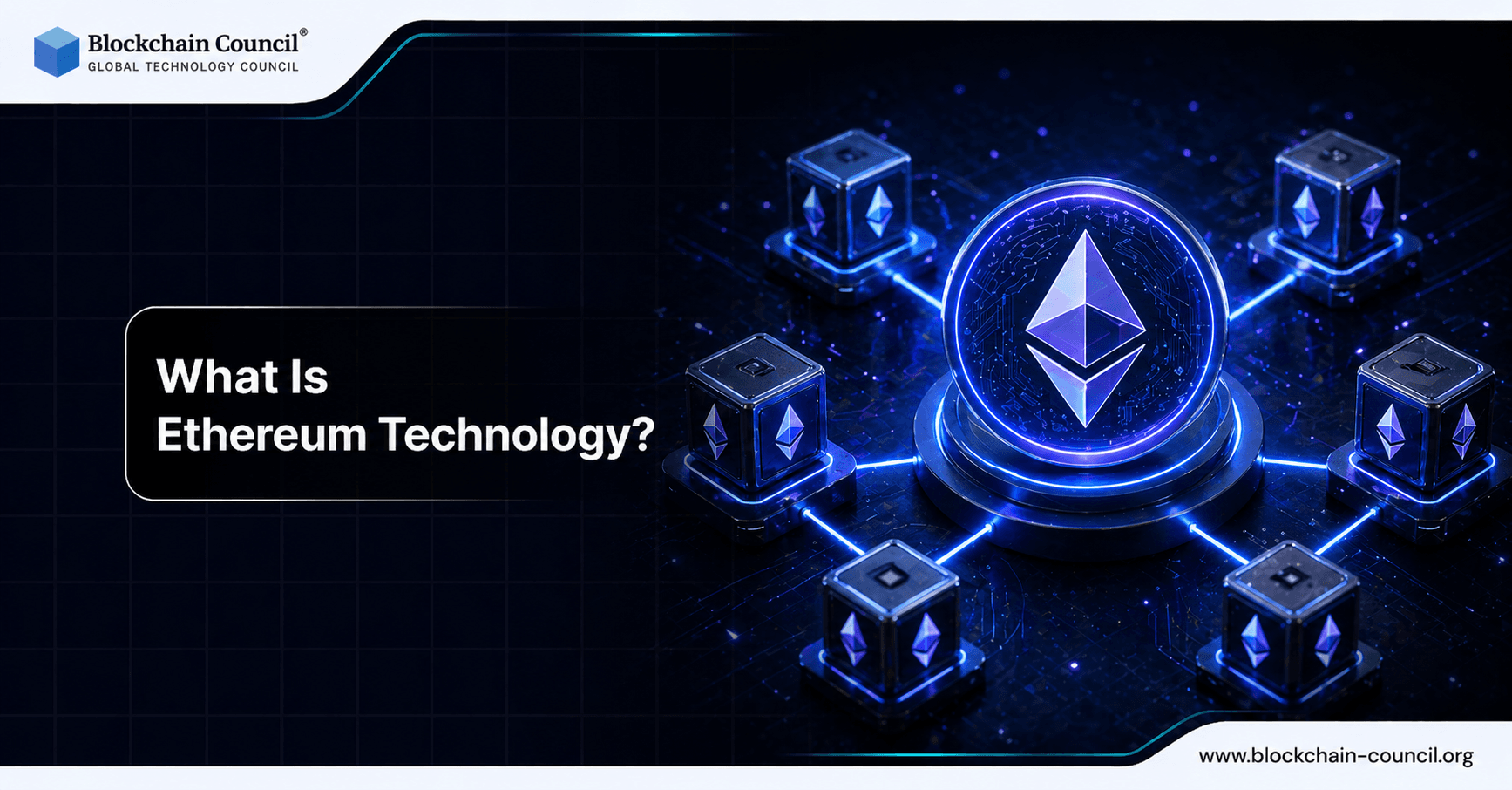
Ethereum is a decentralized blockchain platform that enables developers to build and run smart contracts and decentralized applications (DApps). Unlike Bitcoin, which primarily functions as digital money, Ethereum is designed as a programmable platform that supports a wide range of use cases beyond payments.
Launched in 2015 by Vitalik Buterin and other co-founders, Ethereum has become a foundational layer for Web3 technologies. It powers decentralized finance (DeFi), non-fungible tokens (NFTs), digital identity systems, and many other blockchain-based innovations. Understand Ethereum’s core architecture including the EVM, gas system, and smart contracts by building expertise through a Certified Blockchain Expert, testing contract interactions using a Python certification, and applying these skills in real-world use cases via a Digital marketing course.

This guide explains what Ethereum is, how it works, and why it remains one of the most important technologies in the blockchain ecosystem.
What Is Ethereum?
Ethereum is an open-source blockchain network that allows developers to create applications using smart contracts. These smart contracts are self-executing programs that run on the blockchain and automatically enforce rules without intermediaries.
The native cryptocurrency of Ethereum is called Ether (ETH). It is used to pay for transaction fees, computational services, and network operations.
Ethereum is not just a cryptocurrency. It is a decentralized computing platform that enables trustless interactions between users, applications, and organizations.
Key Components of Ethereum
To understand Ethereum, it is important to look at its core components.
Blockchain Ledger
Ethereum maintains a distributed ledger that records all transactions and smart contract activity. This ledger is shared across thousands of nodes worldwide.
Smart Contracts
Smart contracts are programs stored on the blockchain. They execute automatically when predefined conditions are met.
Ether (ETH)
ETH is the native digital currency used to pay for transactions and computational resources.
Ethereum Virtual Machine (EVM)
The EVM is the runtime environment that executes smart contracts. It ensures that all nodes process transactions consistently.
How Ethereum Works
Ethereum operates as a decentralized network of computers, known as nodes, that validate and store data.
Transaction Process
When a user initiates a transaction, it is broadcast to the network. Validators verify the transaction and include it in a block.
Block Creation
Transactions are grouped into blocks. Each block is linked to the previous one, forming a chain.
State Changes
Unlike Bitcoin, which focuses on transaction records, Ethereum tracks the state of accounts and smart contracts. This allows it to support complex applications.
Execution of Smart Contracts
When a smart contract is triggered, the EVM executes its code across all nodes, ensuring consistent results.
Ethereum Consensus Mechanism
Ethereum originally used Proof of Work (PoW), similar to Bitcoin. However, it transitioned to Proof of Stake (PoS) in 2022 through an upgrade known as “The Merge.”
Proof of Stake (PoS)
In PoS, validators replace miners. Validators stake ETH to participate in block validation.
Key benefits include:
Lower energy consumption
Improved scalability
Enhanced security
Validators earn rewards for validating transactions and maintaining network integrity.
Gas Fees and Transactions
Ethereum uses a system called gas to measure the computational cost of transactions.
Users pay gas fees in ETH to execute transactions or run smart contracts. Gas prices vary depending on network demand.
Layer 2 solutions such as Arbitrum, Optimism, and Polygon help reduce fees and improve transaction speed.
Ethereum vs Bitcoin
Ethereum and Bitcoin serve different purposes.
Bitcoin is primarily a digital currency and store of value. Ethereum is a programmable platform that supports applications and smart contracts.
Bitcoin uses a simpler scripting system, while Ethereum offers a full programming environment.
Ethereum’s flexibility makes it suitable for a wide range of use cases beyond payments.
Use Cases of Ethereum
Ethereum powers many real-world applications.
Decentralized Finance (DeFi)
Users can borrow, lend, trade, and earn interest without traditional banks.
Non-Fungible Tokens (NFTs)
Ethereum enables the creation of unique digital assets used in art, gaming, and collectibles.
Decentralized Applications (DApps)
Developers build applications that run without centralized control.
Tokenization
Real-world assets such as real estate and stocks can be represented digitally on Ethereum.
Build decentralized applications on Ethereum with smart contract deployment and Web3 integrations by mastering development through a Certified Blockchain Expert, integrating frontends using a Node JS Course, and positioning your dApps effectively with an AI powered marketing course.
Advantages of Ethereum
Ethereum offers several benefits.
Decentralization and transparency
Programmability through smart contracts
Large developer ecosystem
Continuous innovation and upgrades
These advantages make Ethereum a leading blockchain platform.
Challenges of Ethereum
Ethereum also faces limitations.
High transaction fees during peak demand
Scalability challenges, though improving with Layer 2 solutions
Complexity for new users and developers
Competition from other blockchain platforms
Ongoing upgrades aim to address these issues.
The Future of Ethereum
Ethereum continues to evolve with improvements in scalability, security, and usability.
Key trends include:
Expansion of Layer 2 networks
Integration with zero-knowledge proofs
Growth of decentralized identity systems
Increased institutional adoption
Ethereum is expected to remain a core infrastructure for Web3.
Frequently Asked Questions (FAQs)
1. What is Ethereum?
Ethereum is a decentralized blockchain platform that allows developers to build smart contracts and decentralized applications.
2. Is Ethereum a cryptocurrency?
Ethereum is a platform, while Ether (ETH) is its native cryptocurrency used for transactions and fees.
3. How is Ethereum different from Bitcoin?
Bitcoin is mainly used as digital money, while Ethereum supports programmable applications and smart contracts.
4. What is Ether (ETH)?
ETH is the native token of Ethereum used to pay for transactions and network operations.
5. What are smart contracts?
Smart contracts are self-executing programs that run on the Ethereum blockchain.
6. What is the Ethereum Virtual Machine?
The EVM is the environment where smart contracts are executed across the network.
7. What is Proof of Stake?
Proof of Stake is a consensus mechanism where validators stake ETH to validate transactions.
8. What happened in the Ethereum Merge?
The Merge transitioned Ethereum from Proof of Work to Proof of Stake in 2022.
9. What are gas fees?
Gas fees are payments made in ETH to execute transactions or run smart contracts.
10. What are Layer 2 solutions?
Layer 2 solutions are networks built on Ethereum to improve speed and reduce fees.
11. What is DeFi?
Decentralized finance refers to financial services built on blockchain without intermediaries.
12. What are NFTs?
NFTs are unique digital assets stored on the Ethereum blockchain.
13. What are DApps?
Decentralized applications run on blockchain networks without centralized control.
14. Is Ethereum secure?
Ethereum is secure due to decentralization and cryptography, but risks can exist in poorly written smart contracts.
15. Who created Ethereum?
Ethereum was proposed by Vitalik Buterin and launched in 2015 with a team of co-founders.
16. Can Ethereum be used for payments?
Yes, ETH can be used for payments, though it is mainly used within the ecosystem.
17. What is staking in Ethereum?
Staking involves locking ETH to participate in transaction validation and earn rewards.
18. What is tokenization on Ethereum?
Tokenization is the process of representing real-world assets as digital tokens on the blockchain.
19. What are the challenges of Ethereum?
Challenges include high fees, scalability, and complexity for beginners.
20. What is the future of Ethereum?
Ethereum is expected to grow with improved scalability, Layer 2 adoption, and broader use cases in Web3.
Related Articles
View All
Ethereum
Grayscale Announces First Ethereum Staking Payout for US-Listed ETF
Grayscale announced the first-ever staking reward payout from a US-listed spot crypto product on January 5, 2026. This event matters because it shows how crypto assets like Ethereum are moving beyond simple price exposure and starting to generate income inside regulated market products. Anyone…
Ethereum
How to Mine Ethereum
Summary Ethereum, the largest altcoin, processes three times more daily transactions than Bitcoin, thanks to its higher capacity and role in NFTs and DeFi. Ethereum
Ethereum
How To Buy An Ethereum Name Service (ENS) Domain?
Summary: ENS allows users to register easy-to-read domain names, such as “mydomain.eth”, and map them to machine-readable addresses, such as Ethereum addresses or content hash addresses. ENS consists of two smart contracts. The first contract, the ENS registry, stores all the domain…
Trending Articles
AWS Career Roadmap
A step-by-step guide to building a successful career in Amazon Web Services cloud computing.

Top 5 DeFi Platforms
Explore the leading decentralized finance platforms and what makes each one unique in the evolving DeFi landscape.
How Blockchain Secures AI Data
Understand how blockchain technology is being applied to protect the integrity and security of AI training data.