

How Crowdsale or Crowdfunding in Blockchain Works?
 Toshendra Kumar Sharma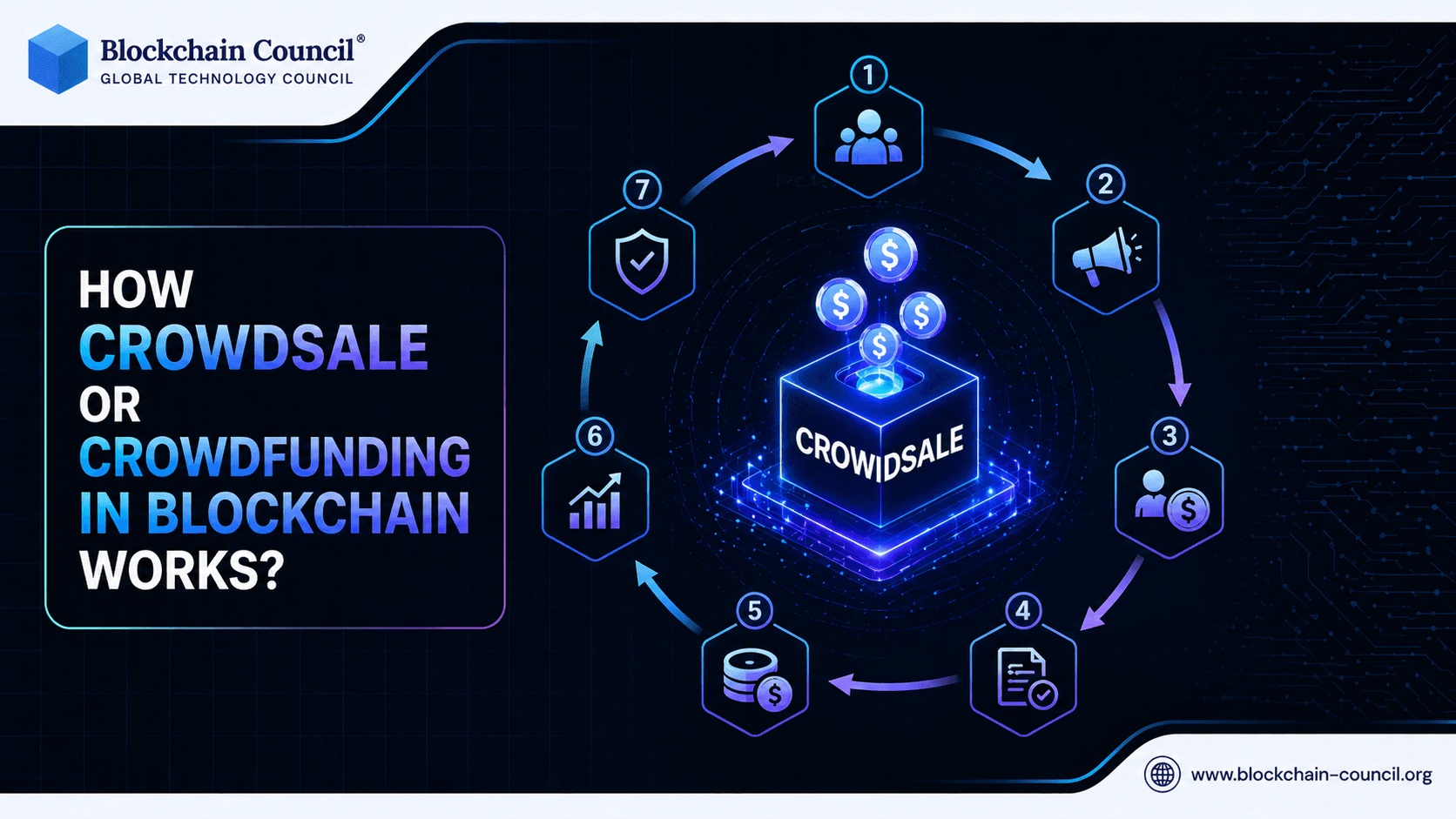
Blockchain-based crowdfunding allows individuals and organizations to raise funds directly from a global audience without relying on traditional intermediaries like banks, venture capitalists, or centralized platforms.
Instead of using platforms such as Kickstarter or Indiegogo, blockchain crowdfunding uses smart contracts and digital tokens to manage contributions, ownership, and distribution of funds. This approach increases transparency, reduces fees, and enables programmable trust between project creators and contributors.

Over time, blockchain crowdfunding has evolved from early Initial Coin Offerings (ICOs) into more structured and regulated models such as Security Token Offerings (STOs), Initial DEX Offerings (IDOs), and DAO-based fundraising. Learn how blockchain-based crowdfunding enables transparent fundraising through token issuance and smart contracts by building expertise through a Cryptocurrency Expert, analyzing token distribution models using a Python certification, and launching successful campaigns via a Digital marketing course.
What Is Blockchain Crowdfunding?
Blockchain crowdfunding is the process of raising capital using decentralized technologies. Contributors send cryptocurrency to a smart contract, which automatically manages fund distribution, token issuance, and refunds if conditions are not met.
Unlike traditional crowdfunding, where a platform acts as a middleman, blockchain eliminates intermediaries. All transactions are recorded on a public ledger, making the process transparent and verifiable.
This model allows creators to interact directly with contributors while ensuring trust through code rather than third-party oversight.
Evolution of Blockchain Fundraising Models
Early blockchain fundraising was dominated by ICOs, where projects issued tokens in exchange for funding. While ICOs enabled rapid capital formation, they also faced issues such as scams, lack of regulation, and poor investor protection.
To address these challenges, newer models have emerged:
Security Token Offerings (STOs): Regulated offerings representing real-world assets or equity
Initial DEX Offerings (IDOs): Token sales conducted on decentralized exchanges
Launchpads: Platforms that vet and support projects before fundraising
DAO-based fundraising: Community-governed funding and decision-making
As of 2026, compliance, transparency, and investor protection have become central to blockchain crowdfunding.
How Blockchain Crowdsales Work
Blockchain crowdfunding typically follows a structured process.
Project Creation
A creator defines the project idea, funding goal, timeline, and token model. This information is often published in a whitepaper or project documentation.
Smart Contract Deployment
A smart contract is created to manage the crowdsale. It includes:
Funding target (soft cap and hard cap)
Token distribution rules
Refund conditions
Timeline for the campaign
Once deployed, the contract operates automatically.
Contribution Phase
Participants send cryptocurrency, such as ETH or stablecoins, to the smart contract. In return, they receive tokens representing value, access, or ownership.
Token Distribution
Tokens are issued automatically based on predefined rules. These tokens may represent:
Utility (access to a product or service)
Governance rights (voting power)
Financial assets (in regulated cases)
Completion or Refund
If the funding goal is reached, the project receives the funds. If not, contributors can claim refunds directly from the smart contract.
Types of Blockchain Crowdfunding
Blockchain crowdfunding can take different forms depending on the project’s goals.
1. Utility Token Crowdsale
In this model, contributors receive tokens that provide access to a product or service.
For example, a project might issue tokens that can later be redeemed for a device, software access, or platform usage.
2. Equity or Security Token Offering (STO)
Here, tokens represent ownership or financial rights in a project. These offerings are typically regulated and require compliance with securities laws.
3. DAO-Based Crowdfunding
This model creates a decentralized organization where contributors become stakeholders.
Funds are controlled by the DAO, and decisions about how to use them are made through voting.
DAO-Based Crowdfunding Explained
DAO-based fundraising is one of the most advanced forms of blockchain crowdfunding.
Tokenized Ownership
Contributors receive governance tokens that represent their stake in the project. These tokens grant voting rights on decisions such as funding allocation or project direction.
Proposal System
Members can submit proposals for how funds should be used. These proposals are voted on by token holders.
Collective Decision-Making
Funds are not controlled by a single entity. Instead, they are released only when proposals are approved by the community.
Automated Execution
Once a proposal passes, the smart contract executes the decision automatically, ensuring transparency and accountability.
Key Benefits of Blockchain Crowdfunding
Blockchain crowdfunding offers several advantages over traditional methods.
Transparency
All transactions and rules are recorded on the blockchain, allowing anyone to verify the process.
Global Access
Anyone with an internet connection and cryptocurrency can participate, removing geographic barriers.
Reduced Costs
By eliminating intermediaries, blockchain reduces fees associated with fundraising.
Automation
Smart contracts handle contributions, token distribution, and refunds automatically.
Challenges and Risks
Despite its advantages, blockchain crowdfunding is not without issues.
Regulatory Uncertainty
Different countries have different rules regarding token sales, making compliance complex.
Security Risks
Smart contract bugs or exploits can lead to loss of funds if not properly audited.
Market Volatility
Cryptocurrency prices can fluctuate significantly, affecting both fundraising and investment value.
Scams and Low-Quality Projects
Although the ecosystem has matured, due diligence is still essential for participants.
Best Practices for Successful Blockchain Fundraising
Projects looking to raise funds through blockchain should follow key best practices.
Conduct smart contract audits
Ensure regulatory compliance
Provide clear documentation and transparency
Build community trust before launching
Use reputable launchpads or platforms
These steps improve credibility and reduce risks for both creators and contributors.
The Future of Blockchain Crowdfunding
Blockchain crowdfunding is becoming more structured, regulated, and integrated with traditional finance.
Emerging trends include:
Tokenization of real-world assets
Integration with decentralized finance (DeFi)
Cross-chain fundraising platforms
Increased institutional participation
As technology and regulation mature, blockchain crowdfunding is expected to become a mainstream method of raising capital globally. Build secure crowdfunding platforms using smart contracts and decentralized funding mechanisms by mastering crypto ecosystems through a Cryptocurrency Expert, developing backend systems using a Node JS Course, and scaling fundraising strategies with an AI powered marketing course.
Frequently Asked Questions
1. What is blockchain crowdfunding?
Blockchain crowdfunding is a method of raising funds using decentralized technology. Contributors send cryptocurrency to smart contracts in exchange for tokens.
2. How is blockchain crowdfunding different from Kickstarter?
Blockchain crowdfunding removes intermediaries and uses smart contracts for transparency. Kickstarter relies on a centralized platform.
3. What is a crowdsale in blockchain?
A crowdsale is a fundraising event where projects sell tokens to contributors in exchange for cryptocurrency.
4. What is an ICO?
An Initial Coin Offering is an early fundraising method where projects issue tokens. It is less common now due to regulatory concerns.
5. What is an IDO?
An Initial DEX Offering is a token sale conducted on a decentralized exchange, providing liquidity and transparency.
6. What is an STO?
A Security Token Offering represents regulated financial assets or equity on the blockchain.
7. What are utility tokens?
Utility tokens provide access to a product or service rather than ownership in a company.
8. Can I get a refund in blockchain crowdfunding?
Yes, many smart contracts include refund mechanisms if the funding goal is not reached.
9. What cryptocurrencies are used in crowdsales?
Commonly used cryptocurrencies include Ethereum, stablecoins, and other blockchain-native tokens.
10. Is blockchain crowdfunding safe?
It can be safe if projects are audited and transparent. However, risks still exist due to scams or vulnerabilities.
11. What is a smart contract in crowdfunding?
A smart contract is code that automatically manages contributions, token distribution, and refunds.
12. What is DAO-based crowdfunding?
It is a model where contributors collectively control funds and decisions through a decentralized organization.
13. What are governance tokens?
Governance tokens give holders voting rights in project decisions or DAO operations.
14. Can anyone participate in a crowdsale?
Most blockchain crowdfunding events are open globally, but some may have regulatory restrictions.
15. What is a soft cap and hard cap?
A soft cap is the minimum funding goal, while a hard cap is the maximum amount a project aims to raise.
16. What are launchpads in crypto?
Launchpads are platforms that help projects raise funds by providing vetting, marketing, and technical support.
17. How do DAOs manage funds?
DAOs use voting mechanisms to approve proposals for spending funds stored in a shared treasury.
18. What are the risks of investing in crowdsales?
Risks include project failure, market volatility, scams, and regulatory changes.
19. What is token vesting?
Token vesting restricts when tokens can be sold or transferred, helping prevent market dumping.
20. What is the future of blockchain crowdfunding?
It is moving toward regulated, transparent, and integrated systems that combine blockchain with traditional finance.
Related Articles
View All
Ethereum
What Is Ethereum Studio - Blockchain & How It Works?
Ethereum Studio is a platform where the question and answer site for users who mainly Ethereum, the decentralized application platform and smart contract enabled blockchain. Join them; it only takes a minute. What is Ethereum Studio – Blockchain and how it works? from Blockchain Council I…

Ethereum
Will Beacon’s Chain Launch to Speed Up Enterprise Blockchain Adoption
If you have followed Ethereum, you must be knowing that Ethereum has recently launched its phase 0, Beacon Chain. If you are excited to know everything related to ETH 2.0 and wondering how this launch will enable enterprise-grade applications, we have got you covered. Table of Contents The Most…

Ethereum
Ethereum Classic Announces Partnerships With Blockchain Developer And DApp
Ethereum Classic Labs, the incubator accelerating the development of the Ethereum Classic community and ecosystem, has revealed the news of its partnerships with the social media DApp iZbreaker and Second State, the blockchain infrastructure developer. iZbreaker is an invite-only, security…
Trending Articles
The Role of Blockchain in Ethical AI Development
How blockchain technology is being used to promote transparency and accountability in artificial intelligence systems.
What is AWS? A Beginner's Guide to Cloud Computing
Everything you need to know about Amazon Web Services, cloud computing fundamentals, and career opportunities.
Blockchain in Supply Chain Provenance Tracking
Supply chains are under pressure to prove not just efficiency, but also authenticity, sustainability, and fairness. Customers want to know if their coffee really is fair trade, if the diamonds are con