

What are the difference between Private & Public Blockchain?
 Toshendra Kumar Sharma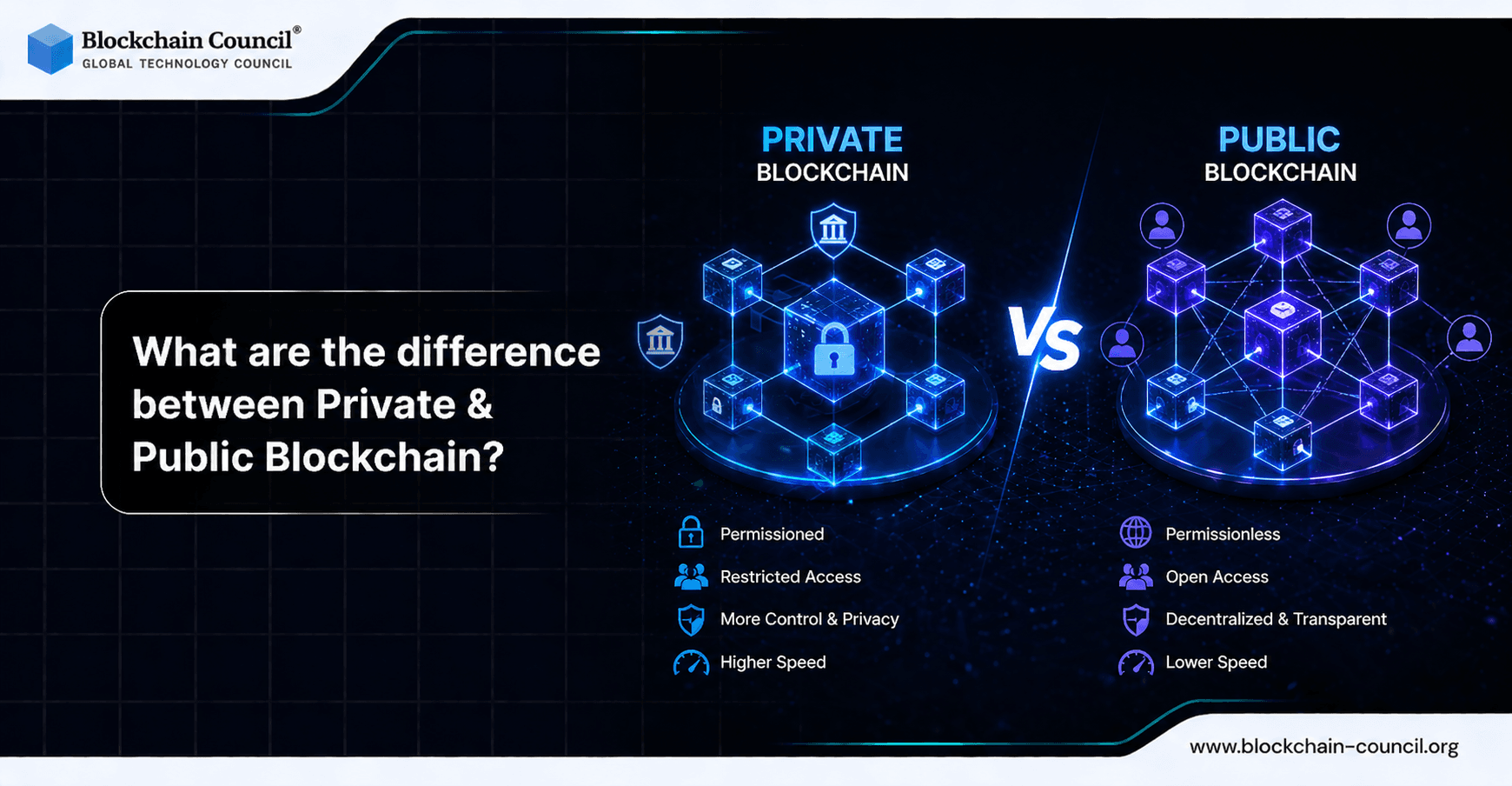
Blockchain technology has evolved far beyond cryptocurrencies. Today, organizations use different types of blockchains depending on their needs. The two primary categories are public blockchains and private blockchains.
While both use distributed ledger technology, they differ significantly in terms of access, control, performance, and use cases. Understanding these differences is essential for businesses, developers, and investors. Understand the differences between private and public blockchain in terms of governance, scalability, and control by building expertise through a Certified Blockchain Expert, analyzing architectures using a Python certification, and applying insights in real-world scenarios via a Digital marketing course.

This explains the key differences between private and public blockchains, their advantages, limitations, and practical applications in 2026.
What Is a Public Blockchain?
A public blockchain is an open and decentralized network that anyone can access and participate in. Examples include Bitcoin and Ethereum.
In a public blockchain, users can join the network without permission, validate transactions, and view all transaction data.
No single entity controls the network. Decisions are made through consensus mechanisms such as Proof of Stake.
Public blockchains prioritize transparency, security, and decentralization.
What Is a Private Blockchain?
A private blockchain is a permissioned network where access is restricted to selected participants. It is usually controlled by a single organization or a group of trusted entities.
In a private blockchain, administrators control who can join the network, who can validate transactions, and what data is visible.
Private blockchains are commonly used in enterprise environments where privacy and control are required.
Key Differences Between Private and Public Blockchain
Access and Participation
Public blockchains are open to anyone with internet access. Private blockchains restrict participation to approved users.
This makes public networks more inclusive, while private networks offer controlled environments.
Decentralization
Public blockchains are fully decentralized, with no central authority controlling the system.
Private blockchains are partially decentralized or centralized, depending on how they are managed.
Transparency
Public blockchains provide full transparency. All transactions are visible and verifiable.
Private blockchains limit visibility to authorized participants, ensuring confidentiality.
Speed and Performance
Private blockchains are faster because they have fewer participants and simpler consensus mechanisms.
Public blockchains may be slower due to large network size and complex validation processes.
Security
Public blockchains rely on decentralization and cryptography for security.
Private blockchains rely on access control and internal governance.
Both can be secure, but the approach differs.
Consensus Mechanisms
Public blockchains use mechanisms like Proof of Stake to validate transactions across distributed nodes.
Private blockchains often use simpler consensus methods such as voting or authority-based validation.
Cost
Public blockchains may involve transaction fees that vary based on network demand.
Private blockchains typically have lower operational costs but require infrastructure and maintenance.
Governance
Public blockchains are governed by community consensus.
Private blockchains are governed by organizations or consortiums.
Advantages of Public Blockchain
Public blockchains offer several benefits.
They provide high transparency and trust because all data is publicly verifiable. They are highly secure due to decentralization.
They support open innovation, allowing developers to build decentralized applications.
Public blockchains are ideal for applications that require trustless environments.
Advantages of Private Blockchain
Private blockchains are designed for efficiency and control.
They offer faster transaction speeds and lower latency. They provide data privacy and restricted access.
Organizations can customize rules and permissions based on their needs.
Private blockchains are suitable for enterprise applications and internal systems.
Use Cases of Public Blockchain
Public blockchains are widely used in cryptocurrencies and digital payments, decentralized finance platforms, non-fungible tokens, and decentralized applications.
These use cases benefit from openness and global participation.
Use Cases of Private Blockchain
Private blockchains are commonly used in supply chain management, banking and financial services, healthcare data management, and enterprise data sharing.
These applications require controlled access and compliance with regulations.
Hybrid and Consortium Blockchains
In practice, many organizations use hybrid or consortium blockchains.
Hybrid blockchains combine features of public and private systems. Consortium blockchains are managed by multiple organizations.
These models balance transparency with control.
Common Misconceptions
A common misconception is that private blockchains are not real blockchains.
While they differ from public systems, they still use distributed ledger technology and consensus mechanisms.
Another misconception is that public blockchains are always better. The choice depends on the use case.
Choosing the Right Blockchain
The choice between public and private blockchain depends on several factors.
If transparency and decentralization are priorities, a public blockchain is suitable.
If privacy, control, and performance are more important, a private blockchain may be the better option.
Organizations should evaluate their requirements carefully before choosing a model. Choose the right blockchain model for enterprise or decentralized applications by mastering system design through a Certified Blockchain Expert, building solutions using a Node JS Course, and positioning solutions using an AI powered marketing course.
The Future of Blockchain Models
Both public and private blockchains will continue to coexist.
Public blockchains will drive innovation in decentralized applications. Private blockchains will support enterprise solutions.
Hybrid models will become more common as organizations seek flexibility and scalability.
Frequently Asked Questions
1. What is a public blockchain?
A public blockchain is an open network where anyone can participate and validate transactions.
2. What is a private blockchain?
A private blockchain is a permissioned network controlled by an organization or group.
3. What is the main difference between public and private blockchain?
The main difference is access. Public blockchains are open, while private blockchains are restricted.
4. Is Bitcoin a public blockchain?
Yes, Bitcoin is a fully decentralized public blockchain.
5. Is Ethereum a public blockchain?
Yes, Ethereum is a public blockchain that supports smart contracts and applications.
6. Are private blockchains centralized?
They are often partially centralized, depending on governance structure.
7. Which is faster, public or private blockchain?
Private blockchains are generally faster due to fewer participants.
8. Are public blockchains secure?
Yes, they are highly secure due to decentralization and cryptography.
9. Do private blockchains have transaction fees?
They usually have lower or configurable costs compared to public blockchains.
10. What is a consortium blockchain?
It is a blockchain managed by multiple organizations rather than a single entity.
11. Can businesses use public blockchains?
Yes, but they must consider scalability, cost, and privacy requirements.
12. What are hybrid blockchains?
Hybrid blockchains combine features of both public and private systems.
13. What is decentralization in blockchain?
It means control is distributed across multiple participants rather than a single authority.
14. Why do enterprises prefer private blockchains?
They offer better control, privacy, and compliance with regulations.
15. Can private blockchains be trusted?
They can be trusted within controlled environments but rely on governance rather than full decentralization.
16. What is transparency in blockchain?
Transparency means that transactions can be verified by participants.
17. Are private blockchains scalable?
Yes, they are generally more scalable due to controlled participation.
18. What industries use private blockchains?
Finance, healthcare, supply chain, and enterprise systems commonly use them.
19. Will private blockchains replace public ones?
No, both serve different purposes and will coexist.
20. What is the future of blockchain types?
Hybrid and interoperable systems will likely dominate future blockchain development.
Related Articles
View All
Development
Securing Web Applications in 2026: OWASP Top 10 (2025), Authentication, and Secure APIs
Learn how to secure web applications in 2026 using OWASP Top 10 (2025), phishing-resistant authentication, and secure API controls for microservices and AI apps.

Development
Serverless Web Development with AWS Lambda and Vercel: Architecture, Costs, and Best Practices
Learn serverless web development with AWS Lambda and Vercel, including architectures, cost models, streaming, edge runtimes, and best practices for performance and security.

Development
Building a Web3-Ready Website: Integrating Wallet Login, Signatures, and On-Chain Data
Learn how to build a Web3-ready website with wallet login, SIWE signatures, and on-chain data using RPC and indexers, plus security and hosting best practices.
Trending Articles

Can DeFi 2.0 Bridge the Gap Between Traditional and Decentralized Finance?
The next generation of DeFi protocols aims to connect traditional banking with decentralized finance ecosystems.
Claude AI Tools for Productivity
Discover Claude AI tools for productivity to streamline tasks, manage workflows, and improve efficiency.
Blockchain in Supply Chain Provenance Tracking
Supply chains are under pressure to prove not just efficiency, but also authenticity, sustainability, and fairness. Customers want to know if their coffee really is fair trade, if the diamonds are con