

What Is Cryptocurency Mining & How It Works?
 Toshendra Kumar Sharma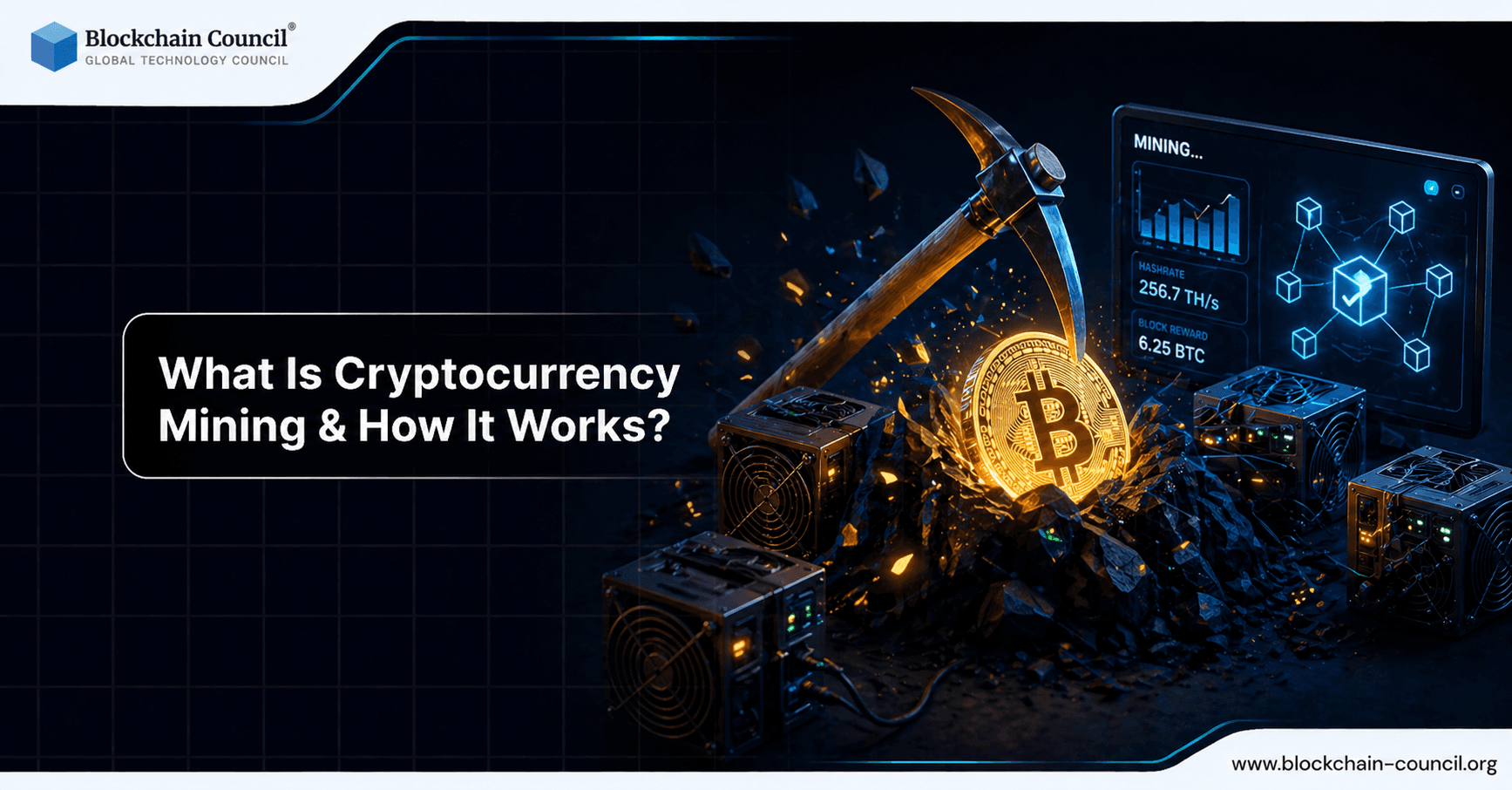
Cryptocurrency mining is the process of validating transactions and adding them to a blockchain network while generating new coins as rewards. It is a core component of many blockchain systems, especially those that use Proof of Work (PoW), such as Bitcoin.
Mining requires computational power, specialized hardware, and energy resources. Over time, it has evolved from simple home-based setups to highly competitive, industrial-scale operations. Understand how cryptocurrency mining validates transactions and secures blockchain networks through computational work by building expertise through a Cryptocurrency Expert, analyzing mining algorithms using a Python certification, and applying insights via a Digital marketing course.

What Is Cryptocurrency Mining?
Cryptocurrency mining is a decentralized process where participants, known as miners, verify transactions and secure the network.
Every transaction made on a blockchain is grouped into a block. Miners compete to solve a cryptographic puzzle that allows them to add this block to the blockchain.
Once verified, the block becomes part of a permanent and tamper-resistant ledger.
The Role of Blockchain in Mining
Blockchain is a distributed ledger that records all transactions across a network of computers.
Each block contains:
A list of transactions
A timestamp
A cryptographic hash of the previous block
This structure creates a chain of blocks that cannot be altered without redoing the computational work for all subsequent blocks.
Mining ensures that only valid transactions are added to this ledger.
Why Mining Is Important
Mining serves three key purposes:
1. Transaction Validation
Miners verify that transactions are legitimate and prevent issues like double spending.
2. Network Security
Mining makes it difficult for attackers to alter blockchain data due to the high computational cost.
3. Coin Creation
New cryptocurrency is introduced into circulation as a reward for miners who successfully validate blocks.
How Cryptocurrency Mining Works
The mining process involves several steps:
Transactions are broadcast to the network
Miners collect transactions into a block
Miners attempt to solve a cryptographic puzzle
The first miner to find a valid solution broadcasts it
Other nodes verify the solution
The block is added to the blockchain
This process is repeated continuously across the network.
Proof of Work and Mining
Most mining-based cryptocurrencies use Proof of Work (PoW) as a consensus mechanism.
In PoW:
Miners compete to solve complex mathematical problems
The difficulty adjusts based on network activity
The process requires significant computational effort
This ensures fairness and security in the network.
Mining Rewards
Miners earn rewards for their work, which typically include:
Block rewards (newly created coins)
Transaction fees from users
For example, in Bitcoin, block rewards decrease over time through events called halvings, reducing the rate of new coin creation.
Types of Cryptocurrency Mining
Mining has evolved significantly over time. Here are the main types:
CPU Mining
CPU mining uses a computer’s central processing unit.
It was common in the early days of cryptocurrencies but is now outdated due to low efficiency and high competition.
GPU Mining
GPU mining uses graphics processing units, which are more powerful and efficient than CPUs.
It is still used for certain cryptocurrencies but less common for Bitcoin due to increasing difficulty.
ASIC Mining
ASIC (Application-Specific Integrated Circuit) mining uses specialized hardware designed specifically for mining.
It is the most efficient and dominant method for mining Bitcoin and other major cryptocurrencies.
Cloud Mining
Cloud mining allows users to rent mining power from remote data centers.
It removes the need for hardware but requires trust in the service provider.
Mining Difficulty and Competition
Mining difficulty adjusts automatically to maintain consistent block times.
As more miners join the network:
Difficulty increases
Competition becomes tougher
Rewards become harder to earn
This ensures network stability but raises the barrier to entry.
Costs of Cryptocurrency Mining
Mining involves several costs:
Hardware investment (ASICs or GPUs)
Electricity consumption
Cooling and maintenance
Pool fees (if mining in a pool)
Profitability depends on balancing these costs with mining rewards.
Mining Pools and Their Role
Most miners join mining pools to combine their computational power.
Benefits of mining pools:
More consistent payouts
Lower risk compared to solo mining
Shared resources
Rewards are distributed based on each participant’s contribution.
Environmental Impact of Mining
Mining, especially PoW mining, consumes significant energy.
In recent years:
Many operations have shifted to renewable energy
More efficient hardware has been developed
Sustainability has become a key focus
Despite improvements, energy consumption remains a major concern.
Is Cryptocurrency Mining Still Profitable in 2026?
Mining can still be profitable, but it depends on:
Electricity costs
Hardware efficiency
Market price of the cryptocurrency
Mining difficulty
For individuals, profitability is often limited without access to low-cost energy or large-scale operations.
Conclusion
Cryptocurrency mining is a critical process that powers decentralized blockchain networks. It ensures transaction validation, network security, and coin generation.
While mining has become more complex and resource-intensive, it remains an essential part of Proof of Work systems like Bitcoin.
Understanding how mining works helps users better evaluate the technology behind cryptocurrencies and their long-term viability. Learn how mining hardware, hash functions, and reward systems work together to sustain blockchain ecosystems by mastering crypto fundamentals through a Cryptocurrency Expert, building mining tools using a Node JS Course, and scaling your crypto journey using an AI powered marketing course.
FAQs
1. What is cryptocurrency mining?
Cryptocurrency mining is the process of validating transactions and adding them to a blockchain while earning rewards in digital currency.
2. How does mining work?
Miners solve cryptographic puzzles to validate blocks. The first to solve the puzzle adds the block and earns rewards.
3. What is Proof of Work in mining?
Proof of Work is a system where miners use computational power to secure the network and validate transactions.
4. What is a mining reward?
A mining reward includes newly created coins and transaction fees given to miners for validating a block.
5. What hardware is used for mining?
Mining uses CPUs, GPUs, or ASICs, with ASICs being the most efficient for major cryptocurrencies like Bitcoin.
6. What is ASIC mining?
ASIC mining uses specialized hardware designed specifically for mining, offering high efficiency and performance.
7. Is CPU mining still useful?
CPU mining is mostly outdated due to low efficiency compared to GPU and ASIC mining.
8. What is GPU mining?
GPU mining uses graphics cards to perform calculations faster than CPUs, suitable for some cryptocurrencies.
9. What is cloud mining?
Cloud mining allows users to rent mining power without owning hardware, but it carries risks.
10. What is a mining pool?
A mining pool is a group of miners who combine resources and share rewards based on their contribution.
11. Why is mining important?
Mining secures the network, validates transactions, and introduces new coins into circulation.
12. What is mining difficulty?
Mining difficulty determines how hard it is to solve a block and adjusts based on network activity.
13. Can anyone mine cryptocurrency?
Yes, but profitability depends on resources, hardware, and electricity costs.
14. Is mining profitable in 2026?
It can be profitable with efficient hardware and low energy costs, but competition is high.
15. How much electricity does mining use?
Mining consumes significant energy, especially in large-scale operations.
16. What is a blockchain ledger?
It is a distributed record of all transactions stored across a network.
17. How long does it take to mine a block?
In Bitcoin, a block is mined approximately every 10 minutes.
18. What is double spending?
Double spending is attempting to use the same cryptocurrency twice. Mining prevents this.
19. Are there alternatives to mining?
Yes, Proof of Stake and other mechanisms validate transactions without mining.
20. What is the future of cryptocurrency mining?
Mining will continue evolving with better efficiency, renewable energy use, and regulatory developments.
Related Articles
View All
Cryptocurrency
Liquidity Mining Explained: How Crypto Users Earn Protocol Incentives
Liquidity mining lets crypto users supply assets to DeFi pools and earn fees plus token incentives. Learn how it works, where rewards come from, and the risks.
Cryptocurrency
Bitcoin Explained: How BTC Works and Why It Matters
Bitcoin explained clearly: learn how BTC works, why proof of work matters, what gives Bitcoin value, and the risks every user should know.
Cryptocurrency
Crypto Taxation for Staking, Mining, Airdrops and NFTs
Learn how staking, mining, airdrops and NFTs may be taxed as income, capital gains or business activity under evolving global crypto tax rules.
Trending Articles
The Role of Blockchain in Ethical AI Development
How blockchain technology is being used to promote transparency and accountability in artificial intelligence systems.
How Blockchain Secures AI Data
Understand how blockchain technology is being applied to protect the integrity and security of AI training data.

Can DeFi 2.0 Bridge the Gap Between Traditional and Decentralized Finance?
The next generation of DeFi protocols aims to connect traditional banking with decentralized finance ecosystems.