
Suyash Raizada
Smart Contracts in Gaming: Play-to-Earn Assets, Rewards, and In-Game Economies
Learn how smart contracts power play-to-earn gaming assets, rewards, NFT ownership, marketplaces, DAOs, and in-game economies.


Browse the latest smart contracts articles, tutorials, and research from Blockchain Council.(76 articles)
Learn how smart contracts power play-to-earn gaming assets, rewards, NFT ownership, marketplaces, DAOs, and in-game economies.

Smart contracts in insurance automate claims, payouts, underwriting, and risk management, with the strongest use cases in parametric and P&C coverage.

Smart contracts in real estate automate tokenization, escrow, and property transfers while improving cost, speed, compliance, and title transparency.

Smart contracts in banking are improving payments, compliance, tokenized deposits, lending, trade finance, and audit workflows, with regulation still shaping adoption.

Smart contracts in healthcare can secure data sharing, automate claims, and manage consent, but adoption remains focused on pilots and targeted systems.

Smart contracts in supply chain systems improve shared visibility, product traceability, payment automation, and trust, while requiring careful governance and data design.

Learn how Smart Contracts in DAOs automate voting, governance, and treasury management while addressing risks such as voting concentration and compliance.

Learn how Smart Contracts in NFTs manage minting, ownership, royalties, marketplace settlement, metadata, and programmable revenue models.
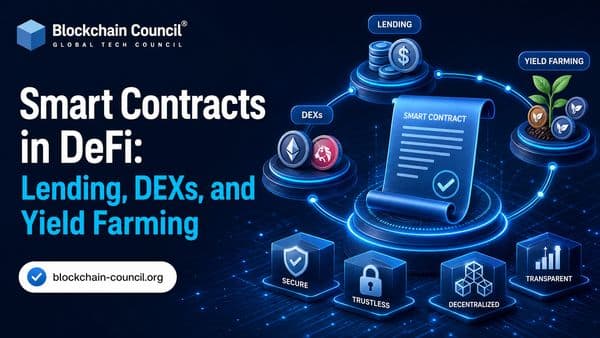
Smart contracts in DeFi automate lending, DEX trading, LP rewards, and yield farming while introducing risks such as bugs, liquidations, and depegs.
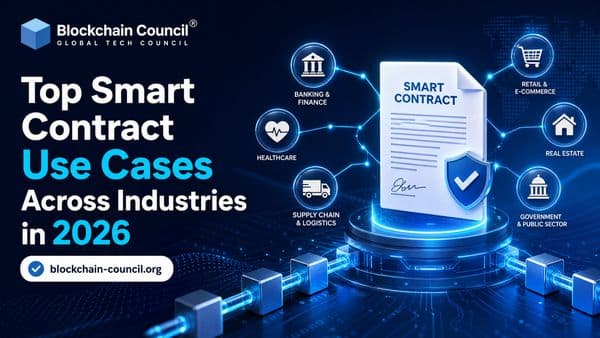
Explore the top smart contract use cases in 2026 across finance, supply chains, healthcare, insurance, real estate, identity, gaming, and energy.

A practical guide to the smart contract lifecycle, covering design, Solidity development, testing, deployment, monitoring, upgrades, and decommissioning.

Learn smart contract architecture, including components, state, logic, execution flow, upgradeability, automation, security layers, and real-world design patterns.