

Smart Contract Architecture Explained: Components, Logic, and Execution Flow

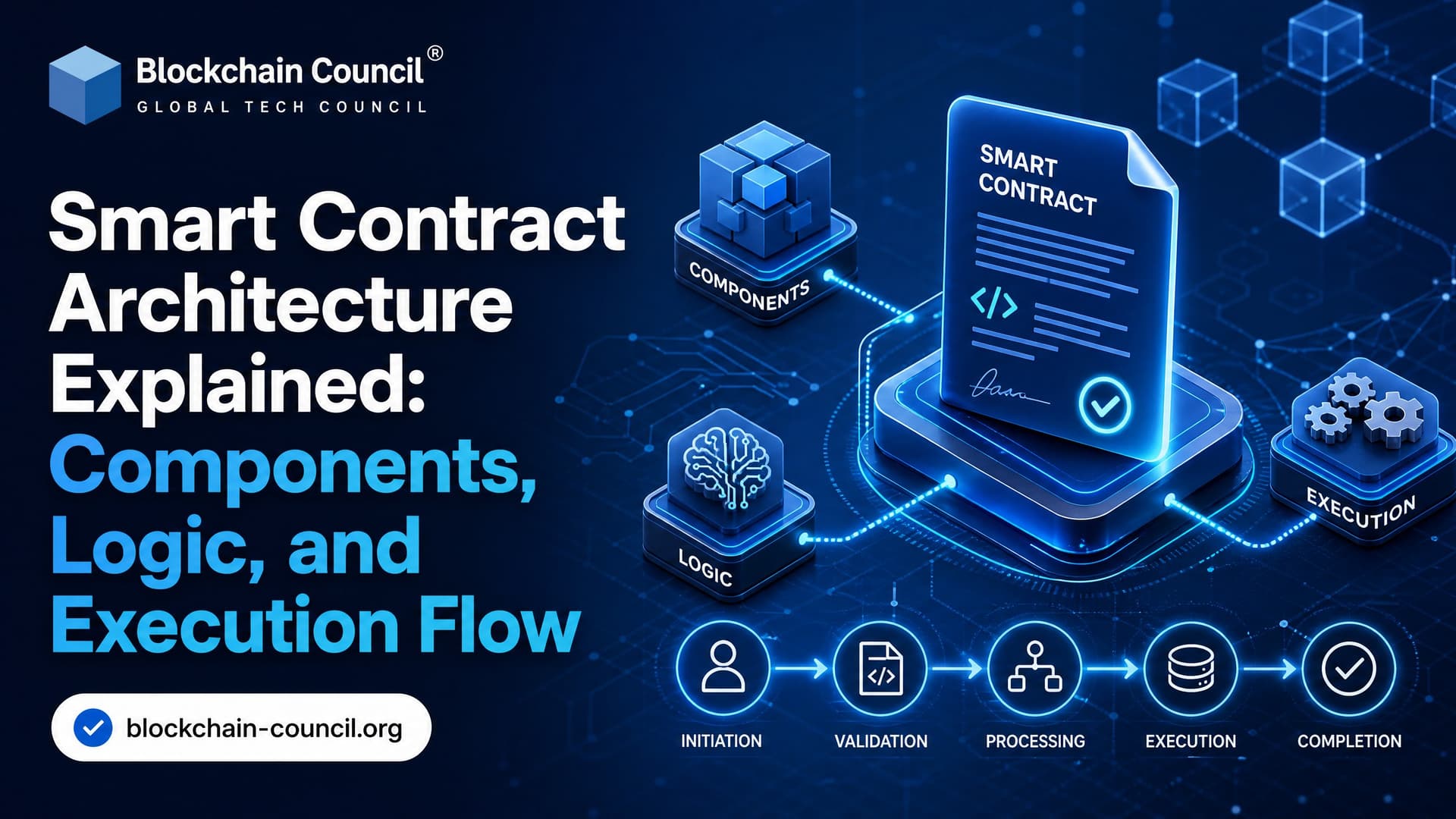
Smart contract architecture is the design of on-chain code, persistent state, execution rules, security controls, and external integrations that make a contract behave predictably on a blockchain. If you build on Ethereum, Polygon, Arbitrum, BNB Chain, Solana, or another smart contract network, the architecture decides more than code style. It decides who can call a function, what data changes, what happens when a call fails, and whether the system can be safely upgraded later.
Think of a smart contract as an account controlled by code. Ethereum's own documentation describes contracts as code and data deployed at an address. They can hold assets, receive transactions, call other contracts, and write state. But they do nothing on their own. Someone or something has to send a transaction first.

What Smart Contract Architecture Includes
A smart contract architecture usually has six main parts:
- Contract code - functions, modifiers, constructors, errors, and events.
- State layer - persistent variables stored on chain.
- Execution environment - the virtual machine that runs bytecode, such as the EVM.
- Interaction layer - wallets, dApps, APIs, ABIs, and other contracts.
- Security layer - access control, validation, safe external calls, and audit controls.
- Upgrade and integration layer - proxies, oracles, automation, and cross-chain messaging.
That sounds tidy. In practice, the hard part is deciding what belongs on chain and what should stay off chain. Store too much data on Ethereum mainnet and gas costs punish you. Store too little and your users cannot verify the system.
Core Components of Smart Contract Architecture
Contract Code and Structure
On Ethereum-like chains, Solidity contracts are commonly organized around:
- State variables, such as balances, owners, price feeds, and configuration values.
- Functions, which contain the contract's business rules.
- Events, which write logs that indexers, wallets, and backend services can read.
- Modifiers, often used for access checks like onlyOwner.
- Constructors, which run once during deployment.
Solidity 0.8.x also changed a beginner trap: arithmetic overflow and underflow now revert by default. If you have ever seen Hardhat return VM Exception while processing transaction: reverted with panic code 0x11, you probably hit an overflow or underflow. Before Solidity 0.8.0, many developers used SafeMath for this protection. Now the compiler handles it unless you deliberately use an unchecked block.
State and Storage Layer
State is what survives after a transaction finishes. A mapping of user balances in an ERC-20 token, a proposal status in a DAO, or a loan's collateral ratio in a lending protocol all live in storage.
Storage is expensive because every full node has to keep enough data to verify the chain. That is why mature contracts separate:
- Critical state, such as balances, ownership, collateral, and governance votes.
- Derived data, which can be reconstructed from events or indexed off chain.
- Large files, which usually belong in IPFS, Arweave, cloud storage, or enterprise databases, with hashes anchored on chain.
Platforms differ here. Ethereum exposes storage through the EVM model. Solana uses an account-based model instead, so you design around accounts and programs rather than EVM storage slots. The mental model you carry from one chain does not transfer cleanly to another.
Execution Environment
The execution environment is the runtime that processes contract bytecode. On Ethereum and EVM-compatible chains, that runtime is the Ethereum Virtual Machine. Every node executes the same bytecode against the same state. Given identical inputs, the result must be identical. Determinism is non-negotiable.
Gas accounting is part of this environment. Each operation has a cost. Under EIP-1559, Ethereum transactions include a base fee that is burned and a priority fee paid to validators. If a transaction runs out of gas, state changes are rolled back, but the gas already spent is not refunded. That surprises new developers once. Usually only once.
Interaction Layer
Users interact through externally owned accounts, usually via wallets like MetaMask. Applications encode function calls using the contract ABI. Other contracts can call public or external functions directly.
This interaction layer is what makes composability possible. A DeFi vault can call an ERC-20 token, a decentralized exchange pool, a lending protocol, and an oracle in one transaction. Powerful, yes. Also risky. One bad external call can create reentrancy, stale price usage, or griefing paths if the architecture is loose.
Security Layer
Security is not a final audit checklist. It is an architectural layer. You design it early.
- Use role-based access control for minting, pausing, and upgrades.
- Validate inputs before state changes.
- Apply the checks-effects-interactions pattern where external calls exist.
- Emit events for sensitive actions.
- Keep admin privileges narrow and visible.
- Use test suites, static analyzers, and formal verification where the value at risk justifies it.
To be blunt, upgradeable contracts without clear admin governance are a common footgun. A proxy gives flexibility, but it also creates a privileged path to change logic. If that admin key is weak, your architecture is weak.
Smart Contract Logic: How Rules Become State Changes
Smart contract logic is deterministic and reactive. A contract does not wake up at midnight to liquidate a loan or release a payment. It waits. A user, keeper, oracle node, bot, or another contract has to call it.
Good contract logic usually follows a state machine pattern:
- An auction moves from Created to Open to Ended.
- A loan moves from Active to Liquidatable to Closed.
- A DAO proposal moves from Pending to Active to Executed or Defeated.
The logic should make invalid transitions impossible. Do not rely on the frontend to hide the wrong button. Attackers call contracts directly.
Events are part of this logic too. They do not change state, but they give off-chain systems a reliable trail. Indexers such as The Graph, block explorers, monitoring tools, and enterprise backends often depend on these logs.
Smart Contract Execution Flow
A standard smart contract execution flow looks like this:
- Transaction creation - A wallet or application builds a transaction with the contract address, function selector, calldata, gas settings, nonce, and optional value.
- Signature and broadcast - The user signs it. The transaction enters the peer-to-peer network.
- Validation and ordering - Nodes check the signature, nonce, fee rules, and basic validity. A block producer orders transactions inside a block.
- VM execution - The virtual machine executes the contract bytecode sequentially. On Ethereum, transactions in a block execute one after another.
- Logic evaluation - The function reads state, checks conditions, calls other contracts if needed, and writes new state.
- Revert or commit - If a require check fails, a revert occurs and state changes are undone. If execution succeeds, state changes persist.
- Event logging - Events appear in the transaction receipt logs for off-chain systems to process.
- Consensus and finality - Validators agree on the block and the new state. On Ethereum mainnet, the chain ID is 1, and finality follows Proof of Stake rules.
Here is the key point: smart contracts guarantee how code runs when invoked. They do not guarantee that anyone will invoke it at the right time.
Event-Driven Execution With Oracles and Automation
Automation fills that gap. Chainlink Automation documents a practical pattern often described as an emit-listen-execute loop.
- Define - Your contract implements functions such as checkUpkeep for read-only condition checks and performUpkeep for state-changing execution.
- Listen - Off-chain nodes simulate the check function and monitor time, logs, prices, or contract state.
- Execute - When conditions are met, a node sends an on-chain transaction that rechecks the condition before changing state.
This pattern works well for recurring payments, collateral monitoring, DAO operations, and DeFi position management. It is the right tool when users cannot be expected to trigger every action manually. It is the wrong tool if your system cannot tolerate oracle or keeper assumptions.
Upgradeability and Modular Design
Many production systems use proxy patterns to separate state from logic. In a UUPS-style or transparent proxy setup, the proxy keeps storage while an implementation contract holds the logic. Upgrading means pointing the proxy to a new implementation.
This can save a protocol after a bug. It can also introduce storage layout errors. If version two adds a variable in the wrong slot, you may corrupt state. Tools like OpenZeppelin Upgrades, Hardhat, and Foundry help detect layout problems, but they do not replace careful design.
Use upgradeability when you need long-term governance, compliance updates, or protocol changes. Avoid it for simple NFTs, small utilities, or contracts where immutability is the main trust feature.
Real-World Architecture Examples
DeFi Protocols
Lending markets, automated market makers, and staking systems combine token contracts, vaults, price oracles, liquidation logic, reward modules, and governance controls. Their architecture has to handle composability and hostile market conditions at the same time.
DAOs and Governance
DAO contracts encode proposals, voting weight, quorum, execution delays, and treasury permissions. A weak governance architecture can turn a voting system into theater if a multisig can override everything silently.
Enterprise and Supply Chain Systems
Enterprise smart contracts often connect on-chain records with off-chain ERP systems, IoT data, and identity controls. In these cases, the oracle and integration layer matter as much as the contract itself.
How to Learn Smart Contract Architecture Properly
If you are preparing for a development or architecture role, do not stop at syntax. Learn storage layout, transaction flow, EVM behavior, upgrade patterns, testing, and security reviews. Blockchain Council's Certified Smart Contract Developer™, Certified Solidity Developer™, and Certified Blockchain Developer™ connect Solidity skills with real architecture decisions. For broader strategy and governance context, look at Certified Blockchain Expert™.
Your next step: build one small contract, test every revert path, deploy it to a testnet, read the transaction trace, then add an event indexer or an automation trigger. That exercise teaches more about smart contract architecture than another diagram ever will.
Related Articles
View All
Smart Contracts
Gas Fees Explained: How Smart Contract Execution Costs Are Calculated
Gas fees measure the cost of smart contract execution. Learn how opcode usage, storage writes, EIP-1559 pricing, and gas limits shape transaction fees.

Smart Contracts
Smart Contract Oracles Explained: Connecting Blockchain Apps to Real-World Data
Smart contract oracles connect blockchain apps to real-world data, enabling DeFi, insurance, IoT, gaming, compliance, and secure Web3 automation.

Smart Contracts
ERC-20, ERC-721, and ERC-1155 Smart Contract Standards Explained
Understand ERC-20, ERC-721, and ERC-1155 smart contract standards, how they differ, and when to use each for tokens, NFTs, and multi-asset systems.
Trending Articles
How Blockchain Secures AI Data
Understand how blockchain technology is being applied to protect the integrity and security of AI training data.
What is AWS? A Beginner's Guide to Cloud Computing
Everything you need to know about Amazon Web Services, cloud computing fundamentals, and career opportunities.
Claude AI Tools for Productivity
Discover Claude AI tools for productivity to streamline tasks, manage workflows, and improve efficiency.