

Smart Contracts in Real Estate: Tokenization, Escrow, and Property Transfers
 Suyash Raizada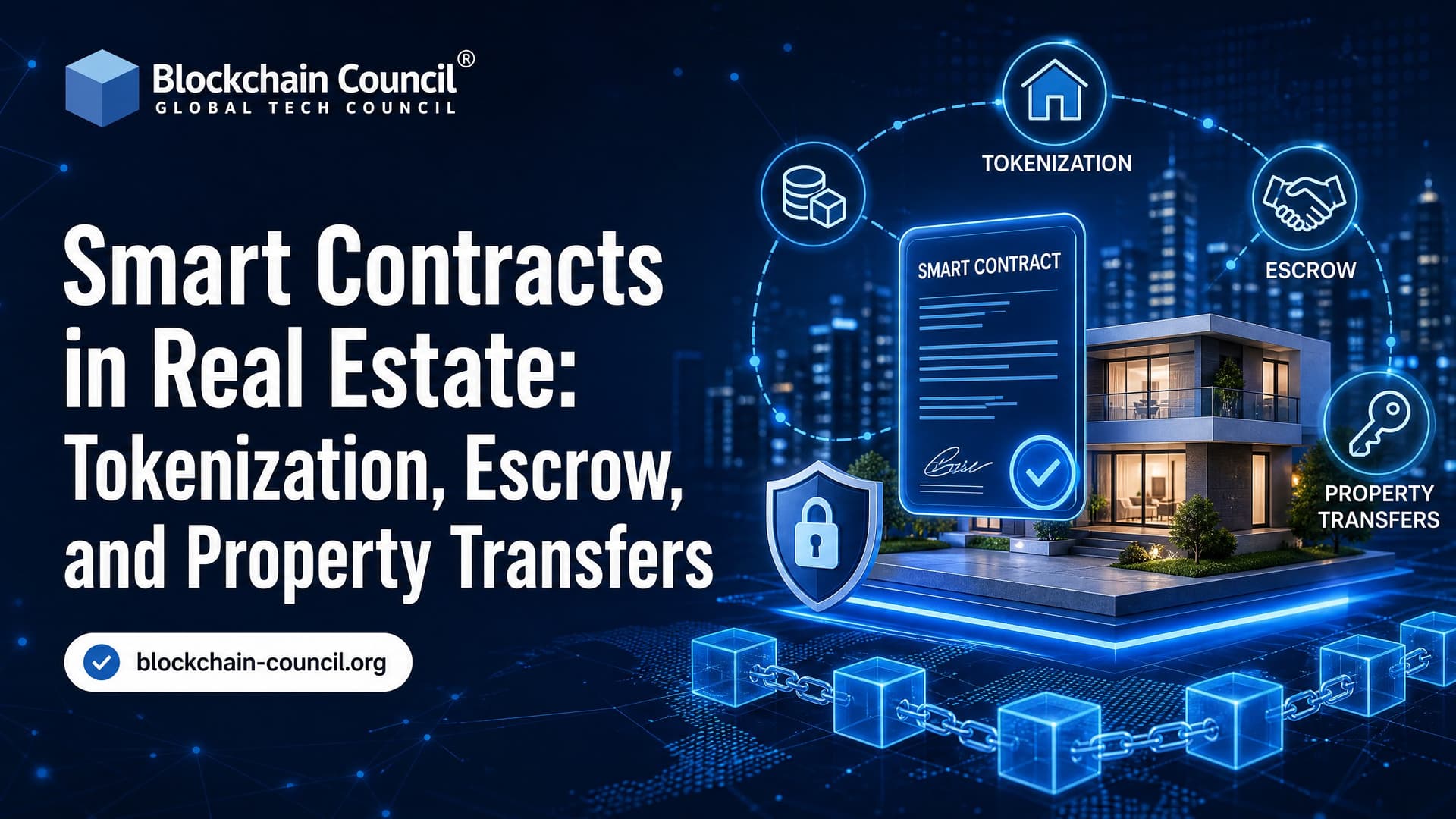
Smart contracts in real estate are no longer a lab experiment. They are being used to tokenize property, automate escrow, and support faster property transfers with audit trails that are difficult to alter. The hard part is not writing the contract. The hard part is connecting code to legal ownership, identity checks, title records, and payment rails without creating a compliance mess.
If you work in property, fintech, Web3, or legal operations, this is where blockchain becomes practical. Real estate transactions are slow because many parties must agree on identity, funds, title, liens, inspection results, and final settlement. Smart contracts can encode part of that workflow so that payment and ownership move only when defined conditions are met.

What Smart Contracts Do in Real Estate
A smart contract is code deployed on a blockchain that executes rules when specific conditions are satisfied. In real estate, those rules usually sit around three workflows:
- Tokenization: converting property rights or economic interests into digital tokens.
- Escrow: holding buyer funds and releasing them only after agreed conditions are met.
- Property transfers: recording or triggering ownership changes after payment, compliance, and title checks.
This does not mean a few lines of Solidity replace a land registry tomorrow. Real property law is jurisdictional. Courts, registrars, lenders, and tax authorities still matter. But smart contracts can cut duplicated paperwork, manual reconciliation, and settlement delays.
Real Estate Tokenization: From Whole Properties to Fractional Ownership
Tokenization represents ownership rights, revenue rights, or investment interests as blockchain tokens. A whole property can be represented as a non-fungible token, often linked to a legal entity that owns the asset. Fractional ownership usually uses security token structures, because investors may receive rental income, appreciation, voting rights, or profit distributions.
Common technical approaches include ERC-721 for unique property-linked NFTs, ERC-1400 for security token style controls, and ERC-3643, also known as T-REX, for permissioned tokens. ERC-3643 is built for regulated assets because transfers can be restricted based on identity, investor status, jurisdiction, and compliance rules. The ERC-3643 Association reports that billions of dollars in assets have been tokenized using the standard.
Why Fractional Real Estate Tokens Matter
Traditional real estate is capital-heavy and illiquid. You usually need a large deposit, local process knowledge, and patience. Tokenization can split economic exposure into smaller units. That opens access to investors who cannot buy an entire apartment building, commercial property, or logistics asset.
It also changes secondary market behavior. Instead of waiting months for a sale, token holders may be able to trade approved tokens on compliant marketplaces. Do not overstate this. A token is only liquid if buyers exist, regulations allow transfer, and the platform has credible market infrastructure. A tokenized property with no secondary demand is still illiquid, just with better recordkeeping.
Smart Contract Escrow: Conditional Settlement Without Manual Chasing
Escrow is one of the clearest near-term use cases for smart contracts in real estate. A buyer deposits funds, often stablecoins such as USDC, into an escrow contract. The contract releases funds to the seller when required conditions are complete. In a tokenized deal, it can also transfer ownership tokens to the buyer in the same transaction flow.
A typical smart contract escrow process looks like this:
- The property interest is represented by an NFT or regulated fractional token.
- The buyer completes identity, sanctions, and investor eligibility checks.
- The buyer sends funds to the escrow contract.
- Off-chain confirmations arrive, such as inspection approval, title clearance, or registry confirmation.
- The contract releases funds to the seller and transfers the ownership token to the buyer.
The benefit is not magic automation. It is fewer handoffs. Escrow officers, lawyers, brokers, title companies, and banks often update separate systems. A shared ledger can cut reconciliation work and make the state of the transaction visible to approved participants.
One practical developer warning: do not build escrow around token transfers until you have tested allowances and receiver behavior. With OpenZeppelin ERC-20 contracts, a buyer who forgets to approve the escrow contract will often hit ERC20: insufficient allowance in older 4.x implementations. With ERC-721, sending a property NFT to a contract that does not implement IERC721Receiver can revert with ERC721: transfer to non ERC721Receiver implementer. These are small details. They stop closings cold in a demo.
Property Transfers and On-Chain Land Registries
Property transfer is harder than token transfer. A blockchain can record ownership claims, but a government registry or court must recognize the record for it to carry legal force. That is why the most serious projects integrate on-chain records with public-sector systems rather than pretending public law does not exist.
Several pilots show the direction. Sweden's land registry authority, Lantmateriet, ran a multi-phase blockchain property transaction pilot. Public reporting on the project pointed to potential taxpayer savings of more than 100 million euros per year from reduced paperwork and faster processing. The Republic of Georgia has registered land titles using anchoring to the Bitcoin blockchain, giving citizens cryptographic proof tied to land records. Indian states have also explored blockchain-based land records to reduce land grabbing and improve title management.
In a mature setup, a smart contract can check title data before settlement. It can block a transfer if there is a lien, a missing approval, or a failed identity check. That matters. Real estate fraud often depends on forged documents, stale records, or opaque ownership chains. Tamper-evident records make those attacks harder.
Technical Architecture Behind Tokenized Real Estate
Production-grade real estate tokenization rarely uses one contract. It is usually a layered system.
- Ownership registry layer: tracks property tokens, balances, transfers, and beneficial ownership records.
- Compliance module: enforces KYC, AML, accredited investor checks, holding periods, and jurisdictional limits.
- Asset management layer: handles capital calls, redemptions, lock-ups, voting, and document references.
- Financial distribution layer: pays rental income, dividends, or profit share to eligible token holders.
- Oracle and registry interfaces: bring in off-chain facts such as inspection approval, title status, mortgage release, and tax confirmation.
For regulated assets, permissionless transfer is usually the wrong default. If a real estate token represents a security, the contract should stop transfers to wallets that have not passed checks. That is where ERC-3643 and similar permissioned frameworks fit better than a plain ERC-20.
Measured Benefits: Cost, Speed, and Transparency
Industry analyses point to real efficiency gains, though results vary by jurisdiction and deal structure. Some tokenized real estate studies estimate total closing cost reductions of up to 55 percent where escrow, title checks, document handling, and broker workflows are digitized. Other platform reports cite transaction cost reductions of around 50 percent and transaction time cuts of about 30 percent.
The settlement gap is also significant. Conventional property settlements can take roughly 45 days in many markets. A smart contract can settle token and payment legs near instantly once conditions are satisfied. The phrase T+0 sounds simple, but it depends on all upstream approvals being ready. Code cannot speed up an unresolved lien or a missing probate document.
Where Smart Contracts Work Best, and Where They Do Not
Smart contracts work best when the asset, participants, and conditions are well defined. Good candidates include:
- Fractional real estate investment vehicles with clear legal wrappers.
- Escrow for tokenized property transactions.
- Rental income distribution to verified token holders.
- Land registry pilots where government agencies participate.
- Construction finance disbursements tied to verified milestones.
They are a poor fit when parties expect informal discretion. If a buyer and seller routinely renegotiate inspection outcomes by phone, rigid automation can create friction. Hybrid escrow works better there: let smart contracts hold funds and record state, but keep human approval gates for ambiguous conditions.
Legal and Compliance Questions You Cannot Ignore
Real estate tokenization touches securities law, property law, tax, data privacy, and anti-money laundering rules. Before deploying anything, answer these questions:
- Does the token represent legal title, beneficial ownership, debt, equity, or only a contractual revenue right?
- Who maintains the off-chain asset and documents?
- Which jurisdiction governs disputes?
- Can regulators or courts compel a freeze, reversal, or ownership correction?
- How are personal data and wallet identity linked without exposing private information on-chain?
Good systems separate public transaction proofs from sensitive identity data. Put hashes, permissions, and proofs on-chain. Keep passports, tax IDs, and closing documents in controlled off-chain systems with clear access rules.
Skills Professionals Need to Build or Audit These Systems
If you want to work with smart contracts in real estate, learn both blockchain engineering and the transaction lifecycle. Solidity 0.8.x, ERC token standards, stablecoin settlement, multisig custody, oracles, and smart contract testing are the technical base. You also need to understand escrow instructions, title insurance, conveyancing, KYC, AML, and securities compliance.
For structured learning, Blockchain Council's Certified Smart Contract Developer™ fits developers building contract logic. Certified Blockchain Expert™ suits product leaders and consultants who need architecture and business context. If your focus is Ethereum standards, Certified Ethereum Expert™ is also relevant.
The Next Step for Real Estate Teams
Start with escrow or income distribution, not full legal title transfer. Those workflows have clear rules, measurable cost savings, and fewer public-sector dependencies. Build a proof of concept using a testnet, a stablecoin mock, a permissioned token standard, and two or three real closing conditions. Then ask counsel and compliance teams to break it.
If you are preparing for a technical role, implement a small escrow contract and test failed approvals, failed token transfers, and refund paths. Pair that practice with the Certified Smart Contract Developer™ path so you can move from theory to contracts that survive real transaction pressure.
Related Articles
View All
Smart Contracts
Smart Contracts for Tokenization: Turning Real-World Assets into Digital Tokens
Learn how smart contracts for tokenization convert real-world assets into compliant digital tokens for issuance, settlement, transfers, and investor checks.

Smart Contracts
Smart Contracts for Real-World Assets (RWA): Tokenization, Compliance, and On-Chain Settlement
Learn how smart contracts for real-world assets (RWA) enable tokenization, compliance-by-design, and on-chain settlement for Treasuries, credit, funds, and real estate.

Smart Contracts
The Future of Smart Contracts: Trends, Challenges, and Opportunities
Explore the future of smart contracts, including AI, interoperability, tokenization, security risks, regulation, and high-value use cases.
Trending Articles
How Blockchain Secures AI Data
Understand how blockchain technology is being applied to protect the integrity and security of AI training data.
What is AWS? A Beginner's Guide to Cloud Computing
Everything you need to know about Amazon Web Services, cloud computing fundamentals, and career opportunities.

Can DeFi 2.0 Bridge the Gap Between Traditional and Decentralized Finance?
The next generation of DeFi protocols aims to connect traditional banking with decentralized finance ecosystems.