

Smart Contracts in NFTs: Minting, Royalties, Ownership, and Marketplaces

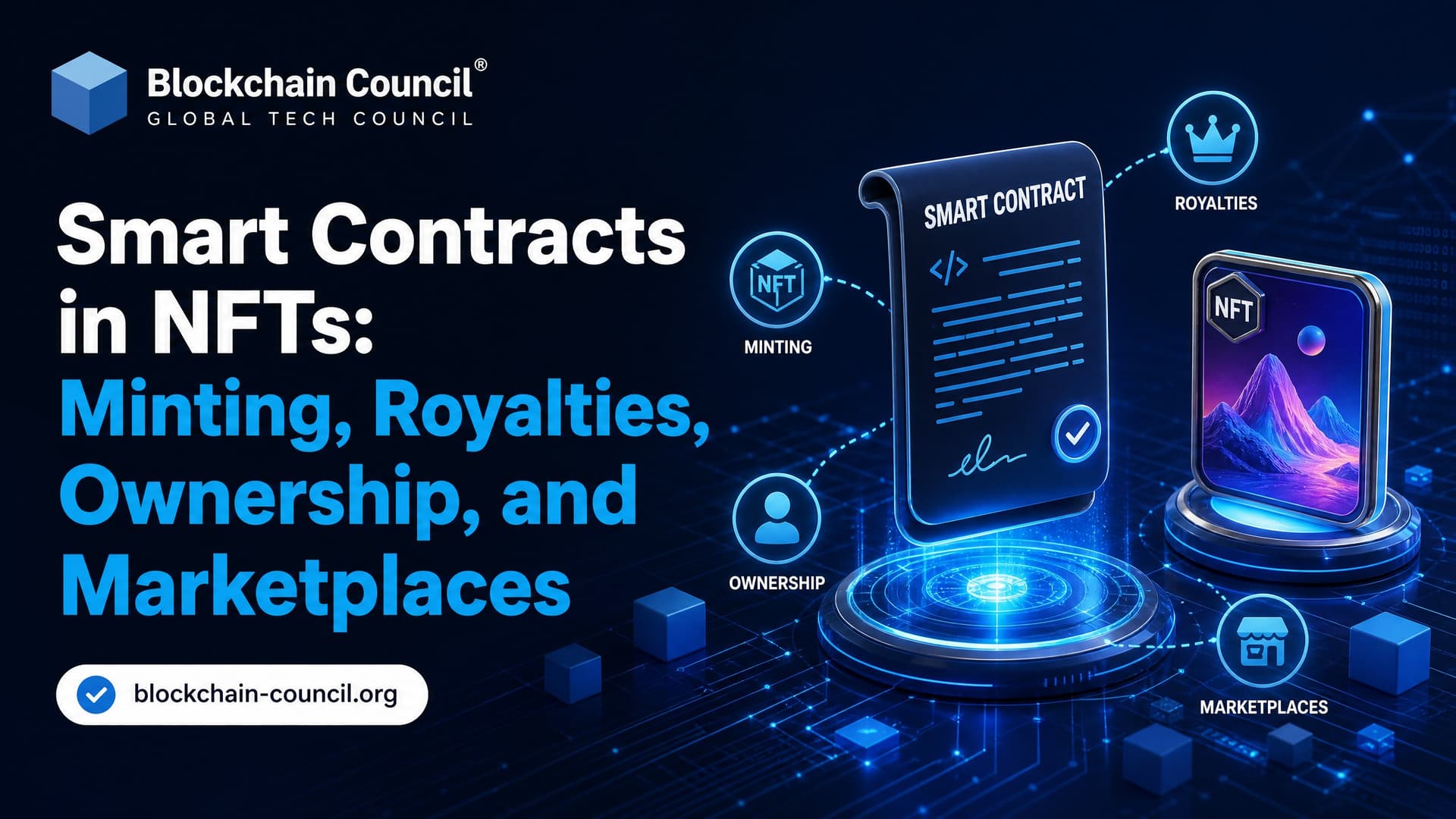
Smart Contracts in NFTs decide what an NFT is, who owns it, how it moves, and whether creators get paid after the first sale. The image is not the NFT. The marketplace page is not the NFT either. The smart contract state on a blockchain, usually Ethereum or a compatible network, is the source of truth.
That distinction matters. If you are building an NFT collection, designing a marketplace, auditing a creator contract, or preparing for a blockchain certification, you need to understand the contract logic underneath the token. Minting, royalties, ownership, metadata, and sale settlement all sit there.

What Smart Contracts Do in NFT Systems
An NFT smart contract is a blockchain program that defines how non-fungible tokens are created and transferred. On Ethereum, most production NFTs use ERC-721 for one-of-one tokens or ERC-1155 for semi-fungible assets such as game items, editions, passes, and collectibles.
In practice, a typical NFT contract handles four jobs:
- Minting: Creating a new token ID and assigning it to a wallet.
- Ownership tracking: Recording which address owns each token.
- Transfer control: Moving tokens through functions such as
transferFromandsafeTransferFrom. - Royalty signaling: Exposing royalty data through standards such as ERC-2981, where supported.
Query an ERC-721 contract with ownerOf(tokenId) and you are asking the contract who owns that NFT. Not OpenSea. Not a JPEG URL. The contract.
Minting NFTs: Token IDs, Metadata, and Gas
Minting is the moment a token becomes part of the blockchain record. A mint function usually creates a new token ID, assigns it to a wallet, and links that ID to metadata. The metadata normally includes the name, description, image URI, and attributes.
Many NFT projects store metadata on IPFS or Arweave. Some store only a URI on chain because putting full images directly in contract storage is expensive. Fully on-chain NFTs exist, but they need careful byte and gas budgeting.
What Happens During a Standard Mint
- You call the mint function from a wallet or marketplace interface.
- The contract checks conditions such as sale status, allowlist proof, payment amount, or maximum supply.
- The contract assigns a token ID to the buyer or creator.
- The contract emits a
Transferevent from the zero address. - Indexers and marketplaces read that event and display the NFT.
Developers often trip on small implementation details here. For example, when upgrading older ERC-721 contracts from OpenZeppelin Contracts 4.x to 5.x, the transfer hooks changed. The old _beforeTokenTransfer and _afterTokenTransfer hooks were replaced by a single _update function. Override the removed hook and Solidity throws Function has override specified but does not override anything. That is not a marketplace bug. It is a contract version mismatch. Check the OpenZeppelin release notes before you copy an older minting tutorial.
Lazy Minting
Lazy minting delays the on-chain mint until purchase. The creator signs structured data off chain, and the NFT is minted only when a buyer completes the transaction. This cuts upfront gas costs, which helps independent artists and small teams.
There is a trade-off. Lazy minting depends on correct signature verification and marketplace support. If the off-chain metadata or signing flow is poorly designed, users may not understand what has actually been minted yet. Be clear in the user interface.
Ownership and Provenance in NFT Smart Contracts
NFT ownership is tied to wallet addresses. Every transfer updates the contract state and emits events that can be traced from mint to current owner. That chain of events creates provenance.
For high-value assets, provenance is not cosmetic. Buyers use it to verify whether a token came from the original collection contract, whether it passed through suspicious wallets, and whether marketplace listings point to the right token address. A fake collection can copy the same image and metadata style, but it cannot fake the original contract address on Ethereum mainnet, where the chain ID is 1.
Marketplaces, wallets, analytics platforms, and compliance systems all read this same on-chain record. That is why contract design needs to be precise from day one. A bad transfer restriction or broken metadata base URI can affect every marketplace integration that follows.
Royalties in NFTs: What Smart Contracts Can and Cannot Enforce
Royalties are where NFT smart contracts get politically and economically messy. Creators want resale revenue. Traders want liquidity and lower fees. Marketplaces compete on cost. Smart contracts sit in the middle.
Marketplace-Level Royalties
Historically, many NFT royalties were enforced at the marketplace level. The NFT contract did not force payment. Instead, a marketplace calculated a royalty during sale settlement and sent a percentage to the creator.
This works only when the marketplace chooses to honor it. If a token moves through a marketplace or direct contract that ignores royalties, the creator may receive nothing. That is the core weakness of marketplace-level royalties.
ERC-2981 Royalty Metadata
ERC-2981, also known as EIP-2981, gives NFT contracts a standard way to expose royalty information. A contract implements royaltyInfo(tokenId, salePrice), which returns a receiver address and a royalty amount. It also uses ERC-165 so other contracts can detect support for the interface.
Example: if a sale price is 1 ETH and the royalty is 5 percent, royaltyInfo should return the creator address and 0.05 ETH as the royalty amount.
Here is the catch. ERC-2981 is a signaling standard, not a payment enforcement standard. A marketplace can read it and pay correctly. It can also ignore it. If your business model depends on guaranteed resale royalties, ERC-2981 alone is not enough.
Enforceable Royalties and ERC721-C
Creator-controlled standards such as ERC721-C and ERC1155-C were designed to make royalty rules harder to bypass. These contracts can restrict transfers, approve specific marketplace contracts, and block zero-fee trading routes that dodge creator payments.
That sounds attractive, but use it carefully. Restrictive transfer logic can reduce marketplace compatibility and frustrate collectors who expect open transferability. For gaming assets, licensed media, and membership NFTs, enforceable rules may make sense. For open art collectibles, heavy restrictions can feel hostile.
Typical NFT Royalty Rates and Economic Trade-offs
Common NFT royalty rates often sit between 5 percent and 10 percent, though contracts can define other values. Some experimental systems use lower rates for high-volume assets or adaptive fees that shift based on market behavior.
To be blunt, 10 percent is not always better than 5 percent. Higher royalties may support creators on each resale, but they can also cut trading volume or push activity to venues that avoid royalties. If you are designing a collection, model expected turnover, buyer behavior, and marketplace support before picking a number.
For enterprise NFT use cases, royalties may not be about creator income at all. They can represent license fees, franchise revenue, music rights, revenue shares for collaborators, or DAO treasury flows.
How NFT Marketplaces Use Smart Contracts
NFT marketplaces use smart contracts to coordinate listings, bids, purchases, auctions, escrow, settlement, and transfers. A marketplace contract usually interacts with the NFT contract through standard interfaces such as ERC-721 and ERC-1155.
A typical fixed-price purchase flow looks like this:
- The seller approves the marketplace contract to transfer the NFT.
- The buyer submits payment.
- The marketplace verifies the listing terms.
- The contract transfers the NFT to the buyer.
- Funds are split among the seller, creator royalty receiver, and marketplace fee recipient.
Before final settlement, a well-designed marketplace checks whether the NFT contract supports ERC-2981. If it does, the marketplace can call royaltyInfo and include that payment in the transaction. If it does not, the marketplace may fall back to its own collection-level royalty settings.
Programmable Ownership: Beyond Collectibles
NFTs are becoming programmable ownership contracts. That shift is bigger than profile pictures.
Newer designs can connect NFTs with:
- Token-bound accounts: NFTs that own other assets through standards such as ERC-6551.
- Revenue splitters: Contracts that route primary and secondary sale proceeds to several wallets.
- Licensing logic: Terms that define commercial rights, usage limits, or renewal periods.
- DAO participation: NFTs that act as voting, access, or membership credentials.
- Layer 2 marketplaces: Lower-fee trading environments with contract-based settlement.
This is where smart contract engineering becomes legal, economic, and technical at the same time. A poorly worded license cannot be fixed by code. A well-written license still needs correct contract implementation.
Legal and Compliance Considerations
NFT smart contracts can provide auditable evidence of ownership history and royalty rules, but they do not automatically solve legal ownership. Owning a token may not mean owning copyright unless the license says so.
Enterprises should document:
- What rights the NFT holder receives.
- Whether royalties are enforced by contract or only requested through marketplaces.
- How revenue splits are calculated.
- Whether transfers are restricted.
- How disputes, takedowns, or metadata errors are handled.
Regulators continue to look at NFTs through broader lenses such as consumer protection, securities law, advertising claims, and AML requirements. Do not treat a smart contract as a substitute for legal review.
Skills Developers Need to Build NFT Smart Contracts
If you want to build production NFT systems, learn the standards before writing custom logic. Start with ERC-721, ERC-1155, ERC-165, and ERC-2981. Then study marketplace approval flows, reentrancy protection, signature verification, and upgrade patterns.
For structured learning, Blockchain Council offers relevant paths such as Certified Smart Contract Developer™, Certified Blockchain Developer™, and Certified NFT Developer™. These help you connect Solidity implementation with NFT marketplace architecture and security review.
Build one small project next: an ERC-721 contract using Solidity 0.8.x, OpenZeppelin Contracts 5.x, IPFS metadata, and ERC-2981 royalties. Deploy it to a testnet, list it on a test marketplace if supported, and inspect every event in a block explorer. That exercise teaches more than reading ten whitepapers.
The Practical Future of Smart Contracts in NFTs
Smart Contracts in NFTs are moving from simple mint-and-transfer scripts to programmable ownership infrastructure. ERC-2981 will likely remain the baseline for royalty metadata. Enforceable royalty models will keep growing where creators need tighter control. Marketplaces will face more pressure to disclose how royalties are handled.
The best NFT contracts are boring in the right places: standard interfaces, clear events, readable royalty logic, tested mint functions, and transparent ownership rules. Save complexity for where it creates real value, such as revenue sharing, licensing, or asset utility.
Your next step is simple. Pick the NFT path that matches your goal. If you write Solidity, focus on Certified Smart Contract Developer™. If you are designing NFT products or marketplaces, start with Certified NFT Developer™ and build a royalty-aware minting contract from scratch.
Related Articles
View All
Smart Contracts
The Future of Smart Contracts: Trends, Challenges, and Opportunities
Explore the future of smart contracts, including AI, interoperability, tokenization, security risks, regulation, and high-value use cases.

Smart Contracts
AI and Smart Contracts: How Artificial Intelligence Is Transforming Web3 Automation
AI and smart contracts are turning Web3 automation into adaptive systems for DeFi, DAOs, insurance, gaming, and enterprise workflows.

Smart Contracts
Cross-Chain Smart Contracts: Bridges, Interoperability, and Multi-Chain dApps
Cross-chain smart contracts connect dApps across Ethereum, L2s, and other L1s, but bridges and message validation demand careful security design. Learn the key patterns and risks.
Trending Articles
The Role of Blockchain in Ethical AI Development
How blockchain technology is being used to promote transparency and accountability in artificial intelligence systems.
AWS Career Roadmap
A step-by-step guide to building a successful career in Amazon Web Services cloud computing.
What is AWS? A Beginner's Guide to Cloud Computing
Everything you need to know about Amazon Web Services, cloud computing fundamentals, and career opportunities.