

Smart Contracts in Supply Chain: Improving Transparency, Traceability, and Trust

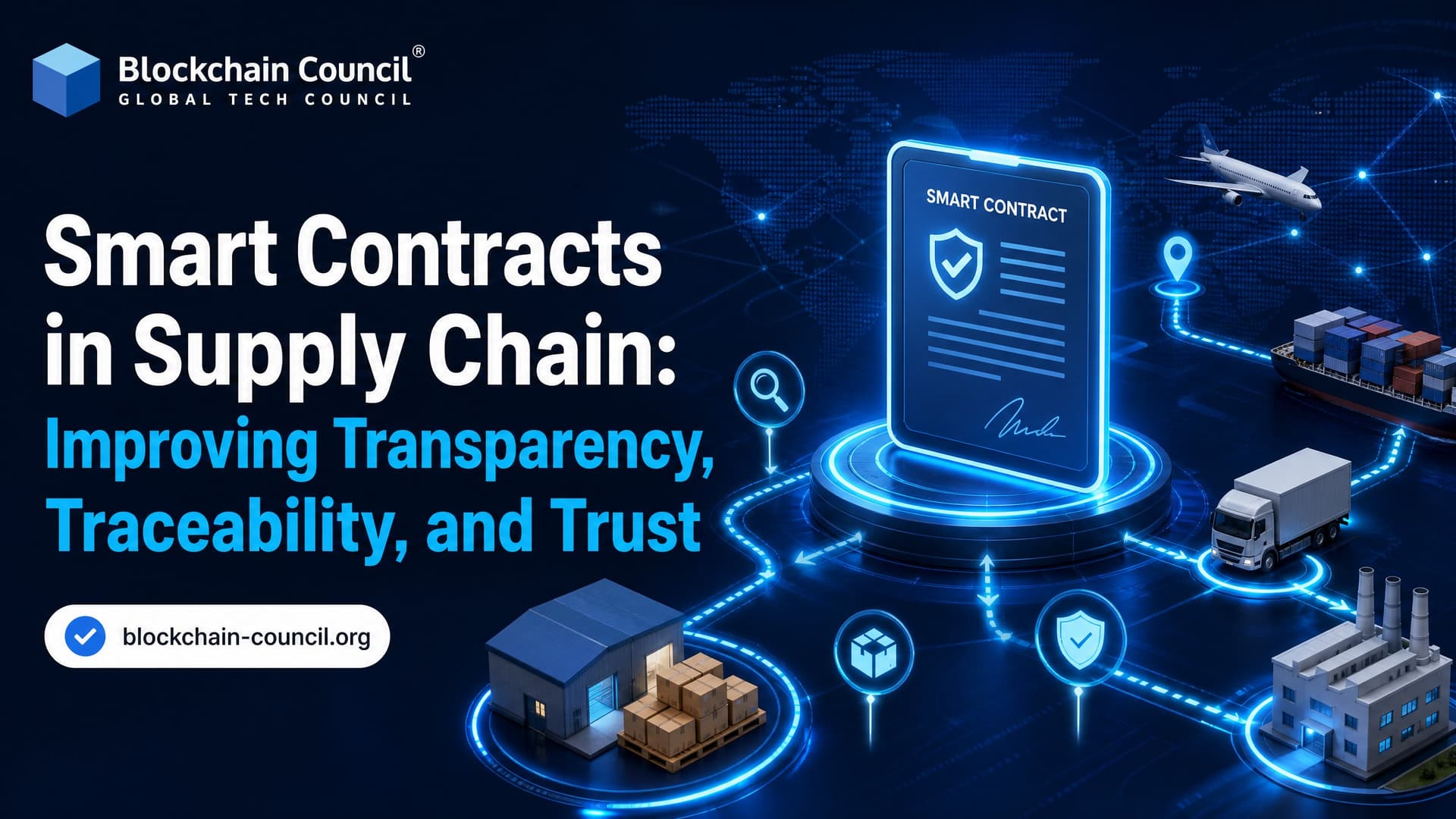
Smart contracts in supply chain systems turn procurement, shipping, quality checks, and payment rules into blockchain-based code that runs when agreed conditions are met. The promise is practical. Fewer private spreadsheets, fewer disputed handoffs, and a shared record that suppliers, logistics providers, buyers, auditors, and sometimes consumers can inspect.
That does not mean every supply chain needs a blockchain. If one company controls the whole process and already trusts its internal ERP data, a conventional database is usually cheaper. Smart contracts earn their keep when several parties need to coordinate, no single party should control the record, and traceability has legal, safety, or commercial value.

What Smart Contracts Do in Supply Chains
A smart contract is a self-executing program deployed on a blockchain. In a supply chain, it can encode rules such as:
- A purchase order becomes active only after supplier approval.
- A shipment changes status after a verified warehouse scan.
- A payment releases when delivery, temperature, and inspection conditions are all satisfied.
- A batch cannot move forward unless required certificates are attached.
The difference from a normal workflow tool is the shared ledger. Once a transaction is confirmed, the record becomes tamper-resistant. Authorized participants see the same history instead of reconciling separate versions from email, EDI messages, spreadsheets, and ERP exports.
Most enterprise deployments use permissioned blockchains or hybrid designs rather than fully public networks. Sensitive pricing, supplier lists, and production volumes are rarely suitable for open publication. The contract may store only hashes, status changes, identifiers, and ownership events on-chain, while documents and sensor logs stay in systems such as ERP, cloud storage, or an IPFS-style content network.
How Smart Contracts Improve Transparency
Transparency starts with a common source of truth. Smart contracts can record order creation, manufacturing milestones, customs events, quality approvals, ownership transfers, and delivery confirmations on a shared ledger. When a dispute happens, everyone reviews the same chronological trail.
This is especially useful in procurement. Buyers often rely on supplier reports, carrier updates, and warehouse records that arrive at different times and in different formats. A smart contract can require each actor to submit the next event before the process advances. No scan, no status change. No inspection approval, no release for sale.
The audit benefit is real. Regulators and internal compliance teams can inspect an immutable event history instead of sampling scattered records. For food, pharma, and regulated raw materials, that trail can shorten investigations and make accountability clearer.
Traceability from Origin to Customer
Traceability is where smart contracts in supply chain projects usually show their strongest business case. A product can be represented as a digital asset, sometimes as a batch-level token or non-fungible record. Each handoff updates its state: harvested, processed, packaged, shipped, received, inspected, and sold.
Food supply chains show the pattern well. IBM Food Trust is often cited for farm-to-table tracking, where producers, processors, distributors, retailers, and consumers can access provenance data. Walmart has tested blockchain-based food traceability to cut the time needed to identify affected products during a recall.
Pharmaceuticals have a sharper need. Counterfeit medicine is not just a commercial problem. It is a safety risk. Consortium projects such as PharmaLedger have explored blockchain-based medicine tracking, where verification at each handoff helps confirm authenticity and chain of custody.
Raw materials and commodities follow similar logic. A brewer, textile company, or electronics manufacturer can track supplier declarations, origin certificates, quality tests, and sustainability claims. If an input is substituted, mislabeled, or missing a required certificate, the contract can block the next step or flag the batch for review.
Trust: The Real Business Outcome
Trust is not created by code alone. It comes from incentives, governance, and verifiable records lining up. Smart contracts help because they reduce the ability of one participant to quietly change history.
Take a few examples. A logistics provider cannot backdate a delivery milestone if the contract requires a timestamped scan from an approved address. A buyer cannot claim a shipment was never received if the receiving wallet signed the event. A supplier cannot attach a new certificate after the fact without leaving an audit trail.
That changes negotiations. Instead of arguing over whose system is correct, parties discuss the shared record. This is why smart contract-based supply chain systems tend to be linked to stronger stakeholder confidence, lower fraud risk, and faster dispute resolution in academic and industry studies.
Real-World Use Cases
Food and agriculture
Food traceability platforms track harvest, processing, packaging, transport, and retail events. The aim is simple. If contamination appears, identify affected batches quickly. Consumers may also scan a product to verify origin or sustainability claims. Nestle has run blockchain-based provenance projects for coffee, giving buyers a way to trace products back toward farms.
Pharmaceuticals
Smart contracts can verify batch status, ownership changes, inspection events, and expiry-related rules. In a sector facing counterfeit drugs and strict regulation, immutable chain-of-custody records carry real value. The contract does not replace legal compliance, but it can make compliance evidence easier to produce.
Logistics and shipping
Shipping involves carriers, ports, customs brokers, insurers, banks, and buyers. Smart contracts can coordinate milestone updates, document submission, and payment triggers. A bill of lading or customs document may still live off-chain, but its hash and approval status can be recorded on-chain so tampering becomes visible.
Supplier collaboration
Outsourcing networks often struggle with production overruns, quality thresholds, and shared resource planning. Smart contracts can define commitments, record quality checks, and allocate resources based on verified events. This works best when the rules are clear before deployment. Vague business terms produce brittle code.
Architecture: What You Actually Need to Build
A workable supply chain smart contract system usually has five layers:
- Identity: wallets or decentralized identifiers for suppliers, carriers, inspectors, buyers, and auditors.
- Asset model: batch IDs, serial numbers, ERC-721 unique assets, or ERC-1155 batch assets where public-chain standards are appropriate.
- Smart contracts: rules for status changes, ownership transfer, payment conditions, and role permissions.
- Off-chain data: certificates, invoices, sensor logs, and ERP records stored outside the chain, with hashes anchored on-chain.
- Oracles and integrations: trusted data feeds from IoT devices, warehouse systems, customs portals, or ERP platforms.
Here is a detail beginners miss. The contract only knows what is submitted to it. If a temperature sensor lies or a warehouse operator scans the wrong pallet, the blockchain will preserve bad data very efficiently. In Solidity 0.8.x tests, a typical access-control mistake shows up as VM Exception while processing transaction: reverted with reason string 'Only carrier'. That is not a blockchain failure. It means your role model, signer, or test fixture is wrong. In supply chain projects, role design is half the work.
Challenges You Should Plan For
- Scalability: high-volume logistics events can create large transaction loads. Public-chain gas fees may be unsuitable for low-margin goods.
- Privacy: suppliers may not want competitors to see volumes, routes, or prices. Use permissioned access, encrypted data, and off-chain storage.
- Interoperability: most companies already run SAP, Oracle, warehouse management systems, and EDI. The blockchain layer has to integrate with them, not pretend they vanish.
- Legal alignment: a smart contract is not automatically a legal contract in every jurisdiction. Map code logic to signed commercial agreements.
- Data quality: immutable does not mean accurate. You need governance for who can submit events, correct mistakes, and audit devices.
- Change management: partners have to adopt the workflow. A traceability system fails if key suppliers treat it as extra paperwork.
The research picture is mixed too. Recent reviews agree that blockchain traceability improves transparency and trust in pilots and demonstrators, but many studies stay conceptual or small-scale. Large, cross-industry performance benchmarks are still limited. That matters when you are building a business case.
Best Practices for Implementation
If you are designing a smart contract supply chain project, start small and specific.
- Pick one painful process: recall tracing, certificate verification, delivery-based payment, or anti-counterfeit checks.
- Define the minimum on-chain data: store proofs and state changes, not every document.
- Use role-based permissions: carriers, inspectors, suppliers, and buyers should not share the same authority.
- Test failure paths: late delivery, failed inspection, duplicate scan, wrong signer, expired certificate.
- Design correction workflows: real operations need reversals, dispute flags, and supervised amendments.
- Integrate with existing systems: ERP and warehouse data entry should feed the contract automatically where possible.
For developers, Hardhat and Foundry are both solid choices for smart contract testing. Foundry is faster for heavy Solidity test suites, while Hardhat stays convenient when your team leans on TypeScript integrations. For enterprise teams, the harder problem is not the compiler. It is aligning governance across organizations that may not fully trust each other.
Skills and Certifications to Consider
If you want to work on smart contracts in supply chain, build competence in both blockchain engineering and supply chain process design. Contract syntax is only the surface. You also need to understand assets, custody, auditability, privacy, and operational controls.
Blockchain Council learning paths worth exploring include the Certified Smart Contract Developer™ for contract design and deployment, the Certified Blockchain Expert™ for architecture and business use cases, and the Certified Blockchain Developer™ if you want broader development depth. Teams working near Ethereum-based systems may also benefit from Ethereum-focused training before designing production workflows.
Where Smart Contracts Fit Next
Smart contracts will not replace ERP systems, logistics platforms, or legal agreements. Think of them as a shared coordination layer across organizations. The strongest near-term use cases are food safety, pharma authenticity, regulated commodities, sustainability reporting, and high-dispute logistics workflows.
Your next step: choose one traceability problem, map every participant and handoff, then write the contract rules before writing code. If the process cannot be stated clearly in plain language, it is not ready for Solidity, Hyperledger Fabric chaincode, or any production blockchain network.
Related Articles
View All
Smart Contracts
Smart Contracts Explained: How Self-Executing Code Automates Trust on Blockchains
Smart contracts explained: learn how self-executing blockchain code automates trust, key use cases in DeFi and beyond, plus security, legal, and scaling trends.

Smart Contracts
The Future of Smart Contracts: Trends, Challenges, and Opportunities
Explore the future of smart contracts, including AI, interoperability, tokenization, security risks, regulation, and high-value use cases.

Smart Contracts
AI and Smart Contracts: How Artificial Intelligence Is Transforming Web3 Automation
AI and smart contracts are turning Web3 automation into adaptive systems for DeFi, DAOs, insurance, gaming, and enterprise workflows.
Trending Articles
The Role of Blockchain in Ethical AI Development
How blockchain technology is being used to promote transparency and accountability in artificial intelligence systems.

Top 5 DeFi Platforms
Explore the leading decentralized finance platforms and what makes each one unique in the evolving DeFi landscape.
What is AWS? A Beginner's Guide to Cloud Computing
Everything you need to know about Amazon Web Services, cloud computing fundamentals, and career opportunities.