

Smart Contracts in DAOs: Automating Governance, Voting, and Treasury Management

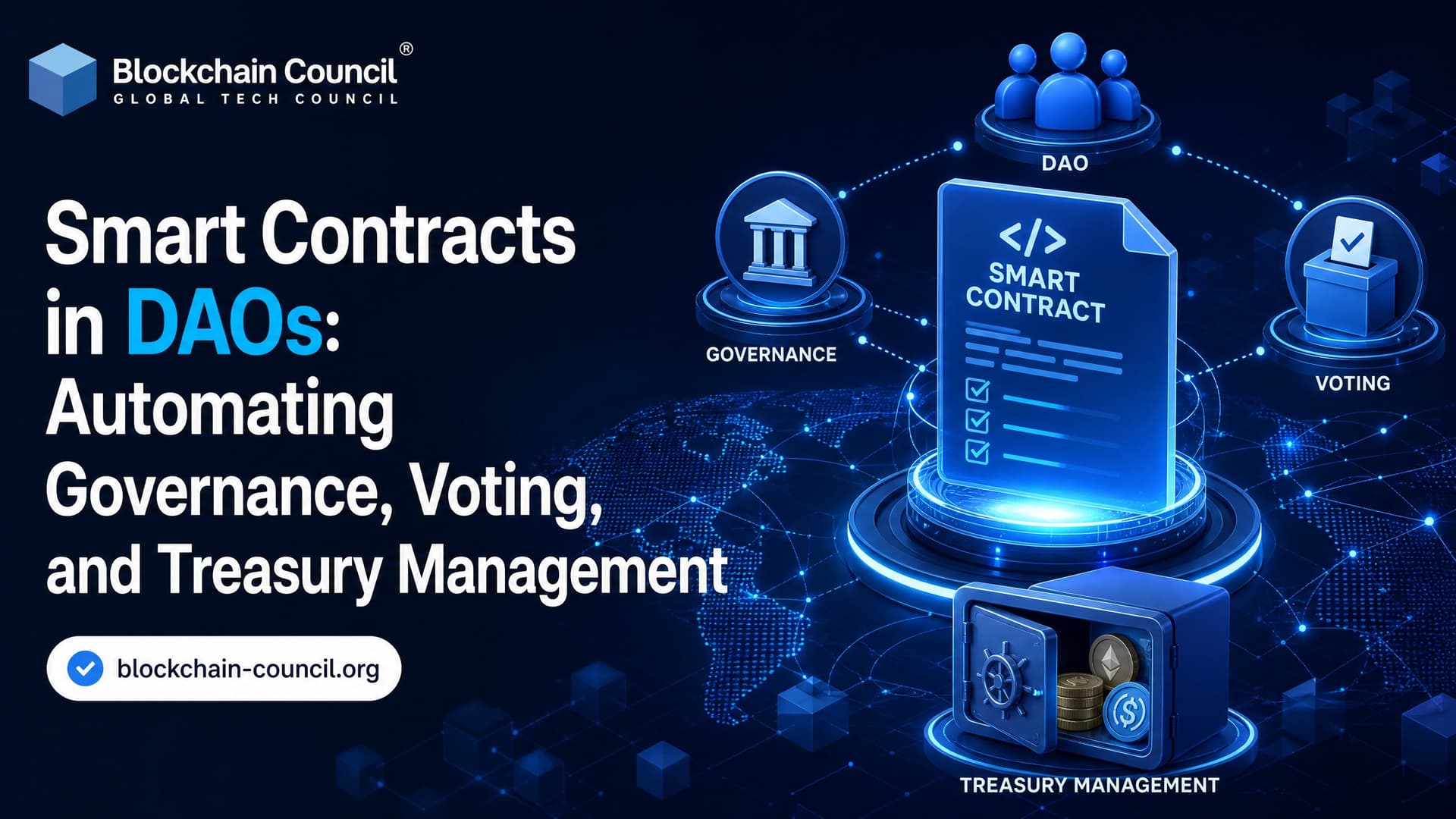
Smart Contracts in DAOs act like the operating layer of decentralized organizations. They define who can propose changes, how votes are counted, when funds can move, and which actions execute after a decision passes. Without smart contracts, a DAO is mostly a chat room with a wallet. With them, it becomes a programmable governance system.
That system is no longer experimental at the small scale. DeepDAO data cited by Eco shows that DAO treasuries controlled more than 26 billion USD onchain in Q1 2026. A Harvard Business School working paper reported more than 10,000 active DAOs, roughly 3.3 million governance voters, and about 22.5 billion USD in treasury assets in early 2025. The direction is clear: more capital is being governed by code, votes, and public execution paths.

What Smart Contracts Do Inside a DAO
A Decentralized Autonomous Organization is a blockchain-based organization where rules are enforced through smart contracts and community voting instead of a central board or administrator. The contracts do the boring but critical work: checking permissions, counting votes, enforcing quorum, holding assets, and executing approved transactions.
Most production DAOs use a few core contract types:
- Governance token contract: Defines token supply, ownership, transfer rules, and often delegation. ERC-20 governance tokens are common, while ERC-721 or ERC-1155 models can be used for membership-based systems.
- Governor contract: Handles proposals, voting delay, voting period, quorum, vote counting, and proposal state.
- Timelock contract: Adds a delay between a passed vote and execution, giving users time to react if a proposal is harmful.
- Treasury contract: Holds DAO assets and restricts spending to approved governance actions.
If you have worked with OpenZeppelin Governor contracts, you know the setup is less magical than it looks in diagrams. A common beginner mistake is forgetting to assign the executor role correctly on the TimelockController. In OpenZeppelin Contracts 4.x, that often ends with an error like AccessControl: account 0x... is missing role 0x.... In OpenZeppelin Contracts 5.x, AccessControl moved toward custom errors such as AccessControlUnauthorizedAccount. Small version changes matter when you are wiring governance that can move real funds.
How Smart Contracts Automate DAO Voting
DAO voting usually follows a staged process. The public chain records the binding steps, while forums and offchain voting tools help the community filter proposals before gas is spent.
- Drafting: A contributor posts an idea in a governance forum. This can include treasury spending, parameter changes, grants, upgrades, or incentive programs.
- Signal vote: Many DAOs use Snapshot or a similar offchain tool to measure support before moving to a binding vote.
- Onchain proposal: A wallet with enough token balance or delegated voting power submits a formal proposal to the Governor contract.
- Voting period: Token holders or delegates vote for, against, or abstain. The contract applies quorum and counting rules.
- Timelock: If the proposal passes, it is queued for a fixed delay, often 2 to 7 days.
- Execution: After the delay, the approved call data is executed. This may transfer funds, change a protocol parameter, or call an upgrade function.
For major DAOs, the whole cycle often takes 14 to 30 days. Forum debate may run 5 to 14 days, onchain voting commonly lasts 3 to 7 days, and timelocks add another safety window. That pace can feel slow. It should. Governance that controls billions of dollars should not behave like a Discord poll.
Governance Tokens and Voting Power
Governance tokens turn ownership or participation into measurable voting power. UNI, MKR, OP, ARB, and LDO are well-known examples used by Uniswap, MakerDAO or Sky, Optimism, Arbitrum, and Lido.
These tokens let holders vote on decisions such as:
- Protocol fee settings
- Treasury allocations and grants
- Liquidity incentives
- Risk parameters
- Smart contract upgrades
- Delegate compensation
Delegation is one of the most useful features in token governance. You can keep your tokens but delegate voting power to someone who studies proposals full time. That matters because most governance proposals are not simple yes-or-no questions. A proposal to change collateral parameters in a lending protocol needs risk analysis, liquidity modeling, oracle review, and an understanding of liquidation behavior under stress.
Smart Contracts for DAO Treasury Management
DAO treasury management is the practice of holding, allocating, deploying, and reporting on protocol-controlled funds. Smart contracts make this process public and enforceable. Every inflow and outflow can be checked onchain.
Large DAO treasuries are now serious financial operations. Eco reported Q1 2026 estimates of about 4.8 billion USD for the Uniswap DAO treasury, 3.9 billion USD for Sky or MakerDAO, 2.1 billion USD for Optimism, 1.7 billion USD for Arbitrum, and 1.4 billion USD for Lido. These are not side wallets. They fund development, liquidity programs, audits, contributor payments, ecosystem grants, and long-term protocol strategy.
A Typical DAO Treasury Spend Flow
A modern DAO treasury spend usually looks like this:
- A contributor or working group drafts a budget request.
- The community debates scope, milestones, reporting, and payment terms.
- A Snapshot vote tests support.
- An onchain vote authorizes exact transactions or a budget envelope.
- The treasury contract executes after the timelock.
- The recipient reports progress back to the DAO.
The best DAOs do not just vote and forget. They use milestone-based payments, public dashboards, service provider reviews, and recurring financial reports. To be blunt, a DAO with a billion-dollar treasury and no treasury policy is not decentralized finance maturity. It is operational risk with a token.
Real DAO Examples
Uniswap DAO
Uniswap governance uses the UNI token to let holders and delegates vote on protocol governance, treasury use, grants, and ecosystem decisions. Its large treasury makes it one of the clearest examples of smart contracts coordinating capital allocation at scale.
MakerDAO and Sky
MakerDAO, now associated with the Sky rebrand, governs the DAI stablecoin system and related protocol parameters. DAO governance has historically shaped stability fees, collateral types, risk settings, and treasury actions. These are technical and financial decisions, not branding exercises.
Optimism, Arbitrum, and Lido
Layer 2 and staking protocol DAOs use governance to decide incentive programs, grants, technical roadmaps, staking economics, and treasury spending. In these systems, smart contracts connect token-holder decisions to real execution on Ethereum and related networks.
The Hard Problem: Voting Power Is Concentrated
The uncomfortable part of DAO governance is that transparent voting does not automatically mean democratic control. The Harvard Business School working paper found that, across more than 200 DAOs, the top 10 percent of voters controlled about 76 percent of voting power. The largest single token holder averaged 38 percent.
That is a serious design problem. Token voting rewards capital concentration. If a few wallets control quorum, proposals may pass because large holders coordinate, not because the wider community agrees. Delegation helps, but it can also create a professional political class inside DAOs.
Possible fixes include:
- Delegated governance: Better than passive voting, but only if delegates are accountable.
- Quadratic voting: Useful for reducing whale influence, though Sybil resistance is hard.
- Vote escrow models: Can align long-term holders, but may also create lock-in games.
- Participation incentives: Helpful, but they can attract low-quality voting if rewards are poorly designed.
My view: token voting is good for transparent protocol control, but weak as a pure democracy. For high-value treasuries, DAOs need a mix of smart contracts, expert delegates, public reporting, legal planning, and strict execution controls.
Security, Compliance, and Design Risks
Smart contracts remove unilateral control, but they do not remove bad design. A faulty proposal payload can send funds to the wrong address. A poorly set quorum can let a tiny minority pass a major treasury transfer. An upgradeable proxy can hide dangerous admin power if the DAO does not understand who controls upgrades.
Regulation is another open issue. Governance tokens may face different treatment depending on jurisdiction, distribution, marketing, and holder rights. Many analysts expect hybrid DAO models where legal entities, DAO registries, compliance tooling, and onchain governance work together. That is not as pure as early DAO theory, but it is more realistic for enterprises and institutions.
Skills You Need to Build or Audit DAO Smart Contracts
If you want to work on DAO governance, learn both the code and the governance process. Solidity 0.8.x, OpenZeppelin Governor, ERC20Votes, TimelockController, Hardhat, Foundry, Snapshot, Tally, and multisig tools such as Safe are practical starting points.
For structured learning, consider Blockchain Council programs such as Certified Smart Contract Developer™, Certified Blockchain Developer™, and Certified Blockchain Expert™. If your work touches governance analytics or proposal review, AI and cybersecurity courses can also help you evaluate risks in automated decision systems.
Where Smart Contracts in DAOs Go Next
Smart Contracts in DAOs will keep moving toward modular governance, cross-chain voting, AI-assisted proposal analysis, and more active treasury operations. The winners will not be the DAOs with the loudest communities. They will be the ones with clear voting rules, secure execution paths, realistic treasury policies, and enough human judgment to know when automation should stop.
Your next step: build a small Governor plus Timelock test DAO on a local Hardhat or Foundry network, submit a proposal that transfers test ERC-20 tokens from a treasury, then try to break it. You will learn more from one failed execution than from ten governance threads.
Related Articles
View All
Smart Contracts
Smart Contracts in Insurance: Automating Claims, Payouts, and Risk Management
Smart contracts in insurance automate claims, payouts, underwriting, and risk management, with the strongest use cases in parametric and P&C coverage.

Smart Contracts
AI and Smart Contracts in DeFi: Automating Risk Management and Fraud Detection
Explore how AI and smart contracts in DeFi support automated risk management, anomaly detection, fraud monitoring, and safer protocol design.

Smart Contracts
Smart Contracts in Healthcare: Secure Data Sharing, Claims, and Consent Management
Smart contracts in healthcare can secure data sharing, automate claims, and manage consent, but adoption remains focused on pilots and targeted systems.
Trending Articles
How Blockchain Secures AI Data
Understand how blockchain technology is being applied to protect the integrity and security of AI training data.
Blockchain in Supply Chain Provenance Tracking
Supply chains are under pressure to prove not just efficiency, but also authenticity, sustainability, and fairness. Customers want to know if their coffee really is fair trade, if the diamonds are con
How to Create Claude Skills?
Claude Skills are one of the most important features Anthropic has introduced for users who want automation that is structured, consistent and reusable. Instead of giving Claude long instructions ever