

The Smart Contract Lifecycle: From Design to Deployment and Maintenance

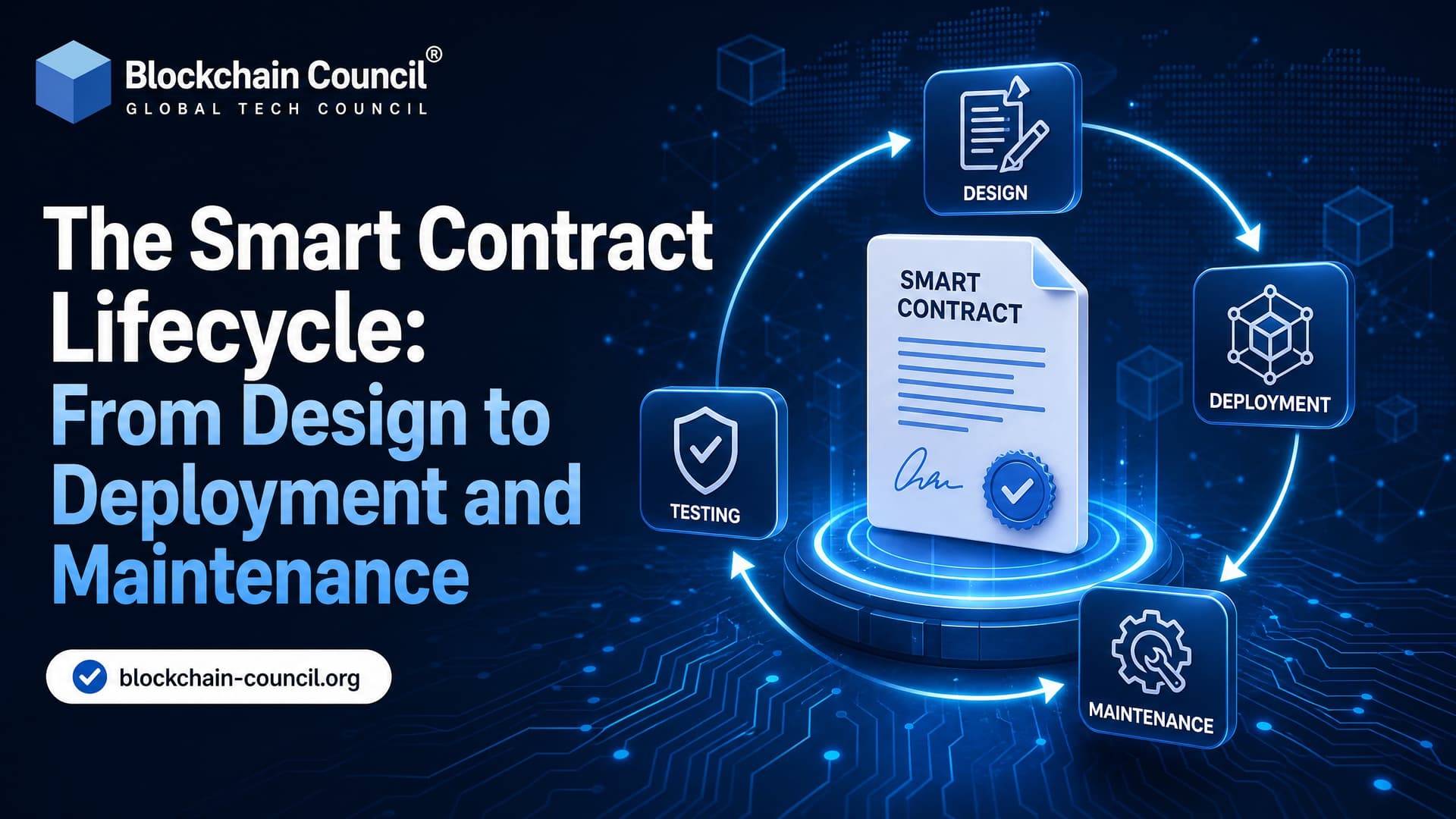
The smart contract lifecycle is the engineering path a contract follows from requirements and design to coding, testing, deployment, monitoring, upgrades, and safe retirement. Treat it like ordinary software and you will miss the hard part: once code controls assets on-chain, small mistakes can become permanent.
Standards and research now describe smart contracts as long-living software systems, not scripts you deploy once and forget. ITU-T Recommendation F.751.17, published in 2024, frames smart contract design, development, compliance, deployment, and revocation as formal lifecycle activities. That is the right direction. If you are building a DeFi protocol, a token vesting contract, an enterprise workflow, or an NFT mint, you need lifecycle discipline from day one.

What Is the Smart Contract Lifecycle?
The smart contract lifecycle has two useful views. The first is the engineering view, which maps closely to software development:
- Requirements and design
- Development and coding
- Testing, verification, and auditing
- Deployment to testnet and mainnet
- Execution and user interaction
- Monitoring and incident response
- Maintenance, upgrades, and migration
- Finalization or decommissioning
The second is the runtime view. On-chain, a contract moves through creation, freezing, execution, and finalization. Freezing matters because deployed bytecode on chains such as Ethereum is normally immutable. You can add upgrade patterns around it, but the bytecode at a deployed address does not simply change.
1. Requirements and Design
Start with a short specification before you open Solidity. One page is enough for many contracts, but it must be precise. Define the actors, permissions, states, events, and invariants. An invariant is something that must always remain true, such as total user balances must never exceed total deposited assets.
This stage is where you decide the contract's risk model. Ask:
- Who can pause the contract?
- Is there an admin role, a multisig, or on-chain governance?
- Will the contract be immutable or upgradeable?
- What happens if an oracle feed stops updating?
- How will users exit if the system is retired?
To be blunt, many smart contract failures begin here, not in the code. A proxy contract with a single externally owned admin key may pass every test and still be a governance risk. For production systems, a multisig such as Safe is usually a better default than a single deployer wallet.
2. Development: Turning the Spec Into Code
Most Ethereum smart contracts are written in Solidity. Use a fixed compiler version such as pragma solidity 0.8.24; rather than a loose range unless your team has a reason to do otherwise. Solidity 0.8.x also includes checked arithmetic by default, so overflows revert instead of silently wrapping as they did before Solidity 0.8.0.
Your development setup should be repeatable. Hardhat and Foundry are the common choices. Foundry is fast for fuzzing and invariant tests. Hardhat is still convenient for TypeScript-heavy teams and deployment scripts. Pick one primary toolchain and keep it consistent across local development, CI, and release builds.
A few practical habits save pain later:
- Pin compiler and dependency versions.
- Keep deployment scripts in version control.
- Emit events for important state changes.
- Write tests as executable specifications, not only happy-path checks.
- Document storage layout if you use upgradeable proxies.
Here is a small detail that trips beginners. Hardhat often fails with Error HH606: The project cannot be compiled when the Solidity version in your config does not match the pragma in an imported contract. That is not a blockchain problem. It is a build configuration problem, and it should be caught long before a release branch exists.
3. Testing, Fuzzing, and Verification
Testing is the quality gate in the smart contract lifecycle. Unit tests check individual functions. Integration tests check user flows. Property tests check claims that must always hold, even across strange sequences of calls.
Test beyond the obvious path
For a token vesting contract, do not only test that tokens release after the cliff. Test early withdrawal attempts, zero address recipients, repeated claims, timestamp boundaries, revoked grants, and rounding behavior. The bug usually lives at the edge.
Modern smart contract testing should include:
- Unit tests: Function-level behavior and access control.
- Integration tests: Interactions across contracts, tokens, and oracles.
- Fuzz tests: Randomized inputs to expose unexpected state changes.
- Invariant tests: Always-true system properties, run across many calls.
- Static analysis: Tools such as Slither to flag known risk patterns.
- Testnet runs: Deployment and interaction on networks that resemble production.
Security audits help, but they are not a substitute for engineering quality. Give auditors a clear spec, threat model, test suite, and deployment plan. You will get a better audit if they do not spend the first week guessing what the protocol is supposed to do.
4. Deployment: From Bytecode to Mainnet
Deployment is not just clicking a button in a wallet. ITU-T F.751.17 describes smart contract compliance and deployment as compiling source code into executable form and deploying it to a blockchain platform. In practice, you also need release management.
Before mainnet deployment, document:
- Network name and chain ID, such as Ethereum mainnet chain ID 1.
- Compiler version and optimizer settings.
- Constructor arguments or initializer parameters.
- Gas pricing approach and fallback RPC endpoints.
- Contract ownership transfer steps.
- Block explorer verification process.
- Rollback or pause procedure if deployment checks fail.
Source verification on Etherscan or a similar explorer is not optional for public systems. Users, auditors, and integrators need to inspect the source code, metadata, and compiler settings. If a contract is not verified, many serious teams will not integrate it.
Immutable vs upgradeable contracts
Choose the mutability model early. Immutable contracts are simpler to reason about and easier to trust when the rules are stable. They are a good fit for small libraries, fixed-supply tokens, and narrow-purpose escrow logic.
Upgradeable proxy patterns are useful when you expect governance-approved fixes or feature changes. They also add complexity. Storage collisions, unsafe initializers, and unclear admin powers are common sources of failure. If your team cannot explain Transparent Proxy, UUPS, and storage layout risks clearly, do not rush into upgradeability.
5. Execution and Runtime Interaction
After deployment, the contract enters active execution. Users send transactions. The contract updates state. Events feed off-chain systems such as indexers, dashboards, accounting tools, and alerting pipelines.
Common runtime examples include:
- Property or asset transfer after payment conditions are met.
- Token vesting that releases funds according to timestamps.
- DeFi liquidations triggered when collateral value falls below a threshold.
- Automated payouts based on oracle-delivered data.
Oracle-dependent contracts need extra care. A liquidation contract may be correct in Solidity but dangerous if it relies on stale price data. Check heartbeat settings, decimals, feed availability, and fallback behavior. A wrong assumption about price feed decimals can distort risk calculations badly.
6. Monitoring and Observability
Monitoring is now a distinct smart contract lifecycle stage. You cannot patch a live incident if you do not know it is happening.
At minimum, monitor:
- Contract events for abnormal activity.
- Large withdrawals or role changes.
- Oracle update delays and price deviations.
- Failed transactions and revert spikes.
- Pause, upgrade, and admin function calls.
- TVL, reserves, or liability metrics for financial contracts.
Use event design deliberately. Events are not only for front-end updates. They are your audit trail. If a privileged role changes, emit a clear event. If a contract is paused, emit why when your design supports it.
7. Maintenance, Upgrades, and Decommissioning
Smart contracts can live for years. Academic work on long-living smart contracts reflects what practitioners already know: deployments accumulate dependencies, integrations, user balances, and operational risk.
Maintenance can include parameter updates, oracle migrations, proxy upgrades, access control changes, emergency pauses, and user migrations to a new version. Every maintenance action should have governance rules and a communication plan.
Plan the end before launch
Decommissioning is often ignored. That is a mistake. If a market, staking pool, or vesting system is retired, users need a safe exit. The contract may need a final withdrawal period, a disabled deposit path, archived documentation, and a published replacement address.
ITU-T guidance explicitly acknowledges that deployed contracts may need revocation for bug fixes or performance reasons. On public blockchains, revocation rarely means deleting the old code. It usually means pausing, disabling entry points, migrating users, or marking the contract as deprecated through public channels.
Current Direction of Smart Contract Lifecycle Management
The field is becoming more formal. Standards bodies are defining lifecycle processes. Research frameworks such as GRV-SC focus on verifiable smart contract generation across design and deployment. Industry teams increasingly use CI pipelines, deterministic builds, fuzzing, explorer verification, and real-time monitoring.
The trend is clear. Smart contract work is moving closer to regulated software engineering. That is healthy. Code that controls funds, identity, or business workflows deserves stricter process than a normal web feature.
Learning Path for Professionals
If you want to build or review contracts professionally, learn the lifecycle in this order:
- Study blockchain fundamentals, transactions, gas, and consensus.
- Learn Solidity 0.8.x, ERC-20, ERC-721, and access control patterns.
- Build with Hardhat or Foundry and write unit, fuzz, and invariant tests.
- Practice testnet deployments and source verification.
- Study proxy patterns, multisig governance, monitoring, and incident response.
For structured study, consider Blockchain Council's Certified Smart Contract Developer™ as a direct fit. If you need a broader base first, the Certified Blockchain Developer™ and Certified Blockchain Expert™ programs pair well with hands-on Solidity work.
Final Takeaway
The smart contract lifecycle is not paperwork. It is how you reduce irreversible mistakes. Write the spec, test the invariants, verify the deployment, monitor the runtime, and design the exit path. Your next step is simple: build a small escrow or vesting contract, deploy it to a testnet, verify the source, add alerts for its events, then document how you would upgrade or retire it.
Related Articles
View All
Smart Contracts
Smart Contract Design Patterns: Proven Architectures for Safer dApps
Learn how smart contract design patterns such as CEI, circuit breakers, proxies, access control, and fuzz testing make dApps safer.

Smart Contracts
AI-Powered Smart Contract Auditing: Detecting Vulnerabilities Before Deployment
Learn how AI-powered smart contract auditing detects vulnerabilities before deployment, where it helps, and why human auditors remain essential.

Smart Contracts
Smart Contract Certification Guide: How to Validate Your Blockchain Skills
Learn how smart contract certification validates blockchain skills, which developer or auditor path to choose, and how to prove expertise with real projects.
Trending Articles
The Role of Blockchain in Ethical AI Development
How blockchain technology is being used to promote transparency and accountability in artificial intelligence systems.
How Blockchain Secures AI Data
Understand how blockchain technology is being applied to protect the integrity and security of AI training data.
Claude AI Tools for Productivity
Discover Claude AI tools for productivity to streamline tasks, manage workflows, and improve efficiency.