

Smart Contracts in DeFi: Lending, DEXs, and Yield Farming

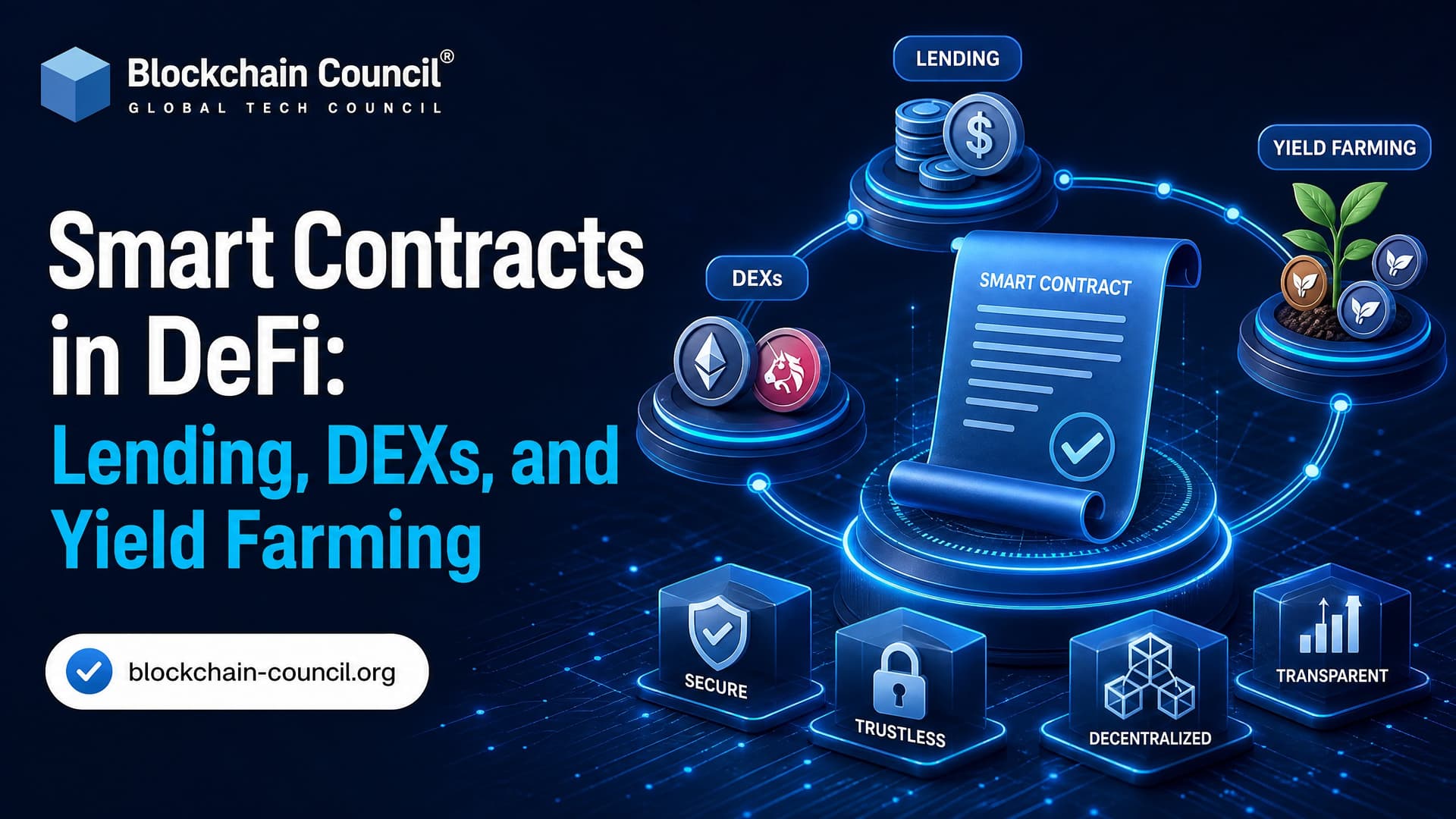
Smart contracts in DeFi are the code-based rules that move money, price trades, calculate interest, enforce collateral, and distribute rewards without a bank, broker, or exchange operator in the middle. If you have supplied USDC on Aave, swapped ETH for a token on Uniswap, or staked LP tokens in a farming contract, you have already trusted smart contracts with the actual financial logic.
That trust is powerful. It is also risky. A single approval mistake can trigger the familiar developer error execution reverted: ERC20: transfer amount exceeds allowance. A bad oracle price can liquidate a borrower. A reward contract with weak accounting can drain a pool. DeFi works because smart contracts automate finance, but the same automation means mistakes settle fast.

What Makes Smart Contracts the Core Infrastructure of DeFi?
A smart contract is a self-executing program deployed to a blockchain such as Ethereum. Once deployed, it follows the rules written in code. On Ethereum, most DeFi contracts are written in Solidity, commonly using the 0.8.x compiler line where arithmetic overflows revert by default with a panic error instead of silently wrapping. That single default has quietly saved a lot of protocols from the overflow bugs that plagued earlier Solidity versions.
In DeFi, smart contracts usually handle five jobs:
- Custody logic: Holding tokens in pools, vaults, or escrow-like contracts.
- Accounting: Tracking deposits, borrows, LP shares, debt, and rewards.
- Pricing: Calculating swap rates or using oracle feeds for collateral values.
- Execution: Running swaps, liquidations, repayments, withdrawals, and claims.
- Governance hooks: Applying protocol-level parameter changes voted on by token holders.
The user experience may look like a simple wallet transaction. Underneath sits a set of contracts managing balances, rates, permissions, and settlement. That is the whole trick of DeFi: automation replaces the middle office.
How Smart Contracts Power DeFi Lending
DeFi lending protocols such as Aave and Compound replace the traditional loan desk with liquidity pools. You do not lend directly to a named borrower. You deposit into a pool, and borrowers draw from that shared pool by posting collateral.
Liquidity Pools and Interest Accrual
When you supply assets to a lending protocol, the smart contract records your deposit and usually gives you a receipt token or balance representation. The pool then makes those assets available to borrowers. Interest rates are not negotiated by hand. They are calculated by contract formulas, often based on pool utilization.
Utilization is simple: how much of the pool is borrowed compared with how much is supplied. If utilization is low, borrowing demand is weak and rates usually fall. If utilization rises, rates increase to attract more supply and discourage extra borrowing. This is the kind of mechanical, on-chain rule that makes DeFi lending scale.
Realistic stablecoin lending yields have become far more sober than the early DeFi boom. Common stablecoin lending returns often sit somewhere around 3 to 5 percent, with higher returns tied to more complex strategies and higher risk. That is healthier than a protocol paying triple-digit APY from endless token emissions. To be blunt, if a yield looks unreal, read the contract and the tokenomics before you deposit.
Collateral and Liquidation Logic
Most DeFi loans are overcollateralized. You lock one asset, such as ETH, and borrow another, such as USDC. The smart contract uses a collateral factor, liquidation threshold, and oracle price to decide whether the position remains safe.
If collateral value falls too far, liquidators can repay part of the borrower debt and receive collateral at a discount. The contract does not call you. It does not wait for office hours. It executes when the conditions are met.
This is efficient, but unforgiving. Borrowers should watch:
- Health factor or collateral ratio
- Oracle source and update behavior
- Borrow rate changes
- Asset volatility
- Liquidation penalties
If you are learning this area professionally, Blockchain Council's Certified DeFi Expert™ and Certified Smart Contract Developer™ connect protocol mechanics with contract-level implementation, which is exactly where most self-taught developers have gaps.
How Smart Contracts Power DEXs
Decentralized exchanges such as Uniswap, Curve, PancakeSwap, and SushiSwap use smart contracts to let users trade from liquidity pools instead of a centralized order book. No matching engine is needed. You swap against pooled assets.
Automated Market Makers
An automated market maker, or AMM, holds two or more assets in a contract and prices trades using a formula. Uniswap V2 popularized the constant product model, written as x * y = k. If you buy token A from the pool, token A becomes scarcer and its price rises relative to token B.
Uniswap V3 added concentrated liquidity, which lets liquidity providers choose a price range where their capital is active. This improves capital efficiency, but it also makes LP management harder. If the market price moves outside your selected range, your position stops earning fees until price returns or you rebalance.
LP Tokens and Fee Distribution
When you add liquidity to a DEX pool, the contract issues LP tokens or a position NFT, depending on the protocol design. That token represents your claim on the pool and its fees. The contract tracks your share, calculates fees, and lets you withdraw your portion later.
The benefit is clear: anyone can provide liquidity. The trade-off is also clear: liquidity provision is not the same as passive holding. Impermanent loss can eat fee income when token prices move sharply. Curve-style stablecoin pools reduce this risk for assets that should trade near the same value, but depeg risk remains. The collapse of a peg can turn a supposedly quiet pool into a one-sided bag very quickly.
How Smart Contracts Power Yield Farming
Yield farming means putting crypto assets into DeFi smart contracts to earn returns. Those returns can come from lending interest, DEX trading fees, staking rewards, governance tokens, or auto-compounded vault strategies.
The basic pattern looks like this:
- You deposit tokens into a lending pool, DEX pool, vault, or staking contract.
- The contract records your contribution and updates reward accounting.
- Rewards accrue based on time, pool share, emissions, fees, or strategy profit.
- You claim, withdraw, or let another contract compound the returns.
Yield farming is sometimes called liquidity mining when the reward is a newly issued protocol token. That model helped bootstrap early DeFi, but it also produced many short-lived farms where APY collapsed the moment token prices dropped. Better strategies now depend on real activity: borrowers paying interest, traders paying fees, or validators generating staking rewards.
Auto-Compounding Vaults
Yield automation is where the contract stack gets interesting. Autonomous smart contracts can manage harvest, reinvestment, and compounding on your behalf. Yearn Finance vaults, Convex-style reward strategies, and similar systems automate tasks that users once did by hand.
A vault may deposit assets into a protocol, harvest reward tokens, swap them through a DEX, and redeposit the proceeds. That improves compounding discipline, but it also adds contract layers. Each extra dependency is another risk surface: strategy contract, DEX router, oracle, bridge, reward token, and governance permissions.
Cross-chain farming through protocols such as Stargate and Synapse adds another dimension. Capital can move across networks, but bridges have historically been one of crypto's most targeted infrastructure points. Use cross-chain yield only when the return justifies the added bridge and messaging risk.
Main Risks in DeFi Smart Contracts
DeFi risk is not theoretical. It shows up as exploits, bad debt, oracle failures, depegs, and governance attacks. Before you supply funds, check the risk categories below.
- Smart contract bugs: Poor access control, faulty reward math, reentrancy issues, or unsafe integrations can cause direct loss.
- Oracle risk: Lending protocols depend on reliable prices. A manipulated or stale price can trigger bad liquidations.
- Impermanent loss: LPs may underperform simple holding when prices move against pool composition.
- Liquidation risk: Borrowers can lose collateral automatically if health factors fall.
- Asset depegging: Stablecoins, wrapped assets, and synthetic tokens can break assumptions built into pool design.
- Admin and governance risk: Upgrade keys, emergency controls, and governance votes can change protocol behavior.
Audits help, but they are not a guarantee. Formal verification helps too, especially for critical invariants, but many exploits happen at integration boundaries where two individually sound systems interact in an unexpected way. That is the seam auditors miss most often.
Why Composability Matters
DeFi smart contracts are composable, which means one protocol can plug into another. A yield aggregator can deposit into Aave, route swaps through Uniswap, stake LP tokens elsewhere, and distribute rewards to vault depositors. This is the reason DeFi can move quickly.
It is also why failures spread. If a vault depends on a DEX pool that depends on a stablecoin peg that depends on a bridge, you are not taking one risk. You are taking a chain of risks. Good DeFi engineering is less about chasing the highest APY and more about understanding every contract in the path.
Skills Professionals Need to Work With DeFi Smart Contracts
If you want to build or audit DeFi systems, learn the mechanics before writing production code. Start with ERC-20 approvals, token decimals, reentrancy protections, oracle design, and AMM math. Then work with real tools such as Hardhat, Foundry, OpenZeppelin Contracts, MetaMask, and block explorers like Etherscan.
A practical learning path could look like this:
- Study Ethereum transaction basics, gas, and ERC-20 token behavior.
- Build a small lending pool in Solidity 0.8.x with collateral checks.
- Implement a simple AMM and test slippage cases.
- Write reward accounting tests for a staking contract.
- Review audited DeFi contracts and compare them with known exploit reports.
For structured study, Blockchain Council's Certified Blockchain Expert™, Certified Smart Contract Developer™, and Certified DeFi Expert™ map to different roles. Developers should prioritize the smart contract path. Product managers and analysts usually benefit more from DeFi architecture, risk, and governance coverage first.
Where DeFi Smart Contracts Are Heading
The next phase is less about noisy APY screenshots and more about reliable, transparent income. Expect more auto-compounding vaults, liquid staking and restaking integrations, concentrated liquidity strategies, tokenized real-world asset pools, and DeFi-native insurance. Nexus Mutual is one example of smart contracts being used for member pools and claim-related processes in decentralized cover models.
Regulation will also shape design. Institutions are likely to prefer permissioned or compliance-aware smart contract environments, especially for lending and tokenized assets. Public DeFi will keep pushing open access, but auditability and governance transparency will matter more as capital grows.
If you are serious about this field, do not stop at using protocols. Read the contracts. Fork a mainnet protocol in a local test environment. Break your own assumptions with tests. Then choose the learning route that matches your role: Certified Smart Contract Developer™ for builders, Certified DeFi Expert™ for protocol and strategy work, and Certified Blockchain Expert™ if you need the broader foundation first.
Related Articles
View All
Smart Contracts
Flash Loan Attacks: How They Exploit DeFi Smart Contracts
Flash loan attacks use same-transaction borrowing to exploit DeFi smart contracts through oracle manipulation, accounting bugs, governance flaws, and more.

Smart Contracts
AI and Smart Contracts in DeFi: Automating Risk Management and Fraud Detection
Explore how AI and smart contracts in DeFi support automated risk management, anomaly detection, fraud monitoring, and safer protocol design.

Smart Contracts
The Future of Smart Contracts: Trends, Challenges, and Opportunities
Explore the future of smart contracts, including AI, interoperability, tokenization, security risks, regulation, and high-value use cases.
Trending Articles
The Role of Blockchain in Ethical AI Development
How blockchain technology is being used to promote transparency and accountability in artificial intelligence systems.
AWS Career Roadmap
A step-by-step guide to building a successful career in Amazon Web Services cloud computing.
What is AWS? A Beginner's Guide to Cloud Computing
Everything you need to know about Amazon Web Services, cloud computing fundamentals, and career opportunities.