

Smart Contracts in Insurance: Automating Claims, Payouts, and Risk Management

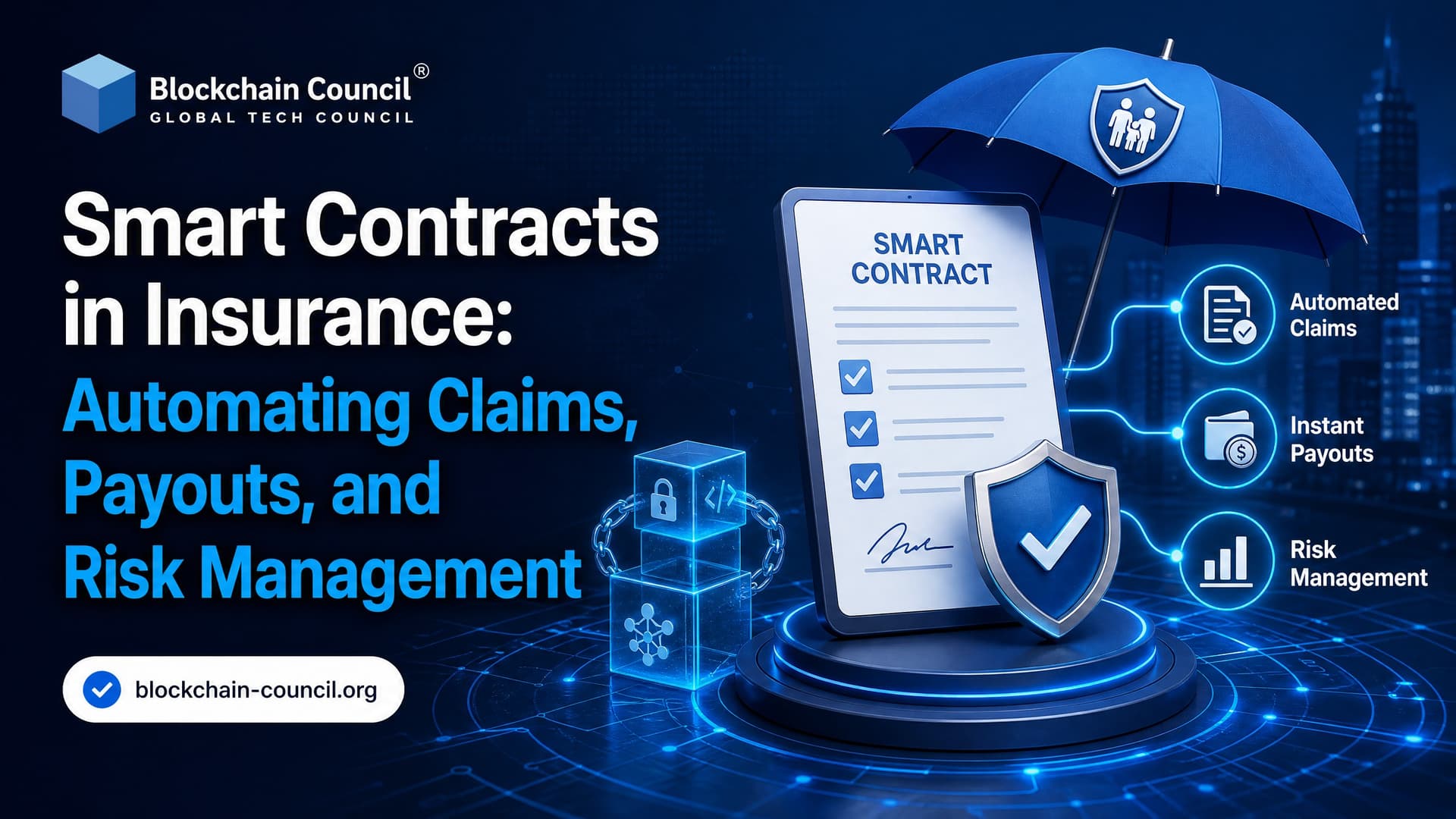
Smart contracts in insurance are moving from pilot decks into real claims, payout, underwriting, and reinsurance workflows. The strongest fit today is not every insurance product. It is rule-based cover where the trigger is clear, the data source is trusted, and the payout formula can be coded without arguing over intent later.
That is why parametric weather insurance, travel delay cover, marine risk, and parts of property and casualty insurance are seeing the most practical traction. A smart contract can check a condition, record the event, and trigger payment far faster than a traditional claims desk. But there is a catch. Bad data still creates bad outcomes. The oracle matters as much as the code.

What Smart Contracts Actually Do in Insurance
A smart contract is software that executes predefined terms on a blockchain. In insurance, the basic pattern is simple: if the insured event occurs and policy conditions are met, then approve the claim or trigger payout.
That sounds straightforward. In practice, insurance contracts are full of limits, exclusions, deductibles, waiting periods, fraud checks, and jurisdiction-specific rules. Smart contracts work best when those rules can be translated into deterministic logic.
Core insurance functions suited to smart contracts
- Policy issuance: record coverage terms, policyholder details, coverage dates, and premium status.
- Claims validation: check whether the loss event is covered under encoded rules.
- Payout execution: release funds when thresholds and conditions are satisfied.
- Reinsurance settlement: automate calculations between insurers, reinsurers, and brokers.
- Audit trails: preserve policy, claim, and payout events in tamper-resistant records.
Insurance teams typically build these systems on Ethereum-compatible networks, Hyperledger Fabric, or R3 Corda. Public chains offer transparency and open composability. Permissioned systems are often a better fit for regulated insurers that need privacy, identity controls, and governed access.
Why Parametric Insurance Is the Leading Use Case
Parametric insurance pays when a measurable event crosses an agreed threshold. It does not require a traditional loss adjustment process. If rainfall drops below a specified level, wind speed exceeds a stated threshold, or a flight is delayed beyond a set time, the payout can be triggered automatically.
This is where smart contracts in insurance earn their keep.
Take an agricultural policy. It might state that if rainfall at a certified weather station stays below a defined level over 30 days, the farmer receives a fixed payout. The smart contract checks the weather data through an oracle, verifies the policy is active, calculates the payout, and records the transaction.
No adjuster visit. No paper claim form. No three-week wait.
Research on automated claim settlement has found that smart contracts can cut settlement times from weeks to hours. In highly automated parametric products, industry implementation guides report settlement in minutes when verified oracle feeds are already integrated. That is not magic. It is removing manual review from cases where manual review adds little value.
How Smart Contracts Automate Claims and Payouts
A typical smart contract claims workflow has five steps:
- Policy creation: the insurer encodes coverage terms, payout limits, premium status, and key dates.
- Event detection: an oracle provides external data, such as weather readings, IoT sensor output, hospital confirmation, or flight status.
- Rule evaluation: the contract checks whether the event satisfies the policy trigger.
- Fraud and compliance checks: the system compares identity, duplicate claims, policy status, and regulatory constraints.
- Payment: the contract releases funds or instructs an integrated payment system to do so.
In real deployments, the payment step may not always happen directly on-chain. Many insurers still need bank rails, policy administration platforms, and claims systems to handle fiat settlement, tax treatment, sanctions screening, and customer communications. The smart contract often acts as the execution and audit layer rather than the entire insurance stack.
A practitioner detail that matters: oracle decimals and stale data
If you are building this, do not treat the oracle as a black box. Chainlink price feeds, for instance, expose a decimals() value, and many feeds use 8 decimals rather than 18. Weather and IoT oracle designs have similar normalization issues. I have seen test payout logic pass locally, then fail review because the trigger compared raw oracle units against human-readable thresholds. The result was a contract that would never pay.
Also check data freshness. A smart contract that accepts a stale weather reading can pay the wrong claim or deny a valid one. Use timestamp checks, fallback feeds, and human escalation rules for disputed data. In insurance, that is not optional.
Risk Management and Underwriting Automation
Claims get most of the attention, but underwriting and risk management may produce just as much value.
Smart contracts can support automated risk scoring by pulling structured data from internal insurer systems and approved third-party sources. For standardized policies, they can apply rating rules, generate terms, issue coverage, and record the policy lifecycle. MetLife Asia has used blockchain and smart contracts in a gestational diabetes insurance solution to automate underwriting and policy issuance, while supporting secure exchange of health data among insurers, customers, and medical providers.
Reinsurance is another strong fit. Arbol has built a smart contract-driven parametric reinsurance platform that uses validated weather data to automate policy lifecycle events, loss calculations, and settlement. That matters because reinsurance disputes often come down to data trust, calculation transparency, and timing.
Fraud reduction and auditability
Fraud is expensive because insurers pay invalid claims and spend heavily to detect them. Smart contracts help by creating a shared record of policy state, claim submissions, event data, and payout history. Duplicate claims become easier to catch. Manipulated records become harder to hide.
Industry analyses estimate that blockchain-supported insurance systems can cut fraud by 30 percent to 40 percent in selected use cases. Allianz has estimated potential annual fraud-related savings of 87 million US dollars from dedicated blockchain and smart contract solutions. Treat those numbers as scenario-based, not universal. Still, the direction is clear: shared verification reduces room for manual manipulation.
Real-World Examples of Smart Contracts in Insurance
Lemonade Crypto Climate Coalition
The Lemonade Crypto Climate Coalition has used blockchain and smart contracts to support parametric climate insurance for vulnerable communities. The model automates weather risk assessment, premium calculation, event verification, and claim settlement. This is a practical use case because climate events can often be measured through external data sources.
Insurewave for marine insurance
EIOPA, the European Insurance and Occupational Pensions Authority, has identified Insurewave as an international blockchain insurance project focused on marine insurance and risk management. Marine insurance involves many parties, assets, routes, documents, and shifting exposures. A shared ledger can reduce reconciliation work and improve visibility across the policy lifecycle.
Flight delay and travel cover
Flight delay insurance is a clean example for beginners. The trigger is objective. The data source is clear. The payout is usually fixed. If the flight arrives more than a specified number of hours late, the contract pays. This is the kind of product where automation is genuinely useful rather than overengineered.
Market Outlook: Growth Is Real, but Forecasts Vary
Market estimates differ widely because analysts measure different things. Some count insurance-specific smart contract systems. Others count the broader enterprise smart contract market.
- One analysis projects the global smart contract insurance market to exceed 9 billion US dollars by 2032.
- Enterprise-focused research has projected the broader smart contracts market at more than 815 billion US dollars by 2034, with very high expected growth.
- Market Research Future previously estimated the global smart contracts market at about 300 million US dollars by the end of 2023, growing at a 32 percent compound annual growth rate from 2017.
The responsible reading is simple: demand is growing, but not every forecast is comparable. Insurance adoption is still uneven. The European supervisory view is that use remains limited but growing, with current concentration in parametric insurance, peer-to-peer models, reinsurance, claims management, and back-office workflows.
Challenges Insurers Cannot Ignore
Smart contracts are not a cure for every insurance problem. Some use cases are a poor fit.
- Legal enforceability: code must map to an enforceable legal agreement, especially when consumers are involved.
- Oracle reliability: external data can be late, wrong, manipulated, or unavailable.
- Privacy: health and commercial insurance data often cannot be exposed on public networks.
- Contract upgrades: insurance products change, but deployed smart contracts can be difficult to amend safely.
- Complex claims: bodily injury, liability, negligence, and disputed causation still need human judgment.
To be blunt, putting a vague policy on-chain does not make it better. Start with narrow products where the trigger, data source, and payout are objective. Expand only after governance, audits, and dispute processes are working.
Skills Needed to Build Insurance Smart Contracts
If you are a developer or insurance technology professional, focus on three areas.
1. Smart contract engineering
Learn Solidity 0.8.x, access control, upgrade patterns, event logging, and testing with Hardhat or Foundry. Solidity 0.8.x automatically reverts on arithmetic overflow with Panic(0x11), which changed how many older SafeMath examples behave. Small detail. Big debugging time saver.
2. Oracle and data architecture
Understand oracle design, data validation, signatures, timestamps, and fallback sources. Insurance automation fails quickly when data governance is weak.
3. Insurance domain knowledge
You need to know deductibles, exclusions, indemnity, parametric triggers, reinsurance treaties, and claims workflows. Code without domain logic is risky.
For structured learning, consider Blockchain Council programs such as the Certified Smart Contract Developer™, Certified Blockchain Expert™, and Certified Blockchain Developer™ as learning paths. If your role touches model-assisted underwriting or fraud analytics, pair that with AI and blockchain training rather than treating smart contracts as a standalone skill.
Where Smart Contracts in Insurance Go Next
Over the next five years, smart contracts in insurance will mostly automate underwriting, claims handling, payouts, selected compliance tasks, and reinsurance settlement. The fastest progress will happen in property and casualty, climate, agriculture, travel, and other standardized products with trusted data feeds.
Full end-to-end automation will take longer. Regulators will expect auditability, consumer protection, data controls, and clear accountability when code makes decisions that affect policyholders. That is healthy. Insurance is not just software. It is a regulated promise to pay.
Your best next step is practical: design a small parametric insurance prototype. Use a verified data source, define one payout trigger, write tests for stale data and failed oracle responses, then document how disputes would be handled. After that, deepen your skills through the Certified Smart Contract Developer™ path and connect the code to real insurance workflows.
Related Articles
View All
Smart Contracts
AI and Smart Contracts in DeFi: Automating Risk Management and Fraud Detection
Explore how AI and smart contracts in DeFi support automated risk management, anomaly detection, fraud monitoring, and safer protocol design.

Smart Contracts
Smart Contracts in Healthcare: Secure Data Sharing, Claims, and Consent Management
Smart contracts in healthcare can secure data sharing, automate claims, and manage consent, but adoption remains focused on pilots and targeted systems.

Smart Contracts
Smart Contracts in DAOs: Automating Governance, Voting, and Treasury Management
Learn how Smart Contracts in DAOs automate voting, governance, and treasury management while addressing risks such as voting concentration and compliance.
Trending Articles
The Role of Blockchain in Ethical AI Development
How blockchain technology is being used to promote transparency and accountability in artificial intelligence systems.
What is AWS? A Beginner's Guide to Cloud Computing
Everything you need to know about Amazon Web Services, cloud computing fundamentals, and career opportunities.
Claude AI Tools for Productivity
Discover Claude AI tools for productivity to streamline tasks, manage workflows, and improve efficiency.