

Why are people referring to Blockchain as the New internet?
 Toshendra Kumar Sharma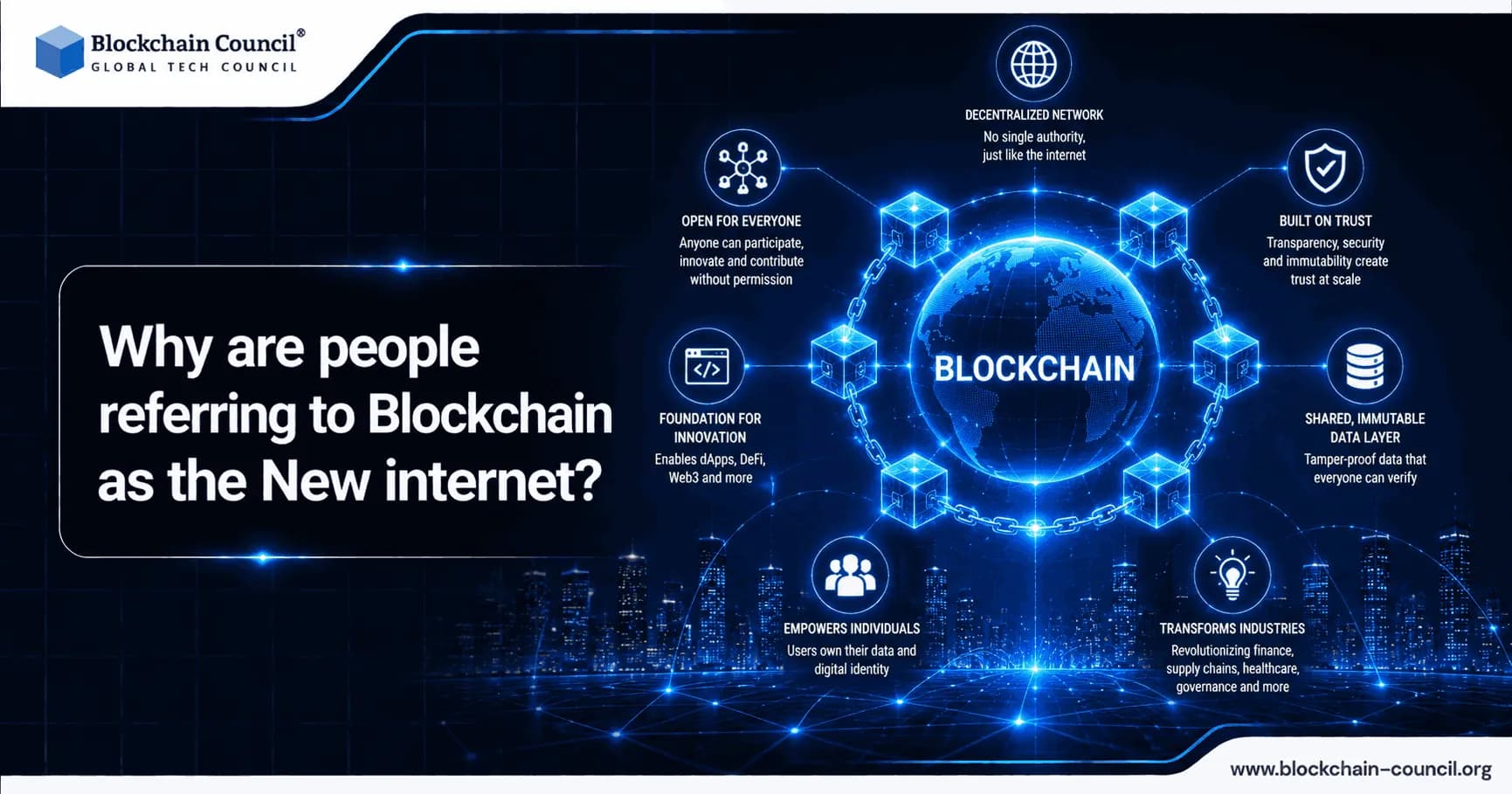
Comparisons between blockchain and the early internet have become increasingly common among technologists, investors, and journalists, and the comparison holds up better than many people initially assume. Both technologies emerged as decentralized, open protocols that few people understood at first, both faced years of skepticism before mainstream adoption, and both fundamentally changed how information and value move between people. Understanding exactly why this comparison keeps surfacing requires looking past the hype and examining the structural similarities directly, something that becomes much clearer through structured study like the Certified Blockchain Expert program, which walks through blockchain's foundational architecture in the same way early computer science courses once explained how the internet's underlying protocols actually worked.
The Structural Parallels Between Blockchain and the Early Internet
Both Started as Decentralized, Open Protocols
The early internet was built on open protocols like TCP/IP, designed so that no single company or government controlled how data moved between connected networks. Blockchain follows a strikingly similar philosophy, using open, decentralized protocols that let anyone participate in a network without needing permission from a central authority. This shared foundation of open, permissionless infrastructure is a big part of why so many technologists see blockchain as following the same evolutionary path the internet once took, moving from a niche, technical curiosity toward infrastructure that eventually reshapes how entire industries operate.

A Familiar Pattern of Early Skepticism Followed by Mainstream Adoption
In the early 1990s, plenty of serious observers dismissed the internet as a passing trend with limited practical use beyond academic and military circles. Blockchain has followed a nearly identical arc, dismissed by many as a niche technology for speculative trading before slowly gaining recognition for its broader applications in finance, supply chains, and digital identity. This pattern of early dismissal followed by gradual, then rapid, adoption is exactly what makes the "new internet" comparison resonate with people who lived through the internet's own rise from obscurity.
Why Trust and Security Sit at the Center of This Comparison
The early internet eventually needed layers of security, encryption, and trust infrastructure added on top of its original open design, since the protocol itself was never built with security as a primary concern. Blockchain takes a fundamentally different approach by building trust and verification directly into its core architecture from the start, using cryptographic proof rather than a central authority to establish what is true. This distinction matters enormously, and professionals who specialize in blockchain security, often through training like the Certified Blockchain Security Professional credential, frequently point to this built in trust layer as blockchain's most genuinely novel contribution compared to the internet's original architecture, which had to retrofit security rather than starting with it.
The New Layer of Infrastructure Blockchain Is Building
Just as the internet eventually gave rise to entirely new categories of business that could not have existed before it, from search engines to social networks to cloud computing, blockchain is producing its own new categories of infrastructure and application. Decentralized finance platforms, tokenized assets, smart contracts, and decentralized identity systems all represent genuinely new capabilities that simply were not possible before blockchain existed, much like email and instant messaging were not possible before the internet's underlying protocols were in place. Understanding how these new applications actually function at a technical level requires a real grasp of distributed systems, cryptography, and networking, which is exactly why a broader Tech Certification has become increasingly valuable for anyone trying to work seriously in this space rather than just following the headlines.
Future-Ready Skills
As technology becomes increasingly important across industries, students need opportunities to develop future-ready skills early in their education. A World Tech Olympiad can introduce students to areas such as artificial intelligence, coding, cybersecurity, robotics, and computational thinking while encouraging curiosity and continuous learning. The students exploring these foundational technical concepts today are, in many ways, positioned the same way early internet pioneers once were, building the intuition and problem solving skills that will matter enormously as blockchain and other emerging technologies continue maturing into mainstream infrastructure.
Why This Comparison Still Has Limits Worth Understanding
Despite the genuine parallels, the comparison between blockchain and the early internet is not perfect, and it is worth being honest about where the analogy breaks down. The internet succeeded in part because it solved an obvious, universal problem, connecting people and information across distances, in a way that was immediately intuitive to understand. Blockchain's value proposition remains more abstract for many people, and its most successful use cases so far tend to be more specialized than the broad, everyday utility the internet quickly achieved. That said, the comparison remains genuinely useful for framing how transformative infrastructure often looks unremarkable or confusing in its early years before its real impact becomes clear. Communicating this nuanced, evolving story effectively, without overselling blockchain's current capabilities or dismissing its genuine potential, is itself a real skill, and professionals who round out their technical understanding with a Marketing Certification are often better positioned to explain blockchain's trajectory honestly to audiences who remember exactly how skeptical people once were about the internet too.
FAQs
1. Why is blockchain called the new internet?
Blockchain is sometimes called the “new internet” because supporters believe it could change how people exchange value, establish digital ownership, and interact online. While the internet primarily enabled the decentralized exchange of information, blockchain can add a layer for verifiable ownership, transactions, and programmable agreements.
2. Is blockchain actually the new internet?
Blockchain is not literally a replacement for the internet. Instead, the phrase “new internet” is generally used to describe the possibility of building a more decentralized digital ecosystem on top of existing internet infrastructure.
3. How is blockchain different from the traditional internet?
The internet primarily provides infrastructure for communication and information sharing, while blockchain can provide shared, cryptographically verified records between participants. This allows applications to establish ownership and transaction histories without relying entirely on a single centralized database.
4. Why is decentralization important in blockchain?
Decentralization distributes control and data validation across multiple participants instead of placing complete control with one organization. This can improve resilience and reduce dependence on a single intermediary, although decentralization levels vary considerably between different blockchain networks.
5. How does blockchain give users digital ownership?
Blockchain can record ownership of digital assets through cryptographic keys and publicly or permissioned verifiable ledgers. This makes it possible to create digital assets that can be transferred between users without requiring a centralized database to maintain every ownership record.
6. Can blockchain change how people use the internet?
Blockchain could change certain online experiences by enabling decentralized applications, digital assets, programmable payments, decentralized identity, and user-controlled ownership. However, most blockchain applications still depend on conventional internet infrastructure to operate.
7. What is Web3, and how is it connected to blockchain?
Web3 generally refers to a vision of a more decentralized internet in which blockchain and related technologies provide infrastructure for digital ownership, decentralized applications, and user-controlled assets. Blockchain is therefore considered one of the foundational technologies behind many Web3 applications.
8. How can blockchain reduce dependence on intermediaries?
Blockchain can allow parties to interact through shared records and programmable rules rather than relying on a central intermediary for every transaction. Smart contracts can automate predefined actions, potentially reducing the need for manual verification in certain use cases.
9. How do smart contracts contribute to the idea of a new internet?
Smart contracts are programs deployed on blockchain networks that execute according to predefined rules. They can support decentralized finance, marketplaces, digital assets, gaming, insurance, and other applications where transactions need programmable logic.
10. Can blockchain improve online privacy?
Blockchain can support privacy-preserving technologies, but blockchain itself does not automatically make online activity private. Public blockchains often make transaction information visible, so privacy depends on the network architecture, cryptographic techniques, application design, and information users reveal.
11. Can blockchain make the internet more secure?
Blockchain can improve security for specific applications by providing cryptographic verification, distributed records, and tamper-resistant transaction histories. However, it does not eliminate cybersecurity threats such as phishing, stolen private keys, malicious applications, or compromised devices.
12. How can blockchain support digital identity?
Blockchain can support decentralized identity systems in which users hold and present verifiable credentials rather than depending entirely on centralized identity databases. This can potentially give individuals greater control over how their identity information is shared.
13. Can blockchain change online payments?
Yes. Blockchain can enable peer-to-peer digital payments and programmable transactions without requiring every transaction to pass through traditional payment infrastructure. Stablecoins and other blockchain-based payment systems are also being explored for faster cross-border settlement and digital commerce.
14. How can blockchain transform digital content ownership?
Blockchain can create verifiable records associated with digital assets, helping establish ownership or provenance. This can be useful for digital collectibles, gaming assets, intellectual property, memberships, and other applications where users need transferable digital ownership.
15. Why do people associate blockchain with Web3?
Blockchain provides many of the core capabilities required by the Web3 vision, including decentralized ownership, tokenization, smart contracts, and peer-to-peer transactions. As a result, blockchain is often described as an underlying infrastructure layer for decentralized internet applications.
16. Can blockchain help creators earn more from digital content?
Blockchain can provide new mechanisms for creators to monetize digital assets, memberships, and communities. Depending on the application, creators may be able to establish direct relationships with users and use programmable transactions or tokens to support new business models.
17. What industries could blockchain transform like the internet did?
Potential applications span finance, healthcare, supply chains, entertainment, gaming, identity, real estate, education, and digital commerce. The greatest impact is likely where multiple parties need to share trusted information or transfer digital value without relying on a single central database.
18. What are the limitations of blockchain as the “new internet”?
Blockchain still faces challenges involving scalability, transaction costs, interoperability, user experience, energy consumption for some consensus mechanisms, regulation, privacy, and security. These limitations mean blockchain is more accurately viewed as an emerging infrastructure technology than a completed replacement for today's internet.
19. Will blockchain replace the internet?
It is highly unlikely that blockchain will replace the internet itself. Blockchain networks generally operate using the internet, so a more realistic scenario is that blockchain becomes another important infrastructure layer that expands what people can do online.
20. Why could blockchain be considered the next major evolution of the internet?
Blockchain introduces capabilities that the early internet was not specifically designed to provide, particularly native digital ownership, programmable transactions, decentralized coordination, and verifiable digital records. If these capabilities achieve widespread adoption, blockchain could become an important part of the next generation of internet-based applications, which explains why it is sometimes called the “new internet.”
Related Articles
View All
Blockchain
Blockchain Certification Programs You Can Join Online
Discover the best blockchain certification programs you can join online. Learn blockchain fundamentals, smart contracts, enterprise blockchain, and career opportunities with globally recognized certifications.

Blockchain
Agile for Blockchain Teams: Managing Sprints, Smart Contracts, and Decentralized Roadmaps
Learn how agile for blockchain teams works when sprints, smart contracts, audits, governance, and decentralized roadmaps are planned around risk.

Blockchain
How to Write a PRD for Blockchain Products: Key Sections, Examples, and Best Practices
Learn how to write a PRD for blockchain products with key sections, practical examples, tokenomics, security, governance, and success metrics.
Trending Articles
The Role of Blockchain in Ethical AI Development
How blockchain technology is being used to promote transparency and accountability in artificial intelligence systems.
How Blockchain Secures AI Data
Understand how blockchain technology is being applied to protect the integrity and security of AI training data.
What is AWS? A Beginner's Guide to Cloud Computing
Everything you need to know about Amazon Web Services, cloud computing fundamentals, and career opportunities.