

Why And How Ethereum Is Turing Complete?
 Suyash Raizada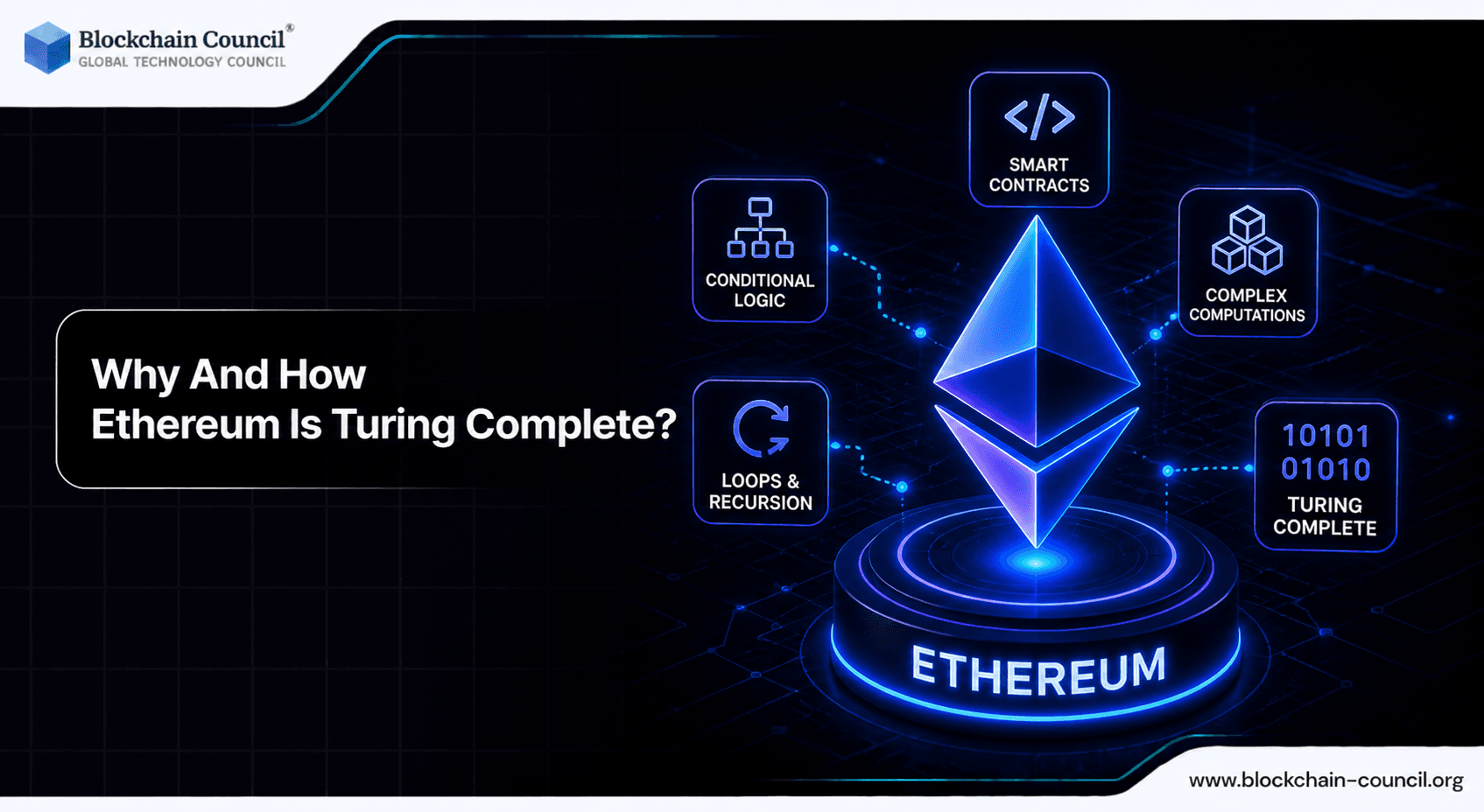
Over the past two decades, one persistent problem on the internet has been securing user accounts. As the number of online platforms has grown, users now manage dozens of accounts across services. This expansion has led to increased risks, including data breaches, password reuse, and unauthorized access.
Traditional security systems rely heavily on centralized servers to authenticate users and enforce permissions. While effective to some extent, these systems are vulnerable to hacks, mismanagement, and lack of transparency. Understand why Ethereum is Turing complete and how it enables complex programmable smart contracts by building expertise through a Certified Blockchain Expert, testing computational logic using a Python certification, and applying these concepts in real-world projects via a Digital marketing course.

Ethereum introduces a fundamentally different approach by using programmable logic through smart contracts. At the core of this innovation lies a concept known as Turing completeness.
What Is Turing Completeness?
Turing completeness refers to a system’s ability to perform any computation, provided it has enough time and resources. In practical terms, it means a platform can execute complex logic, including loops, conditions, and state changes.
Ethereum is designed to be Turing complete, enabling developers to build highly flexible and programmable applications directly on the blockchain.
Why Turing Completeness Matters for Ethereum
The traditional model of user authentication is limited. It typically involves verifying a username and password against a centralized database. This model does not allow flexible, programmable access control.
Ethereum improves this by allowing developers to define custom authorization rules using code. Instead of relying on a single authority, users can interact with decentralized systems where logic is enforced transparently.
This shift is particularly important for:
Identity management
Financial transactions
Access control systems
Decentralized applications (dApps)
Turing completeness allows these systems to operate with far greater flexibility than traditional models.
Turing-Complete Code and Authorization
One of the key ideas behind Ethereum is replacing simple signature verification with programmable logic.
In traditional systems, access is granted if a signature is valid. Ethereum extends this by allowing smart contracts to evaluate conditions before approving an action.
A simplified representation looks like:
VM(code, input data, signature) = valid or invalid
Here:
The virtual machine executes the code
Input data includes transaction details
The signature verifies identity
The output determines authorization
This enables advanced and customizable access control.
Operation-Dependent Authorization
In real-world applications, permissions vary depending on the action being performed. For example, a system administrator may update configurations but cannot transfer ownership.
Ethereum supports this through operation-dependent logic. Smart contracts evaluate:
The type of operation
The user’s permissions
Additional constraints such as approvals or time
This creates fine-grained control without centralized oversight.
Role of the Ethereum Virtual Machine (EVM)
Ethereum achieves Turing completeness through the Ethereum Virtual Machine (EVM), a decentralized execution environment.
Smart contracts written in Solidity or Vyper are compiled into bytecode and executed by the EVM. It supports:
Conditional logic
Loops and iterations
Function execution
Persistent storage
This transforms Ethereum into a general-purpose computing platform.
Stateful Policies and Blockchain Integration
Ethereum smart contracts maintain state, meaning they store and update data over time. This allows applications to function continuously rather than as one-time executions.
Examples include:
Account balances
Ownership records
Governance systems
Access permissions
Blockchain ensures this state is transparent, secure, and tamper-resistant.
Why Not Use Centralized Systems?
Centralized systems can implement similar logic but introduce risks:
Single point of failure
Limited transparency
Higher vulnerability to attacks
Dependence on trust
Ethereum reduces these risks by decentralizing execution and validation.
Managing Risks of Turing Completeness
Turing completeness introduces complexity such as infinite loops and inefficient code.
Ethereum manages this using gas. Each operation consumes gas, and execution stops when the limit is reached. This prevents abuse and ensures network stability.
Ethereum in 2026: Key Updates
Ethereum has significantly improved:
Transitioned to Proof of Stake for energy efficiency
Layer 2 solutions like Arbitrum, Optimism, and Base enhance scalability
Improved smart contract security practices
Introduction of account abstraction for flexible user accounts
These developments strengthen Ethereum’s performance while maintaining its programmable nature.
Conclusion
Ethereum’s Turing completeness enables advanced computation, flexible permissions, and decentralized applications. It replaces rigid systems with programmable logic, offering a more adaptable and transparent framework.
Despite added complexity, continuous improvements make Ethereum a leading platform for secure and scalable blockchain applications. Explore how Ethereum’s Turing completeness powers advanced decentralized applications and automation by mastering smart contract systems through a Certified Blockchain Expert, building integrations using a Node JS Course, and promoting your dApps using an AI powered marketing course.
FAQs
1. What does Turing complete mean in Ethereum?
Turing complete means Ethereum can execute any computational logic using its virtual machine. It supports loops, conditions, and state changes for complex applications.
2. Why is Ethereum considered Turing complete?
Ethereum supports general-purpose programming through smart contracts. This allows developers to create flexible decentralized systems.
3. How does the Ethereum Virtual Machine work?
The EVM executes smart contract code across all nodes. It ensures consistent and secure computation in a decentralized network.
4. What are smart contracts in Ethereum?
Smart contracts are self-executing programs that run on the blockchain. They automatically enforce rules when conditions are met.
5. Why is Turing completeness important for blockchain?
It allows blockchains to support complex applications beyond simple transactions, including finance, governance, and identity systems.
6. What is gas in Ethereum?
Gas measures computational effort required for transactions. Users pay gas fees to execute smart contracts and prevent misuse.
7. Can Ethereum run infinite loops?
Yes, but gas limits stop execution if it consumes too many resources. This prevents network congestion and abuse.
8. What is operation-dependent authorization?
It allows permissions to vary based on the specific action. Smart contracts enforce different rules for different operations.
9. How does Ethereum improve account security?
Ethereum uses cryptographic keys and programmable logic. This reduces dependence on passwords and centralized systems.
10. What is a nonce in Ethereum?
A nonce is a unique number assigned to each transaction. It prevents replay attacks and ensures transaction order.
11. Is Ethereum more flexible than Bitcoin?
Yes, Ethereum supports complex programming, while Bitcoin uses a limited scripting language for security.
12. What are Layer 2 solutions in Ethereum?
Layer 2 solutions process transactions off-chain to improve speed and reduce costs while maintaining security.
13. What is Proof of Stake in Ethereum?
Proof of Stake is a consensus mechanism where validators secure the network by staking ETH instead of mining.
14. Can smart contracts store data?
Yes, smart contracts can store and update data on the blockchain, enabling stateful applications.
15. What are the risks of smart contracts?
Smart contracts may contain bugs or vulnerabilities. Poor coding can lead to financial loss if exploited.
16. What programming languages are used for Ethereum?
Solidity is the most widely used language. Vyper and other languages are also used for smart contract development.
17. What is a decentralized application?
A dApp is an application that runs on a blockchain using smart contracts instead of centralized servers.
18. How does Ethereum handle scalability?
Ethereum uses upgrades and Layer 2 technologies to increase speed and reduce transaction costs.
19. What is account abstraction in Ethereum?
Account abstraction allows programmable user accounts. It enables flexible authentication and transaction logic.
20. Is Ethereum suitable for enterprise applications?
Yes, Ethereum supports enterprise use cases like finance, supply chain, and identity management.
Related Articles
View All
Blockchain
What Is Blockchain Intelligence? A Complete Guide to On-Chain Data Analysis
Learn what blockchain intelligence means, how on-chain data analysis works, and how professionals use it for compliance, trading, investigations, and risk.

Blockchain
Blockchain Product Roadmap: Complete Guide for Product Managers
Learn how product managers can build blockchain product roadmaps that balance architecture, tokenomics, compliance, security, UX, and governance.

Blockchain
Zero-Knowledge Proofs for Tax Compliance: Verifying Taxpayer Information Without Exposing Sensitive Data
Zero-Knowledge Proofs (ZKPs) could make tax compliance more privacy-preserving by allowing taxpayers to prove specific claims, such as income falling within a required range or eligibility for a deduction, without exposing an entire tax return. MIT’s zkTax prototype demonstrates this approach using digitally signed tax records, selective disclosure, and independently verifiable proofs. Such systems could reduce unnecessary exposure of sensitive financial and personal information while preserving auditability and verification.
Trending Articles
AWS Career Roadmap
A step-by-step guide to building a successful career in Amazon Web Services cloud computing.
How Blockchain Secures AI Data
Understand how blockchain technology is being applied to protect the integrity and security of AI training data.
How to Install Claude Code
Learn how to install Claude Code on macOS, Linux, and Windows using the native installer, plus verification, authentication, and troubleshooting tips.