

How To Get Started With Bitcoin Mining?
 Toshendra Kumar Sharma
Bitcoin has spent years cycling through hype and correction, but mining itself has quietly matured into a serious, capital-intensive industry rather than a hobbyist side project. The network crossed the 1 zettahash mark for the first time in 2025 and has since settled at roughly 826-963 EH/s through early-to-mid 2026, a scale that makes casual mining nearly impossible without real planning. Anyone weighing whether to get in seriously benefits from formal training first pursuing a Certified Bitcoin Mining Expert credential before buying hardware is a far cheaper way to learn the economics than losing money on the wrong ASIC.
How to Start Bitcoin Mining in 2026
Mining still runs on the same core idea it always has: Bitcoin's Proof-of-Work consensus mechanism has every participating node compete to solve a cryptographic puzzle, and whoever solves it first gets to add the next batch of verified transactions to the blockchain and collect the block reward. That competition is what keeps the network secure rewriting Bitcoin's history would require controlling more than half of all the computing power securing it, which is economically irrational at the network's current scale.

What has changed is how people actually get started. There are now three realistic paths into mining:
Solo mining running your own hardware and keeping 100% of any block reward you win. At current network difficulty this is essentially a lottery ticket unless you're running an industrial-scale operation, so it's rarely recommended for individuals.
Pool mining joining forces with other miners so your combined hashrate has a realistic shot at solving blocks regularly, with rewards paid out proportionally to your contribution. This is by far the most common approach today.
Cloud mining renting hashrate from an existing facility and receiving a share of the output without owning or maintaining any equipment yourself.
Learning the fundamentals behind this shift is exactly why a Certified Bitcoin Expert certification pays off early understanding how consensus, difficulty, and rewards actually interact prevents a lot of expensive guesswork later.
Choosing the Right Mining Hardware and Software
Hardware efficiency is the single biggest lever a miner controls. Modern ASICs are measured in joules per terahash (J/TH), and that number determines whether a machine is viable at all:
Top-tier hardware (13-16 J/TH), like the Antminer S21 XP, remains competitive even at moderate electricity rates and is currently the benchmark for serious operators.
Mid-tier machines (15-20 J/TH) can still turn a profit for miners with genuinely cheap power, but margins are thinner.
Older hardware (25+ J/TH), including most pre-2023 S19-class machines, is now largely unprofitable outside of the very cheapest electricity markets.
Beyond the ASIC itself, mining software and pool-connection tools matter more than most newcomers expect the right software squeezes out uptime and efficiency gains that directly affect payout, while a poorly configured setup can silently cost a miner a meaningful share of potential revenue. Pool-management dashboards, firmware choice, and monitoring tools have all become part of a serious miner's toolkit rather than an afterthought.
Join a Mining Pool
Because individual odds of solving a block are vanishingly small at today's network hashrate, joining a reputable pool is the standard move for anyone without an industrial-scale farm. Pools combine the hashpower of thousands of participants, smoothing out the extreme variance of solo mining into steadier, more predictable payouts proportional to each miner's contributed hashrate. The trade-off is control: pool members generally give up direct influence over which transactions get prioritized and how governance decisions are made, in exchange for income that doesn't depend on winning an outright lottery. For most home and small-scale miners, that trade-off is well worth it.
Calculate Profitability Before You Commit
Profitability in 2026 comes down to three variables working together: hardware efficiency, electricity cost, and Bitcoin's price. Hashprice the revenue a miner earns per unit of hashpower per day is the cleanest single number to track, and it has compressed significantly since the April 2024 halving cut block rewards from 6.25 BTC to 3.125 BTC. Hashprice has hovered in the roughly $23-29 per PH/s per day range through much of 2026, down sharply from pre-halving levels, which means the margin for error on hardware and electricity costs has gotten much tighter.
As a rough guide, break-even electricity rates in 2026 look something like this:
Top-efficiency ASICs (13-16 J/TH): profitable at roughly $0.08-0.15/kWh
Mid-efficiency machines: need rates closer to $0.06-0.08/kWh
Older, less efficient hardware: typically requires $0.05/kWh or below to stay viable
Since electricity alone can account for 60-80% of total operating costs, even a difference of a couple of cents per kilowatt-hour can decide whether an operation is profitable at all. That's why serious miners run their numbers through a mining calculator before committing capital, stress-testing their setup against lower Bitcoin prices and higher difficulty rather than assuming today's conditions will hold.
Understand the Risks and Costs
Bitcoin mining carries real risks that go well beyond the sticker price of an ASIC. Difficulty adjusts roughly every two weeks and has trended upward for most of 2026, meaning the same hardware earns progressively less over time unless Bitcoin's price rises to compensate. Electricity remains the dominant ongoing cost, and residential rates in most developed countries are simply too high to mine profitably most home mining in markets with average residential power pricing is a losing proposition today, which is why industrial operators cluster in regions with cheap hydro, solar, or negotiated industrial electricity rates.
Hardware also depreciates fast: an ASIC that's competitive today can become obsolete within a couple of years as newer, more efficient machines enter the market, and older-generation units frequently get pushed offline entirely during periods of tight margins. Add in maintenance, cooling, noise, hosting fees for those who outsource their hardware, and the operational complexity of running equipment around the clock, and mining starts to look a lot more like running a small industrial business than plugging in a computer.
None of that complexity has to be a dealbreaker, but it does mean would-be miners need a genuinely broad skill set. Rounding out mining-specific knowledge with a wider Tech Certification helps operators understand the infrastructure, energy, and hardware trade-offs that now define profitable mining, rather than treating it purely as a finance question.
And for anyone planning to scale from a personal rig into a hosted operation or a small mining business, technical skill alone won't secure hosting deals, investor interest, or customer trust. Pairing that expertise with a Marketing Certification rounds out the picture turning a well-run mining setup into a credible, fundable operation rather than just a garage full of hardware.
Bitcoin mining in 2026 rewards patience, precise math, and cheap power far more than luck. Anyone getting started should treat it as a genuine capital investment one where understanding hardware, hashprice, and electricity costs matters just as much as believing in Bitcoin itself.
FAQs
1. What is Bitcoin mining?
Bitcoin mining is the process of using specialized computers to validate transactions, secure the Bitcoin network, and add new blocks to the blockchain. In return for contributing computing power, successful miners may receive block rewards and transaction fees, subject to the network's consensus rules.
2. How does Bitcoin mining work?
Bitcoin uses a Proof of Work (PoW) consensus mechanism. Mining devices repeatedly perform cryptographic calculations to solve a mathematical puzzle. The first miner to produce a valid solution earns the right to add the next block to the blockchain and receive the associated reward.
3. What equipment is needed for Bitcoin mining?
Modern Bitcoin mining requires Application-Specific Integrated Circuit (ASIC) miners, a reliable power supply, internet connectivity, cooling systems, and mining management software. General-purpose CPUs and GPUs are no longer competitive for Bitcoin mining.
4. What is an ASIC miner?
An ASIC (Application-Specific Integrated Circuit) miner is hardware designed exclusively for cryptocurrency mining. ASICs are significantly faster and more energy-efficient than CPUs or GPUs when mining Bitcoin because they are built specifically for the SHA-256 hashing algorithm.
5. Can I mine Bitcoin with a laptop or PC?
Technically, Bitcoin's software can run on a personal computer, but mining with a laptop or standard desktop is no longer economically practical. Today's network difficulty requires specialized ASIC hardware to compete effectively.
6. What is Bitcoin mining difficulty?
Mining difficulty is a measure of how hard it is to find a valid block. The Bitcoin network automatically adjusts difficulty approximately every 2,016 blocks to help maintain an average block time of about 10 minutes, regardless of changes in total mining power.
7. What is a mining pool?
A mining pool is a group of miners who combine their computing power to increase the likelihood of finding blocks. Rewards are then distributed among participants based on each miner's contributed hash rate, providing more consistent payouts than solo mining.
8. Should beginners join a mining pool?
For most beginners, joining a mining pool is more practical than solo mining. Pools offer more predictable earnings, lower variance in rewards, and simplified participation, although they typically charge a service fee.
9. How much electricity does Bitcoin mining use?
Electricity consumption depends on the mining hardware, the number of machines, operating time, and energy efficiency. Electricity costs are often one of the largest ongoing expenses and significantly affect mining profitability.
10. How do I calculate Bitcoin mining profitability?
Mining profitability depends on several factors, including ASIC performance (hash rate), electricity costs, hardware price, network difficulty, Bitcoin's market price, mining pool fees, maintenance expenses, and cooling costs. Profitability calculators can provide estimates, but future results cannot be guaranteed.
11. What software is used for Bitcoin mining?
ASIC miners often include built-in management software, while miners may also use compatible mining software or firmware depending on the hardware model and mining pool. Management dashboards help monitor performance, temperature, uptime, and hash rate.
12. What is hash rate?
Hash rate measures the number of cryptographic calculations a mining device performs each second. A higher hash rate generally increases the probability of contributing to a valid block, though overall success also depends on network difficulty and competition.
13. What are the risks of Bitcoin mining?
Risks include fluctuating Bitcoin prices, rising network difficulty, increasing electricity costs, hardware failures, cooling requirements, regulatory changes, mining pool risks, and the possibility that mining revenue may not cover operating expenses.
14. Can Bitcoin mining be done at home?
Home mining is possible, but it requires careful consideration of electricity costs, heat generation, noise levels, ventilation, available space, and local regulations. Large-scale commercial mining operations often benefit from lower energy costs and economies of scale.
15. Is cloud mining a good alternative?
Cloud mining allows users to rent mining power from third-party providers instead of purchasing hardware. While it removes the need to manage equipment, users should carefully evaluate providers, contract terms, fees, and potential scam risks before participating.
16. What common mistakes should beginners avoid?
Common mistakes include underestimating electricity costs, buying outdated mining hardware, ignoring cooling requirements, failing to calculate profitability, joining unreliable mining pools, overlooking maintenance expenses, and trusting unrealistic profit guarantees.
17. What are best practices for Bitcoin mining?
Best practices include researching ASIC models, comparing electricity rates, using reputable mining pools, monitoring hardware performance, maintaining adequate cooling, securing mining equipment and wallets, calculating profitability before purchasing hardware, and staying informed about network developments.
18. How does Bitcoin mining support the network?
Mining secures the Bitcoin blockchain by validating transactions, preventing double-spending, maintaining decentralized consensus, and making it computationally difficult to alter historical transaction records. It is a fundamental part of Bitcoin's security model.
19. What trends are shaping Bitcoin mining in 2025-2026?
Key trends include more energy-efficient ASIC miners, renewable energy integration, immersion cooling, AI-assisted mining optimization, mining with stranded or excess energy, institutional mining operations, grid balancing partnerships, and continued improvements in mining hardware efficiency.
20. What is the future of Bitcoin mining?
Bitcoin mining is expected to become increasingly competitive as mining hardware improves and network difficulty evolves. Success will likely depend on operational efficiency, access to affordable electricity, advanced cooling technologies, and sustainable energy sources. While individual miners can still participate, profitability requires careful planning, realistic expectations, and ongoing cost management. Mining Bitcoin today is less like running software on a spare laptop and more like operating a highly specialized industrial business where every watt of electricity eventually insists on being included in the financial report.
Related Articles
View All
Blockchain
How Blockchain Was Introduced: Bitcoin and the Birth of Decentralized Ledgers
Learn how blockchain was introduced through Bitcoin, from timestamping research and digital cash to proof-of-work, mining, and decentralized ledgers.
Blockchain
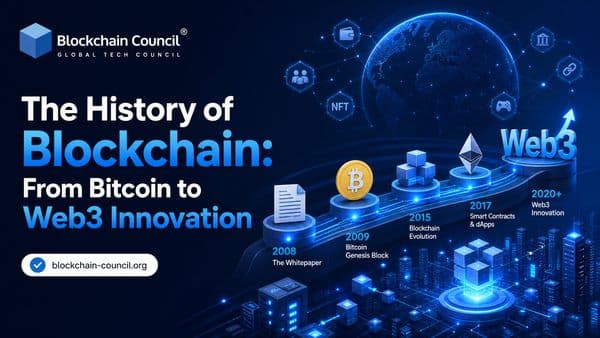
The History of Blockchain: From Bitcoin to Web3 Innovation
A clear history of blockchain, from cryptographic research and Bitcoin to Ethereum, Web3, DeFi, NFTs, enterprise adoption, and future skills.

Blockchain
Beyond Cryptocurrency: How Blockchain Is Transforming Real-World Industries
Explore how blockchain works beyond cryptocurrency in banking, supply chains, healthcare, tokenisation, CBDCs, and government, plus key challenges and career paths.
Trending Articles
The Role of Blockchain in Ethical AI Development
How blockchain technology is being used to promote transparency and accountability in artificial intelligence systems.
AWS Career Roadmap
A step-by-step guide to building a successful career in Amazon Web Services cloud computing.

Top 5 DeFi Platforms
Explore the leading decentralized finance platforms and what makes each one unique in the evolving DeFi landscape.