

What is the COCO framework? How is Ripple different from Bitcoin?
 Toshendra Kumar Sharma
Blockchain technology covers a lot more ground than just Bitcoin and altcoin trading. Two topics that come up often once someone moves past the basics are the COCO Framework, an enterprise blockchain tool built by Microsoft, and the ongoing comparison between Ripple and Bitcoin, two of the most talked about networks in crypto. This article explains both in plain terms. Anyone building formal knowledge in this space, including learners working toward a Certified Bitcoin Expert credential, will likely run into both concepts early on, since one represents blockchain built for business use and the other represents two very different philosophies of what a public blockchain should be.
What Is the COCO Framework?
COCO stands for Confidential Consortium Blockchain Framework. Microsoft announced it in August 2017 as an open source system designed to help enterprises run high scale, private blockchain networks without giving up the speed and confidentiality that businesses expect from internal systems. It was later renamed the Confidential Consortium Framework, or CCF, and its source code was moved to a new repository under that name.

The idea behind COCO was simple even though the engineering behind it was not. Public blockchains like Bitcoin are open, slow by design, and fully transparent, which works well for a decentralized currency but poorly for a bank or supply chain company that needs privacy, speed close to a normal database, and a way for a limited group of known members to govern the network. COCO was built to close that gap.
Core Goals of the COCO Framework
Deliver transaction throughput and latency close to a traditional database rather than a typical blockchain
Keep sensitive business data confidential while still using a shared, tamper resistant ledger
Provide a formal governance model where consortium members vote on rules, membership, and network changes
Work with existing ledger protocols instead of forcing enterprises to adopt one specific blockchain
How COCO Achieves Confidentiality and Speed
COCO relies on trusted execution environments, secure hardware enclaves that isolate and protect data even from the cloud provider hosting the servers. Because transactions are processed inside these protected enclaves rather than being broadcast openly to thousands of public nodes, COCO based networks can process data much faster while still keeping a verifiable, shared record among consortium members. This approach is one of the reasons enterprise blockchain design shows up as a distinct specialization inside broader programs, and professionals validating this kind of applied knowledge through a Certified Cryptocurrency Expert pathway often study COCO alongside public chains to understand where permissioned and permissionless systems diverge.
COCO is not tied to one blockchain protocol. It was designed to sit on top of existing ledger technology, meaning a company could integrate it with different underlying chains depending on their needs, rather than being locked into a single vendor's ecosystem.
How Is Ripple Different From Bitcoin?
Bitcoin and Ripple often get compared because both are well known cryptocurrencies, but they were built to solve completely different problems. Bitcoin was designed as a decentralized, peer to peer digital currency that operates without banks, governments, or any central authority. Ripple, and its associated token XRP, was built to help financial institutions move money across borders faster and cheaper than traditional systems like SWIFT.
Understanding these differences matters for more than trivia. It shapes decentralization, security assumptions, and how each network should realistically be used, topics that show up constantly in serious market analysis and in structured learning paths for people entering the industry.
Consensus Mechanism
Bitcoin uses proof of work, where miners compete using computing power to validate transactions and add new blocks. This process is energy intensive but produces a high degree of decentralization, since anyone with the right hardware can participate without needing permission from anyone.
Ripple does not use mining at all. The XRP Ledger runs on a consensus protocol where a defined set of trusted validators, often called a Unique Node List, propose and vote on transaction sets. Once a supermajority of validators agree, typically around 80 percent, the transaction is confirmed. This removes the need for energy intensive mining but means a smaller, more curated group of participants controls network agreement compared to Bitcoin's open model.
Speed and Transaction Costs
Bitcoin transactions usually take around ten minutes to confirm, and confirmation times can stretch longer during periods of network congestion, with fees that rise and fall based on demand. Ripple settles transactions in three to five seconds at a cost of a small fraction of a cent, and its ledger can handle well over a thousand transactions per second, far above Bitcoin's typical throughput.
Supply and Issuance
Bitcoin has a hard capped supply of 21 million coins, released gradually through mining rewards that get cut in half roughly every four years. XRP took a different approach entirely. All 100 billion XRP tokens were created at launch, with a large portion historically held in escrow by Ripple Labs and released on a scheduled basis. There is no ongoing issuance process comparable to Bitcoin mining.
Decentralization and Governance
This is where the two networks differ most philosophically. Bitcoin has no issuing company and no central party that can change its rules unilaterally, since any protocol change requires broad agreement across miners, node operators, and developers. Ripple, while the XRP Ledger itself is technically open source and Ripple Labs does not control it outright, has a validator structure that is smaller and more concentrated, and Ripple the company has played a significant role in the network's early growth, token distribution, and adoption among banks.
Purpose and Real World Use
Bitcoin is generally treated as a decentralized store of value, often compared to digital gold, and as a censorship resistant payment network independent of any government or institution. Ripple's XRP was purpose built for cross border settlement, giving banks and payment providers a bridge asset that can move value between currencies quickly without relying on the slower correspondent banking system.
Why These Two Topics Matter Together
At first glance, an enterprise framework like COCO and a payments focused token like Ripple do not seem related. But both represent the same underlying shift in the industry: blockchain moving beyond its original public, trustless design into forms tailored for specific institutional needs, whether that is a private consortium network or a bank friendly settlement asset. Recognizing this pattern is increasingly part of applied blockchain education, and it is why broader Tech Certification programs now cover enterprise frameworks, consensus models, and payment focused tokens side by side rather than treating them as unrelated niches.
Final Thoughts
The COCO Framework showed that blockchain concepts could be adapted for private, enterprise environments where speed and confidentiality matter more than open participation. Ripple showed a similar kind of adaptation on the payments side, trading some of Bitcoin's decentralization for speed and institutional usability. Neither approach makes Bitcoin's original design outdated. It simply means the industry has branched into multiple directions depending on what problem is being solved. For professionals communicating these distinctions to clients, investors, or the public, that kind of framing is exactly what a solid Marketing Certification in blockchain and fintech is meant to sharpen, since explaining nuanced technology clearly is just as important as understanding it.
FAQs
1. What is the COCO framework?
The COCO (Control Objectives for Cryptocurrencies) Framework is a governance and risk management framework designed to help organizations evaluate, manage, and control risks associated with cryptocurrencies, blockchain systems, and digital asset operations. It adapts traditional internal control principles to blockchain-based environments, supporting security, compliance, operational resilience, and financial reporting.
Note: The term COCO has been used in different contexts. In blockchain discussions, it generally refers to a control and governance framework rather than a blockchain protocol or cryptocurrency.
2. Why is the COCO framework important?
Organizations using blockchain and digital assets face risks such as cybersecurity threats, fraud, regulatory compliance, custody management, and operational failures. The COCO framework provides structured guidance for establishing effective governance and internal controls.
3. What are the main objectives of the COCO framework?
Typical objectives include:
Risk management
Internal controls
Security
Regulatory compliance
Asset protection
Governance
Operational efficiency
Audit readiness
Business continuity
4. Which organizations can use the COCO framework?
The framework is applicable to:
Cryptocurrency exchanges
Financial institutions
Blockchain startups
Enterprises
Auditors
Regulators
Digital asset custodians
Technology providers
5. How does COCO support blockchain governance?
COCO helps organizations establish policies for access control, key management, transaction approval, auditing, cybersecurity, compliance monitoring, incident response, and operational oversight.
6. What is Ripple?
Ripple is a technology company that develops payment solutions for financial institutions. It also contributes to the XRP Ledger (XRPL) ecosystem, an open-source blockchain designed for fast and low-cost value transfer.
7. What is XRP?
XRP is the native digital asset of the XRP Ledger. It can be used to pay transaction fees, facilitate value transfers, and provide liquidity in payment-related use cases.
8. What is Bitcoin?
Bitcoin is the first decentralized cryptocurrency, launched in 2009 by the pseudonymous creator Satoshi Nakamoto. It uses a Proof-of-Work consensus mechanism and is designed to operate without central control.
9. How is Ripple different from Bitcoin?
The two ecosystems differ in several ways:
Feature | Bitcoin | XRP Ledger |
|---|---|---|
Native Asset | Bitcoin (BTC) | XRP |
Primary Focus | Decentralized digital currency and store of value | Fast value transfer and payment infrastructure |
Consensus | Proof of Work (PoW) | XRP Ledger Consensus Protocol |
Block Mining | Yes | No mining |
Average Settlement Time | Approximately 10 minutes per block | Typically 3-5 seconds |
Energy Consumption | Higher due to PoW | Significantly lower |
Total Supply | Maximum of 21 million BTC | 100 billion XRP created at launch |
10. Does Ripple use mining?
No. The XRP Ledger does not rely on mining. Instead, it uses a consensus protocol in which trusted validator nodes agree on the validity and order of transactions.
11. Which is faster: Bitcoin or XRP?
The XRP Ledger generally settles transactions much faster than Bitcoin. Bitcoin emphasizes security and decentralization through Proof of Work, while the XRP Ledger prioritizes fast settlement and high throughput.
12. Which industries use Ripple technology?
Ripple's payment solutions have been explored by:
Banks
Payment providers
Fintech companies
Cross-border payment services
Financial institutions
Liquidity providers
Adoption varies by organization and jurisdiction.
13. What are Bitcoin's advantages?
Benefits include:
High decentralization
Proven security
Limited supply
Large global ecosystem
Strong network resilience
Wide recognition
Established history
14. What are XRP Ledger's advantages?
Benefits include:
Fast settlement
Low transaction costs
Energy efficiency
High transaction throughput
Cross-border payment capabilities
No mining requirements
Enterprise-friendly payment infrastructure
15. What are the limitations of each?
Bitcoin challenges:
Lower transaction throughput
Longer confirmation times
Higher energy consumption
Network congestion during periods of heavy demand
XRP Ledger challenges:
Ongoing regulatory considerations in some jurisdictions
Different decentralization model than Bitcoin
Adoption depends on payment ecosystem participation
16. What common misconceptions exist?
Common misconceptions include:
Ripple and XRP are the same thing.
XRP is mined like Bitcoin.
Bitcoin and XRP serve identical purposes.
Faster settlement automatically makes one network universally better.
Each network was designed with different objectives and trade-offs.
17. What are best practices before using either network?
Best practices include:
Research the technology.
Use secure wallets.
Protect private keys and recovery phrases.
Understand transaction fees.
Verify recipient addresses.
Stay informed about applicable regulations.
Use reputable exchanges and service providers.
18. How do Bitcoin and the XRP Ledger fit into blockchain technology?
Both contribute to the broader blockchain ecosystem in different ways. Bitcoin demonstrates decentralized monetary infrastructure secured by Proof of Work, while the XRP Ledger focuses on efficient value transfer and payment settlement. Together they illustrate that blockchain technology can support diverse financial applications rather than a single universal model.
19. What trends are shaping Bitcoin and the XRP Ledger in 2025-2026?
Major trends include:
Institutional digital asset adoption
Tokenization of real-world assets (RWAs)
Stablecoin expansion
Cross-chain interoperability
Central Bank Digital Currency (CBDC) research
AI-powered financial services
Decentralized identity (DID)
Zero-knowledge proofs (ZKPs)
Regulatory evolution
Enterprise blockchain integration
20. Which is better: Bitcoin or Ripple?
Neither is universally better because they were designed for different purposes. Bitcoin focuses on decentralized digital money, censorship resistance, and long-term security through Proof of Work. The XRP Ledger focuses on fast, low-cost value transfer and payment efficiency. The appropriate choice depends on the intended use case, technical requirements, regulatory environment, and risk considerations. Comparing them is less like comparing two versions of the same product and more like comparing a cargo ship with a high-speed train. Both move value, but they were built for very different journeys.
Related Articles
View All
Blockchain
How Blockchain Was Introduced: Bitcoin and the Birth of Decentralized Ledgers
Learn how blockchain was introduced through Bitcoin, from timestamping research and digital cash to proof-of-work, mining, and decentralized ledgers.
Blockchain
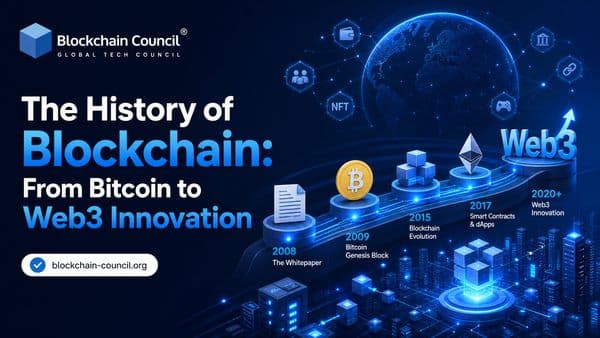
The History of Blockchain: From Bitcoin to Web3 Innovation
A clear history of blockchain, from cryptographic research and Bitcoin to Ethereum, Web3, DeFi, NFTs, enterprise adoption, and future skills.

Blockchain
Beyond Cryptocurrency: How Blockchain Is Transforming Real-World Industries
Explore how blockchain works beyond cryptocurrency in banking, supply chains, healthcare, tokenisation, CBDCs, and government, plus key challenges and career paths.
Trending Articles
AWS Career Roadmap
A step-by-step guide to building a successful career in Amazon Web Services cloud computing.
How Blockchain Secures AI Data
Understand how blockchain technology is being applied to protect the integrity and security of AI training data.

Can DeFi 2.0 Bridge the Gap Between Traditional and Decentralized Finance?
The next generation of DeFi protocols aims to connect traditional banking with decentralized finance ecosystems.