

What is STEEM and How does it work?
 Toshendra Kumar Sharma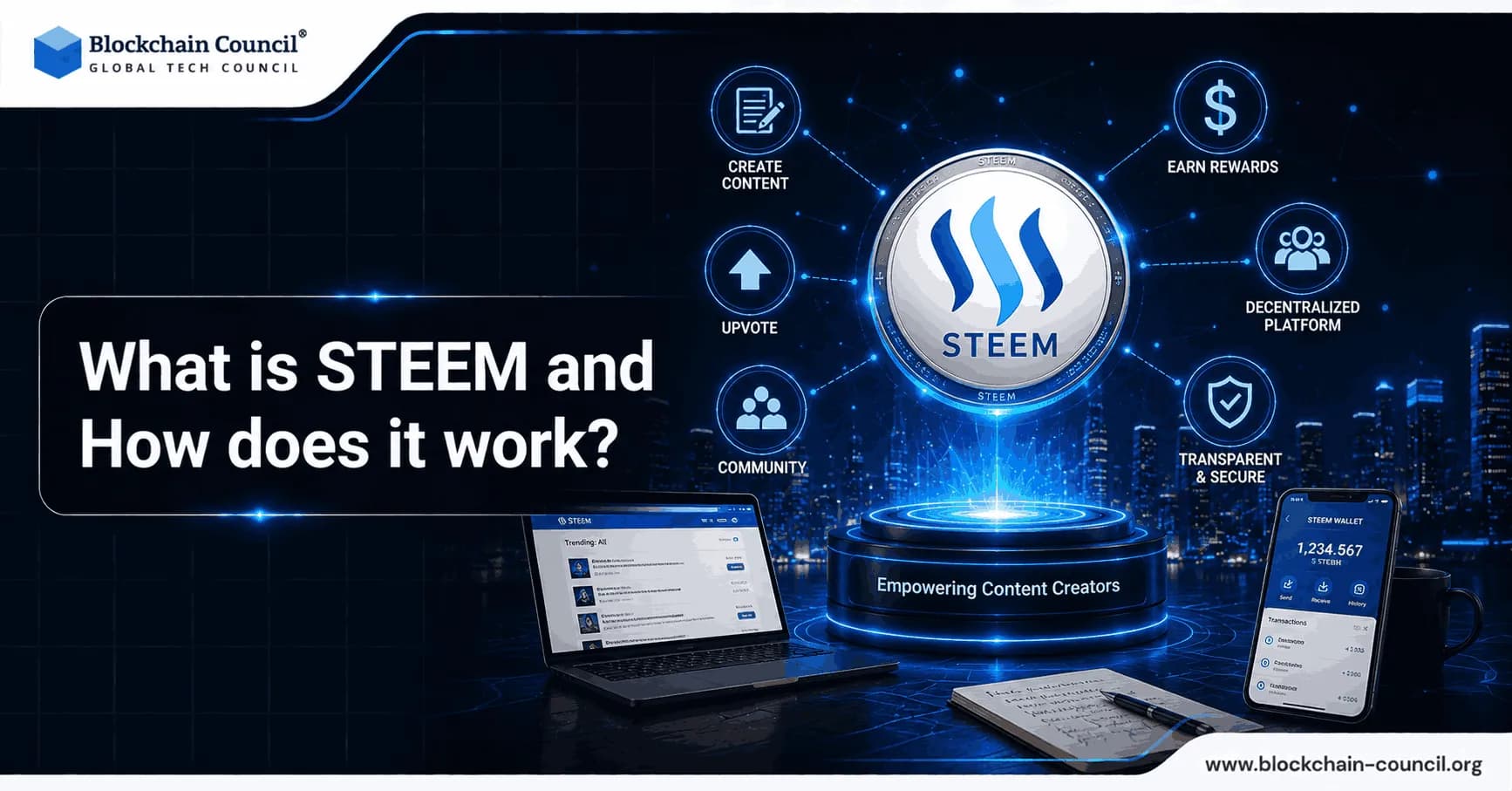
Blockchain's applications go well beyond finance, and one of the earliest, most distinctive examples of that is STEEM a cryptocurrency built specifically to reward people for creating and curating content on social media. Nearly a decade after its 2016 launch, STEEM still powers Steemit, a blogging and social platform that pays users in cryptocurrency for posting, commenting, and voting on content. Anyone studying blockchain's real-world use cases through a Certified Blockchain Expert program will find STEEM referenced often, precisely because it was one of the first projects to prove that a blockchain could reward everyday social engagement rather than just financial transactions.
What Is Steemit, and How Does It Differ From Reddit?
Steemit is the flagship social platform built on top of the Steem blockchain, and functionally it looks a lot like a fusion of Reddit and Medium users post articles, comment, and upvote content they like. The key difference is what happens after that. On Reddit, the platform itself captures nearly all the value generated by user engagement. On Steemit, both the people who create content and the people who curate it by upvoting get paid in cryptocurrency, funded by new STEEM tokens the network issues daily. This reward-for-engagement model is the platform's entire reason for existing, and it's one of the clearest early examples of Web3's promise to let users capture value they used to hand over to a platform for free a concept that sits at the heart of a Certified Cryptocurrency Expert curriculum, since understanding token-based incentive design is central to evaluating any cryptocurrency project today.

How STEEM Actually Works
The Steem blockchain runs on Delegated Proof-of-Stake (DPoS) rather than the energy-intensive Proof-of-Work mining used by Bitcoin. Under DPoS, token holders elect a small number of trusted "witnesses" who validate transactions and produce new blocks, which allows Steem to process transactions quickly and without the mining hardware requirements of older blockchain designs. New STEEM tokens are created by the network every day, but instead of being earned through mining, they're distributed to users who create and curate content the more consistently someone participates and the more their content or curation is upvoted, the larger their share of that daily issuance.
Steem's ecosystem revolves around three distinct currency units, each serving a different purpose:
STEEM the liquid, tradable token that can be bought and sold on the open market, similar to how Bitcoin or Ethereum trade on exchanges. Because its value fluctuates with market demand, it isn't designed to be held as a long-term store of value on its own.
Steem Power (SP) STEEM that's been staked into the network for the long term. Steem Power holders receive the majority share of daily token issuance and also gain greater voting influence over how rewards get distributed, giving long-term, engaged users a stronger say in the platform's direction.
Steem Dollars (SBD) a more stable unit intended to hold its value more consistently than STEEM, typically used as part of a content creator's payout alongside Steem Power.
Where STEEM Stands Today
STEEM's history took a dramatic turn in early 2020, when Steemit Inc. was acquired by Justin Sun, founder of the Tron Foundation, with plans to migrate the platform onto the Tron blockchain. A significant part of the Steem community strongly opposed the move and responded by forking the chain, creating a separate blockchain called Hive that preserved the original Steem codebase and community under new, independent governance. That split means anyone researching STEEM today needs to understand that Steem and Hive are now two separate projects with shared origins but different ownership and communities.
The original Steem blockchain has continued operating since the fork, now closely integrated with the Tron ecosystem, and STEEM tokens remain listed on several exchanges. Steemit itself has also continued running its content-reward model, including recurring community initiatives that direct rewards toward active creators and curators. STEEM's daily trading volume and market presence are far smaller today than during its 2016-2018 peak, reflecting both the Hive fork and the broader maturation of the crypto content-rewards category, where several newer platforms now compete for the same audience.
Getting Started With STEEM
For anyone wanting to actually use the platform rather than just study it, the process remains straightforward:
Create a free Steemit account.
Start publishing posts and participating in existing discussions payouts scale with how much engagement your content generates.
Upvote content you find valuable, which builds your own curation rewards over time.
Accumulate Steem Power for long-term influence and a larger share of daily rewards, or hold Steem Dollars for a more stable payout.
STEEM tokens themselves can also be purchased directly on supporting cryptocurrency exchanges for anyone who wants to participate without going through the content-creation process first.
Evaluating whether a project like STEEM fits into a broader crypto strategy takes more than understanding tokenomics it also requires a working knowledge of the wider blockchain landscape STEEM operates within. A general Tech Certification helps put niche projects like STEEM in context alongside the broader ecosystem of consensus mechanisms, token models, and platform designs competing for the same users and attention.
STEEM's story is also a useful case study in why a strong product isn't enough on its own. The Hive fork happened largely because of a governance and trust breakdown, not a technical failure a reminder that communicating clearly with a community and managing stakeholder trust matters just as much as the underlying blockchain. That's exactly the kind of skill a Marketing Certification builds, helping teams behind token-based platforms maintain the community confidence a reward-driven ecosystem depends on to keep functioning.
STEEM remains one of the more instructive early experiments in blockchain-based social media proof that the model works, and a cautionary tale about what happens when the community and the company that built it stop agreeing on where the project should go.
FAQs
1. What is STEEM?
STEEM is the native cryptocurrency of the Steem blockchain, a decentralized social media and content publishing platform launched in 2016. The network was designed to reward users with cryptocurrency for creating, curating, and engaging with content, enabling a blockchain-based creator economy.
2. How does STEEM work?
STEEM operates on the Steem blockchain using a Delegated Proof of Stake (DPoS) consensus mechanism. Users earn rewards by publishing content, voting on posts, and participating in the ecosystem. The blockchain records content-related activities and distributes rewards according to predefined network rules.
3. What is the Steem blockchain?
The Steem blockchain is a public, decentralized blockchain built specifically for social media applications. It supports content publishing, voting, account management, token transfers, and decentralized applications (dApps) focused on social interaction.
4. What is the STEEM cryptocurrency?
STEEM is the primary cryptocurrency of the Steem ecosystem. It can be transferred between users, traded on supported exchanges, converted into other Steem ecosystem assets, and used within blockchain-based social applications.
5. What are Steem Power (SP) and Steem Dollars (SBD)?
The Steem ecosystem includes three primary tokens:
STEEM: The liquid native cryptocurrency.
Steem Power (SP): A staked version of STEEM that increases a user's influence in governance and content voting.
Steem Dollars (SBD): A blockchain-based token intended to maintain a value roughly equivalent to one U.S. dollar, although its market price can fluctuate.
Each token serves a different role within the ecosystem.
6. What is Delegated Proof of Stake (DPoS)?
Delegated Proof of Stake (DPoS) is a consensus mechanism where token holders vote for trusted representatives, known as witnesses, who validate transactions and produce new blocks. This design enables fast transaction processing while maintaining decentralized governance.
7. How do users earn STEEM?
Users may earn rewards by publishing original content, curating high-quality posts through voting, participating in community activities, and contributing to applications built on the Steem blockchain. Rewards depend on community engagement and network rules.
8. What is content curation on Steem?
Content curation involves discovering, evaluating, and voting for valuable content created by other users. Curators may receive a portion of rewards when they help surface quality posts that gain community recognition.
9. What are witnesses in the Steem network?
Witnesses are elected block producers responsible for validating transactions, creating new blocks, maintaining the blockchain, and contributing to the governance and technical development of the Steem network.
10. What are the main features of Steem?
Key features include decentralized social networking, cryptocurrency rewards for content creation, Delegated Proof of Stake consensus, fast transactions, low transaction costs, community governance, staking through Steem Power, and support for decentralized applications.
11. What are the advantages of STEEM?
STEEM offers creators opportunities to earn cryptocurrency, transparent reward distribution, decentralized governance, rapid blockchain transactions, active online communities, and an alternative to traditional social media monetization models.
12. What are the limitations of STEEM?
Challenges include market volatility, competition from other blockchain-based social platforms, fluctuating user activity, governance debates, evolving creator economy trends, and dependence on community participation for content rewards.
13. Which applications use the Steem blockchain?
Over the years, the Steem blockchain has supported blogging platforms, social networking applications, discussion forums, gaming communities, video platforms, and other decentralized content-sharing services built around blockchain-based rewards.
14. How does STEEM compare with traditional social media?
Traditional social media platforms are centrally controlled and generally monetize user-generated content through advertising. Steem instead uses blockchain technology to distribute rewards directly to creators and curators based on community participation and network governance.
15. How does STEEM compare with Hive?
Hive is a blockchain that originated from a community-led fork of the Steem blockchain in 2020. While both share similar technical foundations, they operate as independent networks with separate governance structures, communities, tokens, and ongoing development.
16. What common mistakes should beginners avoid?
Common mistakes include expecting guaranteed rewards, publishing low-quality content, misunderstanding Steem Power and voting influence, neglecting wallet security, sharing private keys, and investing without researching the platform and its ecosystem.
17. What are best practices for using STEEM?
Best practices include creating original content, engaging constructively with the community, securing account credentials, understanding the different token types, participating in governance when appropriate, following platform guidelines, and staying informed about ecosystem updates.
18. How does STEEM fit into the Web3 ecosystem?
STEEM is considered an early example of a Web3 creator economy platform, demonstrating how blockchain technology can support decentralized content ownership, community governance, creator rewards, and digital asset-based social interactions.
19. What trends are shaping blockchain-based social media in 2025-2026?
Major trends include decentralized creator economies, AI-assisted content creation, tokenized communities, decentralized identity (DID), NFT integration, social finance (SocialFi), blockchain reputation systems, cross-platform interoperability, and privacy-focused Web3 applications.
20. What is the future of STEEM?
STEEM's future will depend on community engagement, developer activity, governance, ecosystem innovation, and its ability to compete within the evolving Web3 social media landscape. While newer decentralized social platforms continue to emerge, STEEM remains historically significant as one of the first blockchain networks to reward users directly for creating and curating content. It helped introduce the idea that social media participants could be stakeholders rather than just the product being monetized. Whether that vision becomes mainstream is a story still being written, one post at a time.
Related Articles
View All
Blockchain
Blockchain vs IoT: How Decentralized Networks and Connected Devices Work Together
Blockchain vs IoT explained: how connected devices, smart contracts, device identity, and decentralized ledgers work together in real systems.

Blockchain
Blockchain Wallets Explained: How They Work, Types, and Security Best Practices
Blockchain wallets manage keys, sign transactions, and secure digital assets. Learn wallet types, risks, best practices, and how to choose the right setup.

Blockchain
Zero-Knowledge Proofs for Tax Compliance: Verifying Taxpayer Information Without Exposing Sensitive Data
Zero-Knowledge Proofs (ZKPs) could make tax compliance more privacy-preserving by allowing taxpayers to prove specific claims, such as income falling within a required range or eligibility for a deduction, without exposing an entire tax return. MIT’s zkTax prototype demonstrates this approach using digitally signed tax records, selective disclosure, and independently verifiable proofs. Such systems could reduce unnecessary exposure of sensitive financial and personal information while preserving auditability and verification.
Trending Articles
The Role of Blockchain in Ethical AI Development
How blockchain technology is being used to promote transparency and accountability in artificial intelligence systems.

Top 5 DeFi Platforms
Explore the leading decentralized finance platforms and what makes each one unique in the evolving DeFi landscape.
What is AWS? A Beginner's Guide to Cloud Computing
Everything you need to know about Amazon Web Services, cloud computing fundamentals, and career opportunities.