

Implementation of Blockchain on Peer-to-Peer Energy Trading
 Toshendra Kumar Sharma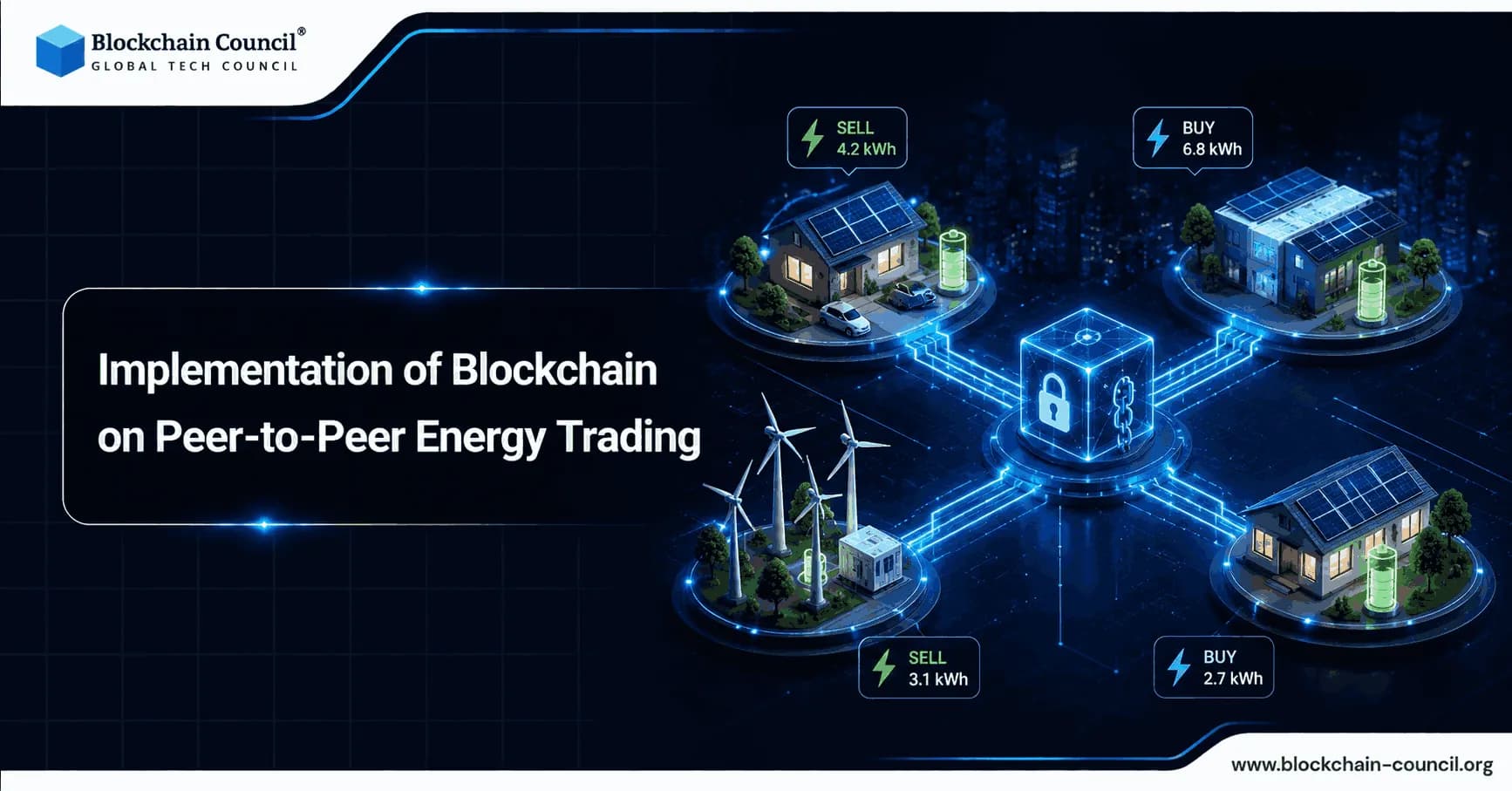
Why Peer-to-Peer Energy Trading Needs Blockchain
Millions of homes now generate their own electricity through rooftop solar, yet most of that excess power still flows back through a centralized utility instead of directly to a neighbor who could use it. Blockchain is changing that equation quickly: the global blockchain in energy trading market is projected to grow from roughly $2.6 billion in 2026 to over $31 billion by 2035, expanding at a compound annual rate near 32%, driven almost entirely by rising demand for decentralized, peer-to-peer electricity exchange. In Europe and North America, more than 40% of residential renewable energy producers are already participating in some form of peer-to-peer trading, a figure that has climbed sharply as smart meters, distributed solar, and blockchain infrastructure have matured together.
For anyone responsible for implementing a system like this, understanding blockchain's underlying mechanics is the necessary starting point. A recognized Certified Blockchain Expert credential gives energy professionals, utility engineers, and project leads the technical foundation needed to move from concept to working implementation with real confidence.

What Peer-to-Peer Energy Trading Actually Solves
Traditional electricity markets route every transaction through a centralized utility acting as the sole intermediary between producers and consumers, even when a home with rooftop solar and a neighbor a few doors down could trade directly. Peer-to-peer energy trading, enabled by blockchain, removes that intermediary layer entirely. Consumers and prosumers, people who both produce and consume electricity, can buy and sell excess power directly, negotiating price and volume in near real time without a utility company brokering every kilowatt-hour.
This shift solves three chronic problems in energy markets: it gives small-scale renewable producers a direct, fair market for their surplus power; it improves grid resilience by distributing energy production and consumption across many local participants instead of a single centralized source; and it creates verifiable, tamper-proof records of exactly how much energy moved between which parties, at what time, and at what price.
The Technical Architecture Behind a Blockchain-Based Trading Platform
Core System Components
Implementing peer-to-peer energy trading on blockchain requires several components working together as a coordinated system:
Smart meters installed at each participant's location, measuring real-time energy production and consumption with enough granularity to support minute-by-minute or even second-by-second trading.
A distributed ledger that records every energy transaction permanently and transparently, giving all participants a shared, verifiable view of the market without relying on a central authority.
Smart contracts that automatically execute trades once agreed conditions are met, matching buyers and sellers, calculating pricing, and settling payment without manual intervention.
An oracle layer connecting real-world energy data, such as actual grid consumption and production readings, to the blockchain, since smart contracts cannot independently verify physical, off-chain events.
A user-facing application or dashboard, giving participants visibility into their energy production, consumption, trading history, and available balance.
Choosing the Right Blockchain Model
Not every blockchain implementation suits energy trading equally well. Three architectural choices dominate current deployments:
Permissioned (private) blockchains restrict participation to verified, authorized parties, such as a specific utility's customers or a defined microgrid community. This model favors regulatory compliance and faster transaction processing, since fewer nodes need to reach consensus.
Public blockchains allow open participation from anyone, maximizing transparency and decentralization, though often at the cost of slower transaction speeds and higher energy consumption for the blockchain layer itself, depending on the consensus mechanism used.
Consortium blockchains sit between the two, governed jointly by multiple utilities, regulators, or community organizations, balancing broader participation with the structured oversight energy markets typically require.
Most real-world peer-to-peer energy trading pilots favor permissioned or consortium models specifically because energy markets are heavily regulated, and utilities need assurance that only verified participants can transact on the network.
Actually building and deploying this kind of multi-layered system, smart meters, smart contracts, oracle integration, and a working front end, requires genuine hands-on development skill, not just conceptual familiarity with blockchain. A Certified Blockchain Developer credential is built specifically to close that gap, giving developers the practical expertise needed to build a trading platform that actually functions under real grid conditions.
Step-by-Step Implementation Process
Phase 1: Market Design and Regulatory Alignment
Before any code is written, implementation teams need to define the actual market structure the platform will support. This includes deciding whether trading will happen in real time or through periodic settlement windows, how pricing will be determined (fixed rates, dynamic auction-based pricing, or a hybrid model), and which regulatory bodies need to approve the platform before it can operate. Regulatory uncertainty remains one of the most commonly cited barriers to adoption, particularly in emerging markets where clear rules for decentralized energy trading are still being written.
Phase 2: Infrastructure and Smart Meter Deployment
Reliable peer-to-peer trading depends entirely on accurate, tamper-resistant energy data. This phase involves installing or upgrading smart meters capable of granular, verifiable readings, and establishing the oracle infrastructure that feeds this real-world data onto the blockchain securely. Any weakness at this stage, whether from meter tampering or unreliable data feeds, undermines the trustworthiness of every transaction built on top of it.
Phase 3: Smart Contract Development and Testing
Development teams build the smart contracts that will govern trade matching, pricing, and settlement. This requires extensive testing on a testnet before deployment, simulating realistic trading volumes, peak demand scenarios, and edge cases like a participant's energy production dropping unexpectedly mid-transaction. A completed pilot involving dairy farms participating in a peer-to-peer energy simulation demonstrated the practical value of this careful testing, reducing electricity costs by roughly 30% and cutting peak demand by close to 24%, while increasing energy sales by 37% compared to a baseline scenario without peer-to-peer trading.
Phase 4: Pilot Deployment and Community Onboarding
Rather than launching platform-wide, most successful implementations start with a contained pilot, often a single microgrid, neighborhood, or community energy cooperative. This allows the implementation team to monitor real-world performance, gather participant feedback, and identify technical or usability issues before scaling further. Community engagement matters enormously here, since adoption depends on participants actually trusting and understanding a system that may feel unfamiliar compared to a traditional utility bill.
Phase 5: Scaling and Grid Integration
Once a pilot proves stable, implementation shifts toward integrating the platform with broader grid infrastructure, connecting with utility systems, expanding smart meter coverage, and potentially linking the platform to renewable energy certificate tracking or carbon credit markets. Established platforms in this space have shown what scaled implementation looks like in practice, with one leading platform reporting over 1.2 million renewable energy certificates traded in a single month, alongside a 30-minute application processing time and administrative cost reductions of up to 72% compared to traditional REC verification processes.
Real-World Deployments Already Running at Scale
More than 300 peer-to-peer energy trading projects are currently active globally, concentrated most heavily in North America, Europe, and the Asia-Pacific region, though adoption is expanding well beyond those established markets. A few examples illustrate how differently implementation can look depending on regional needs.
Established Markets
In Europe and North America, peer-to-peer trading has grown fastest among residential renewable energy producers, supported by dense smart grid infrastructure and relatively mature regulatory frameworks for distributed energy resources. The commercial sector currently drives close to half of all blockchain-based energy trading activity in these regions, largely through operational efficiency gains and cost optimization at scale.
Emerging Market Pilots
Kenya and South Africa are piloting blockchain-based energy trading platforms specifically aimed at improving rural energy access and grid transparency, addressing a very different problem than the efficiency-focused pilots common in wealthier markets. Brazil has seen notable growth in blockchain energy initiatives as well, reflecting a broader pattern across Latin America of decentralized trading models expanding into regions historically underserved by centralized grid infrastructure.
Middle East Investment
The UAE has set an ambitious target for blockchain integration in its energy trading sector, positioning itself as a regional innovation hub as Gulf states invest heavily in both renewable generation and the digital infrastructure needed to trade it efficiently.
Coordinating an implementation across regulatory environments this different, from established European grids to rural microgrids in emerging markets, takes technical judgment that goes beyond writing smart contracts alone. A structured Tech Certification in blockchain development gives implementation teams the broader systems knowledge needed to adapt a platform's architecture to genuinely different infrastructure and regulatory conditions.
Common Implementation Challenges and How to Address Them
Regulatory Uncertainty
A lack of unified regulation affects a majority of emerging markets attempting blockchain-based energy trading, creating hesitation among investors and utilities alike. Implementation teams generally address this by starting with tightly scoped, permissioned pilots that regulators can observe and evaluate before broader rules are finalized.
Scalability and Transaction Speed
Public blockchain networks can struggle to process the high transaction volume real-time energy trading demands, particularly during peak grid activity. Many implementations address this by using layer-two scaling solutions or shifting to permissioned architectures that can process transactions faster without sacrificing the verifiability that makes blockchain valuable in the first place.
Interoperability With Legacy Grid Systems
Existing utility infrastructure was rarely designed with blockchain integration in mind, and connecting a new peer-to-peer trading layer to decades-old grid management systems can be genuinely difficult. Successful implementations typically build a middleware layer specifically to bridge legacy systems with the new blockchain infrastructure, rather than attempting a full-scale replacement all at once.
Participant Trust and Digital Literacy
Even a technically flawless platform fails if participants do not understand or trust it. Community education, transparent onboarding, and simple, intuitive user interfaces consistently prove just as important to a successful rollout as the underlying blockchain architecture itself.
Final Thoughts
Implementing blockchain-based peer-to-peer energy trading is less about the blockchain itself and more about building a complete, trustworthy system around it: reliable smart meters, well-tested smart contracts, a thoughtfully chosen network architecture, and a regulatory and community engagement strategy suited to the specific market being served. The projects already running at scale, from Powerledger's certificate trading platform to rural pilots in Kenya and South Africa, show this is genuinely working infrastructure today, not a distant experiment.
Getting a community or customer base to actually adopt a system this unfamiliar takes more than solid engineering. That is where a well-rounded Marketing Certification becomes genuinely valuable for utilities and energy platforms rolling out peer-to-peer trading, helping translate a fairly technical shift in how electricity is bought and sold into a story participants can actually understand, trust, and want to join.
FAQs
1. What is blockchain-based peer-to-peer energy trading?
Blockchain-based peer-to-peer energy trading is a system that allows households, businesses, and energy producers to buy and sell electricity directly within a local or distributed marketplace. Blockchain records transactions, verifies ownership, and supports automated settlement without requiring every trade to pass through a traditional centralized intermediary.
2. How does peer-to-peer energy trading work?
Participants equipped with solar panels, wind turbines, batteries, or other distributed energy resources can sell surplus electricity to nearby consumers. Smart meters measure energy production and consumption, while a digital platform matches buyers with sellers and records completed trades.
3. Why is blockchain useful for energy trading?
Blockchain provides a shared, tamper-evident ledger that can record electricity generation, consumption, pricing, ownership, and payments. It improves transparency among producers, consumers, grid operators, utilities, regulators, and energy service providers.
4. How is blockchain implemented in a P2P energy marketplace?
Implementation usually involves:
Smart meters measuring energy flows
IoT devices transmitting meter data
A blockchain network recording verified transactions
Smart contracts matching buyers and sellers
Digital wallets handling payments
Grid systems managing physical electricity delivery
Off-chain databases storing high-volume operational data
The blockchain manages the commercial transaction, while the electrical grid still moves the actual electricity.
5. What role do smart meters play?
Smart meters measure how much electricity each participant generates, consumes, imports, or exports. This information is sent securely to the trading platform, where it is validated and used to calculate energy balances and payments.
6. What are smart contracts in energy trading?
Smart contracts are blockchain programs that automatically execute energy trades according to predefined conditions. They can match supply and demand, calculate prices, confirm meter readings, release payments, enforce trading limits, and distribute fees without extensive manual processing.
7. How does the physical electricity transfer occur?
Electricity continues to move through the existing power grid according to physical network conditions. Blockchain does not direct individual electrons from one home to another. It records the financial and contractual allocation of locally generated energy, because even blockchain has limits and cannot negotiate personally with electrons.
8. How are buyers and sellers matched?
A trading platform can match participants using fixed prices, auctions, dynamic pricing, preference-based rules, or automated market algorithms. Smart contracts then confirm eligible transactions and record settlement details.
9. Can households sell surplus solar power?
Yes. A household with rooftop solar panels may sell excess electricity to neighbors, local businesses, a community energy market, or the utility where regulations permit. Smart meters verify the exported electricity, and the blockchain records the resulting transaction.
10. How are payments processed?
Payments may be made through fiat-linked digital payment systems, stablecoins, utility credits, platform tokens, or conventional banking integrations. Smart contracts can automatically transfer payment after validated energy delivery or meter confirmation.
11. Can blockchain support dynamic energy pricing?
Yes. Smart contracts can adjust prices according to electricity demand, local generation, grid congestion, time of day, weather conditions, or market rules. Dynamic pricing can encourage consumers to shift energy use away from peak periods.
12. How does blockchain support renewable energy?
Blockchain can help small renewable energy producers participate in local markets, verify renewable generation, track clean energy certificates, and receive payment for surplus electricity. This may encourage investment in rooftop solar panels, community batteries, and other distributed energy resources.
13. Can blockchain improve grid stability?
Blockchain-based markets can encourage demand response, battery participation, and local energy balancing. However, grid stability still requires professional system operators, forecasting, protection equipment, and physical network controls. Smart contracts are useful, but they should not be left alone to operate a national power grid like an unsupervised group project.
14. What blockchain platforms can support P2P energy trading?
Potential platforms include:
Ethereum and compatible Layer 2 networks
Hyperledger Fabric
Energy Web Chain
Polygon
Hedera
Corda
Avalanche
Permissioned enterprise blockchain networks
The appropriate choice depends on transaction volume, privacy, governance, cost, and regulatory requirements.
15. What are the benefits of blockchain-based energy trading?
Potential benefits include:
Direct transactions between producers and consumers
Transparent pricing and settlement
Faster automated payments
Better renewable energy integration
Reduced reconciliation work
Greater consumer participation
Improved energy traceability
Support for community energy markets
Tamper-evident transaction records
More efficient use of distributed resources
16. What challenges affect implementation?
Major challenges include electricity regulations, grid access rules, smart-meter availability, cybersecurity, privacy, transaction scalability, interoperability, market governance, consumer protection, and integration with utility billing and control systems.
17. What security risks must be addressed?
Risks include compromised smart meters, manipulated IoT data, stolen wallet keys, smart contract vulnerabilities, privacy leaks, unauthorized system access, and attacks on connected energy infrastructure. Blockchain records cannot rescue a system whose sensors are confidently submitting nonsense.
18. What are the best practices for implementation?
Best practices include using certified smart meters, validating energy data, keeping personal and high-volume information off-chain, auditing smart contracts, applying strong identity and access controls, integrating with grid management systems, complying with energy regulations, and beginning with a controlled community pilot.
19. What trends are shaping P2P energy trading in 2026?
Important trends include community microgrids, virtual power plants, vehicle-to-grid integration, household battery storage, AI-based energy forecasting, tokenized renewable energy certificates, smart-meter expansion, automated demand response, decentralized identity, and local flexibility markets.
20. What is the future of blockchain in peer-to-peer energy trading?
Blockchain could become an important transaction and coordination layer for decentralized energy systems. It can connect households, businesses, electric vehicles, batteries, renewable generators, utilities, and grid operators through transparent and programmable markets.
Its long-term success will depend on regulatory approval, reliable meter data, consumer-friendly applications, scalable infrastructure, and integration with physical grid operations. Blockchain may not replace utilities or electricity markets, but it can help transform consumers into active energy participants who generate, store, buy, and sell power instead of merely receiving another mysterious monthly bill.
Related Articles
View All
Blockchain
Blockchain Certification Programs You Can Join Online
Discover the best blockchain certification programs you can join online. Learn blockchain fundamentals, smart contracts, enterprise blockchain, and career opportunities with globally recognized certifications.

Blockchain
Agile for Blockchain Teams: Managing Sprints, Smart Contracts, and Decentralized Roadmaps
Learn how agile for blockchain teams works when sprints, smart contracts, audits, governance, and decentralized roadmaps are planned around risk.

Blockchain
How to Write a PRD for Blockchain Products: Key Sections, Examples, and Best Practices
Learn how to write a PRD for blockchain products with key sections, practical examples, tokenomics, security, governance, and success metrics.
Trending Articles
The Role of Blockchain in Ethical AI Development
How blockchain technology is being used to promote transparency and accountability in artificial intelligence systems.
AWS Career Roadmap
A step-by-step guide to building a successful career in Amazon Web Services cloud computing.
What is AWS? A Beginner's Guide to Cloud Computing
Everything you need to know about Amazon Web Services, cloud computing fundamentals, and career opportunities.