

Supply Chain Operating Models
 Toshendra Kumar Sharma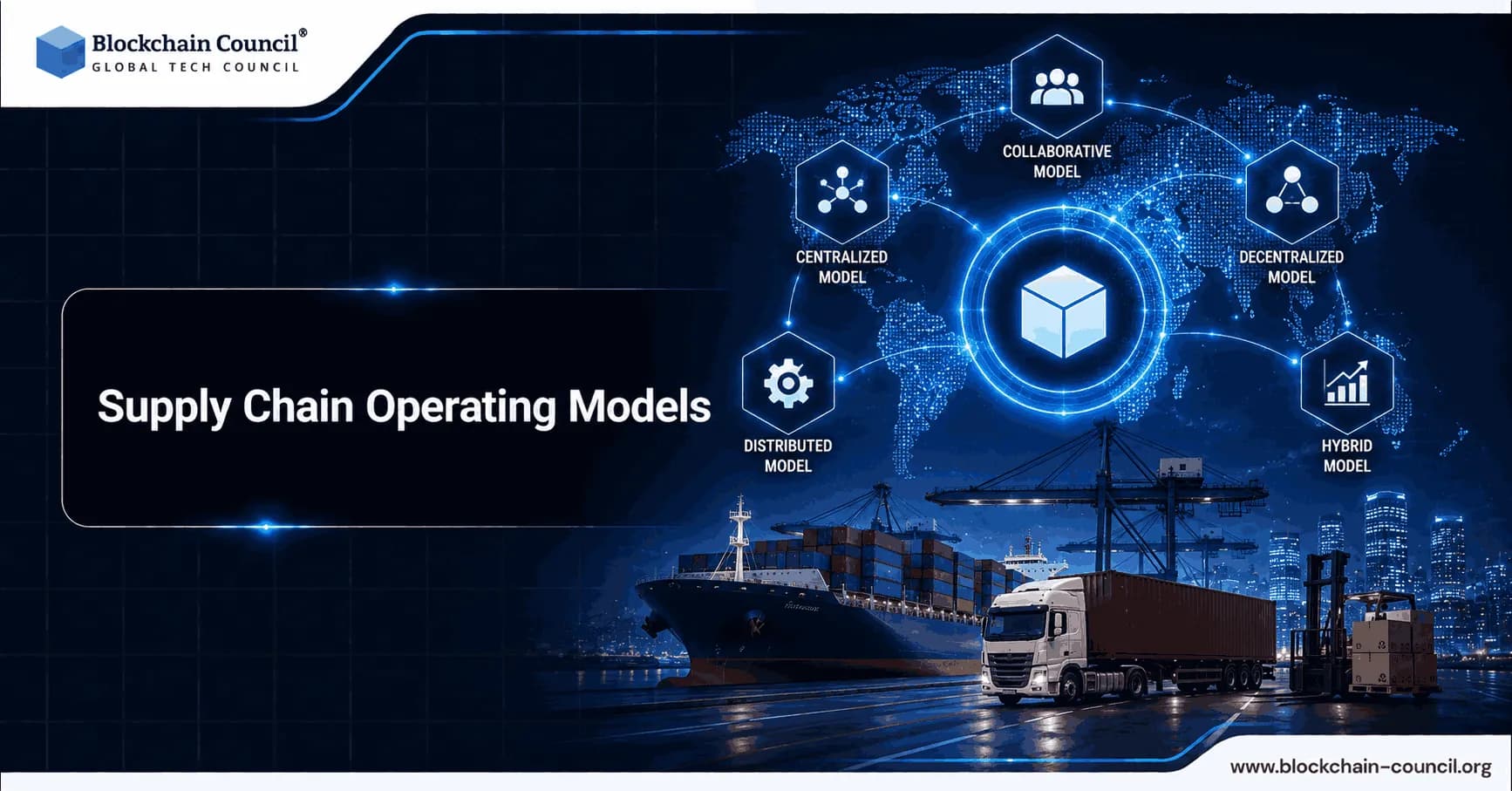
What Is A Supply Chain Operating Model
A supply chain operating model is the underlying structure that determines how a company plans, sources, produces, and delivers goods, along with who makes decisions at each step and how data flows between them. It is less about any single tool and more about the design choices behind an entire network, centralized versus distributed decision-making, siloed systems versus shared data, reactive planning versus real-time visibility. Global investment in digital transformation is projected to reach $3.4 trillion in 2026, and a large share of that spending is going toward rebuilding these operating models rather than simply automating the old ones. For supply chain leaders evaluating where to modernize first, a background like a Certified Blockchain & Supply Chain Professional credential gives a practical framework for understanding which structural changes actually move the needle versus which ones just add complexity.
Why Traditional Operating Models Are Breaking Down
Fragmented Data Across Disconnected Systems
Most legacy supply chains run on data scattered across ERP systems, freight platforms, spreadsheets, email threads, and siloed partner portals that were never designed to talk to each other. That fragmentation is expensive to manage and easy for errors, disputes, or fraud to slip through unnoticed, since no single party has a complete, trusted view of what is actually happening across the network.

Pressure From Every Direction At Once
Supply chains entering 2026 are absorbing geopolitical volatility, shifting trade policy, persistent inflationary cost pressure, and customer expectations for ethical sourcing and fast, reliable delivery all simultaneously. Operating models built for a more predictable era simply were not designed to absorb that many variables changing at once, which is why resilience has become as important a design goal as efficiency.
The Shift Toward Shared, Verifiable Records
Distributed ledger technology directly addresses the fragmentation problem by giving multiple organizations a shared record they can all trust without relying on one central party to reconcile competing versions of the truth. Consortium-style networks, where industry participants agree on shared governance rules, are expected to keep expanding as more sectors standardize around this model rather than each company running its own isolated system. Understanding how to design and govern that kind of shared infrastructure is a specialized skill, and it's part of why a Certified Blockchain Expert credential has become a practical addition for operations leaders who need to speak the same language as the technical teams building these systems.
The Operating Models Reshaping Supply Chains Today
Digital Twin And Simulation-Driven Models
Digital supply chain twins recreate an entire network, including live input from IoT sensors, inside an accessible digital environment. This gives decision-makers a real-time, end-to-end view of everything from customer orders to individual items in transit, and it lets teams test scenarios like a route disruption or a demand spike before committing real inventory or capital to a response.
AI-Driven, Autonomous Operating Models
According to Gartner's 2026 supply chain technology trends, agentic and physical AI are becoming central to how operating models function, with autonomous systems increasingly handling lower-level decisions like adjusting a supplier order or rerouting shipments in response to weather or port delays, freeing human planners to focus on higher-level strategy. Polyfunctional robots and physical AI, which combine machine learning with IoT sensors and automation hardware, are extending this autonomy from planning systems into physical warehouse and logistics operations directly.
Blockchain-Anchored Traceability Models
Blockchain has moved from proof-of-concept into measurable production results. One of the clearest examples comes from a major retailer's blockchain-based traceability system, which cut the time needed to trace produce from farm to store from roughly seven days down to about 2.2 seconds. Across food, pharmaceutical, and other regulated industries, blockchain-enhanced traceability has been shown to cut administrative compliance costs by around 30%, largely by removing the manual reconciliation and paperwork that traditional traceability depended on. Anchoring sensor data and transaction records to a shared ledger also supports faster insurance claims and audits, since the underlying data cannot be quietly altered after the fact.
Supply Chain As A Service Models
Rather than building and maintaining every layer of supply chain infrastructure internally, more companies are shifting toward Supply Chain as a Service models, effectively renting specialized planning, logistics, or visibility capabilities from providers who can operate at a scale and sophistication level a single company would struggle to justify building in-house. This mirrors a broader shift toward composable, API-first operating models, where companies integrate best-in-class tools through cloud-based platforms rather than committing to one monolithic system.
Building and integrating these models well requires genuine technical range, spanning cloud architecture, IoT data pipelines, AI systems, and blockchain infrastructure all at once. That breadth is exactly why a broader Tech Certification has become a valuable credential for supply chain technology leads, since a rollout that only accounts for one layer of this stack tends to create a new silo instead of solving the old ones.
What This Means For How Companies Compete
From Resilience To Total Value
Industry leaders increasingly describe the goal of a modern operating model not just as resilience, but as what some now call total value, a balance between customer experience, operational efficiency, and financial performance rather than optimizing any single one in isolation. Supply chain disruption is now widely treated as structural rather than a temporary cyclical problem, which means the operating model itself has to be built for continuous volatility rather than occasional shocks.
Sustainability Is Now Baked Into The Operating Model
ESG requirements are no longer a separate reporting exercise bolted onto supply chain operations after the fact. Emissions measurement, supplier tracking, and sustainability data are increasingly embedded directly into operational KPIs, meaning the systems used to run day-to-day logistics are the same ones generating the compliance and reporting data regulators and customers now expect.
Communicating The Shift Matters As Much As Building It
None of these structural improvements matter to customers or partners if the change is invisible to them. A faster, more transparent supply chain is a genuine competitive advantage, but only when customers, retail partners, and investors actually understand what changed and why it matters to them. That is a distinct skill from systems architecture, and it's part of why operations and product teams increasingly pair their technical modernization work with a Marketing Certification, ensuring that real operational gains translate into a story customers and partners can actually recognize and value.
Technology & Problem Solving
Technology education is not only about learning tools or programming languages. It also involves understanding problems, analysing information, identifying patterns, and developing logical solutions. A Tech Olympiad gives students an opportunity to develop these problem-solving abilities while exploring different areas of technology.
The Bottom Line
Supply chain operating models are being rebuilt around shared data, autonomous decision-making, and verifiable traceability rather than the siloed, manually reconciled systems most companies have run for decades. Digital twins, AI-driven automation, blockchain-anchored records, and Supply Chain as a Service arrangements are not isolated trends, they are converging into a single, more resilient way of running a network under conditions that are no longer predictable enough for the old model to hold up. The companies pulling ahead are the ones treating this as a genuine structural redesign, not a list of individual tools added on top of a system that was never built to support them.
FAQs
1. What is a supply chain operating model?
A supply chain operating model is the framework that defines how an organization plans, manages, and executes the movement of products, information, and resources across its supply chain. It establishes how responsibilities are divided among procurement, manufacturing, inventory, logistics, distribution, technology, and other functions. An effective operating model connects supply chain activities with business strategy so that decisions about cost, service, resilience, and growth are made consistently rather than independently.
2. Why is a supply chain operating model important?
A supply chain operating model is important because it determines how efficiently a company responds to customer demand while controlling costs and operational risks. Without a clearly defined model, procurement, production, warehousing, logistics, and sales teams may work toward different objectives. A strong model improves coordination, clarifies decision-making authority, establishes accountability, and helps businesses balance customer service with inventory, transportation, manufacturing, and working-capital requirements.
3. What are the main types of supply chain operating models?
Common supply chain operating models include centralized, decentralized, hybrid, regional, global, and network-based models. A centralized model concentrates important decisions within a central supply chain organization, while decentralized models give individual business units or regions greater control. Hybrid models combine central standards and capabilities with local execution. The appropriate structure depends on the company's size, geographic footprint, product portfolio, customer expectations, regulatory environment, and need for operational flexibility.
4. What is a centralized supply chain operating model?
A centralized supply chain operating model places major planning and decision-making responsibilities within a central organization. Procurement strategies, supplier management, inventory policies, technology platforms, and logistics standards may be managed centrally across different business units or regions. Centralization can improve purchasing power, standardization, visibility, and cost control. However, excessive centralization can slow local decision-making and make it harder to respond quickly to regional market conditions or customer requirements.
5. What is a decentralized supply chain operating model?
A decentralized supply chain operating model gives regional teams, business units, or individual markets greater authority over supply chain decisions. Local teams may control sourcing, inventory, manufacturing, logistics, and supplier relationships according to regional requirements. This approach can improve responsiveness and local market knowledge, particularly for companies operating across diverse geographies. The main challenge is maintaining sufficient coordination to prevent duplicated processes, inconsistent technology, fragmented supplier relationships, and unnecessary costs.
6. What is a hybrid supply chain operating model?
A hybrid supply chain operating model combines elements of centralized and decentralized structures. Strategic activities such as technology, supplier standards, data governance, and global procurement may be centrally managed, while regional teams retain authority over execution and market-specific decisions. Many multinational companies use hybrid models because they provide a practical balance between global efficiency and local responsiveness. The difficult part, naturally, is deciding which decisions belong where without creating three committees for every purchase order.
7. How do companies choose the right supply chain operating model?
Companies should choose a supply chain operating model based on business strategy, customer expectations, product characteristics, geographic complexity, supplier networks, regulatory requirements, and risk exposure. A company competing primarily on cost may prioritize standardization and centralization, while a company competing on speed or customization may require greater regional autonomy. The best model is not necessarily the most sophisticated one. It is the model that consistently supports the organization's commercial objectives and can adapt as those objectives change.
8. What is the difference between a supply chain strategy and an operating model?
A supply chain strategy defines what the organization wants its supply chain to achieve, while the operating model explains how those objectives will be delivered. Strategy may prioritize lower costs, faster delivery, resilience, sustainability, or customer responsiveness. The operating model then establishes the organizational structure, processes, technologies, governance, capabilities, and performance measures required to achieve those priorities. In simple terms, strategy defines the destination, while the operating model determines how the organization actually gets there.
9. What are the key components of a supply chain operating model?
A comprehensive supply chain operating model usually covers organizational structure, governance, processes, technology, data, talent, performance management, supplier relationships, and decision rights. It should define who is responsible for planning, sourcing, manufacturing, inventory, logistics, and customer fulfillment. It also determines how information flows between these functions and which decisions are centralized, automated, or delegated. These components need to operate as one system rather than as isolated functional departments.
10. How does technology influence supply chain operating models?
Technology increasingly determines how modern supply chains are structured and managed. Cloud platforms, artificial intelligence, Internet of Things devices, automation, digital twins, blockchain, and advanced analytics can provide real-time visibility and improve decision-making across complex supply networks. Technology can also automate repetitive planning, procurement, warehousing, and logistics activities. However, simply installing new software does not create a modern operating model. Processes, responsibilities, skills, governance, and data quality must evolve alongside the technology.
11. How is AI changing supply chain operating models?
Artificial intelligence is shifting supply chains from largely reactive operations toward more predictive and increasingly autonomous decision-making. AI can analyze demand patterns, supplier performance, inventory positions, transportation conditions, weather, pricing, and external risks to recommend or automate operational decisions. This changes the roles of supply chain teams because employees spend less time manually processing information and more time managing exceptions, scenarios, relationships, and strategic decisions. Human oversight remains important where decisions involve significant financial, regulatory, or customer consequences.
12. What role does supply chain planning play in the operating model?
Supply chain planning connects customer demand with procurement, manufacturing, inventory, and distribution capabilities. The operating model determines whether planning is conducted globally, regionally, locally, or through a combination of these approaches. Integrated planning can help organizations identify capacity shortages, inventory imbalances, supplier constraints, and demand changes earlier. Modern planning models increasingly use real-time data and scenario analysis rather than relying exclusively on periodic forecasts that may already be outdated by the time someone finishes presenting them.
13. How does an operating model improve supply chain resilience?
A resilient operating model gives organizations the visibility, decision rights, supplier options, inventory policies, and contingency processes needed to respond to disruption. Companies can design alternative sourcing strategies, regional production capacity, backup transportation routes, and strategic inventory buffers for critical materials. The objective is not to eliminate every disruption, which is impossible, but to reduce the time required to detect problems, evaluate alternatives, make decisions, and restore operations.
14. How do supply chain operating models support sustainability?
Supply chain operating models can incorporate sustainability directly into sourcing, manufacturing, logistics, packaging, inventory, and supplier-management decisions. Organizations can assign responsibility for emissions reduction, ethical sourcing, circular-economy programs, waste reduction, and environmental reporting. Sustainability becomes more effective when it is embedded into everyday operational decisions rather than managed as a separate corporate initiative. Data platforms and product traceability systems can also help companies measure environmental performance across suppliers and logistics networks.
15. What is a digital supply chain operating model?
A digital supply chain operating model uses connected technologies and data to coordinate planning and execution across the supply network. It can combine cloud platforms, AI, IoT sensors, automation, digital twins, advanced analytics, and real-time data integration. Instead of relying heavily on spreadsheets, emails, and disconnected systems, digital operating models create greater visibility across suppliers, factories, warehouses, transportation providers, and customers. The goal is faster and more accurate decision-making rather than digitizing inefficient processes exactly as they already exist.
16. What are the biggest challenges in transforming a supply chain operating model?
The biggest challenges often involve organizational change rather than technology. Companies may struggle with unclear decision rights, fragmented data, legacy systems, competing departmental objectives, limited digital skills, and resistance to new processes. Global organizations also need to balance standardization with local requirements. Successful transformation therefore requires leadership alignment, clear governance, measurable objectives, technology integration, workforce development, and realistic implementation stages rather than attempting to redesign the entire supply chain in one heroic corporate initiative.
17. How can supply chain operating models reduce costs?
An effective operating model can reduce costs by improving procurement coordination, inventory utilization, production planning, warehouse operations, transportation efficiency, and supplier management. Better visibility helps companies avoid excessive inventory, emergency freight, duplicated purchasing, unused capacity, and inefficient logistics routes. Centralizing selected activities can also increase purchasing leverage and eliminate redundant work. Cost reduction should nevertheless be balanced with service and resilience, since the cheapest possible supply chain can become extremely expensive when a single disruption stops it from functioning.
18. How should companies measure supply chain operating model performance?
Companies should evaluate performance using measures connected to customer service, cost, inventory, delivery reliability, working capital, productivity, quality, resilience, and sustainability. The exact measures should reflect the organization's strategic priorities rather than relying on generic industry metrics. Performance management should also examine end-to-end outcomes because optimizing one function can damage another. For example, reducing inventory may improve working capital while simultaneously increasing stockouts and lost sales if the decision is made without considering customer demand and supply variability.
19. What supply chain operating model trends are important in 2026?
In 2026, supply chain operating models are increasingly shaped by AI-assisted planning, autonomous workflows, regionalization, multi-sourcing, digital twins, real-time visibility, advanced robotics, control towers, sustainability requirements, and geopolitical risk management. Companies are also reconsidering highly centralized global networks in favor of more flexible combinations of global scale and regional resilience. Another important trend is the development of human-plus-AI operating models, where technology handles increasingly complex analysis while people retain responsibility for strategic judgment, relationships, exceptions, and governance.
20. What is the future of supply chain operating models?
The future of supply chain operating models is likely to be more connected, predictive, automated, resilient, and adaptive. Companies will increasingly use AI and real-time data to identify demand changes, supply disruptions, inventory problems, and logistics constraints before they become major operational failures. Decision-making will move closer to real time, while digital platforms will connect suppliers, manufacturers, logistics providers, distributors, and customers more closely.
The strongest future operating models will not simply pursue maximum efficiency. They will balance cost, speed, resilience, sustainability, customer experience, and risk. That balance matters because recent supply chain disruptions have demonstrated that a network optimized exclusively for efficiency can be wonderfully inexpensive right up until something goes wrong.
Ultimately, a successful supply chain operating model determines not only how products move from suppliers to customers, but also how quickly an organization can understand change and respond to it. In an increasingly unpredictable business environment, adaptability is becoming as important as efficiency.
Related Articles
View All
Blockchain
Zero-Knowledge Proofs for Tax Compliance: Verifying Taxpayer Information Without Exposing Sensitive Data
Zero-Knowledge Proofs (ZKPs) could make tax compliance more privacy-preserving by allowing taxpayers to prove specific claims, such as income falling within a required range or eligibility for a deduction, without exposing an entire tax return. MIT’s zkTax prototype demonstrates this approach using digitally signed tax records, selective disclosure, and independently verifiable proofs. Such systems could reduce unnecessary exposure of sensitive financial and personal information while preserving auditability and verification.

Blockchain
Blockchain Certification Programs You Can Join Online
Discover the best blockchain certification programs you can join online. Learn blockchain fundamentals, smart contracts, enterprise blockchain, and career opportunities with globally recognized certifications.

Blockchain
Agile for Blockchain Teams: Managing Sprints, Smart Contracts, and Decentralized Roadmaps
Learn how agile for blockchain teams works when sprints, smart contracts, audits, governance, and decentralized roadmaps are planned around risk.
Trending Articles
The Role of Blockchain in Ethical AI Development
How blockchain technology is being used to promote transparency and accountability in artificial intelligence systems.

Top 5 DeFi Platforms
Explore the leading decentralized finance platforms and what makes each one unique in the evolving DeFi landscape.
Claude AI Tools for Productivity
Discover Claude AI tools for productivity to streamline tasks, manage workflows, and improve efficiency.