

South Korea to Increase Investments in Blockchain as Compared to 2018
 Toshendra Kumar Sharma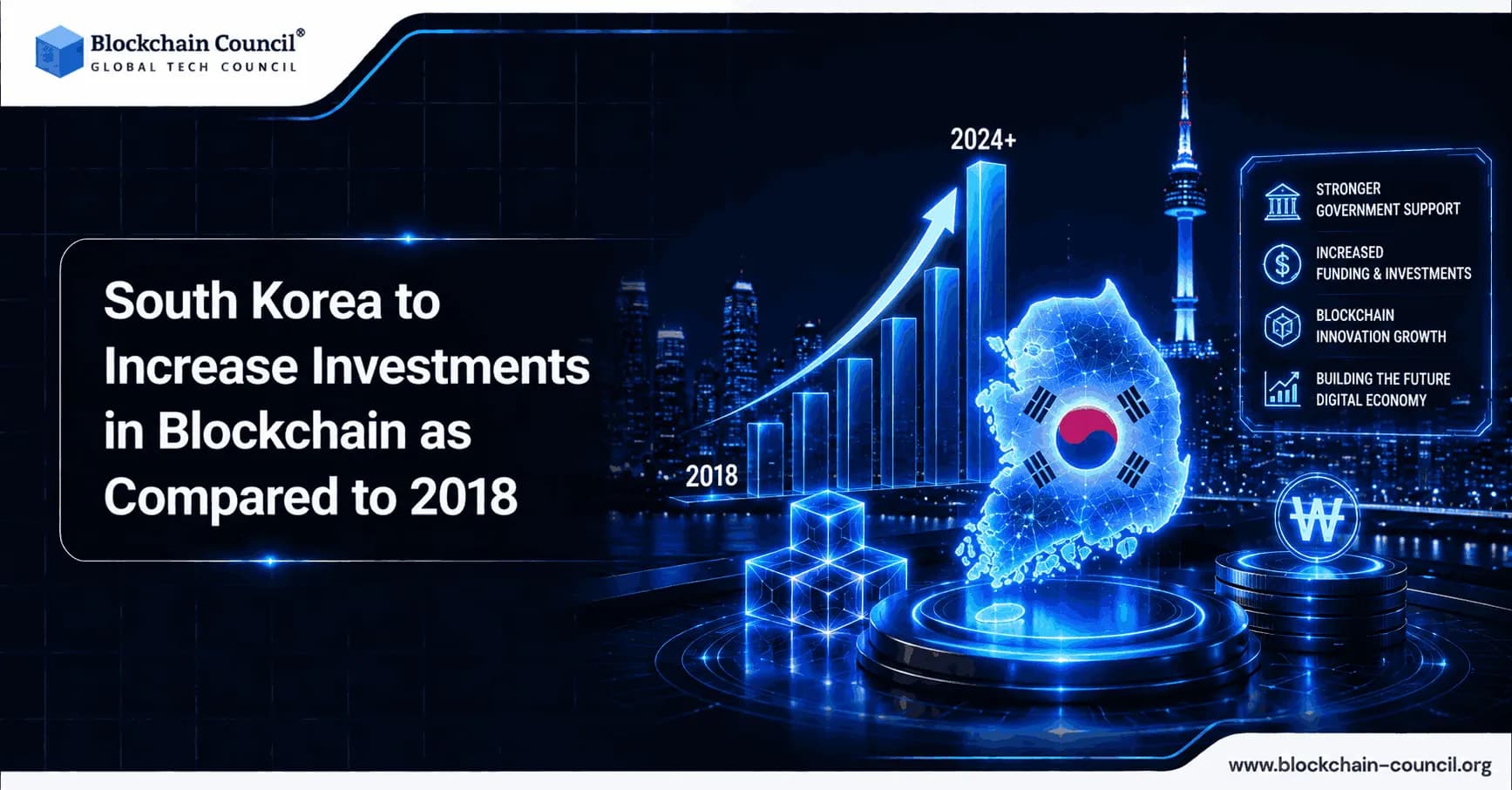
South Korea's relationship with blockchain technology has undergone a genuine reversal since 2018. That year is remembered in the crypto industry mainly for South Korea's crackdown era, tightened exchange rules, a ban on initial coin offerings, and a government posture that treated the technology with real suspicion following the speculative excess of that period. In July 2026, the country's Ministry of Economy and Finance announced the opposite approach entirely, unveiling plans to actively foster the blockchain economy as part of its official growth strategy for the second half of the year, including large-scale blockchain pilot projects and new legislation designed to strengthen South Korea's competitiveness in the global digital asset ecosystem. For professionals trying to understand what this shift actually means on the ground, the Certified Blockchain Expert credential offers a structured way to build real technical grounding before evaluating the opportunity this policy reversal represents.
The scale of this shift becomes clearer when placed alongside South Korea's broader fiscal picture. The government set total 2026 expenditure at 728.0 trillion won, up 8.1 percent from 2025, marking the steepest budget increase in four years, while the national research and development budget alone climbed 11.2 percent to a record 39.5 trillion won. Blockchain is not the single largest line item inside that spending increase, artificial intelligence and semiconductors dominate the headline numbers, but it has been formally restored to the center of the country's digital economic strategy after years of comparatively cautious positioning.

From Restriction in 2018 to Active Investment in 2026
Understanding the significance of this shift requires understanding just how differently South Korea approached blockchain policy less than a decade ago.
The 2018 Posture Was Defined by Caution and Restriction
In 2018, South Korean regulators were primarily focused on containing the risks associated with speculative crypto trading, implementing real-name banking requirements for exchanges and maintaining a formal ban on initial coin offerings that remained in place for years afterward. Blockchain technology itself was not rejected outright, some limited pilot funding for enterprise and public-sector blockchain applications existed even then, but the dominant policy energy of that period went into restriction and risk containment rather than active promotion.
The 2026 Posture Is Built Around Active Promotion
That contrast could not be sharper today. South Korea's Finance Ministry has outlined plans to promote large-scale blockchain pilot projects, expand blockchain use in financial infrastructure, and advance a Digital Asset Basic Act specifically designed to give the private digital asset sector a clear legal framework rather than an ambiguous, restriction-first regulatory environment. The government has also indicated it will allow companies to invest in cryptocurrencies, with specific restrictions maintained around stablecoins, a level of institutional openness that would have been genuinely difficult to imagine during the 2018 crackdown era.
What South Korea's 2026 Blockchain Push Actually Includes
The policy shift is not simply rhetorical. Several concrete initiatives are already moving through South Korea's government pipeline.
The Digital Asset Basic Act
The proposed Digital Asset Basic Act, in development since mid-2025 and expected to advance toward enactment in the second half of 2026, is designed to lay out a foundational legal framework for digital asset businesses, including rules of business conduct and a formal structure for Korean won-backed stablecoins. This kind of comprehensive legislation stands in direct contrast to the more piecemeal, restriction-oriented regulatory approach that characterized the years immediately following 2018.
Tokenized Government Bonds and CBDC Integration
South Korea plans to launch a pilot project tokenizing government bonds linked to an institutional central bank digital currency project, slated for 2027, with the Bank of Korea examining interoperability between its CBDC infrastructure and other blockchain networks. Legal amendments to the Capital Markets Act and the Electronic Act, scheduled to take effect in February 2027, will give blockchain-based ledgers formal recognition as security registries, a genuinely significant legal milestone that treats blockchain infrastructure as legitimate financial market plumbing rather than an experimental sideshow. Officials are separately studying the tokenization of state-owned real estate, potentially allowing retail investors to participate in and share returns from state property for the first time. Building the kind of applications and infrastructure this policy shift will require is exactly where a credential like the Certified Blockchain Developer becomes genuinely relevant, since South Korea's expanding blockchain economy will need real engineering talent capable of building compliant, production-grade systems, not just theoretical blockchain knowledge.
Deposit Tokens for Public Spending
South Korea's Ministry of Economy and Finance began testing blockchain-based deposit tokens for government spending in the fourth quarter of 2026, replacing traditional government purchasing cards with programmable, blockchain-based payments that can carry built-in restrictions on spending timing and categories. This follows an earlier pilot involving electric vehicle charging subsidies, and the new phase is being implemented first in Sejong, the country's administrative capital, under a 2026 regulatory sandbox program that temporarily exempts the pilot from standard payment regulations while its effectiveness gets tested. The government has also moved to modernize its 76-year-old National Property Act specifically to classify virtual currencies and intellectual property as formal national assets, updating a management framework that predates the existence of digital assets entirely.
Why the Shift Matters for Businesses and Investors
South Korea's renewed blockchain investment carries real, practical implications for anyone evaluating the country as a market or operating base.
Clearer rules for won-backed stablecoins and a forthcoming regulatory framework for spot crypto exchange-traded funds could meaningfully increase legal certainty and institutional participation, addressing exactly the kind of regulatory ambiguity that made businesses cautious about operating in South Korea's digital asset space during the years following the 2018 crackdown. The country's roadmap increasingly shows blockchain policy moving beyond simple exchange regulation and toward stablecoins, tokenized public finance, and institutional-grade digital asset infrastructure, a genuinely different strategic posture than treating blockchain purely as a speculative trading risk to be managed.
Building the Technical Talent to Support This Growth
None of these ambitious pilot programs succeed without a real talent pipeline capable of building and maintaining the underlying technical infrastructure.
South Korea's blockchain economy plans depend on genuine technical execution, tokenized bond settlement systems, CBDC interoperability layers, and programmable deposit token infrastructure all require sophisticated, production-grade engineering work, not just policy documents. Programs under Tech Certification help engineers and technical teams build exactly this kind of applied expertise, covering the broader systems and security discipline needed to build the kind of resilient, compliant blockchain infrastructure South Korea's government pilots will require as they move from sandbox testing toward full-scale deployment.
Future-Ready Skills
As technology becomes increasingly important across industries, students need opportunities to develop future-ready skills early in their education. A World Tech Olympiad can introduce students to areas such as artificial intelligence, coding, cybersecurity, robotics, and computational thinking while encouraging curiosity and continuous learning.
The kind of structured, technical curiosity these students build early positions the next generation of South Korean and global talent to step directly into the blockchain, AI, and digital infrastructure roles this national investment strategy is actively creating.
Communicating This Opportunity to Global Investors
South Korea's blockchain resurgence is happening alongside a much larger national push into artificial intelligence and semiconductors, and clearly communicating where blockchain fits within that broader strategy matters for any business or investor trying to evaluate the opportunity accurately.
While AI and semiconductor investment dominate the headline figures in South Korea's 2026 economic plan, the blockchain initiatives running alongside them, tokenized government bonds, CBDC interoperability, and a comprehensive digital asset legal framework, represent a genuine, if smaller, piece of a much larger technology-led growth strategy. Explaining that context accurately, without either overstating blockchain's share of the investment or understating the genuine policy shift it represents, requires real communication skill. A Marketing Certification can help professionals and firms operating in this space present South Korea's blockchain opportunity honestly to international investors and partners, building the kind of accurate, trustworthy narrative that supports genuine long-term engagement with the market.
The Bottom Line on South Korea's Blockchain Investment Shift
South Korea's approach to blockchain has moved decisively from the restriction-first posture of 2018 toward active, government-backed investment and legislative support in 2026. The Digital Asset Basic Act, tokenized government bond pilots linked to CBDC infrastructure, programmable deposit tokens for public spending, and a modernized national asset framework that formally recognizes virtual currencies together represent a genuinely different strategic relationship with the technology than the one defined by the 2018 crackdown era. While artificial intelligence and semiconductors remain the dominant priorities in South Korea's broader economic strategy, blockchain has been restored to a real, funded place within that agenda, creating genuine opportunity for businesses, developers, and investors willing to engage with a market that has clearly moved past its earlier caution.
FAQs
1. Why was South Korea increasing its investment in blockchain compared with 2018?
South Korea viewed blockchain as an important emerging technology capable of supporting digital transformation, data security, and new business models. In its 2019 innovation investment plan, the government significantly increased funding for areas including blockchain, big data, and AI compared with 2018.
2. How much did South Korea plan to invest in blockchain in 2019?
South Korea announced plans to invest approximately 40 billion won in blockchain technology in 2019, about three times the investment planned for 2018. The broader innovation program covered blockchain alongside other technologies and industries.
3. Why did South Korea consider blockchain important?
The South Korean government considered blockchain a technology capable of improving data management, security, transparency, and digital transactions. It also saw blockchain as part of the wider technological transformation associated with the Fourth Industrial Revolution.
4. Was South Korea investing in blockchain or cryptocurrencies?
The investment plans primarily focused on blockchain technology and its applications, rather than simply purchasing or promoting cryptocurrencies. The government was interested in using distributed ledger technology for industries, public services, data management, and innovation.
5. What was South Korea's 2019 blockchain investment strategy?
The strategy focused on developing blockchain capabilities, creating an early domestic market, supporting research and development, encouraging businesses, and developing skilled professionals. South Korea's Blockchain Technology Development Strategy was formally introduced in June 2018 as part of its broader blockchain industry development efforts.
6. How much did blockchain-related investment increase compared with 2018?
According to South Korea's 2018 government investment plan, the blockchain allocation associated with the digital platform initiative was planned to rise from approximately 6.8 billion won in 2018 to 130 billion won in 2019, a substantial increase. This figure should be understood as part of the government's broader platform-economy investment framework rather than as the entire national blockchain budget.
7. What industries could benefit from South Korea's blockchain investment?
Potential applications included finance, logistics, public administration, identity management, document verification, healthcare, and other digital services. Seoul, for example, announced plans for blockchain-powered public services including electronic voting and paperless verification of documents and credentials.
8. How was blockchain expected to support South Korea's digital economy?
Blockchain could provide a shared and tamper-evident way to manage information and transactions among multiple participants. South Korea's government specifically connected blockchain with the development of a digital platform economy and stronger data-management security.
9. Did South Korea plan to develop blockchain talent?
Yes. Workforce development was an important part of the strategy. The government planned programs to train thousands of specialists across promising technology sectors, while its blockchain strategy also included professional training and support for developing the domestic blockchain ecosystem.
10. How did Seoul support blockchain development?
Seoul introduced a five-year plan that included blockchain business complexes, training centers, and funding for blockchain startups. The city planned to spend 60.3 billion won by 2021 on two business complexes and proposed a 100 billion-won public-private fund for blockchain startups by 2022.
11. Did South Korea want to become a blockchain hub?
Yes. In 2018, South Korean government officials publicly discussed developing the country into a blockchain hub and creating successful commercial applications of the technology. The objective was to strengthen South Korea's position in an emerging global technology market.
12. How did blockchain investment relate to South Korea's Fourth Industrial Revolution strategy?
Blockchain was treated as one of several technologies associated with the Fourth Industrial Revolution. Government initiatives sought to combine emerging technologies with business and public-sector applications to increase productivity, innovation, and economic competitiveness.
13. Did South Korea's blockchain investment focus only on large companies?
No. Government programs also aimed to encourage startups, research institutions, and smaller businesses. Proposed blockchain legislation included provisions for startup support, research and development, professional training, and assistance for small and medium-sized blockchain companies.
14. Why was blockchain investment important despite cryptocurrency market volatility?
The government's blockchain strategy was broader than cryptocurrency speculation. Blockchain was being evaluated as an underlying technology for data management, authentication, transactions, public services, and new digital infrastructure, meaning its potential could be considered separately from short-term cryptocurrency prices.
15. Did South Korea's blockchain strategy continue after 2019?
Yes. South Korea continued developing blockchain policies and initiatives after the initial 2018 strategy. In 2020, the Ministry of Science and ICT announced an updated Blockchain Technology Diffusion Strategy focused on practical adoption, decentralized identifiers, corporate support, and next-generation blockchain technologies.
16. What role did blockchain play in South Korea's public services?
Blockchain was explored for applications such as identity verification, electronic voting, document authentication, and other services where data integrity and trust are important. The country's later blockchain diffusion strategy specifically highlighted decentralized identifiers and public-sector applications.
17. Did South Korea increase blockchain research and development spending?
Yes. Later budget planning continued to allocate resources to blockchain R&D. In 2019, South Korean reporting indicated that blockchain R&D funding was planned to increase significantly, including support for blockchain platforms and consensus-algorithm research.
18. What were the main goals of South Korea's blockchain investment?
The major goals included building a domestic blockchain ecosystem, developing technical competitiveness, supporting startups and businesses, training skilled professionals, encouraging practical applications, and establishing a foundation for long-term industry growth.
19. Did increased government investment guarantee blockchain adoption in South Korea?
No. Government funding can accelerate research, infrastructure, and experimentation, but successful adoption also depends on technology maturity, business demand, regulation, interoperability, security, and user acceptance. Investment creates opportunities but does not automatically guarantee commercial success.
20. What can other countries learn from South Korea's blockchain investment strategy?
South Korea's approach demonstrates the value of combining government funding with research, workforce development, startup support, public-sector pilots, and long-term technology strategies. Its experience also shows that blockchain policy needs to distinguish the potential of blockchain infrastructure from the volatility and risks associated with individual cryptocurrencies.
Related Articles
View All
Blockchain
Beyond Cryptocurrency: How Blockchain Is Transforming Real-World Industries
Explore how blockchain works beyond cryptocurrency in banking, supply chains, healthcare, tokenisation, CBDCs, and government, plus key challenges and career paths.
Blockchain
Smart Contracts & dApps: How Blockchain Becomes Programmable
Learn how smart contracts and dApps make blockchain programmable, from Ethereum and tokens to DeFi, NFTs, real use cases, benefits, and key risks.

Blockchain
Behind the Blocks: How Blockchain Transactions Actually Work
Go behind the blocks to see how a blockchain transaction really works: wallets and keys, digital signatures, verification, hashing, blocks, consensus, proof of work vs proof of stake, and how miners and validators secure the network.
Trending Articles
AWS Career Roadmap
A step-by-step guide to building a successful career in Amazon Web Services cloud computing.
What is AWS? A Beginner's Guide to Cloud Computing
Everything you need to know about Amazon Web Services, cloud computing fundamentals, and career opportunities.

Can DeFi 2.0 Bridge the Gap Between Traditional and Decentralized Finance?
The next generation of DeFi protocols aims to connect traditional banking with decentralized finance ecosystems.