

Sony’s new patent in Blockchain Technology giving way to new age education system
 Toshendra Kumar Sharma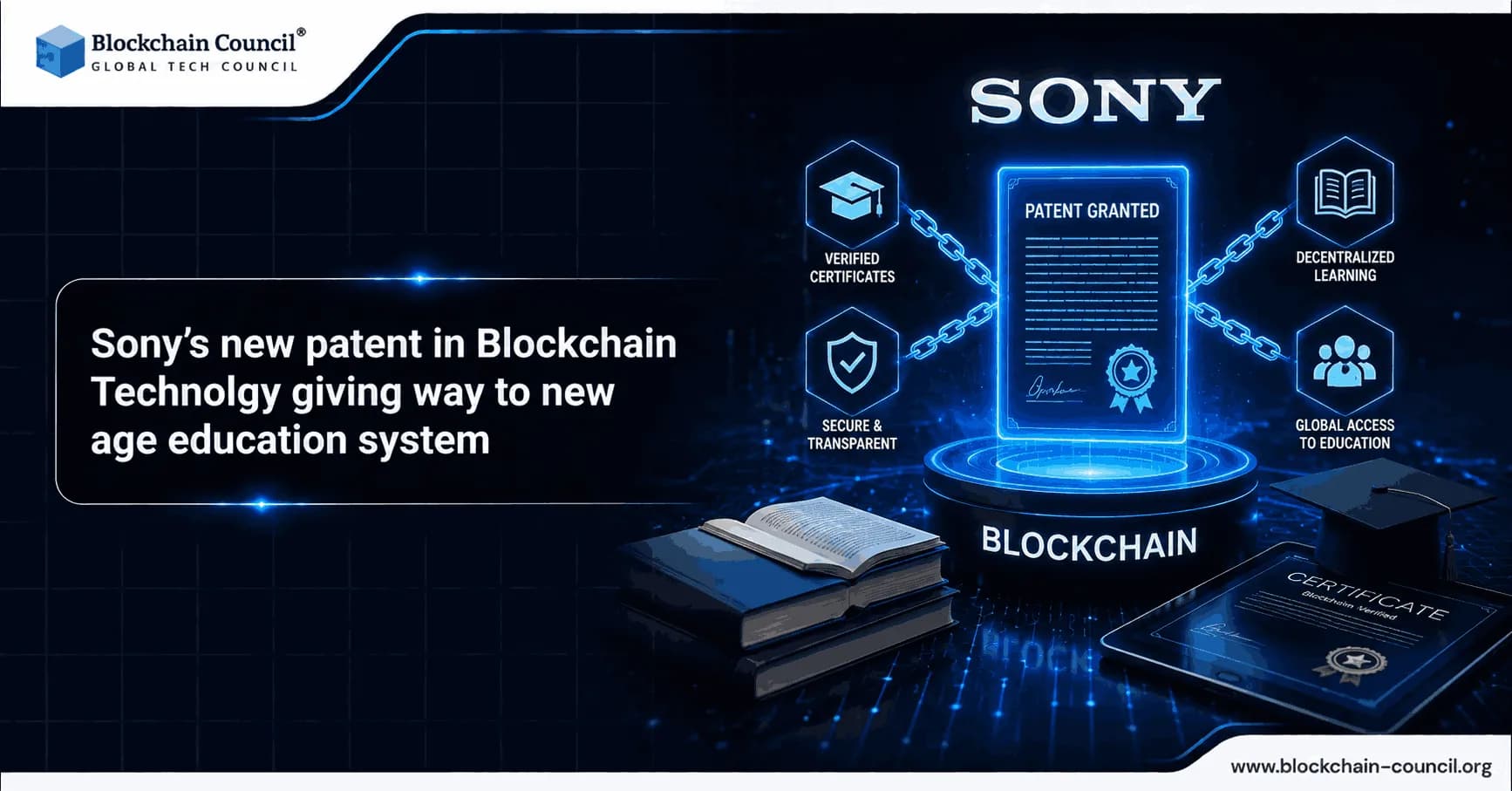
Academic fraud is more common than most people assume industry estimates suggest that somewhere between 17% and 30% of resumes submitted globally contain at least one falsified or misrepresented academic credential. That gap between what people claim and what they can actually prove is exactly the problem Sony set out to solve when it filed a patent for a blockchain-based education platform, developed in partnership with IBM. Years later, that early filing looks less like a one-off experiment and more like an early blueprint for where credential verification was always headed a direction the education sector is now moving toward at scale, with the global blockchain-in-education market valued at roughly $3.4 billion in 2026 and projected to grow at a compound annual rate approaching 45% over the next several years.
For anyone trying to understand how a patent like this actually translates into real-world infrastructure, it helps to have a working grasp of blockchain fundamentals first. A recognized Certified Blockchain Expert credential is a common starting point for professionals who want to move from "I've heard of this" to genuinely understanding how systems like Sony's are built.

What Sony's Patent Actually Proposed
Sony's application, titled "Electronic Apparatus, Method for Electronic Apparatus and Information Processing System," described a system that uses blockchain as a shared, trusted ledger for storing a student's educational history courses completed, certificates earned, degrees awarded in a format the company referred to as a kind of digital transcript.
The core idea was straightforward but powerful: instead of a student's records living in a single institution's database (which a third party has to contact and trust every time verification is needed), the records live on a distributed ledger that authorized parties teachers, administrators, and even the students themselves can access and validate directly. Sony described these authorized participants as "nodes" on the network, each able to confirm or contribute to a student's verified educational history.
Notably, the patent also referenced concepts like smart contracts and smart property, suggesting that knowledge and credentials could eventually be treated almost like transferable digital assets exchanged, verified, and transacted through the same blockchain infrastructure. Sony later built on this foundation with a related blockchain-based digital rights management system, expanding the same underlying framework to cover e-books, scientific data, and other forms of educational content.
Why This Kind of System Matters for Education
Traditional academic verification is slow and manual. An employer or university checking a candidate's degree often has to contact the issuing institution directly, wait for a response, and trust that the paperwork hasn't been altered along the way. Sony's blockchain-based approach was designed to solve several problems at once:
Tamper-proof records Once a credential is recorded and validated on the chain, it can't be quietly edited or forged.
Instant third-party verification Employers or other institutions can confirm a credential's authenticity without waiting on a manual response from the issuing school.
Reduced administrative overhead Institutions spend less time responding to verification requests, since the data is already accessible to authorized parties.
Portable academic identity Because the record isn't tied to one institution's private database, students retain access to a verifiable history of their education as they move between schools, countries, or employers.
To build platforms with this level of complexity verified identity, distributed access, and blockchain-native record-keeping technical teams need real depth beyond conceptual familiarity. That's exactly the gap a Certified Blockchain Developer credential is built to close, covering the practical skills behind building and securing systems like the one Sony described.
How the Broader Education Sector Has Caught Up
Sony's patent wasn't an isolated idea it turned out to anticipate exactly where the education technology sector was heading. In the years since, blockchain-based credentialing has moved from patent filings into active deployment:
Blockchain-based credential verification adoption has climbed roughly 40% over the past few years as institutions look for more reliable alternatives to manual checks.
Blockchain-secured verification systems can cut academic fraud significantly while also compressing verification turnaround time from days down to minutes in many implementations.
Over 820 million micro-credentials, certificates, and degrees were issued globally in a single recent year, creating real operational pressure for scalable, interoperable verification infrastructure precisely the kind of system Sony's patent envisioned.
The broader blockchain-in-education market is forecast to grow from roughly $3.4 billion in 2026 to well over $60 billion within the next decade, driven by rising credential fraud, growing global student mobility, and demand for systems that work across institutions and borders.
That said, adoption still has room to run only a modest share of institutions currently report a full working understanding of blockchain technology, which remains one of the biggest brakes on faster rollout.
Turning a system like this into something institutions and students will actually trust and adopt isn't just an engineering challenge it also depends on how well the value is explained to non-technical stakeholders: school administrators, parents, and hiring managers who've never had to evaluate a blockchain platform before. That's where a well-structured Tech Certification becomes valuable for product and implementation teams, giving them enough technical fluency to translate the architecture into terms institutional decision-makers can evaluate confidently.
What This Means for the Future of Academic Credentials
Sony's early work, alongside similar initiatives from institutions like MIT and the University of Melbourne, helped establish blockchain-based credentialing as a credible, working model rather than a theoretical use case. The direction this is heading points toward a few clear shifts:
Micro-credentials becoming verifiable by default Short courses, certifications, and skill badges recorded on-chain from the moment they're issued.
Cross-border recognition becoming simpler A blockchain-based record doesn't need to be re-verified from scratch every time a student or employee crosses a border or changes institutions.
AI-assisted analysis of verified records Once academic histories are structured and reliably verified on-chain, institutions can apply analytics to spot curriculum gaps or personalize learning paths with far more confidence in the underlying data.
Smart-contract-based scholarship and tuition disbursement Payments and financial aid released automatically once verified milestones, like course completion, are met.
Final Thoughts
Sony's blockchain education patent looked, at the time, like an interesting but early experiment. Looking back from 2026, it reads more like an accurate forecast of where academic credentialing was always going to end up verifiable, portable, and free from the slow manual checks that have defined the system for generations. As more institutions and platforms build on this same foundation, the organizations that explain this shift clearly to students, employers, and administrators will be the ones that drive real adoption. That's a genuine opportunity for teams pairing technical development with a solid Marketing Certification, turning a genuinely complex piece of infrastructure into something institutions and the public can actually understand and trust.
FAQs
1. What is Sony's blockchain patent for education?
Sony has explored blockchain-related patents and technologies aimed at securely managing educational records, digital rights, learning data, and academic credentials. While patents demonstrate research and innovation, they do not necessarily indicate that a commercial product has been launched.
2. Why is blockchain important for education?
Educational institutions manage vast amounts of sensitive information, including student records, certificates, transcripts, diplomas, attendance, and assessments. Blockchain can improve the security, authenticity, transparency, and portability of these records.
3. How does blockchain work in education?
Blockchain records cryptographic proofs, timestamps, and verification data for educational credentials on a distributed ledger. Rather than storing complete student records on-chain, most implementations keep sensitive data in secure off-chain databases while using blockchain to verify authenticity.
4. How can blockchain improve digital certificates?
Blockchain enables educational institutions to issue tamper-resistant digital certificates that employers, universities, and licensing bodies can verify instantly without relying on manual verification processes.
5. Can blockchain prevent fake degrees?
Yes. Blockchain can make academic credential fraud more difficult by providing verifiable digital records of issued certificates and diplomas. Organizations can independently confirm whether a credential was issued by an authorized institution.
6. How does blockchain improve student record management?
Blockchain creates secure verification records for academic achievements, transcripts, certifications, attendance, and course completions, making it easier for students to share trusted credentials across institutions and employers.
7. Can students control their academic records?
Yes. Blockchain-based digital identity systems can enable students to manage and selectively share verified educational credentials while maintaining greater control over their personal information.
8. How does blockchain support lifelong learning?
Blockchain can store verifiable records of degrees, professional certifications, online courses, vocational training, workshops, and continuing education throughout a person's career, creating a portable lifelong learning profile.
9. Can blockchain improve online education?
Yes. Blockchain can verify course completion, issue digital certificates, authenticate instructors, secure examination records, and support trusted credential verification for online learning platforms.
10. How does blockchain improve employer verification?
Employers can quickly verify educational credentials through blockchain-based systems without contacting universities directly, reducing hiring delays and helping detect fraudulent qualifications.
11. Which educational institutions can benefit from blockchain?
Schools, universities, colleges, vocational training centers, online learning platforms, certification providers, corporate training organizations, government education agencies, and research institutions can all benefit from blockchain-based credential management.
12. Which blockchain platforms are suitable for education?
Common blockchain platforms explored for education include Ethereum, Hyperledger Fabric, Polygon, Hedera, Solana, Avalanche, and other enterprise or permissioned blockchain networks designed for secure credential management.
13. What are the advantages of blockchain in education?
Benefits include secure digital credentials, reduced certificate fraud, faster verification, improved record portability, stronger data integrity, enhanced privacy, simplified administration, transparent audit trails, and better collaboration between educational institutions and employers.
14. What challenges exist when implementing blockchain in education?
Challenges include integration with legacy student information systems, regulatory compliance, privacy protection, implementation costs, interoperability, governance, scalability, staff training, and standardization across institutions.
15. Can blockchain replace universities or teachers?
No. Blockchain is a supporting technology for managing educational records and credentials. It cannot replace educators, academic institutions, curriculum development, classroom learning, or student engagement.
16. What common mistakes should educational institutions avoid?
Common mistakes include storing sensitive student information directly on public blockchains, neglecting encryption, overlooking privacy regulations, failing to audit smart contracts, ignoring interoperability standards, and implementing blockchain without solving a clearly defined educational challenge.
17. What are best practices for implementing blockchain in education?
Best practices include storing personal data off-chain, recording only cryptographic proofs on-chain, implementing decentralized identity (DID), following international credential standards, conducting regular security audits, integrating with existing student information systems, and complying with education and data protection regulations.
18. How does blockchain fit into digital education?
Blockchain complements artificial intelligence (AI), cloud computing, learning management systems (LMS), digital identity, online assessments, educational analytics, virtual classrooms, and credential verification platforms to modernize education.
19. What trends are shaping blockchain in education in 2025-2026?
Major trends include decentralized identity (DID), verifiable digital credentials, AI-powered personalized learning, blockchain-secured academic records, lifelong learning passports, micro-credentials, tokenized educational achievements, zero-knowledge proofs (ZKPs), cross-border credential recognition, and enterprise workforce certification platforms.
20. What is the future of blockchain in education?
Blockchain is expected to play an increasingly important role in modern education by improving credential verification, student mobility, lifelong learning, and institutional efficiency. Rather than replacing existing educational systems, blockchain will likely integrate with learning platforms, digital identity solutions, and student information systems to create more secure and portable academic records. Patents from companies like Sony highlight growing interest in these possibilities, but widespread adoption will depend on collaboration between technology providers, educational institutions, and regulators. After all, a diploma is most valuable when proving it is genuine takes seconds instead of weeks.
Related Articles
View All
Blockchain
Blockchain Train Technology: Rail Use Cases, Benefits, and Limits
Blockchain train technology is moving from pilots to practical rail use cases in freight, ticketing, asset records, IoT security, and audit trails.

Blockchain
Why Companies Are Investing in Blockchain Technology?
Explore why companies are investing in blockchain technology to reduce costs, improve trust, secure data, modernize payments, and create new business models.

Blockchain
Blockchain Certification Programs You Can Join Online
Discover the best blockchain certification programs you can join online. Learn blockchain fundamentals, smart contracts, enterprise blockchain, and career opportunities with globally recognized certifications.
Trending Articles
The Role of Blockchain in Ethical AI Development
How blockchain technology is being used to promote transparency and accountability in artificial intelligence systems.
How Blockchain Secures AI Data
Understand how blockchain technology is being applied to protect the integrity and security of AI training data.
How to Install Claude Code
Learn how to install Claude Code on macOS, Linux, and Windows using the native installer, plus verification, authentication, and troubleshooting tips.