

Proof-of-Work versus Proof-of-Stake
 Toshendra Kumar Sharma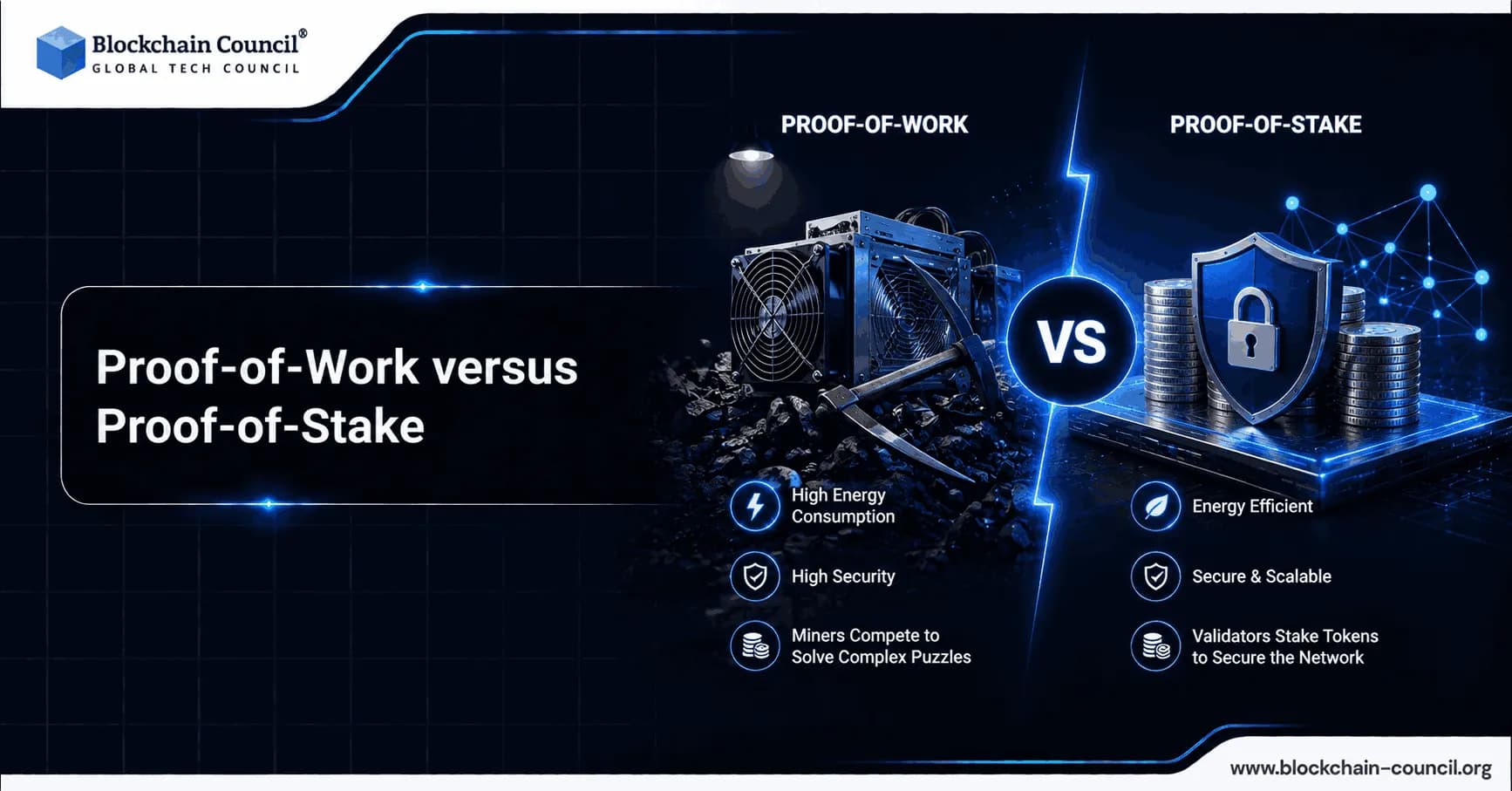
Every blockchain needs a way to get thousands of strangers, scattered across the globe, to agree on a single version of the truth without a bank, government, or company sitting in the middle to referee. Two mechanisms have emerged as the dominant answers to that problem: Proof-of-Work (PoW), the system securing Bitcoin's roughly 900+ exahash-per-second network, and Proof-of-Stake (PoS), now securing over $100 billion in staked value across Ethereum alone. These aren't just technical footnotes they represent two fundamentally different philosophies for building trust into a decentralized system, and the choice between them shapes everything from a network's energy footprint to who can realistically participate in securing it.
Understanding the real trade-offs between these two models not just the marketing pitch for either one starts with a solid grounding in cryptocurrency fundamentals. A Certified Cryptocurrency Expert credential is a practical starting point for anyone comparing these systems seriously, whether for investing, building, or simply making sense of an industry that increasingly runs on both.

How Each Model Actually Works
Proof-of-Work PoW secures a network through raw computational competition. Miners race to solve a cryptographic puzzle by testing enormous numbers of possible solutions using specialized hardware, and whoever finds a valid answer first earns the right to add the next block and collect the reward. The security comes directly from cost: rewriting past transactions would require redoing an enormous, prohibitively expensive amount of computational work, making tampering economically irrational. Bitcoin remains the definitive example, with its network difficulty adjusting automatically to keep block production steady regardless of how much total computing power is competing.
Proof-of-Stake PoS secures a network through economic risk instead of computational cost. Rather than competing with raw hardware power, participants lock up ("stake") a set amount of the network's native cryptocurrency as collateral. The protocol then selects a validator typically weighted by stake size to propose the next block, while other validators verify it's valid. If a validator behaves dishonestly, a portion of their staked funds is destroyed through a penalty called "slashing." Ethereum is the largest live example, having fully transitioned from Proof-of-Work to Proof-of-Stake in September 2022.
Both systems solve the same underlying problem achieving decentralized consensus without a central authority but they get there through very different incentive structures, and that difference cascades into nearly every other point of comparison below.
Building a genuinely well-rounded understanding of blockchain architecture means going beyond consensus mechanisms alone. A Certified Blockchain Expert credential gives professionals the broader technical context smart contracts, network design, cryptography needed to evaluate why a project chose one consensus model over the other in the first place.
Head-to-Head: Where the Two Models Actually Differ
Energy consumption This is the most cited difference, and for good reason. Bitcoin's Proof-of-Work network consumes an estimated 138 to 180 TWh of electricity annually comparable to a mid-sized country's total power usage because computational competition is the entire security mechanism. Proof-of-Stake networks like Ethereum, by contrast, consume a small fraction of that, since validators don't need to run power-intensive hardware around the clock to compete for blocks; they simply need to stay online and honest.
Hardware and entry barriers Competitive Bitcoin mining today requires specialized ASIC hardware, with leading machines achieving efficiency levels near 9.5 to 13.5 joules per terahash equipment that's expensive, quickly outdated, and generally impractical for casual participants. Proof-of-Stake lowers the hardware barrier significantly; running an Ethereum validator mainly requires the staking minimum (32 ETH for a solo validator) and a reasonably modest computer setup, rather than industrial-grade mining rigs.
Capital requirements PoW's barrier to entry is largely hardware and electricity cost. PoS shifts that barrier toward capital: you need enough of the native asset to stake, which for solo Ethereum validators runs into tens of thousands of dollars at current prices though liquid staking pools have made smaller-scale participation far more accessible by combining many users' funds to meet that threshold collectively.
Decentralization dynamics Both models face real centralization pressure, just from different directions. In Bitcoin mining, a small number of large mining pools control a majority of network hashrate, since scale and cheap electricity access naturally concentrate mining power. In Ethereum staking, liquid staking protocols have seen similar concentration, with a single dominant platform managing more than 60% of the entire liquid staking market a dynamic the Ethereum community is actively working to address through protocol-level changes.
Transaction throughput and finality Proof-of-Stake networks generally achieve faster block finality, since validator attestation doesn't require the same computational race that Proof-of-Work does. This is one reason many newer, high-throughput blockchains have chosen PoS or PoS-derived models from the outset rather than adopting Proof-of-Work.
Security track record Proof-of-Work has the longer real-world track record Bitcoin's network has operated continuously since 2009 without a successful large-scale attack, largely because the cost of overpowering the network's hashrate has grown so large it's economically irrational. Proof-of-Stake has a shorter track record at Bitcoin's scale, though Ethereum's multi-year, multi-hundred-billion-dollar operation under PoS has demonstrated the model can secure enormous real-world value reliably, with genuine but statistically rare slashing incidents.
Weighing the Trade-Offs in the Middle of the PoW vs. PoS Debate
Neither model is objectively "better" each makes different trade-offs that suit different priorities:
Factor | Proof-of-Work | Proof-of-Stake |
|---|---|---|
Energy use | Very high | Low |
Entry barrier | Hardware and electricity cost | Staking capital requirement |
Security basis | Computational cost | Economic penalty (slashing) |
Historical track record | Longest-running, battle-tested | Growing, proven at large scale |
Centralization risk | Mining pool concentration | Liquid staking protocol concentration |
Transaction speed | Generally slower | Generally faster |
Neither column is a clean win. PoW advocates point to its long, uninterrupted security record and resistance to certain theoretical attack vectors that don't map cleanly onto PoS systems. PoS advocates point to dramatically lower environmental impact and broader accessibility for everyday participants who can't compete with industrial mining operations.
Deploying either consensus model correctly whether launching a new blockchain, running validator or mining infrastructure, or evaluating a network's real security posture requires genuine technical depth. A structured Tech Certification in blockchain development gives engineers and technical decision-makers the grounding to evaluate these systems on their actual architecture, not just their marketing narrative.
Why Some Networks Choose One Over the Other
Bitcoin stays on Proof-of-Work largely because its community values the model's long security track record and views the computational cost as a feature, not a flaw a deliberate, unforgeable "cost of trust" that's difficult to replicate through any other mechanism. Changing Bitcoin's consensus model at this point would also require overwhelming community consensus, which is unlikely given how central PoW is to Bitcoin's identity and security philosophy.
Ethereum moved to Proof-of-Stake specifically to address energy consumption and scalability concerns that had grown increasingly difficult to justify as the network's user base and environmental scrutiny both expanded. The 2022 transition, widely referred to as "The Merge," is generally regarded as one of the most technically complex upgrades ever executed on a live blockchain network of that scale, and it succeeded without any disruption to the network's transaction history.
Most newer blockchains launch directly on Proof-of-Stake today, largely because it offers faster transaction speeds, dramatically lower energy costs, and a more accessible entry point for a broader base of participants advantages that matter more for newer networks trying to establish themselves than PoW's longer track record does.
Final Thoughts
Proof-of-Work and Proof-of-Stake represent two genuinely different answers to the same hard problem: how do you get a decentralized network to trust itself without a central authority? PoW earns that trust through the brute economic cost of computation; PoS earns it through the direct financial risk validators take on with their own staked capital. Bitcoin's continued commitment to PoW and Ethereum's successful migration to PoS both stand as proof that either approach can secure enormous real-world value the right choice depends on what a given network is actually trying to optimize for.
For projects and platforms operating in this space, explaining these trade-offs clearly to users, investors, and partners is just as important as choosing the right model in the first place. That's where a solid Marketing Certification becomes genuinely valuable, helping teams translate consensus mechanism trade-offs into messaging that a non-technical audience can actually follow and use to make informed decisions.
FAQs
1. What is the difference between Proof-of-Work (PoW) and Proof-of-Stake (PoS)?
Proof-of-Work (PoW) and Proof-of-Stake (PoS) are two blockchain consensus mechanisms used to validate transactions and secure decentralized networks.
Proof-of-Work relies on miners solving cryptographic puzzles using specialized computing hardware.
Proof-of-Stake relies on validators who lock (stake) cryptocurrency as collateral to participate in block validation.
Both aim to achieve decentralized consensus but use different methods and incentives.
2. How does Proof-of-Work work?
In Proof-of-Work, miners compete to solve complex mathematical puzzles. The first miner to find a valid solution earns the right to add a new block to the blockchain and receives block rewards and transaction fees.
Examples: Bitcoin, Litecoin, Dogecoin.
3. How does Proof-of-Stake work?
In Proof-of-Stake, participants stake cryptocurrency to become validators. The protocol selects validators to propose and validate blocks according to its rules. Honest validators may receive rewards, while dishonest behavior can result in penalties such as slashing.
Examples: Ethereum, Cardano, Solana, Avalanche.
4. Which is more energy efficient?
Proof-of-Stake is generally far more energy efficient than Proof-of-Work because it does not require miners to perform continuous computational work using energy-intensive hardware.
5. Which is more secure?
Both mechanisms can provide strong security when properly implemented.
Proof-of-Work derives security from computational cost and energy expenditure.
Proof-of-Stake derives security from economic incentives, where validators risk losing their staked assets if they violate protocol rules.
Security depends on network design, decentralization, implementation quality, and community participation rather than the consensus mechanism alone.
6. Which is more decentralized?
Neither mechanism is inherently more decentralized.
PoW can become concentrated among large mining operations with access to inexpensive electricity and specialized hardware.
PoS can become concentrated if a small number of validators or staking providers control a significant portion of the staked assets.
Both systems require careful protocol design to encourage decentralization.
7. Which offers faster transactions?
Many Proof-of-Stake blockchains are designed to achieve faster block production and transaction finality than traditional Proof-of-Work networks. However, transaction speed depends on the specific blockchain's architecture rather than the consensus mechanism alone.
8. What hardware is required?
Proof-of-Work: Specialized ASIC miners or, on some networks, GPUs.
Proof-of-Stake: A standard server or computer capable of running validator software, or participation through delegated staking or staking pools.
9. How are participants rewarded?
Proof-of-Work miners receive:
Block rewards
Transaction fees
Proof-of-Stake validators may receive:
Staking rewards
Transaction fees
Other protocol-defined incentives
Reward structures vary by blockchain.
10. What are the environmental impacts?
Proof-of-Work consumes substantial electricity because miners continuously perform computational work. Proof-of-Stake typically has a much lower energy footprint because it does not depend on large-scale mining operations.
11. What is slashing?
Slashing is a penalty mechanism used by many Proof-of-Stake networks. Validators who act dishonestly or violate protocol rules may lose part of their staked cryptocurrency.
Proof-of-Work generally does not use slashing because miners instead bear costs through hardware investment and electricity consumption.
12. Which cryptocurrencies use PoW and PoS?
Proof-of-Work:
Bitcoin
Litecoin
Dogecoin
Monero
Proof-of-Stake:
Ethereum
Cardano
Solana
Avalanche
Polkadot
Cosmos
Tezos
Near Protocol
13. What are the advantages of Proof-of-Work?
Benefits include:
Long-established security model
Proven resistance against many attack types
High decentralization potential
Strong network resilience
Simple incentive structure
Extensive real-world track record
14. What are the advantages of Proof-of-Stake?
Benefits include:
Lower energy consumption
Reduced hardware requirements
Faster transaction processing on many networks
Greater scalability potential
Easier participation through staking
Lower environmental impact
Flexible governance models
15. What are the disadvantages of each?
Proof-of-Work challenges:
High energy consumption
Expensive mining equipment
Hardware centralization risks
Higher operational costs
Proof-of-Stake challenges:
Validator concentration
Staking centralization
Governance complexity
Slashing risks
Evolving security models
16. What common misconceptions exist?
Common misconceptions include:
PoS is automatically more secure than PoW.
PoW is obsolete because it uses more energy.
PoS completely eliminates centralization risks.
One consensus mechanism is universally better.
In reality, each approach involves trade-offs that suit different blockchain goals.
17. What are best practices for users?
Whether using PoW or PoS networks:
Research the blockchain before participating.
Use secure wallets.
Protect private keys and recovery phrases.
Understand validator or mining risks.
Keep software updated.
Learn local tax and regulatory requirements.
Diversify investments where appropriate.
18. How do PoW and PoS fit into blockchain technology?
Both consensus mechanisms work with distributed ledgers, cryptographic hashing, public key cryptography, networking protocols, and smart contracts to maintain secure, decentralized blockchain systems.
19. What trends are shaping blockchain consensus in 2025-2026?
Major trends include liquid staking, restaking, hybrid consensus models, zero-knowledge proofs (ZKPs), modular blockchain architectures, AI-powered validator optimization, decentralized identity (DID), sustainable mining initiatives, cross-chain interoperability, and energy-efficient blockchain infrastructure.
20. Which consensus mechanism is better?
Neither Proof-of-Work nor Proof-of-Stake is universally superior. Proof-of-Work remains highly regarded for its proven security model and resilience, while Proof-of-Stake offers greater energy efficiency and often improved scalability. The most appropriate choice depends on the blockchain's objectives, security requirements, governance model, and intended use cases. As the blockchain ecosystem evolves, both mechanisms are likely to coexist, each serving different applications and communities. In technology, as in life, there is rarely a perfect solution. There are only trade-offs, carefully disguised as innovation.
Related Articles
View All
Blockchain
Zero-Knowledge Proofs for Tax Compliance: Verifying Taxpayer Information Without Exposing Sensitive Data
Zero-Knowledge Proofs (ZKPs) could make tax compliance more privacy-preserving by allowing taxpayers to prove specific claims, such as income falling within a required range or eligibility for a deduction, without exposing an entire tax return. MIT’s zkTax prototype demonstrates this approach using digitally signed tax records, selective disclosure, and independently verifiable proofs. Such systems could reduce unnecessary exposure of sensitive financial and personal information while preserving auditability and verification.

Blockchain
Blockchain Certification Programs You Can Join Online
Discover the best blockchain certification programs you can join online. Learn blockchain fundamentals, smart contracts, enterprise blockchain, and career opportunities with globally recognized certifications.

Blockchain
Agile for Blockchain Teams: Managing Sprints, Smart Contracts, and Decentralized Roadmaps
Learn how agile for blockchain teams works when sprints, smart contracts, audits, governance, and decentralized roadmaps are planned around risk.
Trending Articles

Top 5 DeFi Platforms
Explore the leading decentralized finance platforms and what makes each one unique in the evolving DeFi landscape.
Claude AI Tools for Productivity
Discover Claude AI tools for productivity to streamline tasks, manage workflows, and improve efficiency.
How to Install Claude Code
Learn how to install Claude Code on macOS, Linux, and Windows using the native installer, plus verification, authentication, and troubleshooting tips.