

Can Blockchain Improve Digital Identification?
 Toshendra Kumar Sharma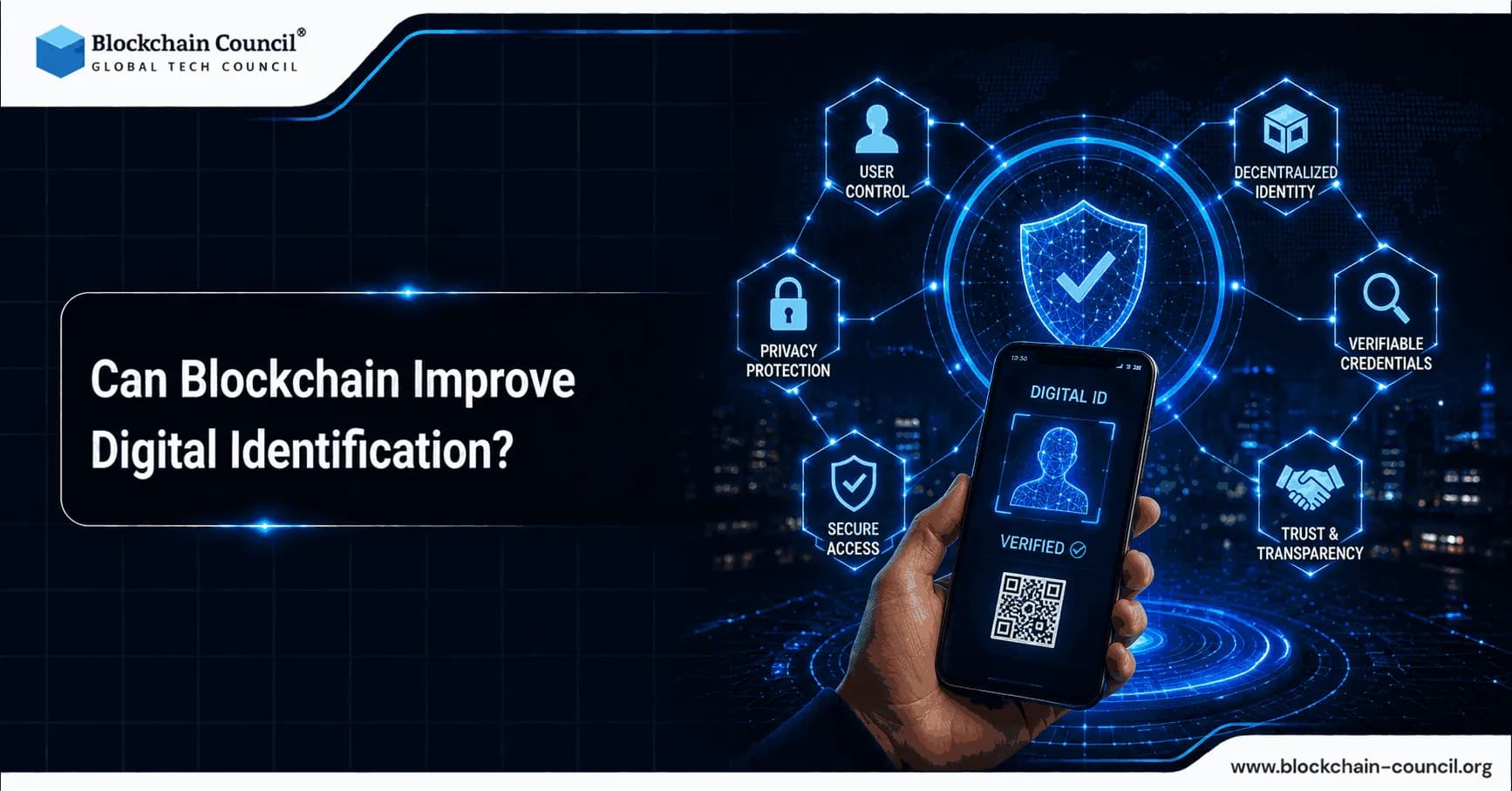
Most people assume their digital identity is something handed to them: a government database entry, a social media login, a corporate account they don't actually control. That assumption is getting harder to defend. Centralized identity systems keep failing the people they're supposed to protect, with data breaches exposing billions of records and platforms revoking access without much recourse for the person affected. Blockchain-based identity is emerging as a genuine structural alternative rather than a theoretical one, with the self-sovereign identity market alone projected to nearly double in a single year, moving from roughly $3.5 billion to $6.6 billion in 2026. For professionals trying to understand where this shift is actually heading, a Certified Blockchain Expert background offers a solid technical foundation for evaluating identity systems built on distributed ledgers rather than a single company's servers.
Why Traditional Digital Identity Keeps Breaking Down
The core weakness in most digital identity systems today is concentration. A government agency, bank, or platform holds a centralized copy of a person's identifying information, which makes that single database an obvious and valuable target. When it's breached, the damage is immediate and often irreversible, since a stolen date of birth or national ID number can't simply be reset the way a password can. Beyond breaches, centralized identity creates a quieter problem: individuals have little meaningful control over who accesses their information, how long it's retained, or what it gets used for once it leaves their hands.

Regulators have started responding at scale. The EU's eIDAS 2.0 regulation now legally requires every member state to issue European Digital Identity wallets by the end of 2026, putting privacy-preserving, selective-disclosure identity tools in the hands of roughly 450 million people. In the United States, mobile driver's licenses built on similar cryptographic principles are already accepted at hundreds of TSA checkpoints across more than a dozen states. Security teams building and auditing these systems increasingly hold a Certified Blockchain Security Professional credential, since securing an identity system where the user holds their own keys requires a genuinely different threat model than securing a traditional centralized login database.
How Blockchain-Based Identity Actually Works
Blockchain doesn't replace identity verification with something looser or less rigorous, it restructures who holds the information and how it gets confirmed. A few core building blocks make this possible.
Decentralized identifiers (DIDs). Instead of an identity tied to a specific company's database, a DID is a unique identifier a person controls directly, anchored to a blockchain rather than any single institution's servers. Losing access to one platform doesn't mean losing the identifier itself.
Verifiable credentials. These are tamper-evident digital versions of real-world credentials, a driver's license, a university degree, a professional certification, cryptographically signed by the issuing authority and storable in a person's own digital wallet rather than scattered across dozens of separate accounts.
Selective disclosure. This is arguably the most practical privacy upgrade blockchain identity offers. Rather than handing over an entire ID document to prove a single fact, a person can cryptographically prove they're over eighteen, or that they hold a valid professional license, without revealing their exact birthdate or any other unrelated detail on the document.
The digital trust triangle. Most self-sovereign identity systems run on three roles working together: an issuer who creates and signs a credential, a holder who stores it in their own wallet, and a verifier who checks its authenticity against the blockchain record, all without needing to contact the original issuer directly for every single verification.
Where Adoption Is Actually Happening
This isn't confined to pilot projects anymore. Recent market research indicates that more than 65% of enterprises are now actively considering blockchain for identity verification, and roughly 72% of financial institutions are integrating decentralized identity systems specifically to combat fraud. Government and public sector adoption has surged by around 75% over the past two years alone, and demand for self-sovereign identity models has climbed nearly 60% as digital transactions keep increasing across every sector. Healthcare systems are using verifiable credentials to let patients control access to their medical history, and financial inclusion programs have used portable, blockchain-anchored credit histories to give people in underbanked regions a verifiable financial record for the first time.
Building systems that actually deliver on this promise requires real fluency across cryptography, distributed systems, and standards like decentralized identifiers and verifiable credentials simultaneously. That's why a broader Tech Certification has become a common investment for teams working in this space, since a blockchain identity project that only understands one layer of that stack tends to produce a system that's technically sound but practically unusable.
The Honest Limitations
Blockchain identity is gaining real momentum, but it isn't a finished technology. Scalability remains a genuine constraint for public blockchain networks handling identity verification at national scale, which is part of why many government and enterprise deployments favor permissioned or hybrid architectures over fully public chains. Usability is another persistent hurdle: managing private keys is unfamiliar and unforgiving for most people, and losing access to a wallet without a recovery mechanism can mean losing an identity entirely, a much higher-stakes failure than forgetting a password. Interoperability between different identity frameworks and jurisdictions is still evolving too, meaning a credential issued in one system doesn't always verify cleanly in another yet. And regulatory frameworks, while accelerating, still vary significantly by country, which complicates any identity system meant to work across borders.
Turning Identity Infrastructure Into Something People Actually Adopt
None of this technology matters if the people it's meant to serve don't trust it or understand why it's better than what they already use. Explaining decentralized identifiers and selective disclosure to a non-technical audience, in a way that builds genuine confidence rather than confusion, is a distinct skill from building the underlying protocol. Organizations rolling out blockchain-based identity products increasingly pair that technical work with a Marketing Certification, recognizing that adoption ultimately depends on clear, credible communication just as much as it depends on cryptographic soundness.
Technology & Problem Solving
Technology education is not only about learning tools or programming languages. It also involves understanding problems, analysing information, identifying patterns, and developing logical solutions. A Tech Olympiad gives students an opportunity to develop these problem-solving abilities while exploring different areas of technology.
The Bottom Line
Blockchain can meaningfully improve digital identification, not by making identity more complicated, but by returning control to the person the identity actually belongs to. Decentralized identifiers, verifiable credentials, and selective disclosure directly address the concentration risk and lack of user control that have made centralized identity systems such a persistent target for breaches and misuse. The technology still has real scalability, usability, and interoperability gaps to close, but with major governments now legally mandating digital identity wallets and enterprise adoption accelerating across finance, healthcare, and government, 2026 looks less like an early experiment and more like the inflection point where blockchain-based identity starts becoming the default rather than the alternative.
FAQs
1. Can blockchain improve digital identification?
Yes. Blockchain can improve digital identification by enabling decentralized identity (DID), verifiable credentials, stronger authentication, and greater user control over personal information. Rather than storing sensitive identity data directly on a blockchain, most modern systems use blockchain to verify credentials while keeping private information securely off-chain.
2. What is digital identification?
Digital identification is the electronic representation of an individual's or organization's identity. It enables users to securely prove who they are when accessing online services, opening accounts, signing documents, or conducting digital transactions.
3. What is decentralized identity (DID)?
Decentralized Identity (DID) is a framework that allows individuals to create and control their own digital identities without depending entirely on a centralized authority. Users can selectively share verified credentials while maintaining ownership of their identity information.
4. How does blockchain support digital identity?
Blockchain records cryptographic proofs, public keys, and verification data that enable trusted identity validation. Sensitive personal information typically remains encrypted in secure off-chain storage, while blockchain provides a tamper-evident method of verifying authenticity.
5. What are verifiable credentials?
Verifiable credentials are digitally signed documents such as passports, driver's licenses, university degrees, professional certifications, or employment records that can be independently verified using cryptographic methods without exposing unnecessary personal information.
6. How does blockchain improve privacy?
Blockchain-based identity systems allow users to disclose only the information required for a transaction. For example, someone can prove they are over a required age without revealing their exact birth date by using privacy-enhancing cryptographic techniques such as zero-knowledge proofs (ZKPs).
7. Can blockchain reduce identity theft?
Blockchain can reduce certain identity-related risks by improving authentication, reducing reliance on centralized identity databases, and enabling cryptographically verified credentials. However, it cannot eliminate identity theft entirely, especially if users lose control of their credentials or private keys.
8. How does blockchain improve authentication?
Instead of relying only on usernames and passwords, blockchain identity systems can use cryptographic keys and digitally signed credentials for stronger authentication, reducing the risk of password-related attacks.
9. Can blockchain improve Know Your Customer (KYC)?
Yes. Blockchain-based identity solutions can simplify KYC by allowing users to reuse verified credentials across multiple organizations, reducing repeated document submissions while supporting regulatory compliance.
10. How does blockchain support governments?
Governments can use blockchain to support digital identity initiatives, citizen services, passport verification, business registration, land records, healthcare access, tax administration, and public service authentication while maintaining appropriate privacy protections.
11. Which industries benefit from blockchain digital identity?
Industries include:
Banking and financial services
Healthcare
Government
Education
Insurance
Telecommunications
Retail
Travel
Real estate
Supply chain
Human resources
Legal services
12. Which blockchain platforms support digital identity?
Popular platforms include:
Hyperledger Indy
Hyperledger Aries
Ethereum
Polygon
Hedera
Avalanche
Solana
Other decentralized identity ecosystems implementing W3C DID standards
13. What are the advantages of blockchain digital identity?
Benefits include:
Greater user control
Enhanced privacy
Reduced identity fraud
Faster identity verification
Tamper-evident records
Improved interoperability
Lower administrative costs
Better regulatory compliance
Secure credential sharing
Stronger digital trust
14. What challenges exist when implementing blockchain identity?
Challenges include interoperability, regulatory compliance, governance, user adoption, private key management, accessibility, implementation costs, recovery mechanisms, privacy requirements, and integration with existing identity systems.
15. Can blockchain replace passports or national IDs?
Not entirely. Blockchain can support digital versions of identity credentials and improve verification processes, but governments determine the legal status of passports, national identity cards, and other official documents. In many cases, blockchain is expected to complement existing identity systems rather than replace them.
16. What common mistakes should organizations avoid?
Common mistakes include storing personal information directly on public blockchains, neglecting privacy regulations, failing to provide secure credential recovery options, skipping security audits, overlooking accessibility requirements, and implementing blockchain without a clear identity governance framework.
17. What are best practices for implementing blockchain-based digital identity?
Best practices include storing sensitive data off-chain, using decentralized identity (DID) and verifiable credentials, implementing zero-knowledge proofs where appropriate, conducting regular security audits, protecting cryptographic keys, complying with privacy regulations, following open identity standards, and designing user-friendly recovery processes.
18. How does blockchain fit into the future of digital identity?
Blockchain complements artificial intelligence (AI), biometric authentication, cloud computing, cybersecurity, digital wallets, mobile identity, confidential computing, and privacy-enhancing technologies to create more secure and interoperable digital identity ecosystems.
19. What trends are shaping blockchain digital identity in 2025-2026?
Major trends include decentralized identity (DID), verifiable credentials (VCs), zero-knowledge proofs (ZKPs), digital identity wallets, AI-assisted identity verification, reusable KYC, cross-border identity interoperability, account abstraction, quantum-resistant cryptography research, and digital public infrastructure (DPI).
20. What is the future of blockchain in digital identification?
Blockchain is expected to become an important foundation for next-generation digital identity systems by improving privacy, interoperability, and user control. Rather than replacing existing government and enterprise identity infrastructure, blockchain will integrate with biometrics, AI, digital wallets, and open identity standards to enable faster and more secure verification. As online interactions continue to grow, individuals are likely to gain greater control over when, where, and how they share personal information. After all, proving who you are should not require handing over your entire life story every time a website asks for your name.
Related Articles
View All
Blockchain
Blockchain Digital Identity Management Patents: Key Innovations and Market Trends
A practitioner-focused look at blockchain digital identity management patents, from biometric wallets and DIDs to KYC, EU wallets, IoT, and market growth.

Blockchain
Why Blockchain Is the Future of Digital Trust, Finance, and Data Security
Blockchain is becoming core infrastructure for digital trust, finance, and data security through shared ledgers, stablecoins, smart contracts, and verifiable records.

Blockchain
Beyond Cryptocurrency: How Blockchain Is Transforming Real-World Industries
Explore how blockchain works beyond cryptocurrency in banking, supply chains, healthcare, tokenisation, CBDCs, and government, plus key challenges and career paths.
Trending Articles
The Role of Blockchain in Ethical AI Development
How blockchain technology is being used to promote transparency and accountability in artificial intelligence systems.

Top 5 DeFi Platforms
Explore the leading decentralized finance platforms and what makes each one unique in the evolving DeFi landscape.
What is AWS? A Beginner's Guide to Cloud Computing
Everything you need to know about Amazon Web Services, cloud computing fundamentals, and career opportunities.