

Importance Of Blockchain In Healthcare Data Management
 Toshendra Kumar Sharma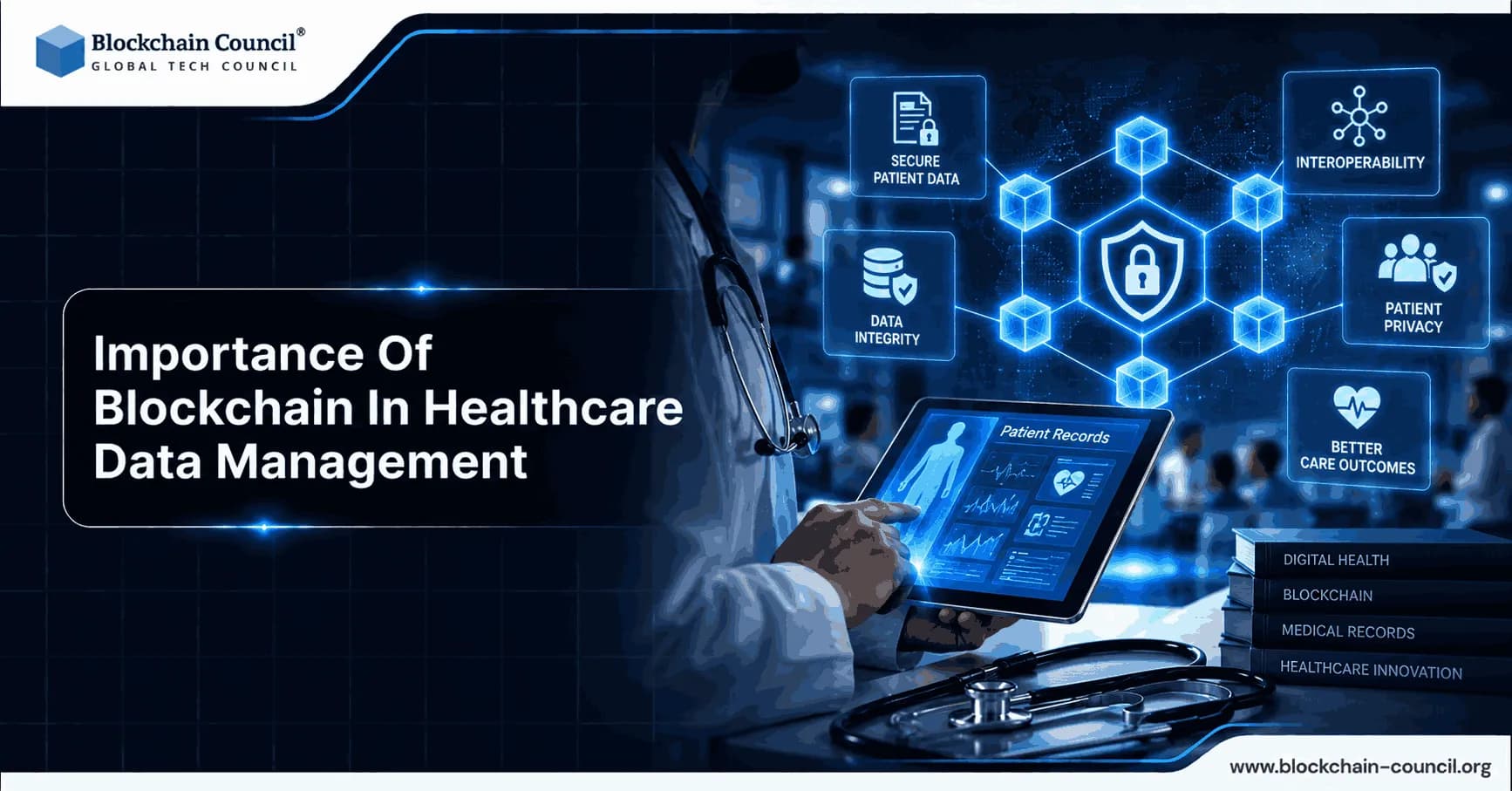
Introduction: Fixing a Healthcare System That Struggles to Share Data
Healthcare generates enormous volumes of sensitive information every day, yet hospitals, clinics, and insurers still struggle to share that information reliably with one another. Fragmented systems, incompatible software, and vulnerable centralized databases have long created inefficiencies that put both patient care and privacy at risk. Blockchain technology is increasingly being positioned as a solution to this problem, offering a decentralized way to store and verify health records that no single point of failure can compromise. Professionals who want to understand how this shift is unfolding often begin with a Certified Blockchain Expert credential, which builds the foundational knowledge needed to evaluate how distributed ledgers can support something as sensitive as medical data.
The stakes in healthcare data management are unusually high. A single data breach can expose deeply personal medical histories, while fragmented records can lead to duplicated tests, delayed diagnoses, and preventable medical errors. Blockchain's core properties, immutability, decentralization, and cryptographic security, directly address these long-standing pain points.

How Blockchain Solves Healthcare's Interoperability Problem
Most hospital systems today operate as isolated data silos, unable to easily or safely exchange patient information with other providers. This fragmentation forces patients to repeat their medical history at every new facility and leaves emergency responders working with incomplete information during critical moments. Blockchain creates a unified, decentralized layer that allows different healthcare networks to securely reference and verify the same patient data, giving physicians, specialists, and emergency staff access to a consistent medical history regardless of where it originated.
This shared infrastructure reduces redundant testing and diagnostic errors that often stem from incomplete records. Rather than replacing existing hospital databases entirely, many blockchain healthcare systems use a hybrid approach, keeping sensitive patient information encrypted off-chain while storing verification hashes on-chain to confirm that records have not been altered. For professionals who want to specialize specifically in applying blockchain within clinical and regulatory environments, a Certified Blockchain & Healthcare Professional credential provides targeted knowledge of how these systems are designed to meet both technical and compliance requirements.
Strengthening Security Against Data Breaches
Centralized medical databases remain one of the most attractive targets for cybercriminals, largely because compromising a single server can expose millions of patient records at once. Blockchain removes this single point of failure by distributing cryptographic proofs across a network of independent nodes rather than storing everything in one location. Once data is written to the chain, it cannot be quietly edited or deleted, which eliminates the uncertainty around who changed a record and when.
This same structure also strengthens access control. Blockchain enables fine-grained, cryptographic permissions so that doctors, laboratories, and insurers only see the specific information they are authorized to view, and those permissions can be revoked instantly without relying on a single administrator. Because every transaction is logged and verified across multiple nodes, suspicious activity becomes far easier to detect and trace.
Real-World Applications Transforming Patient Care
Blockchain's role in healthcare extends well beyond securing electronic health records. Supply chain management has emerged as one of the strongest use cases, with blockchain systems tracking pharmaceuticals and medical equipment from manufacturer to patient to prevent counterfeiting and verify authenticity. Clinical trials and research have also benefited, with blockchain improving transparency around how data is collected, stored, and shared among research institutions.
Patient consent management represents another meaningful application, allowing individuals to control exactly who can access their health records through immutable, verifiable consent records rather than paper forms buried in administrative systems. Smart contracts add a further layer of automation, automatically triggering insurance claim payments once treatment data and coverage rules match predefined criteria, cutting down on billing delays and administrative disputes.
Deploying these systems successfully requires professionals who understand more than blockchain alone, since healthcare technology often intersects with cloud infrastructure, cybersecurity, and regulatory compliance. A broad Tech Certification helps build that wider technical foundation, giving learners the cross-disciplinary skills needed to design and maintain complex healthcare technology systems.
Future-Ready Skills
As technology becomes increasingly important across industries, students need opportunities to develop future-ready skills early in their education. A World Tech Olympiad can introduce students to areas such as artificial intelligence, coding, cybersecurity, robotics, and computational thinking while encouraging curiosity and continuous learning. Exposure like this early on can help cultivate future healthcare technologists capable of building the secure, interoperable systems patients will depend on for years to come.
Navigating Compliance and Regulatory Requirements
Implementing blockchain in healthcare is not simply a technical exercise. Any system handling patient data must comply with strict privacy regulations, which typically means sensitive health information should never be stored directly on a public blockchain in its raw form. Instead, successful implementations rely on hybrid architectures that keep protected health information encrypted in secure databases while placing only verification records on-chain. This approach preserves the benefits of blockchain's tamper resistance without compromising the regulatory protections patients are entitled to.
Healthcare organizations exploring blockchain adoption need careful planning around governance, data ownership, and cross-border data sharing rules, particularly as more providers begin experimenting with international health data exchange.
Building Awareness Around Blockchain's Healthcare Potential
Even as the technical case for blockchain in healthcare grows stronger, patients, providers, and administrators still need to understand why these systems matter and how they actually protect personal information. Many people remain unfamiliar with concepts like decentralized records or cryptographic consent management, which can slow adoption even when the underlying technology offers clear benefits.
Healthcare technology companies bringing these solutions to market need clear communication strategies to build trust among both clinical staff and patients. A Marketing Certification equips professionals with the skills needed to translate complex blockchain concepts into messaging that resonates with healthcare audiences, helping accelerate adoption of systems that ultimately improve patient outcomes and data security.
As healthcare systems around the world continue grappling with data silos, security threats, and inefficient record sharing, blockchain offers a practical path toward a more connected and trustworthy infrastructure. From decentralized electronic health records to automated insurance claims, the technology is steadily moving from research pilots into real clinical environments, positioning it as a foundational layer for how patient data will be managed in the years ahead.
FAQs
1. Why is blockchain important in healthcare data management?
Blockchain can help healthcare organizations create tamper-evident records, improve auditability, and coordinate data sharing across multiple organizations. These capabilities may help address challenges involving fragmented health records, data integrity, privacy, and interoperability.
2. How can blockchain improve healthcare data security?
Blockchain can create a distributed and cryptographically linked record of authorized transactions and data-access events. This can make unauthorized changes easier to detect, although blockchain does not replace encryption, authentication, access controls, or other cybersecurity measures.
3. Can blockchain protect electronic health records?
Blockchain can support the integrity and auditability of electronic health records by recording verifiable transactions related to those records. In many proposed systems, sensitive medical information is kept off-chain while blockchain stores hashes, permissions, or other verification information.
4. How does blockchain improve healthcare data interoperability?
Blockchain can provide a shared coordination layer through which authorized healthcare organizations can verify data exchanges and access events. When combined with standards such as HL7 FHIR, blockchain-based architectures may improve technical communication between healthcare systems, although interoperability remains a significant implementation challenge.
5. Can blockchain give patients more control over their health data?
Yes. Blockchain-based healthcare systems can support patient-controlled permissions and consent mechanisms, allowing patients to participate more directly in decisions about who can access their information. The effectiveness of this approach depends on the identity, consent, governance, and privacy architecture surrounding the blockchain.
6. How can blockchain improve patient data privacy?
Blockchain can support privacy-preserving access controls, cryptographic verification, and permission management. However, putting identifiable medical information directly on an immutable blockchain can create privacy problems, so many proposed architectures keep sensitive information off-chain.
7. Can blockchain help prevent unauthorized access to medical records?
Blockchain can strengthen access-control systems by creating verifiable records of permissions and data-access events. Smart contracts can also be used to enforce predefined access policies, but secure identity management and properly configured authorization systems are still essential.
8. How can blockchain help with patient consent management?
Smart contracts can help record and enforce predefined consent rules for accessing healthcare information. A blockchain-based consent system can also provide an auditable history of when permissions were granted, changed, or revoked, although healthcare organizations must ensure that the system complies with applicable privacy regulations.
9. Can blockchain improve medical data sharing between hospitals?
Yes. A permissioned blockchain can provide participating hospitals and healthcare organizations with a shared mechanism for verifying data-sharing events and access permissions. This can reduce some coordination problems caused by isolated databases, but integration with existing hospital systems remains a major challenge.
10. How can blockchain help healthcare data auditing?
Blockchain can provide a chronological, tamper-evident record of transactions and access events. This can make it easier for authorized organizations to investigate who accessed or interacted with particular records and support compliance audits.
11. Can blockchain reduce healthcare data fraud?
Blockchain can make certain forms of record manipulation more difficult to hide because changes to recorded information can be detectable. However, blockchain cannot guarantee that information entered into the system is accurate, so data validation and trusted data sources remain necessary.
12. How can blockchain support healthcare regulatory compliance?
Blockchain can create auditable records of data access, consent, transactions, and other compliance-related activities. Research has explored permissioned blockchain architectures with smart contracts for automating aspects of privacy-policy enforcement and compliance monitoring, but legal and regulatory requirements still need to be addressed at the system-design level.
13. Can blockchain help with healthcare data exchange?
Yes. Blockchain can provide a shared trust and verification layer for exchanging information among hospitals, laboratories, insurers, researchers, and other authorized organizations. Its potential is particularly relevant where several independent organizations need to coordinate access to sensitive information.
14. What are the benefits of blockchain for electronic health records?
Potential benefits include stronger auditability, improved access control, better data integrity, patient participation in consent management, and improved coordination between healthcare organizations. However, systematic reviews emphasize that many existing solutions remain prototypes rather than widely deployed production systems.
15. Can blockchain improve healthcare data integrity?
Yes. Blockchain's cryptographic structure can make unauthorized modification of previously recorded information easier to detect. This can help establish confidence that a record or transaction has not been altered after it was recorded, provided the original data was accurate.
16. What type of blockchain is best for healthcare data management?
Permissioned or consortium blockchains are often considered suitable for healthcare because participating organizations can control access to the network. A 2025 systematic review found consortium blockchains to be the dominant approach in privacy-preserving healthcare data-sharing research because they provide greater control over access and privacy.
17. Should medical records be stored directly on a blockchain?
Usually, sensitive medical records should not simply be placed directly on a public blockchain. A common approach is to store sensitive information in controlled off-chain systems while using blockchain for hashes, permissions, consent records, or audit information.
18. What are the challenges of using blockchain in healthcare?
Major challenges include scalability, interoperability, privacy, regulatory compliance, governance, identity management, data quality, and integration with existing healthcare infrastructure. Recent reviews also find that most privacy-preserving blockchain healthcare solutions remain at early technology-readiness levels.
19. Is blockchain currently widely used for healthcare data management?
Blockchain healthcare research has grown considerably, but widespread production deployment remains limited. Recent systematic reviews report that many solutions have been evaluated through prototypes, pilots, or proof-of-concept systems rather than large-scale clinical deployments.
20. What is the future of blockchain in healthcare data management?
Blockchain could become a useful component of healthcare data infrastructure for identity, consent, auditability, secure data exchange, and interoperability. Its long-term adoption will depend on clinical validation, scalable architectures, regulatory alignment, interoperability standards, and collaboration between healthcare organizations and technology providers.
Related Articles
View All
Blockchain
Blockchain Digital Identity Management Patents: Key Innovations and Market Trends
A practitioner-focused look at blockchain digital identity management patents, from biometric wallets and DIDs to KYC, EU wallets, IoT, and market growth.

Blockchain
Why Blockchain Is the Future of Digital Trust, Finance, and Data Security
Blockchain is becoming core infrastructure for digital trust, finance, and data security through shared ledgers, stablecoins, smart contracts, and verifiable records.

Blockchain
What Is Blockchain Intelligence? A Complete Guide to On-Chain Data Analysis
Learn what blockchain intelligence means, how on-chain data analysis works, and how professionals use it for compliance, trading, investigations, and risk.
Trending Articles
The Role of Blockchain in Ethical AI Development
How blockchain technology is being used to promote transparency and accountability in artificial intelligence systems.
AWS Career Roadmap
A step-by-step guide to building a successful career in Amazon Web Services cloud computing.
How Blockchain Secures AI Data
Understand how blockchain technology is being applied to protect the integrity and security of AI training data.