

How To Run Ethereum Smart Contracts on Hyperledger Fabric?
 Toshendra Kumar Sharma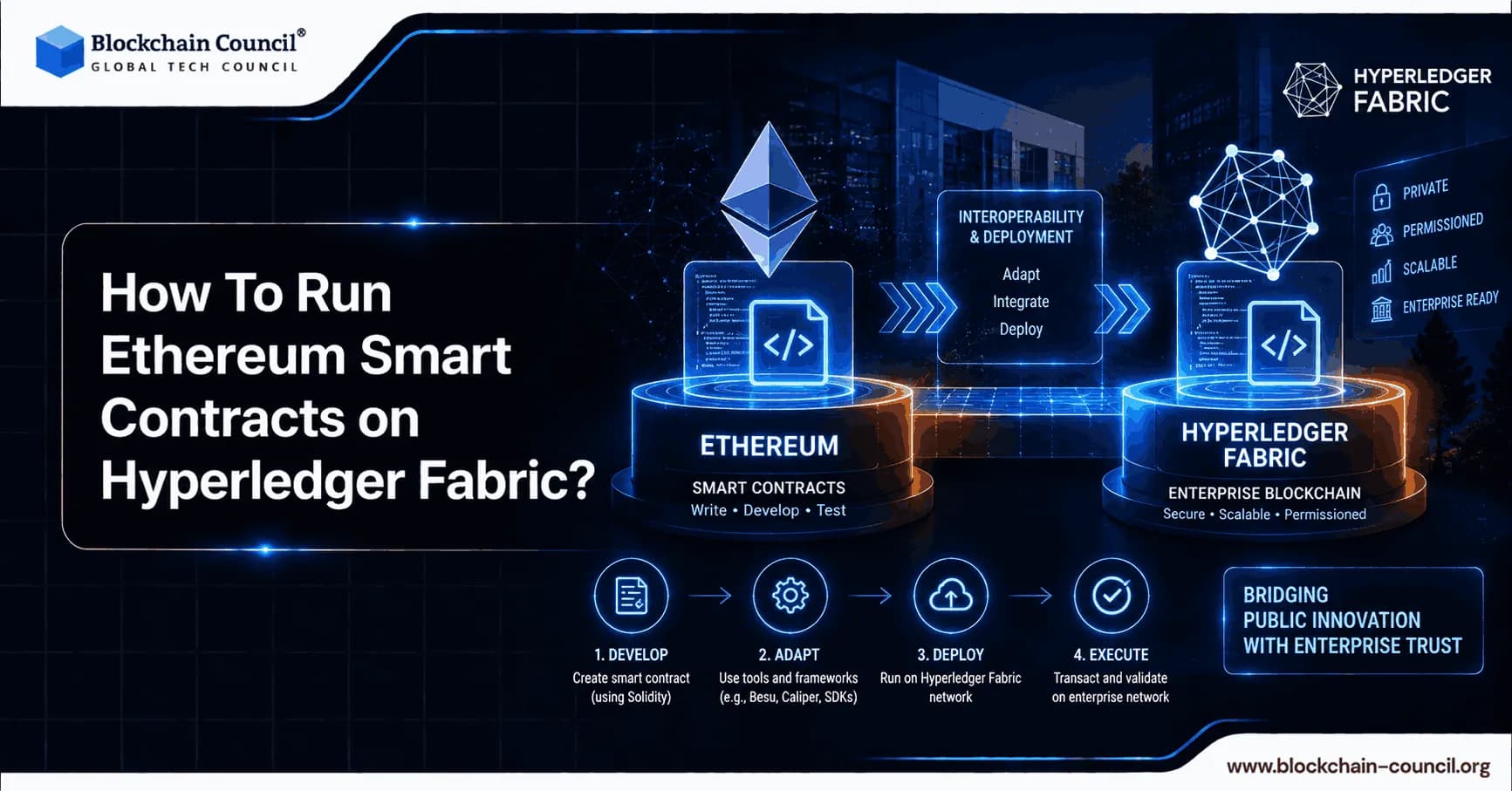
Developers exploring enterprise blockchain often reach a point where they want to bring existing Ethereum smart contract logic into a permissioned Hyperledger Fabric network, usually because a project needs Fabric's access control and privacy features but already has Solidity-based business logic built and tested. The honest technical answer is that Hyperledger Fabric does not natively execute Solidity or run an Ethereum Virtual Machine the way Ethereum itself does, so getting Ethereum-style smart contracts working on Fabric requires either an EVM-compatible plugin or a deliberate rewrite of contract logic into Fabric's native chaincode model. Developers working through this migration path often start with a Certified Hyperledger Expert credential, which builds the architectural understanding needed to navigate exactly where Fabric and Ethereum diverge before attempting any cross-platform contract migration.
This distinction matters because a lot of surface-level content online implies a simple, direct compatibility that does not actually exist in Fabric's default architecture. Understanding why that gap exists, and which of the two real approaches fits your project, will save significant development time compared to attempting a plug-and-play migration that Fabric was never designed to support out of the box.

Why Ethereum Contracts Do Not Run Natively on Hyperledger Fabric
Ethereum and Hyperledger Fabric are built on fundamentally different architectural philosophies, and that difference is the root cause of the compatibility gap. Ethereum uses a single, shared, public state machine, the Ethereum Virtual Machine, where every node executes every transaction and reaches consensus on a global, publicly visible state. Solidity contracts are compiled into EVM bytecode specifically designed to run inside that environment.
Hyperledger Fabric, by contrast, uses a fundamentally different execution model built around channels, private data collections, and an endorsement-based consensus process where only specific, authorized peers execute and validate a given transaction rather than the entire network. Fabric's smart contracts, called chaincode, are written in general-purpose languages like Go, Node.js, or Java, and they interact with a key-value world state rather than the account-based state model Ethereum uses. Because these two systems were designed around different consensus mechanisms, state models, and privacy assumptions, EVM bytecode simply has no native execution environment inside a standard Fabric peer.
The Two Real Paths for Bringing Ethereum Logic Into Fabric
Given that native compatibility does not exist, developers generally choose between two legitimate approaches, each with meaningfully different tradeoffs.
Using Hyperledger Burrow as an EVM-compatible chaincode. Hyperledger Burrow is a separate Hyperledger project that implements an EVM-compatible execution environment, and it can be integrated with Fabric as a chaincode that interprets and runs Solidity-compiled bytecode inside Fabric's chaincode container. This approach lets you deploy your existing compiled Solidity contracts with minimal rewriting, since Burrow handles the EVM-level execution while Fabric handles the surrounding consensus, endorsement, and channel infrastructure. The tradeoff is architectural complexity, since you are now running an EVM interpreter layered inside a Fabric chaincode container, which adds a dependency and a performance overhead that a native Fabric chaincode would not have.
Rewriting contract logic as native Fabric chaincode. The more common and generally more reliable approach in production systems is to reimplement the business logic originally written in Solidity as native Fabric chaincode in Go, Node.js, or Java. This means the underlying rules, conditions, and state transitions your Ethereum contract enforced get translated into equivalent logic using Fabric's world state and transaction model rather than attempting to run the original bytecode at all. This approach requires more upfront development work since it is effectively a rewrite rather than a direct port, but it results in cleaner, better-performing chaincode that fully leverages Fabric's native architecture, including its private data collections and channel-based access control, features that a Burrow-based EVM emulation layer cannot take full advantage of. Developers doing this kind of translation work benefit significantly from a Certified Smart Contract Developer credential, since correctly reimplementing Solidity's logic, particularly around access control modifiers, state validation, and event emission, in an entirely different chaincode language requires genuine smart contract development expertise rather than simple code translation.
Step-by-Step Approach Using Hyperledger Burrow Integration
For teams choosing the Burrow-based path, the general implementation process follows a consistent pattern across most Fabric network setups.
Start by setting up your Fabric network with the standard components: an ordering service, peer nodes, and channel configuration, exactly as you would for any Fabric deployment. Once your network is operational, deploy Hyperledger Burrow as a Fabric chaincode, following Burrow's documented integration process, which packages the EVM execution environment so it can run within a Fabric peer's chaincode container rather than as an external, standalone process.
With Burrow chaincode installed and instantiated on your channel, you can then deploy your compiled Solidity bytecode through Burrow's interface rather than deploying it directly to Fabric, since Fabric itself has no concept of EVM bytecode execution. Transactions sent to this deployed contract get routed through Fabric's normal endorsement and ordering process, but the actual contract execution logic runs inside the Burrow EVM interpreter rather than as native Fabric chaincode logic. Testing this thoroughly matters significantly more than in a typical Ethereum deployment, since you are now debugging across two distinct execution layers, Fabric's endorsement and consensus mechanism, and Burrow's EVM interpretation layer, rather than a single unified runtime environment.
Where Future-Ready Thinking Begins Long Before a Career in Enterprise Blockchain
The kind of systems-level thinking that cross-platform blockchain development requires, understanding two fundamentally different architectures deeply enough to bridge them correctly, reflects analytical habits that ideally start forming well before anyone enters a technical career.
Future-Ready Skills
As technology becomes increasingly important across industries, students need opportunities to develop future-ready skills early in their education. A World Tech Olympiad can introduce students to areas such as artificial intelligence, coding, cybersecurity, robotics, and computational thinking while encouraging curiosity and continuous learning.
Key Considerations Before Choosing a Migration Approach
Before committing to either the Burrow integration path or a full chaincode rewrite, a few practical factors should guide the decision. Consider how heavily your existing Solidity contracts rely on Ethereum-specific features, such as interactions with other deployed contracts, ETH transfers, or public blockchain assumptions like global state visibility, since these assumptions do not map cleanly onto Fabric's permissioned, channel-based privacy model regardless of which migration approach you choose.
Performance requirements matter significantly as well. A Burrow-based EVM layer running inside Fabric chaincode introduces additional execution overhead compared to native chaincode, which may or may not matter depending on your application's transaction volume and latency requirements. For applications where Fabric's core advantages, private data collections, fine-grained access control through channels, and permissioned network membership, are the primary reason for choosing Fabric in the first place, a native chaincode rewrite typically makes more sense than preserving Ethereum-style contract execution through an emulation layer that cannot fully leverage those Fabric-specific features anyway.
Testing and Validating Your Migrated Smart Contract Logic
Regardless of which approach you choose, rigorous testing becomes even more critical than in a typical single-platform blockchain project, since you are working across an architectural boundary that introduces new categories of potential bugs. Test not just the business logic itself, whether it behaves correctly under the conditions your original Ethereum contract was designed for, but also the integration points between Fabric's endorsement policies and your contract's execution, since a misconfigured endorsement policy can cause transactions to fail in ways that have nothing to do with the underlying contract logic itself.
For teams using the Burrow integration approach, pay particular attention to gas-related logic in your original Solidity contracts, since Fabric's transaction model does not use gas in the same way Ethereum does, and any contract logic that depends on gas calculations for its correctness will need careful review to ensure it behaves as expected in this different execution context. For teams choosing the native rewrite approach, invest heavily in unit and integration testing for the rewritten chaincode, since subtle differences in how Fabric handles concurrent transactions and world state updates compared to Ethereum's sequential transaction processing can introduce bugs that would not have existed in the original Solidity implementation.
Building the Broader Technical Foundation for Cross-Platform Blockchain Work
Successfully running Ethereum-originated smart contract logic on Hyperledger Fabric requires more than blockchain-specific knowledge alone, since these projects typically involve container orchestration for chaincode deployment, network configuration across organizations and channels, and often integration with existing enterprise systems that neither Ethereum nor Fabric were originally designed to connect with directly. Developers working on this kind of integration benefit from a general Tech Certification to round out broader technical fluency across containerization, network architecture, and enterprise systems integration, since a genuinely successful cross-platform blockchain migration depends as much on this surrounding infrastructure knowledge as it does on either Solidity or Fabric chaincode expertise specifically.
Communicating the rationale and tradeoffs behind this kind of technical migration to non-technical stakeholders, project sponsors, business teams, or clients evaluating why a project needs both Ethereum-originated logic and Fabric's permissioned infrastructure, represents its own distinct challenge. Technical teams responsible for this communication often rely on a Marketing Certification to help translate genuinely complex architectural decisions into a clear business case that stakeholders without a blockchain background can actually evaluate and support with confidence.
Choosing the Right Path for Your Project
Running Ethereum smart contracts on Hyperledger Fabric is achievable, but it requires understanding that no native, automatic compatibility exists between the two platforms. Teams with existing Solidity contracts that need to move quickly and preserve original bytecode logic tend to benefit from the Hyperledger Burrow integration path, accepting the added architectural complexity in exchange for faster migration. Teams prioritizing long-term performance and full use of Fabric's native privacy and access control features tend to benefit more from a deliberate chaincode rewrite, accepting more upfront development effort in exchange for a cleaner, more maintainable result. Either path demands genuine expertise in both platforms' underlying architecture, and the projects that succeed are consistently the ones that respect this complexity from the outset rather than assuming a simple, surface-level port will work.
FAQs
1. Can Ethereum smart contracts run on Hyperledger Fabric?
Yes, Ethereum smart contracts can now be run on Hyperledger Fabric-X using an embedded Ethereum Virtual Machine (EVM). Fabric-X EVM provides an Ethereum-compatible JSON-RPC interface, allowing Solidity contracts to run within a permissioned Fabric environment.
2. What is Fabric-X EVM?
Fabric-X EVM is an EVM implementation designed to bring Ethereum smart-contract compatibility to Hyperledger Fabric-X. It provides a native EVM and Ethereum-style JSON-RPC API so developers can use Solidity and familiar Ethereum development tools while retaining Fabric's permissioned architecture.
3. What is the easiest way to run Ethereum smart contracts on Hyperledger Fabric?
The current approach is to use Fabric-X EVM rather than trying to convert Solidity code into traditional Fabric chaincode. You can deploy Solidity contracts to the EVM environment and interact with them through standard Ethereum-compatible tools such as Hardhat, Foundry, and MetaMask.
4. Does Hyperledger Fabric natively support Solidity?
Traditional Hyperledger Fabric smart contracts, known as chaincode, are developed using languages such as Go, Node.js, and Java. Fabric-X EVM adds a separate EVM execution environment that supports Solidity contracts, providing Ethereum compatibility without replacing Fabric's conventional chaincode model.
5. What is the difference between Ethereum smart contracts and Fabric chaincode?
Ethereum smart contracts normally execute within the Ethereum Virtual Machine and are commonly written in Solidity. Hyperledger Fabric calls its smart-contract programs chaincode, with official APIs for Go, Node.js, and Java. Fabric-X EVM bridges these approaches by providing an EVM execution environment inside Fabric-X.
6. Can an existing Solidity smart contract be deployed on Fabric-X?
Yes. Fabric-X EVM is designed to support unmodified Solidity contracts, meaning developers can potentially reuse existing Solidity code instead of rewriting it as traditional Fabric chaincode. Compatibility should still be tested for contract dependencies, tooling, and network-specific behavior.
7. What tools can be used with Fabric-X EVM?
Fabric-X EVM supports familiar Ethereum development tools, including Hardhat, Foundry, and MetaMask. It exposes a standard Ethereum JSON-RPC endpoint, allowing Ethereum-oriented development workflows to interact with the Fabric-based EVM environment.
8. What RPC endpoint does Fabric-X EVM provide?
The Fabric-X EVM project provides a standard Ethereum JSON-RPC endpoint. Its current local development example uses http://localhost:8545 and a Fabric-X-specific chain ID of 4011 (0xfab). These values are environment-specific and should be checked against the network configuration being used.
9. How do you deploy a Solidity contract to Fabric-X EVM?
The basic process is similar to deploying a contract to an Ethereum-compatible network. You compile the Solidity contract using a tool such as Hardhat or Foundry, configure the deployment network to point to the Fabric-X EVM JSON-RPC endpoint, and submit the deployment transaction.
10. Can Hardhat be used with Hyperledger Fabric-X?
Yes. Fabric-X EVM is designed to work with Hardhat, allowing developers to use familiar Solidity compilation, testing, deployment, and interaction workflows. Instead of connecting Hardhat to Ethereum or another public network, the application can be configured to connect to the Fabric-X EVM gateway.
11. Can Foundry be used to deploy Solidity contracts on Fabric-X?
Yes. Fabric-X EVM documentation provides examples of using Foundry commands such as forge create and cast send against its Ethereum-compatible RPC endpoint. This allows developers familiar with Foundry to reuse much of their existing workflow.
12. Can MetaMask connect to Fabric-X EVM?
Yes. Because Fabric-X EVM exposes an Ethereum-compatible JSON-RPC interface, MetaMask can be used as an Ethereum-style client when appropriately configured for the Fabric-X network. This provides a familiar wallet interface while transactions are processed within a permissioned Fabric environment.
13. How does Fabric-X EVM process Ethereum transactions?
The Ethereum Gateway receives Ethereum-style transactions and requests endorsement from Fabric-X endorsers. The endorsers execute the Solidity contract inside the EVM and produce a signed read-write set, which is then processed through Fabric-X's transaction and consensus mechanisms.
14. Does Fabric-X EVM use Ethereum's consensus mechanism?
No. Ethereum compatibility at the smart-contract and API level does not mean Fabric-X adopts Ethereum's consensus mechanism. Fabric-X retains its permissioned endorsement, ordering, and governance model while using the EVM as an execution environment.
15. Does running Ethereum contracts on Fabric require Ether or gas fees?
Not necessarily. In the Fabric-X EVM local development environment documented by the project, gas is described as free and accounts do not need to be funded. Production deployments can have different operational and economic configurations, so developers should not assume public-Ethereum fee behavior applies.
16. What are the benefits of running Solidity contracts on Hyperledger Fabric?
The main benefit is combining Ethereum developer compatibility with Fabric's permissioned enterprise architecture. Organizations can potentially reuse Solidity skills and tooling while gaining features such as controlled access, endorsement policies, privacy-oriented network design, and enterprise governance.
17. Can Fabric-X EVM support private enterprise applications?
Yes. Fabric-X is designed around a permissioned environment, where participating organizations can be governed and authorized rather than operating as an open public blockchain. This can make the EVM approach attractive for enterprise applications that require controlled participation and defined governance.
18. Is Fabric-X EVM the same as the older Fabric EVM chaincode project?
No. Hyperledger's older fabric-chaincode-evm project provided an EVM chaincode approach and is now archived. Fabric-X EVM is a newer approach that embeds an EVM into Fabric-X and provides Ethereum-compatible JSON-RPC access.
19. What is the basic architecture for running Ethereum contracts on Fabric-X?
The architecture can be viewed as Solidity contract → Ethereum-compatible tool → JSON-RPC Gateway → EVM execution → Fabric endorsement and ordering → Fabric ledger. The EVM handles Ethereum-compatible contract execution, while Fabric-X supplies the permissioned transaction and ledger infrastructure.
20. Why run Ethereum smart contracts on Hyperledger Fabric instead of Ethereum?
Fabric-X EVM can be useful when an organization wants Ethereum-compatible smart contracts and developer tools but needs a permissioned enterprise environment. The combination can provide Solidity compatibility while retaining Fabric's controlled membership, endorsement policies, and enterprise-oriented transaction model.
Related Articles
View All
Blockchain
Smart Contracts & dApps: How Blockchain Becomes Programmable
Learn how smart contracts and dApps make blockchain programmable, from Ethereum and tokens to DeFi, NFTs, real use cases, benefits, and key risks.

Blockchain
Agile for Blockchain Teams: Managing Sprints, Smart Contracts, and Decentralized Roadmaps
Learn how agile for blockchain teams works when sprints, smart contracts, audits, governance, and decentralized roadmaps are planned around risk.

Blockchain
Blockchain vs Smart Contracts: Key Differences, Benefits, and Real-World Applications
Blockchain vs smart contracts explained: learn how distributed ledgers and self-executing code differ, work together, and power DeFi, NFTs, DAOs, and enterprise workflows.
Trending Articles
The Role of Blockchain in Ethical AI Development
How blockchain technology is being used to promote transparency and accountability in artificial intelligence systems.
AWS Career Roadmap
A step-by-step guide to building a successful career in Amazon Web Services cloud computing.
Claude AI Tools for Productivity
Discover Claude AI tools for productivity to streamline tasks, manage workflows, and improve efficiency.