

How did Malta Became the Blockchain Island?
 Toshendra Kumar Sharma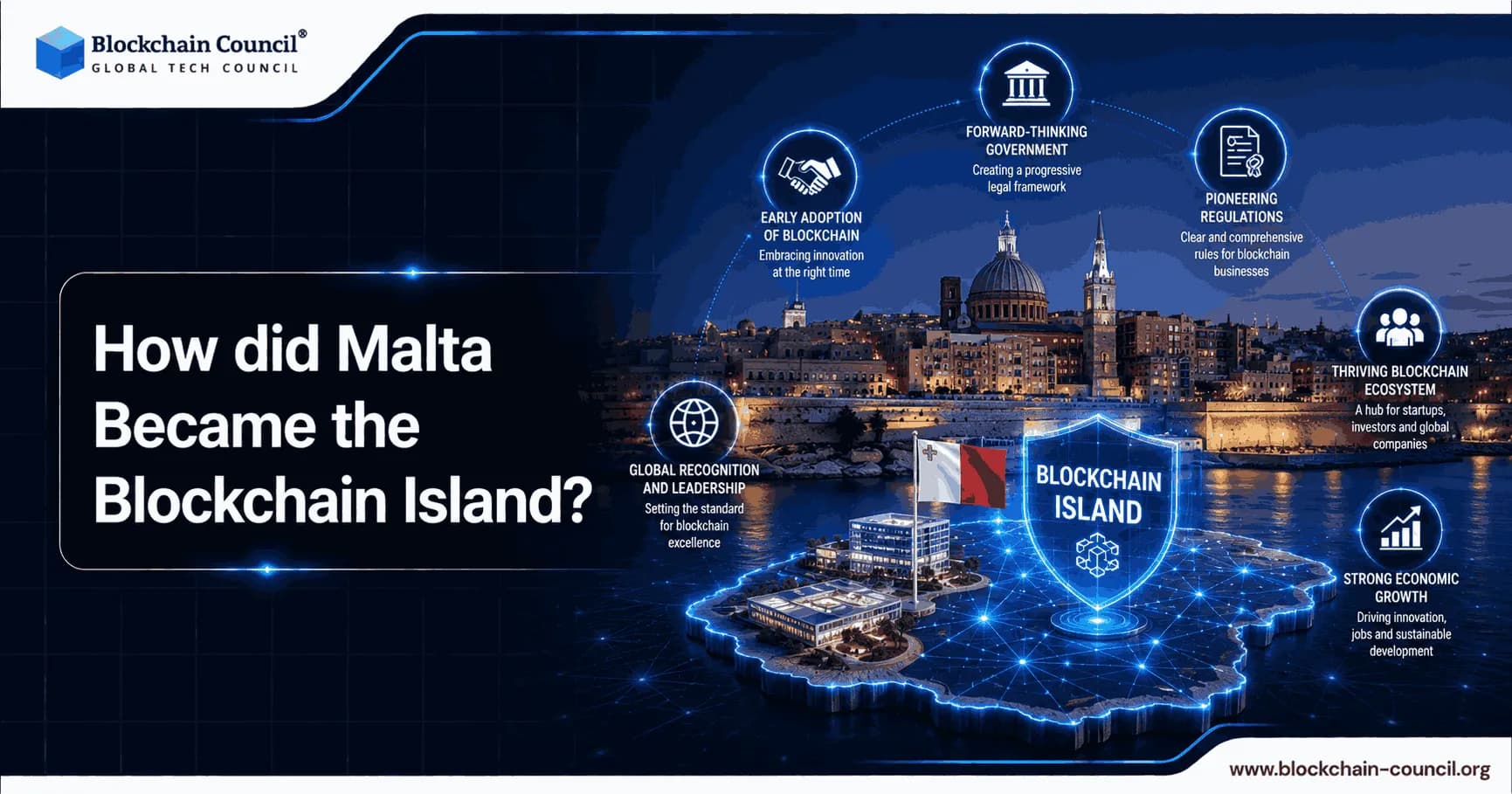
Malta became known as the "Blockchain Island" after its government introduced a coordinated legal and regulatory framework designed to attract blockchain businesses and establish the country as a destination for distributed ledger technology. Rather than relying only on cryptocurrency enthusiasm, Malta attempted to create legal certainty around blockchain-based activities, digital assets, and innovative technology.
For professionals looking to understand the technology behind this transformation, a Certified Blockchain Expert can provide a strong foundation in blockchain concepts, applications, and industry use cases.

Why Did Malta Embrace Blockchain?
Malta is a relatively small European country with limited natural resources and a strong dependence on international business, tourism, and services. Its government saw emerging digital industries as an opportunity to attract investment, companies, and highly skilled professionals.
Blockchain was identified as one of the technologies that could support this strategy.
Instead of treating blockchain primarily as a cryptocurrency trend, Malta sought to establish rules covering different parts of the blockchain ecosystem. This approach helped distinguish the country's strategy from jurisdictions that offered only general support for emerging technologies.
How Did Malta Build Its Blockchain Framework?
A major milestone came in 2018, when Malta introduced three important pieces of legislation related to distributed ledger technology.
These included the:
Malta Digital Innovation Authority Act
Innovative Technological Arrangement and Services Act
Virtual Financial Asset Act
Together, these laws created a framework covering technology certification, innovative technological arrangements, and virtual financial assets.
Malta Digital Innovation Authority
The Malta Digital Innovation Authority, commonly known as the MDIA, was established to oversee and certify certain technology arrangements and provide a regulatory framework for innovative technologies.
The framework aimed to increase confidence in blockchain-based systems by establishing standards around technology arrangements and service providers.
Virtual Financial Assets
Malta also introduced legislation covering virtual financial assets. The framework provided rules for activities involving certain digital assets and related services.
This was important because companies operating in the cryptocurrency and blockchain sector often faced uncertainty about how their products and services would be treated under existing financial regulations.
Malta's Strategy Was More Than Cryptocurrency
One reason Malta gained international attention was its attempt to position blockchain as a broader technology rather than simply a synonym for cryptocurrency.
The country promoted applications involving:
Financial services
Digital assets
Smart contracts
Distributed databases
Digital identity
Gaming
Technology services
This broader strategy helped create an environment in which technology companies could explore blockchain applications within a defined regulatory framework.
For people interested in the technical side of blockchain adoption, a Certified Blockchain Developer can help build practical knowledge of blockchain development, smart contracts, decentralized applications, and blockchain programming concepts.
Why Regulatory Clarity Mattered
Blockchain companies often face a difficult question: how should a new technology be regulated when existing laws were designed for traditional financial and technological systems?
Malta attempted to address this challenge by creating legislation specifically focused on blockchain and digital assets.
Creating Greater Business Certainty
Clear rules can help companies understand:
Which licenses may be required
What compliance obligations apply
How digital assets are treated
Which regulatory authority oversees an activity
What standards technology providers must meet
Greater certainty can make it easier for businesses to evaluate whether establishing operations in a particular jurisdiction makes commercial sense.
Malta's Appeal to Blockchain Companies
The country's blockchain strategy attracted considerable international attention, particularly during the industry's rapid expansion in the late 2010s.
Malta offered several factors that were attractive to international technology businesses:
EU Membership
Malta is a member of the European Union, giving businesses established there access to the broader European economic environment while operating within an EU member state.
Technology-Friendly Policy
Government support for emerging technologies helped position Malta as a jurisdiction willing to experiment with new regulatory approaches.
Established Financial Services Sector
Malta already had experience in financial services and regulation, providing an existing foundation for businesses operating at the intersection of technology and finance.
Challenges to the Blockchain Island Model
Becoming a blockchain-friendly jurisdiction does not guarantee long-term industry success. Blockchain businesses must still deal with international regulations, compliance requirements, market conditions, cybersecurity concerns, and changing technology.
Malta's approach also faced scrutiny as regulators and international organizations increased their focus on preventing money laundering, protecting consumers, and maintaining financial stability.
Regulation Must Keep Evolving
Digital assets and blockchain applications develop quickly. A regulatory framework that works for one generation of technology may need to evolve as new business models emerge.
This creates a continuing challenge for governments seeking to balance innovation with consumer protection and financial oversight.
The Importance of Technology Skills
Malta's blockchain strategy also illustrates how regulation and technology development need to work together. Creating a legal framework is only one part of developing a technology ecosystem. Countries also need developers, cybersecurity specialists, business professionals, entrepreneurs, and other skilled workers.
A broader Tech Certification can complement blockchain-specific knowledge by helping learners develop wider technology skills relevant to digital transformation.
Future-Ready Skills
As technology becomes increasingly important across industries, students need opportunities to develop future-ready skills early in their education. A World Tech Olympiad can introduce students to areas such as artificial intelligence, coding, cybersecurity, robotics, and computational thinking while encouraging curiosity and continuous learning.
What Can Other Countries Learn From Malta?
Malta's experience provides several lessons for countries attempting to attract emerging technology businesses.
Build Clear Rules
Businesses are more likely to invest when they understand the legal and regulatory environment in which they will operate.
Support Innovation
Government policies can encourage experimentation while maintaining appropriate safeguards for consumers and markets.
Develop Skilled Talent
Technology ecosystems require people with practical skills. Education and professional development are therefore essential components of long-term technology strategies.
Avoid Focusing on One Technology
Blockchain can interact with artificial intelligence, cybersecurity, cloud computing, IoT, and other technologies. A sustainable digital economy should therefore support a broader technology ecosystem.
Is Malta Still the Blockchain Island?
The phrase "Blockchain Island" became closely associated with Malta because of the country's early efforts to establish dedicated blockchain and digital asset legislation. However, the global regulatory environment has changed significantly since Malta first gained attention.
Today, blockchain businesses operate across many jurisdictions, and competition among countries has increased. Malta's early strategy remains an important example of how a government attempted to use regulation and policy to attract an emerging technology sector.
The country's experience demonstrates that becoming a technology hub requires more than promotional messaging. Legal clarity, regulatory credibility, skilled talent, infrastructure, investment, and continued policy development all matter.
Conclusion
Malta became known as the "Blockchain Island" largely because it moved early to establish a dedicated legal framework for blockchain, distributed ledger technology, and virtual financial assets. Its 2018 legislative package provided a foundation for regulating technology arrangements and digital asset activities while signaling strong government support for the sector.
Although the blockchain industry and regulatory landscape have evolved since then, Malta's approach remains a useful case study in technology policy. It shows how a small country can attempt to turn an emerging technology into an economic opportunity through regulation, innovation, and investment in digital infrastructure.
As blockchain continues to develop alongside artificial intelligence and other emerging technologies, businesses will need professionals who can translate technological innovation into practical market opportunities. A Marketing Certification can complement technical expertise by helping professionals understand digital strategy, communication, and business growth in technology-driven markets.
FAQs
1. Why is Malta called the Blockchain Island?
Malta became known as the “Blockchain Island” because its government actively promoted blockchain technology and introduced a dedicated legal and regulatory framework for distributed ledger technology and virtual financial assets. The country positioned itself as an early jurisdiction seeking to provide legal certainty while encouraging blockchain innovation.
2. When did Malta start its journey to become the Blockchain Island?
Malta's blockchain journey accelerated in 2017, when its government approved a National Blockchain Strategy and established a taskforce to develop a roadmap for implementing it. The strategy focused on using blockchain for public-sector efficiency while creating an ecosystem that could attract innovative businesses and investment.
3. What was Malta's National Blockchain Strategy?
Malta's National Blockchain Strategy was a government initiative designed to explore and develop opportunities created by distributed ledger technology. It focused not only on regulation but also on potential blockchain applications in public services and the development of a technology-friendly business ecosystem.
4. What blockchain laws did Malta introduce in 2018?
Malta introduced three major pieces of legislation in 2018: the Malta Digital Innovation Authority Act, the Innovative Technology Arrangements and Services Act, and the Virtual Financial Assets Act. Together, these laws created a framework covering technology oversight, innovative technology arrangements and services, and virtual financial assets.
5. What is the Malta Digital Innovation Authority?
The Malta Digital Innovation Authority (MDIA) was established under the Malta Digital Innovation Authority Act as the country's authority for innovative technology. Its responsibilities included regulatory functions relating to innovative technology arrangements and services, including distributed or decentralized ledger technology.
6. Why was blockchain regulation important to Malta?
Malta's government believed that clear regulation could give businesses and investors greater certainty about operating in the emerging blockchain sector. Rather than leaving the industry in a regulatory grey area, Malta sought to establish rules covering digital assets and blockchain-related technologies.
7. What was the Innovative Technology Arrangements and Services Act?
The ITAS Act established a framework for regulating designated innovative technology arrangements and services. It covered areas including distributed ledger technology, smart contracts, technical administration, and related technology services.
8. What was the Virtual Financial Assets Act?
The Virtual Financial Assets Act (VFA Act) established rules for activities involving virtual financial assets, including certain initial virtual financial asset offerings and services. The framework also addressed areas such as VFA service providers and DLT exchanges, with the Malta Financial Services Authority serving as the competent authority.
9. How did Malta attract blockchain companies?
Malta promoted a combination of regulatory certainty, technology-friendly policies, and a developing digital ecosystem. The government publicly positioned the country as an international hub for blockchain operators, which helped attract attention from companies and investors interested in the emerging sector.
10. Did Malta only focus on cryptocurrency?
No. Malta's blockchain strategy was broader than cryptocurrency. Government initiatives explored applications of blockchain in areas such as education, healthcare, transport, land administration, and financial services, demonstrating an interest in using distributed-ledger technology for public and commercial applications.
11. How did Malta use blockchain in education?
Malta experimented with blockchain-based academic credentials through a 2017 pilot involving Learning Machine. In 2019, the government announced that Malta would extend the initiative and adopt the Blockcerts open standard for academic credentials across public and private educational institutions.
12. What role did the government play in Malta's blockchain growth?
The government played a central role by developing a national strategy, consulting industry stakeholders, establishing regulatory institutions, and passing dedicated legislation. This coordinated approach helped Malta present itself as a jurisdiction willing to experiment with blockchain while creating formal rules around the technology.
13. Why did blockchain companies consider Malta attractive?
Companies were attracted by Malta's early regulatory framework and the government's public commitment to digital innovation. The country's objective was to offer greater transparency and legal certainty while creating an environment where technology businesses could develop and operate.
14. Was Malta the first country to create a blockchain regulatory framework?
Malta's government described its 2018 framework as the first national legislative framework specifically addressing DLT technology. Its three-law approach became one of the most notable early examples of comprehensive blockchain regulation at a national level.
15. How did Malta's blockchain approach differ from banning cryptocurrency?
Instead of taking a purely restrictive approach, Malta sought to establish rules under which certain blockchain and virtual-asset activities could operate. The objective was to combine innovation with investor protection, market integrity, and regulatory oversight.
16. What benefits did Malta expect from becoming a blockchain hub?
Malta expected blockchain to contribute to digital-sector growth, attract international businesses, create investment opportunities, and encourage technological innovation. The government also viewed blockchain as a potential tool for improving public-sector processes and services.
17. Did Malta's blockchain strategy include cybersecurity and trust?
Yes. Malta's regulatory framework emphasized transparency, legal certainty, and trust in innovative technology. The MDIA also developed certification mechanisms intended to support confidence in DLT platforms and related technology services.
18. Is Malta still involved in blockchain technology today?
Yes. Malta continues to maintain institutions and initiatives related to distributed ledger and innovative technology. The MDIA states that it continues working with the Malta Financial Services Authority on a robust regulatory and legal framework and participates in the European Blockchain Regulatory Sandbox.
19. Did Malta's original blockchain laws remain unchanged?
No. Malta's blockchain regulatory environment has evolved as technology and European regulation have developed. For example, the original Innovative Technology Arrangements and Services Act was later repealed, demonstrating that the country's regulatory framework has continued to change rather than remaining fixed since 2018.
20. How did Malta become the Blockchain Island?
Malta's transformation came from a combination of early government commitment, a national blockchain strategy, dedicated legislation, regulatory institutions, industry consultation, and real-world blockchain experiments. Its 2018 three-law framework gave the country international visibility and helped establish the “Blockchain Island” reputation, although the regulatory environment has continued to evolve since then.
Related Articles
View All
Blockchain
Beyond Cryptocurrency: How Blockchain Is Transforming Real-World Industries
Explore how blockchain works beyond cryptocurrency in banking, supply chains, healthcare, tokenisation, CBDCs, and government, plus key challenges and career paths.

Blockchain
Smart Contracts & dApps: How Blockchain Becomes Programmable
Learn how smart contracts and dApps make blockchain programmable, from Ethereum and tokens to DeFi, NFTs, real use cases, benefits, and key risks.

Blockchain
Behind the Blocks: How Blockchain Transactions Actually Work
Go behind the blocks to see how a blockchain transaction really works: wallets and keys, digital signatures, verification, hashing, blocks, consensus, proof of work vs proof of stake, and how miners and validators secure the network.
Trending Articles
AWS Career Roadmap
A step-by-step guide to building a successful career in Amazon Web Services cloud computing.
Claude AI Tools for Productivity
Discover Claude AI tools for productivity to streamline tasks, manage workflows, and improve efficiency.
How to Create Claude Skills?
Claude Skills are one of the most important features Anthropic has introduced for users who want automation that is structured, consistent and reusable. Instead of giving Claude long instructions ever