

How is India Empowering its Economy Using Blockchain?
 Toshendra Kumar Sharma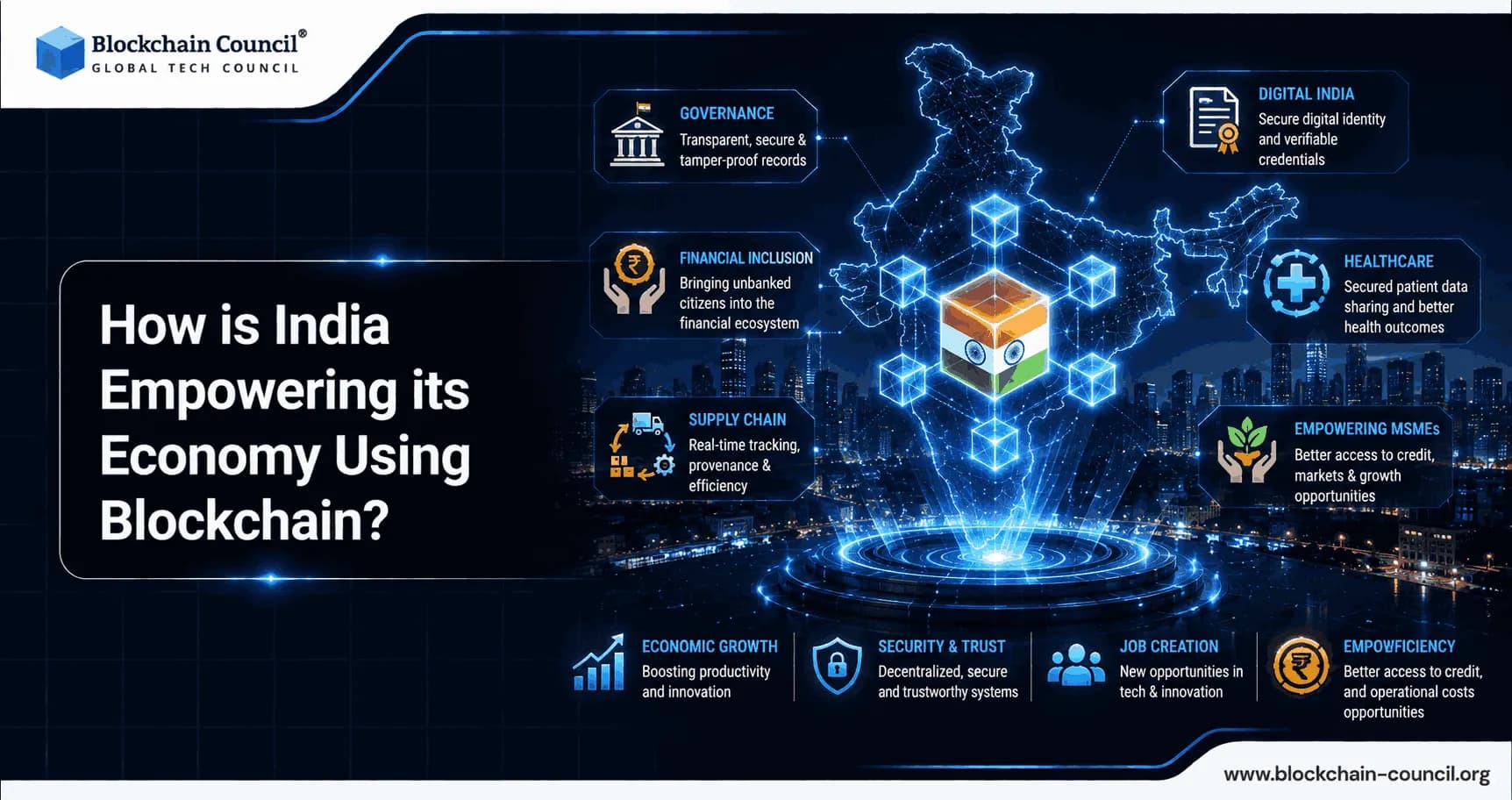
Introduction: A National Push Toward Distributed Ledger Adoption
India has moved well past the pilot-project stage of blockchain adoption, with government ministries, state administrations, and private enterprises now working together to embed the technology into core parts of the economy. From land records to public distribution systems, blockchain is increasingly being treated as infrastructure rather than experimentation. Professionals who want to understand the technical foundation behind this shift often start by pursuing a Certified Blockchain Expert credential, which builds the knowledge needed to evaluate how these large-scale government and enterprise systems are actually designed.
This growing momentum reflects a deliberate strategy rather than a passing trend. India's policymakers have recognized that blockchain can address longstanding problems around transparency, fraud, and inefficiency in public systems, while also creating new opportunities for the country's fast-growing technology workforce.

Government-Led Blockchain Initiatives Driving Adoption
The Ministry of Electronics and Information Technology launched the Blockchain India Challenge in early 2026, a national initiative inviting startups to pitch and pilot blockchain-based digital governance solutions. The challenge specifically focuses on permissioned, non-crypto blockchain applications, prioritizing regulatory control, auditability, and tamper resistance across government services. Startups selected through the program receive stage-wise funding, mentorship, and the opportunity to deploy pilot projects directly with government departments.
This initiative builds on the earlier National Blockchain Framework, which was introduced to provide Blockchain-as-a-Service infrastructure for government departments across the country. The framework gives various ministries a shared technology stack, reducing the cost and complexity of building blockchain applications from scratch. Developers who want to contribute directly to these kinds of large-scale government platforms often pursue a Certified Blockchain Developer credential, which provides the practical coding and architecture skills needed to build and deploy permissioned blockchain systems at scale.
State-Level Innovation Across India
Individual states have taken their own steps toward blockchain adoption, often tailoring the technology to local priorities. Andhra Pradesh has worked with blockchain platforms to secure land records and reduce disputes over property ownership. Telangana has explored blockchain applications in education and real estate, aiming to make certificate verification and property transactions more transparent. Tamil Nadu has gone further by establishing a dedicated state blockchain policy, signaling long-term commitment rather than one-off experimentation.
These state-level efforts demonstrate how blockchain adoption in India is not confined to a single centralized program but is instead spreading organically as local governments identify problems the technology can solve.
Blockchain's Role in Strengthening Public Trust
One of the clearest economic benefits of blockchain in India lies in its ability to reduce fraud and corruption in public systems. Land record management has historically been vulnerable to forged documents and disputed ownership claims, costing citizens time and money while discouraging investment in property markets. Blockchain-based land registries create a tamper-resistant record of ownership history, making fraudulent claims far harder to sustain.
Certificate verification is another area seeing meaningful improvement. Educational and professional certificates verified through blockchain systems eliminate the need for lengthy manual authentication processes, benefiting both employers and job seekers in a country with one of the world's largest workforces. Supply chain management has also started incorporating blockchain to track goods from origin to delivery, reducing counterfeiting and improving accountability across complex logistics networks.
Building the systems needed to support this level of trust requires professionals with a wide range of technical capabilities. A well-rounded Tech Certification helps individuals develop the broader technology skill set, spanning cybersecurity, cloud infrastructure, and data management, that underpins these government-backed blockchain platforms.
Future-Ready Skills
As technology becomes increasingly important across industries, students need opportunities to develop future-ready skills early in their education. A World Tech Olympiad can introduce students to areas such as artificial intelligence, coding, cybersecurity, robotics, and computational thinking while encouraging curiosity and continuous learning. Encouraging this kind of early exposure helps build a future workforce capable of sustaining India's growing blockchain ecosystem well beyond the current wave of government pilots.
Balancing Innovation With Regulatory Clarity
While blockchain adoption for governance has advanced steadily, the broader conversation around cryptocurrency regulation remains more complex. Enterprises across India are reportedly ready to scale their blockchain initiatives, but policy uncertainty around digital assets continues to hold back faster progress in some sectors. Upcoming budget decisions are expected to clarify how India plans to balance innovation with financial oversight, a decision that could significantly influence whether blockchain investment and talent remain within the country or shift elsewhere.
This distinction between blockchain infrastructure and cryptocurrency speculation has become increasingly important in Indian policy circles, with officials consistently emphasizing that most government-backed initiatives are non-crypto in nature and focused purely on improving public service delivery.
Communicating Blockchain's Value to a Broader Audience
For blockchain adoption to translate into lasting economic empowerment, the benefits need to reach beyond government departments and technology circles. Citizens, small businesses, and everyday professionals need to understand how these systems affect them directly, whether through faster certificate verification, more secure property transactions, or improved welfare distribution. Bridging that communication gap requires more than technical expertise.
A strong Marketing Certification equips professionals with the tools to explain complex blockchain initiatives in language that resonates with the public, helping build the trust and awareness needed for these government programs to achieve widespread adoption rather than remaining confined to pilot projects.
India's blockchain journey reflects a broader shift happening across emerging economies, where the technology is being used not for speculative trading but for solving practical governance and infrastructure challenges. As programs like the Blockchain India Challenge continue producing pilot deployments across land records, healthcare, and supply chains, the country is steadily building a digital economy grounded in transparency and trust, positioning itself as a model that other nations in the global south may look to replicate.
FAQs
1. How Is India Using Blockchain Technology to Empower Its Economy?
India is using blockchain technology to strengthen digital governance, improve public-service delivery, reduce fraud, create trusted digital records, modernize financial infrastructure, and encourage technology innovation.
A major initiative is India's National Blockchain Framework (NBF), which provides shared infrastructure for government blockchain applications. Its Vishvasya Blockchain Stack offers Blockchain-as-a-Service through geographically distributed NIC data centres in Bhubaneswar, Pune, and Hyderabad.
The broader economic strategy can be summarized as:
Blockchain → Digital Trust → Reduced Administrative Friction → Secure Transactions → Better Public Services → Innovation → Economic Efficiency
India's approach is notable because much of the emphasis is on practical infrastructure rather than simply creating another cryptocurrency and hoping everyone becomes wealthy by Thursday.
2. What Is India's National Blockchain Framework?
The National Blockchain Framework (NBF) is a Government of India initiative designed to provide scalable, secure, interoperable blockchain infrastructure for citizen-centric applications.
The framework includes:
Vishvasya Blockchain Stack → NBFLite → Praamaanik → National Blockchain Portal
The framework was officially launched in September 2024 with a budget outlay of ₹64.76 crore. It supports permissioned blockchain applications and includes smart contracts, APIs, privacy, security, interoperability, and distributed infrastructure.
Rather than every government department building an entirely separate blockchain system, the framework provides reusable national infrastructure.
3. What Is the Vishvasya Blockchain Technology Stack?
Vishvasya is India's government-backed blockchain technology stack designed to provide Blockchain-as-a-Service (BaaS).
It supports:
Distributed Infrastructure → Smart Contracts → Security → Privacy → Interoperability → APIs → Application Development
The infrastructure is hosted across NIC data centres in Bhubaneswar, Pune, and Hyderabad, providing geographical distribution for blockchain-based government services.
Vishvasya can therefore function as a foundation upon which different government agencies develop trusted digital applications without recreating the underlying infrastructure every time.
4. How Is Blockchain Improving Digital Governance in India?
Blockchain can improve governance by creating tamper-resistant, traceable, shared records among authorized government entities.
Potential and deployed applications include:
Certificates → Property Records → Judicial Records → Supply Chains → Document Verification → Government Services
The Government of India's October 2025 National Blockchain Framework backgrounder reported that more than 34 crore documents had been verified through the blockchain platform as of October 21, 2025.
At India's scale, reducing even small amounts of administrative duplication or document fraud can produce meaningful economic benefits.
5. How Is India Using Blockchain for Property and Land Records?
Property records are one of blockchain's significant public-sector applications because land ownership involves multiple records, authorities, transactions, and historical changes.
Blockchain can create a tamper-resistant chronology of:
Property Registration → Ownership Changes → Verification → Transfers → Supporting Documents
A 2026 Government of India backgrounder reported that more than 3 crore property documents had been verified through blockchain platforms as of October 2025.
Better record integrity can potentially reduce document manipulation, improve verification, and make property administration more efficient. Blockchain does not eliminate land disputes by itself, naturally. Humans remain perfectly capable of disputing things stored in excellent databases.
6. How Can Blockchain Reduce Fraud and Corruption in India?
Blockchain creates records that are difficult to modify without detection.
This can help organizations establish:
Who Created a Record → When It Was Created → Whether It Changed → Who Authorized a Transaction → Complete Transaction History
The National Blockchain Framework specifically targets security, transparency, accountability, and trusted digital service delivery.
Blockchain cannot eliminate corruption automatically because fraud can occur before information reaches the ledger. But once properly validated information is recorded, tamper-resistant records can make unauthorized manipulation more difficult.
7. How Is Blockchain Supporting India's Digital Public Infrastructure?
India already has substantial digital infrastructure involving digital identity, payments, digital documents, and online government services.
Blockchain can complement this ecosystem by providing a trust and verification layer where multiple organizations need to share records without relying entirely on one organization's database.
India's National Strategy on Blockchain envisions a trusted national digital platform covering technology infrastructure, standards, legal and regulatory considerations, human-resource development, and government applications.
The objective is therefore not to replace every existing database with blockchain. It is to deploy blockchain where shared, tamper-evident records provide genuine value.
8. How Is Blockchain Being Used in India's Financial Sector?
India's financial sector is exploring blockchain and distributed-ledger technology across areas such as:
Digital Currency → Securities → Covenant Monitoring → Settlement → Audit Trails → Tokenization
SEBI has already established operational guidelines for using Distributed Ledger Technology for security and covenant monitoring.
In January 2026, SEBI also established a working group to develop a five- and ten-year technology roadmap for India's market infrastructure institutions, explicitly including distributed ledger technology and tokenization among the technologies to be considered.
This indicates that India's blockchain-finance story increasingly extends beyond cryptocurrency trading.
9. What Is the Role of Blockchain in India's Securities Market?
Distributed-ledger technology can help create shared records between entities involved in securities markets.
One existing application is security and covenant monitoring, where DLT provides common infrastructure for monitoring information related to debt securities. SEBI issued operational guidelines for this system in 2022.
Depository infrastructure is also evolving. Public disclosures indicate that blockchain-based DLT has been implemented for security and covenant monitoring, with exploration of additional DLT-based offerings for other asset classes.
Potential future applications could involve:
Tokenized Securities → Settlement → Compliance → Audit Trails → Collateral → Asset Servicing
10. What Is the Role of the Digital Rupee in India's Blockchain Economy?
The Digital Rupee (e₹) is India's Central Bank Digital Currency issued by the Reserve Bank of India.
It is the digital form of the Indian rupee and carries the guarantee of the RBI. Retail and wholesale CBDC pilots have been conducted in India.
The Digital Rupee can be stored in participating digital wallets and used for person-to-person and person-to-merchant transactions. RBI information also indicates interoperability with UPI QR codes.
It is important, however, not to automatically equate CBDC with public blockchain cryptocurrency. The Digital Rupee is central-bank money, not a decentralized cryptocurrency such as Bitcoin.
11. How Can Blockchain Improve Supply Chains in India?
India has enormous supply chains spanning agriculture, pharmaceuticals, manufacturing, logistics, food, textiles, and exports.
Blockchain can provide a shared record of:
Production → Certification → Shipment → Warehousing → Distribution → Retail
This can improve traceability and make it easier to investigate counterfeit or improperly sourced goods.
Government reporting identifies medicine supply-chain tracking among blockchain applications already being developed or deployed in India's governance ecosystem.
For sectors where provenance and authenticity matter, blockchain can therefore function as a shared verification layer.
12. How Can Blockchain Help India's Agriculture Sector?
Agricultural blockchain systems could potentially connect:
Farmer → Produce → Quality Certification → Warehouse → Logistics → Buyer → Payment
Potential applications include crop traceability, agricultural supply chains, warehouse records, certifications, insurance, financing, and export provenance.
For example, export-oriented agricultural products could carry verifiable records showing origin, certifications, processing, and movement through the supply chain.
The economic benefit comes not from blockchain itself but from reducing information asymmetry and improving trust between participants.
13. How Can Blockchain Strengthen India's Pharmaceutical Industry?
Pharmaceutical supply chains require accurate information about manufacturing, batches, distribution, authenticity, and regulatory compliance.
Blockchain can create traceable records such as:
Manufacturer → Batch → Distributor → Pharmacy/Hospital → Verification
India's government has specifically identified medicine supply-chain tracking among blockchain applications supporting digital governance and trusted records.
This is potentially important for a country with a large pharmaceutical manufacturing and distribution ecosystem, particularly where product authenticity and traceability matter.
14. How Is Blockchain Helping Startups and Innovation in India?
India is developing infrastructure specifically intended to reduce barriers for blockchain experimentation.
NBFLite, part of the National Blockchain Framework, provides a lightweight blockchain sandbox designed for startups and academia to prototype applications, conduct research, and build skills.
MeitY's 2025-26 annual report says the broader blockchain-framework project had generated five patent filings and 51 research papers.
In February 2026, MeitY also launched the Blockchain India Challenge to promote blockchain-based digital-governance solutions involving government departments and startups.
15. How Can Blockchain Support India's MSMEs?
India's Micro, Small and Medium Enterprises could potentially benefit from blockchain in areas such as:
Digital Identity → Invoice Verification → Supply-Chain Records → Trade Finance → Certifications → Payments → Provenance
For example, verified transaction and invoice histories could potentially help lenders evaluate businesses more efficiently when combined with appropriate financial and consent frameworks.
Blockchain-based supply-chain systems could also give smaller manufacturers verifiable records of product origin and movement.
The practical objective is straightforward: reduce verification costs and increase trust between businesses that may not already trust one another. This is one of blockchain's less theatrical but more economically credible uses.
16. How Can Blockchain Help India's Export Economy?
Blockchain can support international trade by creating verifiable digital records for:
Certificates of Origin → Shipping → Quality Certifications → Customs Documents → Product Provenance → Payments
Exporters often interact with numerous organizations, including banks, logistics companies, customs authorities, insurers, inspection agencies, and overseas buyers.
Shared distributed records can potentially reduce repetitive verification and make product provenance easier to establish.
For Indian sectors such as pharmaceuticals, agriculture, textiles, gems, manufacturing, and food products, stronger traceability can become particularly useful when overseas buyers require evidence about origin or compliance.
17. How Is India Using Blockchain Beyond Cryptocurrency?
India's government blockchain strategy demonstrates that blockchain and cryptocurrency are not the same thing.
Major non-crypto applications include:
Document Verification → Property Records → Judicial Records → Medicine Supply Chains → Securities Monitoring → App Verification → Government Services
The National Blockchain Framework was explicitly designed for citizen-centric applications and trusted digital service delivery.
This means India's economic blockchain strategy is increasingly about digital trust infrastructure, rather than merely encouraging speculative crypto trading.
18. What Are the Main Challenges for Blockchain Adoption in India?
India still faces several challenges before blockchain can achieve large-scale economic adoption.
These include:
Scalability: systems must handle enormous transaction volumes.
Interoperability: different platforms must communicate.
Privacy: sensitive citizen and commercial information requires protection.
Legal Recognition: digital records and tokenized rights need clear legal treatment.
Cybersecurity: keys, applications and infrastructure require protection.
Skills: developers, administrators, lawyers and regulators need blockchain expertise.
Integration: blockchain must work with existing government and enterprise systems.
India's National Blockchain Framework directly addresses several technical issues through security, privacy, interoperability, scalable infrastructure, smart contracts, and reusable Blockchain-as-a-Service components.
19. What Blockchain Career Opportunities Are Emerging in India?
Growing blockchain adoption can create opportunities for:
Blockchain Developers → Solidity Developers → Smart Contract Engineers → Blockchain Architects → Cybersecurity Specialists → Web3 Developers → DLT Engineers → Blockchain Consultants → Tokenization Specialists → Digital Asset Professionals
Public-sector infrastructure creates additional demand around permissioned blockchain, interoperability, cybersecurity, identity, governance, and enterprise integration.
Financial-sector modernization could expand opportunities further. SEBI's 2026 technology-roadmap initiative explicitly includes DLT and tokenization, suggesting that blockchain knowledge may increasingly intersect with conventional securities-market technology.
A useful career combination is therefore:
Software Engineering + Blockchain + Cybersecurity + Finance/Governance Domain Knowledge
20. What Is the Future of Blockchain Technology in India's Economy?
India's blockchain trajectory increasingly points toward enterprise and public infrastructure rather than cryptocurrency alone.
The most promising areas include:
Digital Governance → Property Records → Financial Markets → Tokenization → Digital Currency → Supply Chains → Healthcare → Trade → Document Verification → Cybersecurity → Startup Innovation
The infrastructure is already moving beyond pilot rhetoric. India's National Blockchain Framework operates across geographically distributed NIC infrastructure, and government reporting said more than 34 crore documents had been verified through the blockchain platform by October 21, 2025.
Meanwhile, the securities sector is considering DLT and tokenization in its long-term technology planning, while RBI continues its Digital Rupee initiative.
A useful way to understand India's strategy is:
Digital India + Blockchain → Trusted Digital Infrastructure
Blockchain + Government → Transparent Public Services
Blockchain + Finance → DLT, Tokenization and Digital Money
Blockchain + Industry → Traceable Supply Chains
Blockchain + Startups → New Products and Research
Blockchain + Skills → Digital Employment and Innovation
The real economic opportunity is therefore not simply asking whether India will become a "crypto economy." It is whether blockchain can reduce verification costs, strengthen trust, improve record integrity, and make transactions between governments, businesses, financial institutions, and citizens more efficient.
That is a considerably less exciting headline than "everyone gets rich from tokens," but inconveniently, useful infrastructure is usually how economies actually get empowered.
Related Articles
View All
Blockchain
Beyond Cryptocurrency: How Blockchain Is Transforming Real-World Industries
Explore how blockchain works beyond cryptocurrency in banking, supply chains, healthcare, tokenisation, CBDCs, and government, plus key challenges and career paths.

Blockchain
Smart Contracts & dApps: How Blockchain Becomes Programmable
Learn how smart contracts and dApps make blockchain programmable, from Ethereum and tokens to DeFi, NFTs, real use cases, benefits, and key risks.

Blockchain
Behind the Blocks: How Blockchain Transactions Actually Work
Go behind the blocks to see how a blockchain transaction really works: wallets and keys, digital signatures, verification, hashing, blocks, consensus, proof of work vs proof of stake, and how miners and validators secure the network.
Trending Articles
The Role of Blockchain in Ethical AI Development
How blockchain technology is being used to promote transparency and accountability in artificial intelligence systems.
How Blockchain Secures AI Data
Understand how blockchain technology is being applied to protect the integrity and security of AI training data.

Can DeFi 2.0 Bridge the Gap Between Traditional and Decentralized Finance?
The next generation of DeFi protocols aims to connect traditional banking with decentralized finance ecosystems.