

How is Blockchain Relevant to Self Driving Cars?
 Toshendra Kumar Sharma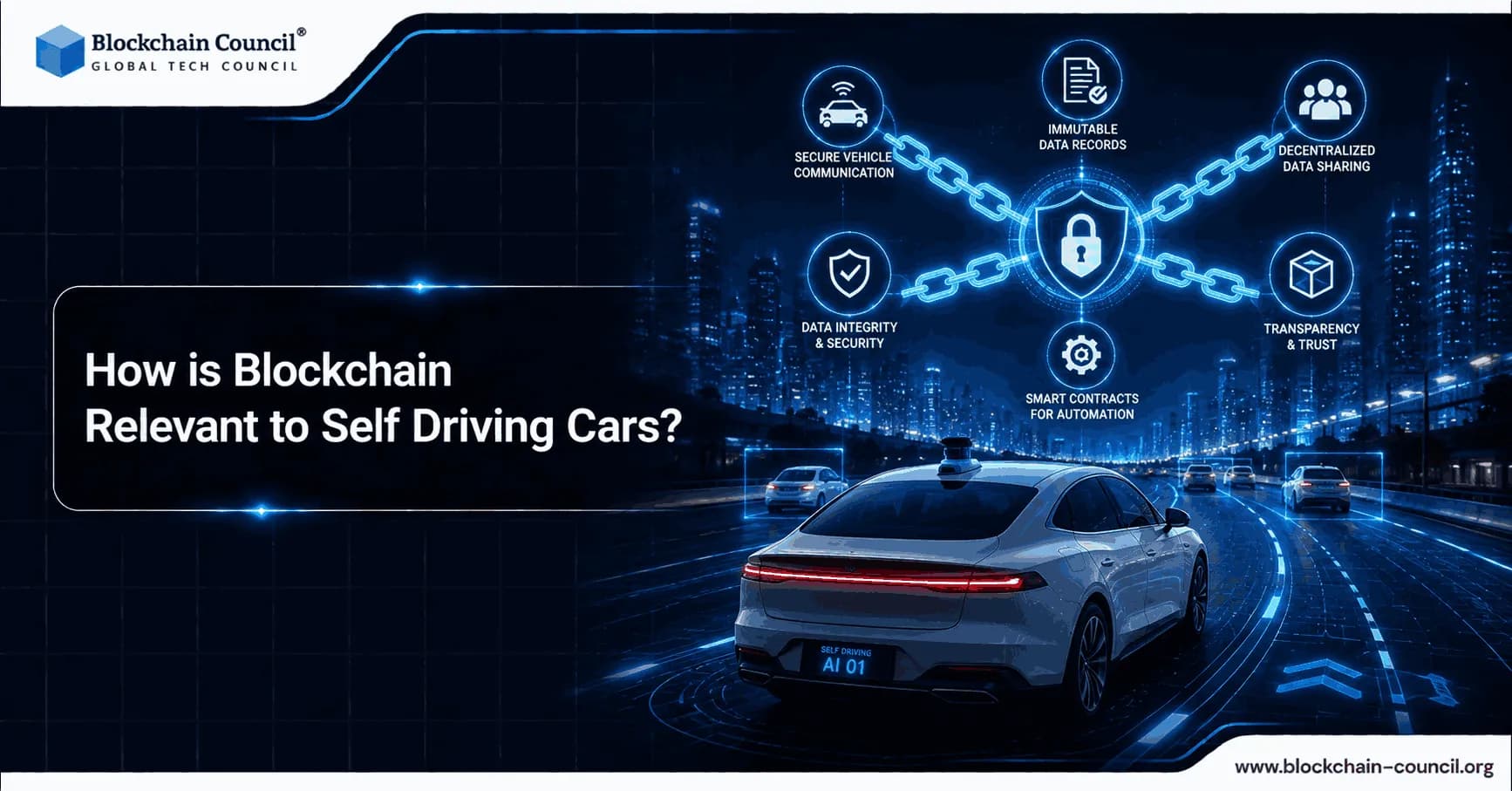
Self-driving cars generate an almost unbelievable amount of data every second sensor readings, camera feeds, location coordinates, and split-second decisions that all need to be trustworthy, tamper-proof, and instantly shareable with other vehicles and infrastructure. The self-driving car market itself is on a steep climb, expected to grow from roughly $48 billion in 2025 toward hundreds of billions by the mid-2030s, and the automotive blockchain market supporting this ecosystem is growing even faster, projected to expand from under $2 billion in 2026 to well over $12 billion by 2033. Autonomous vehicles need AI to drive but increasingly, they need blockchain to make that driving trustworthy, secure, and coordinated at scale.
Understanding why these two technologies keep showing up together starts with understanding blockchain itself. A recognized Certified Blockchain Expert credential gives professionals in mobility, automotive engineering, and transportation policy a working foundation before diving into how it intersects with autonomous vehicle systems specifically.

Why Autonomous Vehicles Need More Than Just AI
Self-driving cars rely on artificial intelligence to interpret sensor data and make real-time driving decisions, but AI alone doesn't solve every problem an autonomous vehicle faces. Consider what's actually at stake:
A self-driving car needs to prove its sensor data wasn't tampered with before a safety investigation.
Fleets of autonomous vehicles need to share real-time road and hazard data with each other without a single company controlling or potentially manipulating that shared information.
Vehicles need a secure, verifiable digital identity to authenticate themselves to charging stations, toll systems, and other infrastructure.
Passengers and insurers need transparent, disputable-proof records of what a vehicle actually did during an incident.
These are fundamentally data integrity and trust problems, not decision-making problems and that's exactly where blockchain's core strengths come into play alongside AI's perception and decision-making capabilities.
Because the value here comes specifically from combining AI's real-time decision-making with blockchain's verified data layer, professionals building in this space increasingly pursue a Certified Artificial Intelligence (AI) Expert credential alongside their blockchain training, giving them fluency in both halves of the autonomous vehicle technology stack rather than just one.
Core Ways Blockchain Supports Self-Driving Car Technology
Secure vehicle-to-everything (V2X) communication Autonomous vehicles constantly exchange data with other cars, traffic infrastructure, and cloud systems a concept known as V2X (vehicle-to-everything) communication. Blockchain can secure these exchanges by verifying that data comes from a legitimate source and hasn't been altered in transit, which matters enormously when a "phantom hazard" signal from a compromised source could cause a vehicle to brake unnecessarily or, worse, ignore a real one.
Tamper-proof sensor and decision logs Every decision a self-driving car makes when it braked, why it changed lanes, what its sensors detected in the moment before an incident can be recorded on a blockchain in a way that can't be altered after the fact. This creates a verifiable "black box" record that regulators, insurers, and manufacturers can trust during safety investigations, without relying solely on the manufacturer's own internal logs.
Digital vehicle identity and authentication Blockchain-based digital identity systems give each autonomous vehicle a unique, verifiable credential it can use to authenticate itself at charging stations, toll booths, parking systems, and service centers without needing a centralized authority to check in with for every transaction.
Decentralized mapping and road data sharing High-definition maps are essential for autonomous navigation, but keeping them updated in real time is a massive coordination challenge. Blockchain-based systems allow a network of vehicles to contribute verified road condition and hazard updates to a shared map, with each contribution traceable back to a verified source reducing the risk of bad actors injecting false data into the shared mapping layer.
Cybersecurity for connected and autonomous vehicles Rising cybersecurity concerns around connected and autonomous vehicles are actively driving blockchain adoption in the automotive sector, since decentralized architecture removes the single point of failure that a purely centralized vehicle network would otherwise present to attackers.
Practical Applications Already Taking Shape in the Middle of the Autonomous Vehicle Boom
Smart contracts for autonomous ride-hailing As robotaxi services expand across major cities, smart contracts can automate fare calculation, payment processing, and even dispute resolution between passengers and autonomous fleet operators all without a human dispatcher or billing department in the loop.
Blockchain-based vehicle financing and leasing Smart contract-based loan origination and servicing is already being used commercially in automotive financing, and platform-based solutions now represent the majority of the automotive blockchain market, reflecting how central this application has become to the broader autonomous mobility ecosystem.
Autonomous fleet coordination Autonomous mobility networks are projected to be the fastest-growing segment of the automotive blockchain market through the next decade, driven by increased investment in autonomous transportation infrastructure and the need for secure, real-time data transfer between fleet vehicles operating together.
Supply chain and component traceability Blockchain is also being used further back in the process verifying suppliers, tracking carbon emissions across production networks, and meeting emerging battery passport requirements for electric and autonomous vehicle components, giving manufacturers and regulators a verifiable record of how a self-driving vehicle's components were sourced and built.
Industry partnerships accelerating adoption Major automotive and technology players have been actively building out this ecosystem from strategic partnerships developing production-ready autonomous vehicle platforms with strengthened cybersecurity, to companies integrating blockchain alongside AI across connected mobility and personalized driving experiences.
Bringing these systems from concept to production requires teams that genuinely understand secure system architecture, not just the theory behind it. A structured Tech Certification in blockchain development gives automotive engineers, mobility startups, and IT teams the practical skills needed to build and evaluate these integrations properly.
The Regulatory and Trust Angle
Self-driving cars face intense scrutiny over safety, liability, and data privacy and blockchain offers a way to address several of these concerns directly. City-level approvals, safety recalls, and defined operational boundaries already shape where and how autonomous vehicles can legally operate, and verifiable, tamper-proof data trails make it significantly easier for regulators to audit an autonomous vehicle's behavior after an incident, rather than relying purely on a manufacturer's self-reported logs. As Level 4 robotaxi deployments expand into more cities globally, this kind of independently verifiable record-keeping is likely to become a genuine regulatory expectation rather than a competitive differentiator.
Final Thoughts
Self-driving cars represent one of the clearest real-world cases of AI and blockchain working as genuine partners rather than competing technologies. AI handles the perception and decision-making that lets a vehicle navigate the world; blockchain secures the data, communication, and transactions that let that vehicle operate safely and transparently within a much larger connected ecosystem. As autonomous fleets scale into more cities over the next several years, that partnership is only going to become more central to how the industry proves safety, earns regulatory trust, and builds public confidence.
Explaining that value clearly to consumers, regulators, and investors most of whom aren't thinking about V2X protocols or digital vehicle identity is its own challenge. That's where a solid Marketing Certification becomes genuinely useful for mobility companies and automotive brands, helping translate complex blockchain-and-AI infrastructure into a story the public can actually understand and trust as autonomous vehicles become a bigger part of everyday life.
FAQs
1. How can blockchain be used in self-driving cars?
Blockchain can support autonomous vehicles by enabling secure data sharing, decentralized identity, vehicle-to-vehicle (V2V) communication, smart contracts, automated payments, maintenance records, software update verification, and tamper-resistant audit trails.
2. Why is blockchain important for autonomous vehicles?
Self-driving cars generate massive amounts of data and interact with multiple systems, including traffic infrastructure, charging stations, insurance providers, manufacturers, and payment networks. Blockchain helps create secure, transparent, and verifiable records for these interactions.
3. How does blockchain work in self-driving cars?
Blockchain records important events such as software updates, maintenance history, ownership transfers, charging sessions, toll payments, and vehicle communications. Smart contracts can automate transactions, while decentralized networks verify data integrity.
4. Can blockchain improve vehicle security?
Yes. Blockchain can help secure software update records, verify digital identities, protect communication between connected systems, and reduce the risk of unauthorized modifications to critical vehicle data. It complements, rather than replaces, traditional cybersecurity measures.
5. How does blockchain support vehicle-to-vehicle (V2V) communication?
Blockchain can provide trusted verification for messages exchanged between vehicles, helping ensure that participating vehicles communicate with authenticated sources. This may improve the integrity of certain shared data, though low-latency safety functions still rely on dedicated communication technologies.
6. Can blockchain improve autonomous vehicle payments?
Yes. Smart contracts can automate payments for tolls, parking, charging stations, ride-sharing services, vehicle subscriptions, insurance, and maintenance without requiring manual intervention.
7. How does blockchain support electric self-driving cars?
Blockchain can record EV charging sessions, automate payments at charging stations, verify renewable energy usage, support peer-to-peer energy trading, and help manage battery lifecycle records.
8. Can blockchain improve vehicle maintenance?
Yes. Blockchain creates tamper-evident maintenance histories, service records, recalls, inspections, and replacement part information, making it easier for manufacturers, repair centers, and buyers to verify a vehicle's history.
9. How does blockchain improve supply chain management for vehicles?
Blockchain enables manufacturers to track components from suppliers to assembly plants, verify part authenticity, reduce counterfeit components, and improve traceability throughout the automotive supply chain.
10. Can blockchain improve car ownership records?
Yes. Blockchain can securely record ownership transfers, registrations, financing records, leasing agreements, and insurance information, reducing paperwork and improving transparency.
11. Which blockchain platforms are suitable for autonomous vehicle applications?
Popular blockchain platforms include Ethereum, Hyperledger Fabric, Hedera, Polygon, Avalanche, Solana, IOTA (for IoT-focused applications), and other enterprise blockchain solutions depending on scalability, governance, and privacy requirements.
12. Which industries benefit from blockchain and autonomous vehicles?
Industries including automotive manufacturing, transportation, logistics, insurance, smart cities, mobility-as-a-service (MaaS), energy, fleet management, telecommunications, and public infrastructure can benefit from blockchain-enabled vehicle ecosystems.
13. What are the advantages of blockchain for self-driving cars?
Benefits include secure data sharing, trusted digital identities, automated payments, transparent maintenance records, improved supply chain traceability, enhanced cybersecurity, fraud reduction, efficient fleet management, and stronger auditability.
14. What challenges exist when implementing blockchain?
Challenges include scalability, latency, interoperability, integration with legacy automotive systems, regulatory compliance, privacy requirements, implementation costs, governance, cybersecurity, and ensuring real-time performance for safety-critical operations.
15. Can blockchain operate a self-driving car?
No. Blockchain does not drive autonomous vehicles. Vehicle navigation, perception, decision-making, and control rely primarily on artificial intelligence (AI), sensors, cameras, radar, LiDAR, GPS, and onboard computing. Blockchain serves as supporting infrastructure for trust, verification, and transaction management.
16. What common mistakes should automotive companies avoid?
Common mistakes include assuming blockchain solves all cybersecurity challenges, storing excessive sensor data directly on-chain, neglecting privacy protections, skipping smart contract audits, overlooking interoperability, and implementing blockchain without identifying a clear operational benefit.
17. What are best practices for implementing blockchain in autonomous mobility?
Best practices include storing high-volume sensor data off-chain, recording only essential verification information on-chain, integrating decentralized identity (DID), conducting regular security audits, using permissioned networks where appropriate, ensuring compliance with transportation regulations, and combining blockchain with robust cybersecurity practices.
18. How does blockchain fit into the future of mobility?
Blockchain complements artificial intelligence (AI), Internet of Things (IoT), 5G connectivity, edge computing, cloud platforms, smart cities, electric vehicles (EVs), digital identity, and advanced transportation systems to create more secure and connected mobility ecosystems.
19. What trends are shaping blockchain and autonomous vehicles in 2025-2026?
Major trends include vehicle-to-everything (V2X) communication, AI-powered fleet management, decentralized identity (DID), machine-to-machine (M2M) payments, tokenized mobility services, blockchain-based EV charging, smart city integration, digital vehicle passports, software-defined vehicles, and carbon emissions tracking.
20. What is the future of blockchain in self-driving cars?
Blockchain is expected to become an important supporting technology for autonomous transportation by improving trust, automation, transparency, and secure data management. Rather than replacing AI or vehicle control systems, blockchain will likely integrate with connected car platforms, electric vehicles, smart infrastructure, and mobility services to streamline transactions and verify critical information. As autonomous vehicles become more connected, the ability to securely exchange trusted data may prove just as valuable as the ability to navigate roads. After all, even the smartest car benefits from knowing that the information it receives is as reliable as the brakes it depends on.
Related Articles
View All
Blockchain
Blockchain Certification Programs You Can Join Online
Discover the best blockchain certification programs you can join online. Learn blockchain fundamentals, smart contracts, enterprise blockchain, and career opportunities with globally recognized certifications.

Blockchain
Agile for Blockchain Teams: Managing Sprints, Smart Contracts, and Decentralized Roadmaps
Learn how agile for blockchain teams works when sprints, smart contracts, audits, governance, and decentralized roadmaps are planned around risk.

Blockchain
How to Write a PRD for Blockchain Products: Key Sections, Examples, and Best Practices
Learn how to write a PRD for blockchain products with key sections, practical examples, tokenomics, security, governance, and success metrics.
Trending Articles
The Role of Blockchain in Ethical AI Development
How blockchain technology is being used to promote transparency and accountability in artificial intelligence systems.
How Blockchain Secures AI Data
Understand how blockchain technology is being applied to protect the integrity and security of AI training data.
Blockchain in Supply Chain Provenance Tracking
Supply chains are under pressure to prove not just efficiency, but also authenticity, sustainability, and fairness. Customers want to know if their coffee really is fair trade, if the diamonds are con