

How Can Blockchain Transform Higher Education?
 Toshendra Kumar Sharma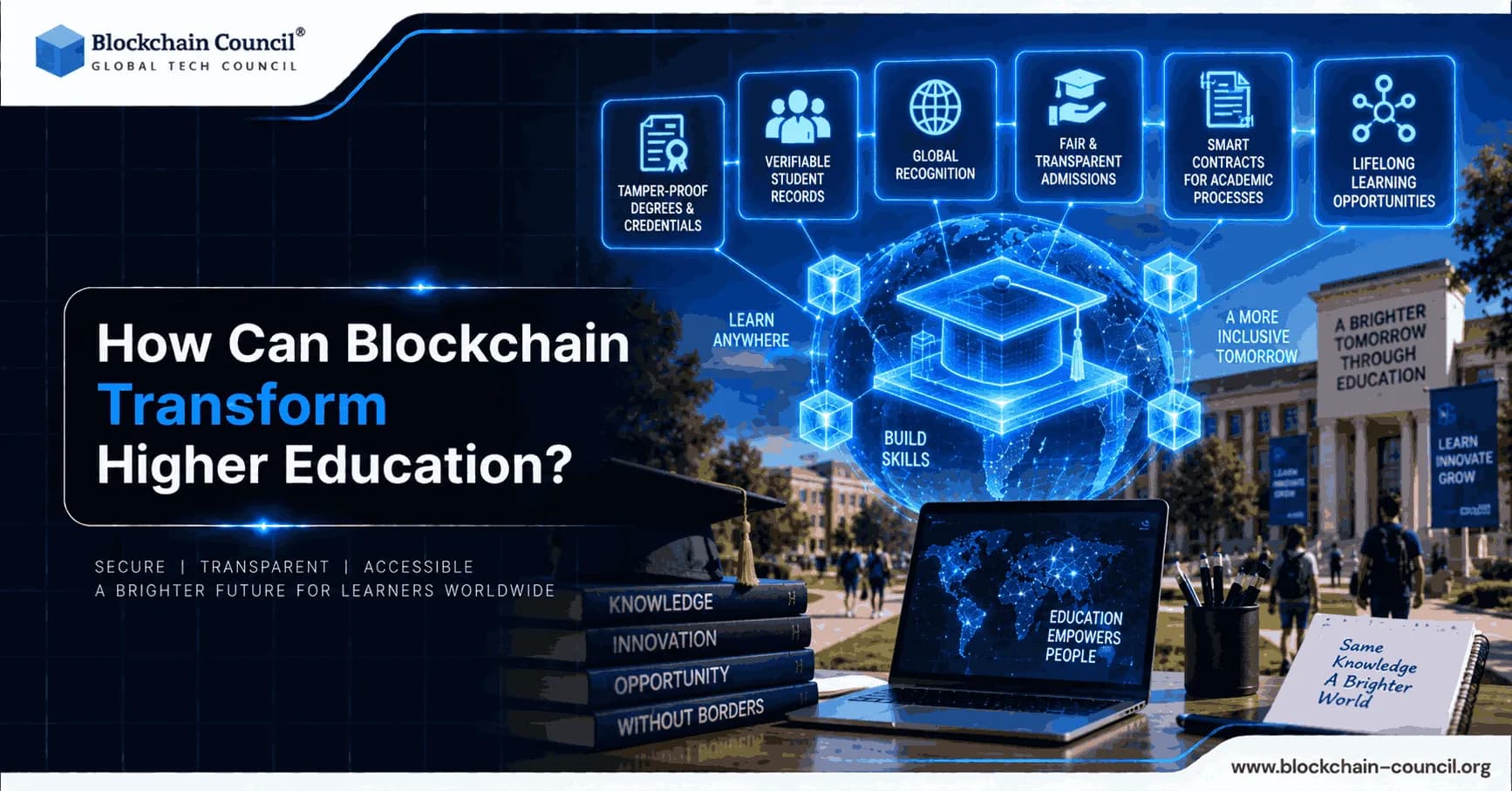
Higher education is becoming increasingly digital, with universities managing academic records, credentials, admissions, research data, payments, and student services through online systems. Blockchain technology could transform several of these areas by creating secure, verifiable, and tamper-resistant digital records. For educators, administrators, and technology professionals exploring this transformation, becoming a Certified Blockchain Expert can provide a stronger understanding of blockchain applications and their potential impact on education.
Blockchain is not simply about cryptocurrency. Its ability to maintain trusted records and enable controlled data sharing makes it relevant to universities seeking more efficient ways to manage academic information and digital credentials.

What Is Blockchain in Higher Education?
Blockchain is a distributed ledger technology that records information across a network. Properly designed blockchain systems can make records easier to verify and more difficult to alter without authorization.
In higher education, this technology can be applied to academic credentials, student records, research collaboration, identity verification, and other administrative processes.
For professionals interested in building the technology behind these applications, a Certified Blockchain Developer program can help develop practical knowledge of blockchain development, smart contracts, decentralized applications, and related technologies.
1. Secure and Verifiable Academic Credentials
One of the most promising applications of blockchain in education is digital credential verification.
Universities issue degrees, diplomas, certificates, and transcripts. Students may later need to prove these qualifications to employers, government agencies, or other educational institutions.
Faster Credential Verification
A blockchain-based credential can provide a verifiable record that an authorized institution issued a qualification.
Instead of relying entirely on manual verification, an employer or university could verify a digital credential through an appropriate verification system.
This could reduce administrative work and make credential verification faster, particularly for graduates applying internationally.
2. Reduce Academic Credential Fraud
Fake degrees and altered academic documents can create serious problems for employers and educational institutions.
Blockchain can help address this issue by creating records that are difficult to manipulate after they have been properly issued.
Establishing Institutional Trust
When credentials are issued by an authorized institution and linked to verifiable blockchain records, third parties can have greater confidence that the information has not been improperly changed.
Blockchain cannot determine whether an institution originally issued a legitimate qualification, so governance and trusted credential issuers remain essential.
3. Give Students Greater Control Over Their Records
Traditional academic records are generally maintained by educational institutions. Blockchain-based digital identity and credential systems could give students greater control over how verified information is shared.
For example, students could potentially maintain digital versions of their qualifications and selectively provide them to employers or other institutions.
Supporting Lifelong Learning
Students increasingly earn qualifications from multiple universities, online learning platforms, professional organizations, and training providers.
A portable digital credential system could help individuals build a more comprehensive record of their learning throughout their careers.
4. Improve Student Identity Management
Universities manage sensitive information about students, including enrollment details, academic histories, and identity information.
Blockchain-based identity systems could help institutions establish verifiable digital identities while allowing appropriate access controls.
The goal would not be to place sensitive personal information publicly on a blockchain. Instead, institutions could use permissioned systems and cryptographic verification to control access and validate information.
5. Streamline University Administration
Higher education involves numerous administrative processes, from admissions and enrollment to credential issuance and transfers.
Blockchain could automate selected processes through smart contracts. A smart contract can execute predefined actions when specified conditions are satisfied.
Automating Routine Processes
For example, a university could potentially use blockchain-based workflows to verify certain credentials, record approvals, or trigger administrative actions.
Automation could reduce repetitive paperwork and allow staff to focus on tasks that require human judgment.
6. Strengthen Research Collaboration
Universities generate significant amounts of research and intellectual property. Collaboration often involves researchers from different institutions and countries.
Blockchain could provide a verifiable record of specific research-related events, such as data submissions, document versions, intellectual property registrations, or contribution records.
This could support greater transparency in collaborative research environments.
7. Improve Transparency in Education
Blockchain can provide a shared record that authorized participants can independently verify.
This could be useful for scholarship distribution, educational grants, accreditation records, and other processes where transparency is important.
Building Greater Accountability
When appropriate information is recorded through a trusted system, institutions can create clearer audit trails. This can help identify when information was added or changed and which authorized participants were involved.
However, blockchain should complement existing governance and auditing procedures rather than replace them.
The Role of Emerging Technology Skills
Blockchain adoption in universities will require professionals who understand more than distributed ledgers. Educational institutions may need expertise in cybersecurity, cloud computing, artificial intelligence, data management, software development, and digital identity.
A Tech Certification can complement blockchain expertise by helping technology professionals develop broader knowledge of the digital systems that support modern educational institutions.
Universities can also benefit by giving students opportunities to learn these technologies through practical projects, research, internships, and technology-focused programs.
Future-Ready Skills
As technology becomes increasingly important across industries, students need opportunities to develop future-ready skills early in their education. A World Tech Olympiad can introduce students to areas such as artificial intelligence, coding, cybersecurity, robotics, and computational thinking while encouraging curiosity and continuous learning.
What Are the Challenges of Blockchain in Higher Education?
Blockchain offers potential benefits, but universities need to address several challenges before implementing it at scale.
Privacy and Data Protection
Academic records can contain sensitive personal information. Institutions must ensure that blockchain solutions comply with applicable privacy and data protection requirements.
Implementation Costs
Developing and maintaining blockchain infrastructure can require specialized skills and resources. Universities need to evaluate whether blockchain provides sufficient value for each use case.
Interoperability
Universities use many different student information systems, learning management systems, credential platforms, and databases. Blockchain solutions need to work effectively with existing infrastructure.
Governance
Universities and education networks must establish clear rules about who can issue, access, verify, and update information.
How Blockchain Could Shape the Future of Higher Education
The long-term impact of blockchain may extend beyond individual applications. It could contribute to a more portable and verifiable education ecosystem in which students maintain trusted records of their learning across institutions.
Universities could also use blockchain alongside artificial intelligence, cloud computing, and advanced analytics to create more connected digital services.
At the same time, technology adoption must be supported by effective communication. Institutions need to explain the benefits of digital credentials, data security, and new learning technologies to students, parents, faculty, employers, and other stakeholders. Professionals with a Marketing Certification can contribute by developing strategies that communicate complex educational technologies in a clear and accessible way.
Conclusion
Blockchain has the potential to transform higher education by making academic credentials easier to verify, reducing credential fraud, improving student control over records, streamlining administration, supporting research collaboration, and creating greater transparency.
Its success will depend on responsible implementation. Universities must consider privacy, governance, interoperability, security, cost, and regulatory requirements before adopting blockchain solutions.
As education becomes increasingly digital, blockchain could become an important part of the infrastructure supporting trusted academic records and portable credentials. Combined with AI, cybersecurity, cloud computing, and other emerging technologies, it may help create a more secure, transparent, and student-centered higher education ecosystem.
FAQs
1. How Can Blockchain Transform Higher Education?
Blockchain can transform higher education by creating trusted digital records for credentials, academic achievements, student records, and learning experiences. It can also make it easier for students, universities, employers, and other authorized organizations to verify educational information.
2. How Can Blockchain Improve Academic Credential Verification?
Blockchain can allow universities to issue digitally verifiable credentials that can be checked without repeatedly contacting the institution that issued them. This can make verification faster while helping reduce the risk of fraudulent or altered certificates.
3. Can Blockchain Prevent Fake Educational Certificates?
Blockchain can make fraudulent modification of blockchain-based credentials significantly more difficult because the verification record is tamper-resistant. However, blockchain does not automatically determine whether the original information entered by an institution was accurate.
4. How Can Blockchain Improve Student Records?
Blockchain can provide a trusted record of selected academic achievements, credentials, and learning activities. Instead of relying exclusively on paper documents or isolated databases, students could have portable digital records that can be verified by authorized parties.
5. Can Students Own and Control Their Academic Credentials?
Blockchain-based credential systems can give students greater control over how their verified educational achievements are stored and shared. This approach can support learner-controlled records that students can present to employers, universities, or other organizations when needed.
6. How Can Blockchain Help Students Share Their Degrees With Employers?
Students could share digitally verifiable certificates or credentials with prospective employers. Employers could independently verify the authenticity of those credentials instead of relying entirely on emails, paper documents, or manual communication with universities.
7. Can Blockchain Make University Transcripts More Efficient?
Yes. Blockchain-based transcripts could provide a more efficient way to store and share authoritative records of student learning and achievements. This could reduce administrative work involved in repeatedly producing and verifying academic records.
8. How Can Blockchain Support Digital Diplomas?
Universities can use blockchain-based credential technologies to issue digital diplomas that contain verifiable information about a student's qualification. A recipient can then share the credential digitally, while an authorized third party can verify its authenticity.
9. Can Blockchain Help Recognize Skills Beyond University Degrees?
Blockchain can support credentials for individual skills, competencies, courses, certifications, badges, and other learning achievements. This could help create a more comprehensive record of lifelong learning rather than focusing exclusively on traditional degrees.
10. How Can Blockchain Support Lifelong Learning?
A blockchain-based credential system can allow individuals to accumulate and share verified records of learning throughout their careers. This could include formal university education as well as professional development, skills training, and other recognized learning experiences.
11. Can Blockchain Improve International Recognition of Degrees?
Blockchain can help make educational credentials easier to verify across institutions and borders by providing standardized digital records. However, blockchain alone does not guarantee international recognition because governments, universities, and professional bodies still determine whether qualifications meet their requirements.
12. How Can Blockchain Reduce Administrative Work for Universities?
Blockchain can automate or simplify processes involving credential issuance, verification, record sharing, and authentication. By reducing repetitive requests for academic documents and manual verification, universities could potentially reduce administrative workloads.
13. Can Blockchain Improve Data Security in Higher Education?
Blockchain can provide tamper-resistant records and cryptographic verification for selected educational information. However, universities still need conventional security measures such as access controls, encryption, secure identity management, and privacy policies to protect sensitive student information.
14. How Can Blockchain Improve Student Privacy?
A properly designed blockchain system can give students greater control over which credentials or claims they share and with whom. Sensitive personal information does not necessarily need to be stored directly on a blockchain, which can help reduce unnecessary exposure of private data.
15. Can Blockchain Connect Universities and Employers?
Yes. Blockchain-based credentials can create a trusted bridge between educational institutions and employers. Universities can issue verifiable credentials, while employers can use those credentials to confirm qualifications and skills more efficiently.
16. How Can Blockchain Support Online Education?
Blockchain can provide verifiable credentials for online courses, certifications, badges, and other learning achievements. This can help learners demonstrate skills acquired through different educational platforms and learning environments.
17. Can Blockchain Improve Academic Credit Transfer?
Blockchain could make it easier for authorized institutions to verify previously earned credentials and learning achievements. A standardized digital record may reduce some of the administrative work involved in evaluating and transferring academic information between institutions.
18. What Are the Challenges of Using Blockchain in Higher Education?
Major challenges include privacy, interoperability, governance, technical integration, scalability, cost, regulatory requirements, and the lack of universally adopted credential standards. Universities also need clear policies defining who can issue, access, update, and verify educational records.
19. Does Blockchain Replace Traditional University Systems?
No. Blockchain is more likely to complement existing student information systems, learning platforms, credentialing systems, and databases. Its strongest potential is in situations where multiple organizations need to verify and exchange trusted records without relying entirely on manual processes.
20. What Is the Future of Blockchain in Higher Education?
The future of blockchain in higher education is likely to focus heavily on digital credentials, portable learning records, skills verification, and trusted data exchange. As digital education expands, blockchain could become one component of broader credentialing infrastructure, provided institutions address interoperability, privacy, governance, and standards.
Related Articles
View All
Blockchain
Beyond Cryptocurrency: How Blockchain Is Transforming Real-World Industries
Explore how blockchain works beyond cryptocurrency in banking, supply chains, healthcare, tokenisation, CBDCs, and government, plus key challenges and career paths.
Blockchain
Smart Contracts & dApps: How Blockchain Becomes Programmable
Learn how smart contracts and dApps make blockchain programmable, from Ethereum and tokens to DeFi, NFTs, real use cases, benefits, and key risks.

Blockchain
Behind the Blocks: How Blockchain Transactions Actually Work
Go behind the blocks to see how a blockchain transaction really works: wallets and keys, digital signatures, verification, hashing, blocks, consensus, proof of work vs proof of stake, and how miners and validators secure the network.
Trending Articles

Top 5 DeFi Platforms
Explore the leading decentralized finance platforms and what makes each one unique in the evolving DeFi landscape.
How Blockchain Secures AI Data
Understand how blockchain technology is being applied to protect the integrity and security of AI training data.
Claude AI Tools for Productivity
Discover Claude AI tools for productivity to streamline tasks, manage workflows, and improve efficiency.