

How Technology is transforming transactions?
 Toshendra Kumar Sharma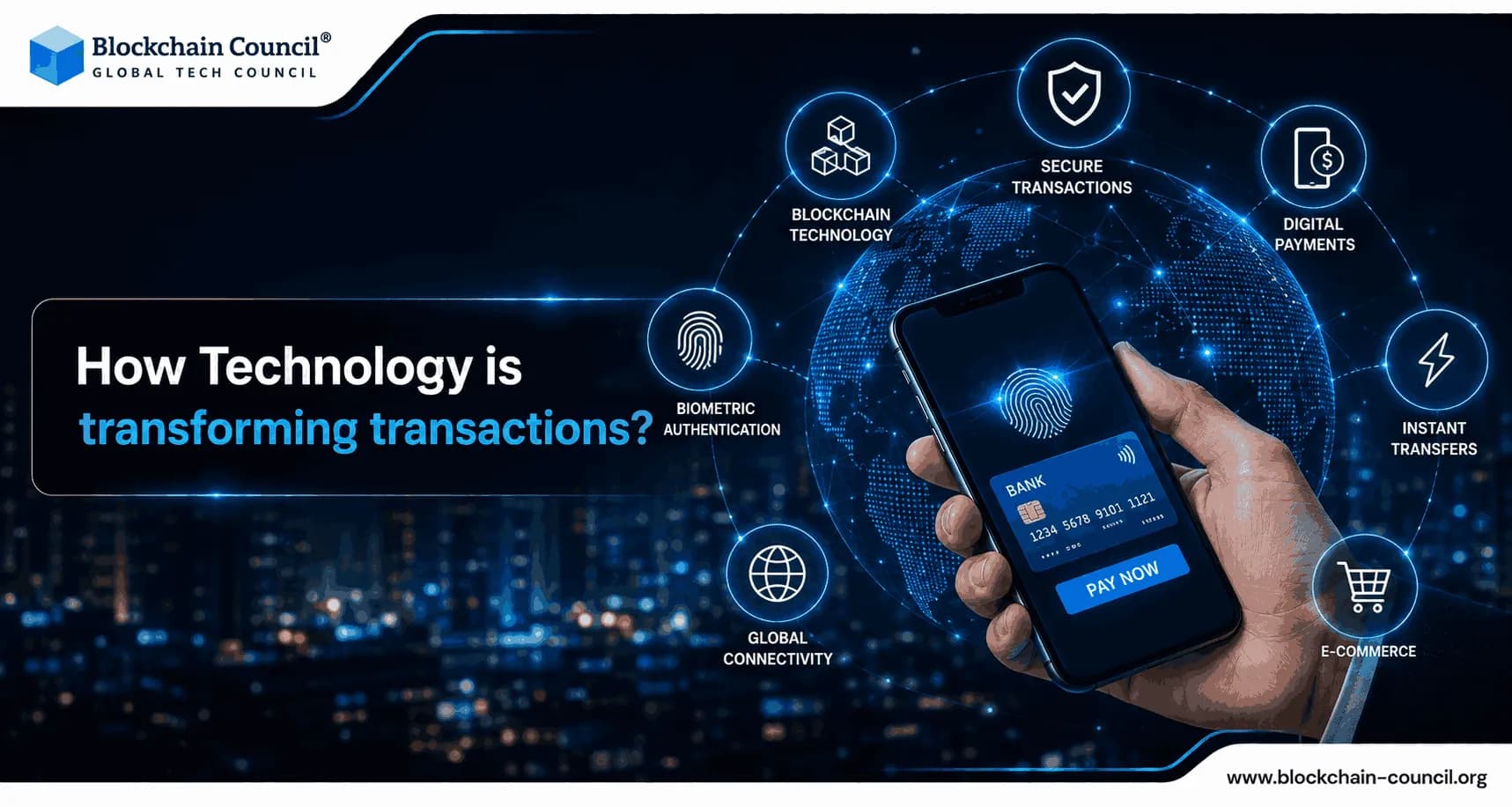
A transaction used to mean a physical handshake, a signed paper contract, or a trip to a bank branch to move money between accounts. Today, the same exchange of value can happen in seconds, verified automatically, and recorded permanently without either party needing to trust the other directly. This shift has not happened through any single innovation, but through a convergence of technologies working together to remove friction, delay, and risk from how value actually moves. As this transformation accelerates, more professionals are pursuing a Certified Blockchain Expert credential to understand exactly which technologies are driving this change and how deep the transformation actually goes.
In this article, we will look at the specific technologies reshaping how transactions happen today, how each one contributes to faster and more trustworthy exchanges of value, and where this transformation is headed next.

The Core Shift Behind Modern Transactions
Every transaction ultimately depends on answering the same basic question, can both parties trust that the exchange will actually happen as agreed. Historically, this trust came from intermediaries, banks verifying funds, notaries confirming signatures, escrow agents holding value until conditions were met. Technology is increasingly replacing that human mediated trust with verifiable, automated systems that confirm a transaction's legitimacy without requiring a person or institution to manually check every step.
This shift matters enormously for both individuals and businesses, since removing manual verification steps directly translates into faster settlement, lower costs, and fewer opportunities for error or fraud to slip through unnoticed. Understanding exactly how this automated trust actually gets built, particularly through blockchain based systems, requires real financial and technical depth, which is why professionals across banking and fintech are increasingly pursuing a Certified Blockchain & Finance Professional qualification, building the combined expertise needed to work at the center of this transformation rather than simply adapting to it after competitors move first.
Quick Answer
Technology is transforming transactions by replacing manual, intermediary dependent verification with automated, verifiable systems, including blockchain based ledgers, smart contracts, real time payment rails, biometric authentication, and AI powered fraud detection. Together, these technologies are cutting settlement times from days to seconds, lowering transaction costs, and creating transparent, tamper proof records that reduce disputes and fraud across financial, retail, and business to business transactions alike.
Technologies Actually Driving This Transformation
1. Blockchain and Distributed Ledgers
Blockchain allows transactions to be recorded on a shared, tamper proof ledger that every authorized party can independently verify, removing the need for a single central institution to serve as the sole source of truth. This has already reshaped cross border payments, trade finance, and securities settlement, moving processes that once took days down to minutes in many production deployments already live today.
2. Smart Contracts and Automated Execution
Smart contracts take this a step further by automatically executing a transaction's terms once predefined conditions are verified, removing the manual approval steps that traditionally slowed down everything from insurance payouts to supplier payments. Specialized platforms have emerged specifically to make this kind of automation more accessible to businesses, with providers like Blockchain0x working to simplify how companies integrate automated, blockchain based transaction infrastructure without needing to build every layer of that system internally.
3. Real Time Payment Rails
Beyond blockchain specifically, many countries have built real time payment infrastructure that settles domestic transactions in seconds rather than the multi day batch processing traditional banking relied on for decades. These systems, increasingly common worldwide, reflect a broader technological expectation that has reshaped what both consumers and businesses now consider an acceptable transaction speed.
Actually building the infrastructure capable of processing transactions this quickly and securely, whether blockchain based or built on modernized traditional rails, requires serious engineering depth. This is why development teams working on transaction infrastructure increasingly pursue a formal Tech Certification to validate the specialized skills needed to build systems that handle real money moving at genuinely high volume and speed.
4. Biometric and Passwordless Authentication
Verifying identity during a transaction has shifted significantly away from passwords and PINs toward biometric authentication, fingerprints, facial recognition, and increasingly passkey based systems that confirm identity without requiring users to remember or type anything. This reduces fraud risk while also removing friction that used to slow down legitimate transactions, benefiting both security and everyday convenience simultaneously.
5. AI Powered Fraud Detection
Artificial intelligence now monitors transaction patterns in real time, flagging suspicious activity far faster and more accurately than manual review ever could. This allows legitimate transactions to process smoothly while genuinely risky ones get caught and investigated before funds actually move, a balance that manual fraud review historically struggled to strike effectively at scale.
6. Tokenization of Assets and Payments
Beyond simple currency, technology is increasingly enabling entire assets, real estate, securities, loyalty points, to be represented digitally and transacted with the same speed and verification as a simple payment. This expands what counts as a tradable transaction well beyond traditional money movement, opening new markets for fractional ownership and instant settlement that were not previously practical.
What This Transformation Means in Practice
For businesses, this shift translates directly into lower operational costs, since automated verification reduces the manual reconciliation work that traditionally required entire teams. For consumers, it means transactions that once took days, an international money transfer, a property purchase, an insurance claim, now increasingly happen in a fraction of that time. And for the broader economy, faster, more transparent transactions reduce the friction that has historically limited how efficiently capital and value can move between the people and businesses that need it.
Building Early Skills for the Next Generation of Technology
As transactions become increasingly shaped by blockchain, artificial intelligence, automation, cybersecurity, and other digital technologies, understanding the foundations behind these systems will become useful well beyond traditional technology careers. Introducing these concepts early can help students develop computational thinking, problem-solving, and technical skills that prepare them for a world where digital infrastructure is involved in almost every form of commerce and communication.
Designed to encourage technology learning among school students, the World Tech Olympiad (WTO) brings together participants from Class 2 to Class 12 through different technology-focused challenges. Its areas include robotics, AI, programming, computational thinking, and cybersecurity, with competition levels structured to suit different age groups and abilities.
The Olympiad supports participation through separate routes for families and educational institutions. Parents can enroll their children directly, while schools can register as institutions and facilitate participation for students who meet the eligibility requirements.
Final Thoughts
Technology is not transforming transactions through any single breakthrough, but through the combined effect of blockchain, smart contracts, real time payment rails, biometric authentication, and AI driven fraud detection all maturing and converging at roughly the same time. Together, these technologies are replacing slow, intermediary dependent verification with fast, automated trust, fundamentally changing what people and businesses now expect a transaction to actually feel like.
As this transformation continues, companies building these systems need to do more than deliver reliable infrastructure. They need to clearly explain these changes to customers and partners who are used to how transactions have always worked. That is why organizations driving this shift are increasingly pairing their technical work with a Marketing Certification to communicate these advances clearly and build genuine trust during a period where the basic mechanics of exchanging value are changing faster than most people have fully noticed.
Transactions are no longer defined by how long they take or how many intermediaries they require. Technology has already redefined what a transaction can be, and that redefinition is still very much underway.
FAQs
1. How is technology transforming financial transactions?
Technology is making financial transactions faster, more digital, automated, data-driven, and increasingly available around the clock. Mobile wallets, real-time payment networks, contactless payments, blockchain, stablecoins, artificial intelligence, biometrics, and cloud infrastructure are changing how consumers and businesses exchange value. The broader shift is from transactions that depend heavily on physical cash and manual processing toward digital systems capable of verifying, processing, and settling payments almost instantly.
2. What technologies are changing the way people make payments?
Major technologies transforming payments include smartphones, digital wallets, QR codes, NFC, biometrics, artificial intelligence, blockchain, stablecoins, APIs, cloud computing, and real-time payment networks. These technologies increasingly work together rather than independently. A customer may authenticate with biometrics, initiate payment through a mobile wallet, have AI systems analyze the transaction for fraud, and receive confirmation through cloud-based payment infrastructure within seconds.
3. How have mobile payments transformed everyday transactions?
Mobile payments allow consumers to use smartphones and wearable devices instead of relying exclusively on cash or physical cards. Digital wallets can securely store payment credentials and support contactless transactions through NFC or QR codes. Mobile technology has also expanded financial access in regions where smartphone-based financial services can reach consumers more easily than conventional bank branches.
4. How are real-time payments changing banking?
Real-time payment systems allow money to move between eligible accounts within seconds rather than waiting hours or days for settlement processes. They can improve consumer transfers, bill payments, business payments, payroll, and merchant transactions. For companies, faster payments can improve cash-flow management and reduce uncertainty. Real-time infrastructure is also encouraging banks and FinTech companies to develop services around instant financial data and programmable workflows.
5. How is blockchain transforming transactions?
Blockchain enables digital assets to be transferred through shared networks where transactions can be cryptographically verified. Smart contracts can add programmable conditions, allowing certain transactions to execute automatically. Blockchain is particularly relevant to digital assets, tokenized financial markets, stablecoin payments, and settlement between organizations. Its value is strongest when several independent participants need shared verification rather than when a conventional centralized database already works efficiently.
6. How are stablecoins transforming digital payments?
Stablecoins are blockchain-based digital assets designed to maintain a relatively stable reference value, commonly linked to currencies such as the U.S. dollar. They can move across compatible blockchain networks continuously, making them useful for trading, international transfers, treasury operations, and digital commerce. Stablecoins are increasingly connecting conventional currencies with blockchain applications and programmable financial infrastructure.
7. How is artificial intelligence changing financial transactions?
AI can analyze transactions in real time to identify fraud, assess risk, personalize payment experiences, automate financial operations, and improve customer support. Machine-learning systems can detect unusual patterns that traditional rules may miss. AI agents may also increasingly initiate transactions on behalf of users, making identity, authorization, spending controls, and transaction accountability increasingly important parts of future payment infrastructure.
8. How is biometric technology transforming payments?
Biometric authentication uses characteristics such as fingerprints, facial recognition, or other biological signals to verify a person's identity. It can make payments more convenient by reducing dependence on passwords and PINs. Smartphones and payment applications already use biometric authentication extensively. Strong implementations combine biometrics with device security, encryption, and additional authentication mechanisms because biometric information requires particularly careful protection.
9. How are contactless payments changing consumer behavior?
Contactless technology allows consumers to complete transactions by tapping a card, smartphone, or wearable device near a compatible payment terminal. The speed and convenience of these transactions have helped reduce reliance on physical cash in many markets. Contactless payments also demonstrate an important principle of financial technology: consumers tend to adopt complicated infrastructure most enthusiastically when the interface requires them to do almost nothing.
10. How is technology transforming cross-border transactions?
Digital payment platforms, blockchain networks, stablecoins, APIs, and modern banking infrastructure are creating new ways to move money internationally. These technologies can reduce processing delays and improve transaction visibility. Blockchain-based settlement can operate continuously, while stablecoins can provide digitally transferable currency-denominated value. Foreign exchange, regulation, sanctions screening, AML requirements, and local banking rules still remain important parts of cross-border payments.
11. How are digital wallets changing transactions?
Digital wallets allow users to store payment credentials, digital assets, tickets, identity information, and potentially Verifiable Credentials in one application. They can support cards, bank payments, cryptocurrencies, stablecoins, and other forms of digital value depending on the provider. Future wallets may increasingly combine payment and identity functions, allowing users to prove who they are and complete transactions through the same digital interface.
12. How is tokenization changing financial transactions?
Tokenization can represent financial assets such as bonds, funds, commodities, deposits, or other economic rights as programmable digital tokens. These assets can potentially interact directly with smart contracts and settle through compatible digital-money infrastructure. Tokenization can reduce reconciliation and make certain financial workflows more automated. It is therefore becoming increasingly relevant to institutional finance rather than remaining purely a cryptocurrency concept.
13. How are smart contracts transforming business transactions?
Smart contracts are programs that automatically execute predefined rules on blockchain networks. Businesses can potentially use them for payments, settlement, escrow, insurance, supply-chain transactions, and digital-asset transfers. For example, a payment could be triggered after a trusted system confirms that goods have been delivered. Complex commercial relationships still require legal agreements and mechanisms for resolving situations the code did not anticipate.
14. How is technology making transactions more secure?
Modern transactions use encryption, tokenization, biometrics, device authentication, AI-based fraud detection, behavioral analysis, and cryptographic signatures to improve security. Payment systems can evaluate transactions in real time and identify suspicious activity before authorization. Blockchain adds tamper-evident records in appropriate applications. No technology eliminates fraud entirely, however, because criminals also possess computers and an unfortunate commitment to professional development.
15. How is digital identity transforming online transactions?
Digital identity technologies can help businesses verify customers more efficiently while reducing repetitive document submission. Verifiable Credentials can allow trusted organizations to issue digitally signed evidence of identity, qualifications, or eligibility. Privacy-enhancing technologies can also enable users to prove specific facts without revealing unnecessary information. Better identity infrastructure can reduce fraud while making online onboarding and transactions more convenient.
16. How is technology changing business-to-business transactions?
B2B transactions are becoming increasingly automated through APIs, electronic invoicing, real-time payments, blockchain settlement, cloud platforms, and AI. Companies can connect purchasing, invoicing, treasury, accounting, and payment systems so that fewer transactions require manual processing. Smart contracts and tokenized money could further automate settlement when predefined commercial conditions are satisfied.
17. How will AI agents transform transactions?
AI agents could increasingly purchase digital services, pay invoices, manage subscriptions, book travel, trade assets, or negotiate transactions on behalf of individuals and businesses. These agents will need secure identities, authorization rules, spending limits, and payment infrastructure. Stablecoins and programmable blockchain payments could become useful because software agents can interact with them directly, potentially creating a growing machine-to-machine economy.
18. Will digital payments eventually replace cash?
Digital payments will probably continue reducing the role of cash in many economies, but complete replacement is neither inevitable nor universally desirable. Cash provides accessibility, privacy, resilience during technical outages, and usefulness for people without reliable digital access. Governments and financial institutions therefore need to balance payment innovation with financial inclusion, cybersecurity, operational resilience, and consumer choice.
19. What payment technology trends are most important in 2026?
Important trends include real-time payments, stablecoins, tokenized deposits, Real-World Asset tokenization, AI-driven fraud prevention, biometric authentication, embedded finance, digital identity, programmable payments, and increasingly intelligent digital wallets. Interoperability is another major trend because consumers and businesses increasingly expect different banks, wallets, payment networks, currencies, and digital-asset systems to communicate without requiring complicated manual processes.
20. What will the future of transactions look like?
The future of transactions is likely to be instant, intelligent, programmable, increasingly invisible, and available across multiple forms of money.
Consumers may continue using familiar cards, bank accounts, mobile wallets, and real-time payment systems while stablecoins, tokenized deposits, and potentially central bank digital currencies become additional settlement options.
AI will increasingly operate around these payment systems. An authorized AI assistant could identify a product, compare prices, place an order, select a payment method, and complete a transaction within limits established by its user. Businesses could use autonomous agents to purchase computing resources, settle invoices, or manage treasury operations.
Blockchain and smart contracts could provide programmable settlement for some of these transactions, while digital identity systems verify the people, businesses, devices, and AI agents involved.
The most significant change is therefore not simply the disappearance of cash or the growth of cryptocurrency. It is the transformation of a transaction from a standalone payment event into an automated digital process combining identity, data, intelligence, and settlement.
In the past, people actively performed transactions. Increasingly, technology will perform parts of transactions for them.
The challenge will be making these systems fast and convenient without sacrificing security, privacy, consumer protection, or human control.
The future payment may take milliseconds to execute while relying on AI, cryptography, cloud infrastructure, identity systems, fraud detection, and several financial networks underneath. The customer, displaying humanity's finest appreciation for engineering, will mostly be annoyed if the confirmation screen takes three seconds to load.
Related Articles
View All
Blockchain
Beyond Cryptocurrency: How Blockchain Is Transforming Real-World Industries
Explore how blockchain works beyond cryptocurrency in banking, supply chains, healthcare, tokenisation, CBDCs, and government, plus key challenges and career paths.

Blockchain
Behind the Blocks: How Blockchain Transactions Actually Work
Go behind the blocks to see how a blockchain transaction really works: wallets and keys, digital signatures, verification, hashing, blocks, consensus, proof of work vs proof of stake, and how miners and validators secure the network.

Blockchain
Blockchain Explained: The Technology Changing How We Trust & Transact
Blockchain explained from the ground up: what it is, why it was created, centralised vs decentralised systems, how blocks, nodes, and ledgers work, how data is stored, security, real-world examples, and how blockchain compares with traditional databases.
Trending Articles
AWS Career Roadmap
A step-by-step guide to building a successful career in Amazon Web Services cloud computing.
What is AWS? A Beginner's Guide to Cloud Computing
Everything you need to know about Amazon Web Services, cloud computing fundamentals, and career opportunities.
How to Create Claude Skills?
Claude Skills are one of the most important features Anthropic has introduced for users who want automation that is structured, consistent and reusable. Instead of giving Claude long instructions ever