

FINMA has Authorized InCore Bank to Deal With Cryptocurrencies
 Toshendra Kumar Sharma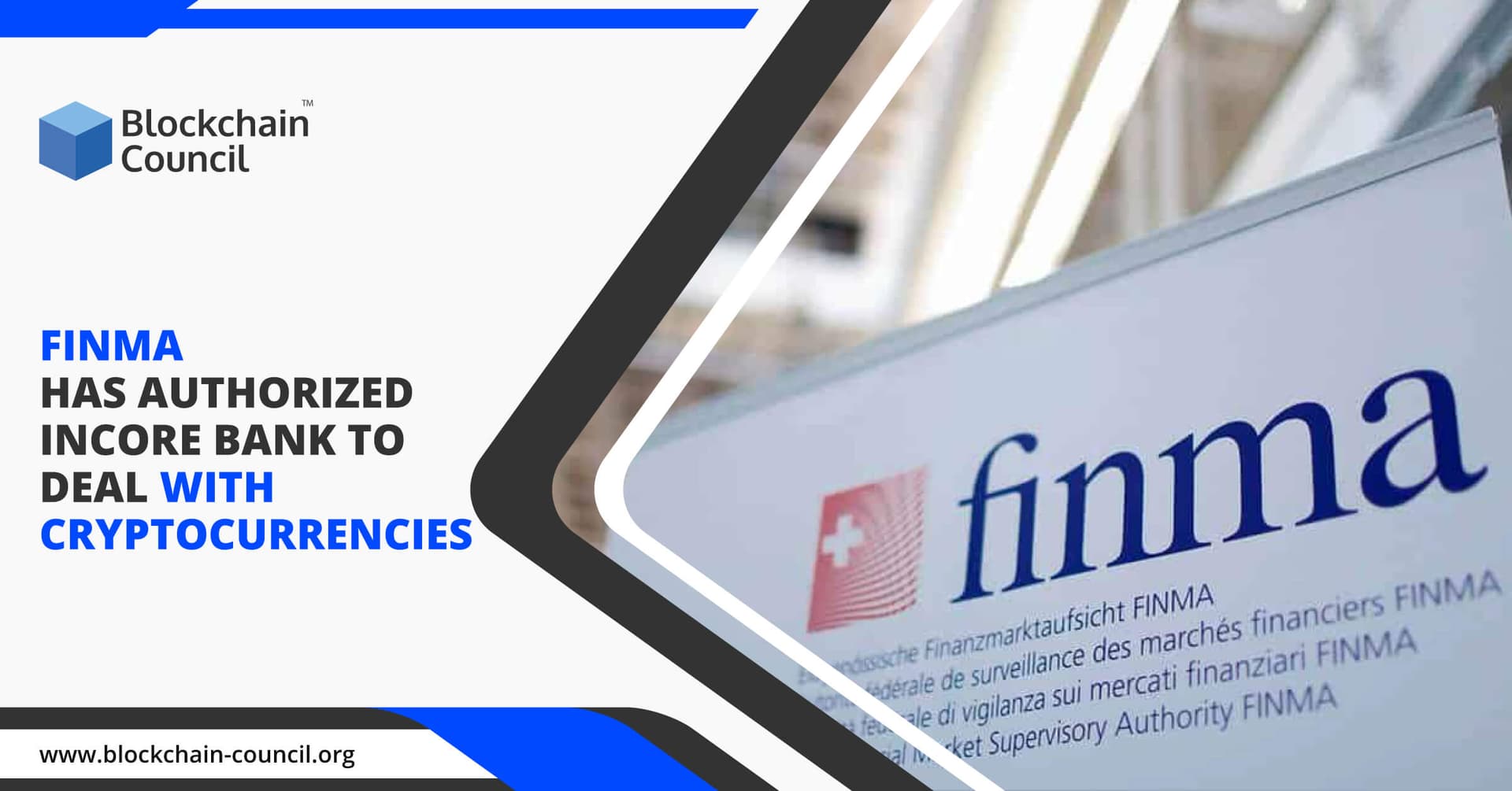
FINMA has Authorized InCore Bank to Deal with Cryptocurrencies. The Swiss Financial Market Supervisory Authority(FINMA) has given the green light to InCore bank to engage in digital asset transactions that will allow customers worldwide to access and transact within the bank. InCore bank becomes the first approved Swiss business-to-business bank to deal with the crypto sphere. The approval comes as an encouraging step toward establishing a blockchain-powered banking system across the European Union banking space.

According to the announcement, the firm allows institutional clients to purchase, sell, and hold crypto assets and allows banks to develop their tokenization capabilities, which is expected to play a vital role in the emerging asset class.
FINMA is a Swiss government body responsible for financial regulation, which includes the supervision of banks, stock exchanges, insurance companies, securities dealers, and other financial intermediaries in Switzerland. Founded in 2007, InCore Bank is a one-stop business-to-business transaction bank, providing banks, security dealers, asset managers, and fintech companies with first-class transaction banking and outsourcing services.
FINMA’s Approval is a Huge Step Towards Crypto-Banking Services
It’s worth noting that the bank, InCore had already partnered with Inacta AG, an independent Swiss-based IT consulting firm, to provide crypto-assets management. In a statement to Finews.ch, Mark Dambacher, CEO of InCore Bank, stated that: “Our customers benefit in one fell swoop from the expansion to the new asset class without having to invest in infrastructure and new processes themselves. And this while maintaining the usual security standards and how we build the bridge to traditional asset classes.”
Company Executives from the bank also stated that FINMA approval is a massive step towards crypto-banking services, and further, it plans to expand its blockchain strategy in the coming months. Moreover, the bank is considering adding brokerage, custody, and transfer services to security tokens.
Swiss Continues to Grow in Crypto Domain
Swiss banks have always been at the forefront when it comes to the adoption of crypto assets. In 2019, FINMA warned the country that Switzerland is particularly prone to money laundering risks for reasons, including the use of blockchain technology. The document was stated, “In addition to traditional money-laundering risks, the financial industry also faces new risks in the area of blockchain technology and the crypto assets that are attracting growing interest from clients.”
However, later on, on February 7, 2020, FINMA passed an anti-money laundering provision. The threshold for unidentified crypto exchange transactions was lowered from 5,000 CHF to 1,000 CHF. In January 2020, it was reported that Julius Bar, the third-largest private bank in Switzerland, is expanding its digital assets product offerings to its Swiss-based customers in a bid to meet their growing demand. Moreover, it was reported that the financial institution is collaborating with Swiss-based FINMA-licensed cryptocurrency bank, Seba Crypto AG (SEBA), to offer trading services and crypto custodial to the clients.
In March 2020, Sygnum bank launched a DCHF-backed stablecoin to make it easier for people to invest in the digital asset economy, designed to facilitate the trading of financial instruments like bonds, shares, and others.
To get instant updates about Blockchain Technology and to learn more about online blockchain certifications, check out Blockchain Council.
Related Articles
View All
Blockchain
Beyond Cryptocurrency: How Blockchain Is Transforming Real-World Industries
Explore how blockchain works beyond cryptocurrency in banking, supply chains, healthcare, tokenisation, CBDCs, and government, plus key challenges and career paths.

Blockchain
Smart Contracts & dApps: How Blockchain Becomes Programmable
Learn how smart contracts and dApps make blockchain programmable, from Ethereum and tokens to DeFi, NFTs, real use cases, benefits, and key risks.

Blockchain
Public, Private & Consortium Blockchains: Which Network Fits the Use Case?
Compare public, private, and consortium blockchains by security, speed, privacy, and control, with real examples and a simple guide to choosing the right network.
Trending Articles
The Role of Blockchain in Ethical AI Development
How blockchain technology is being used to promote transparency and accountability in artificial intelligence systems.
AWS Career Roadmap
A step-by-step guide to building a successful career in Amazon Web Services cloud computing.
What is AWS? A Beginner's Guide to Cloud Computing
Everything you need to know about Amazon Web Services, cloud computing fundamentals, and career opportunities.