

Crypto Millionaire to build a Blockchain Smart City in Nevada
 Toshendra Kumar Sharma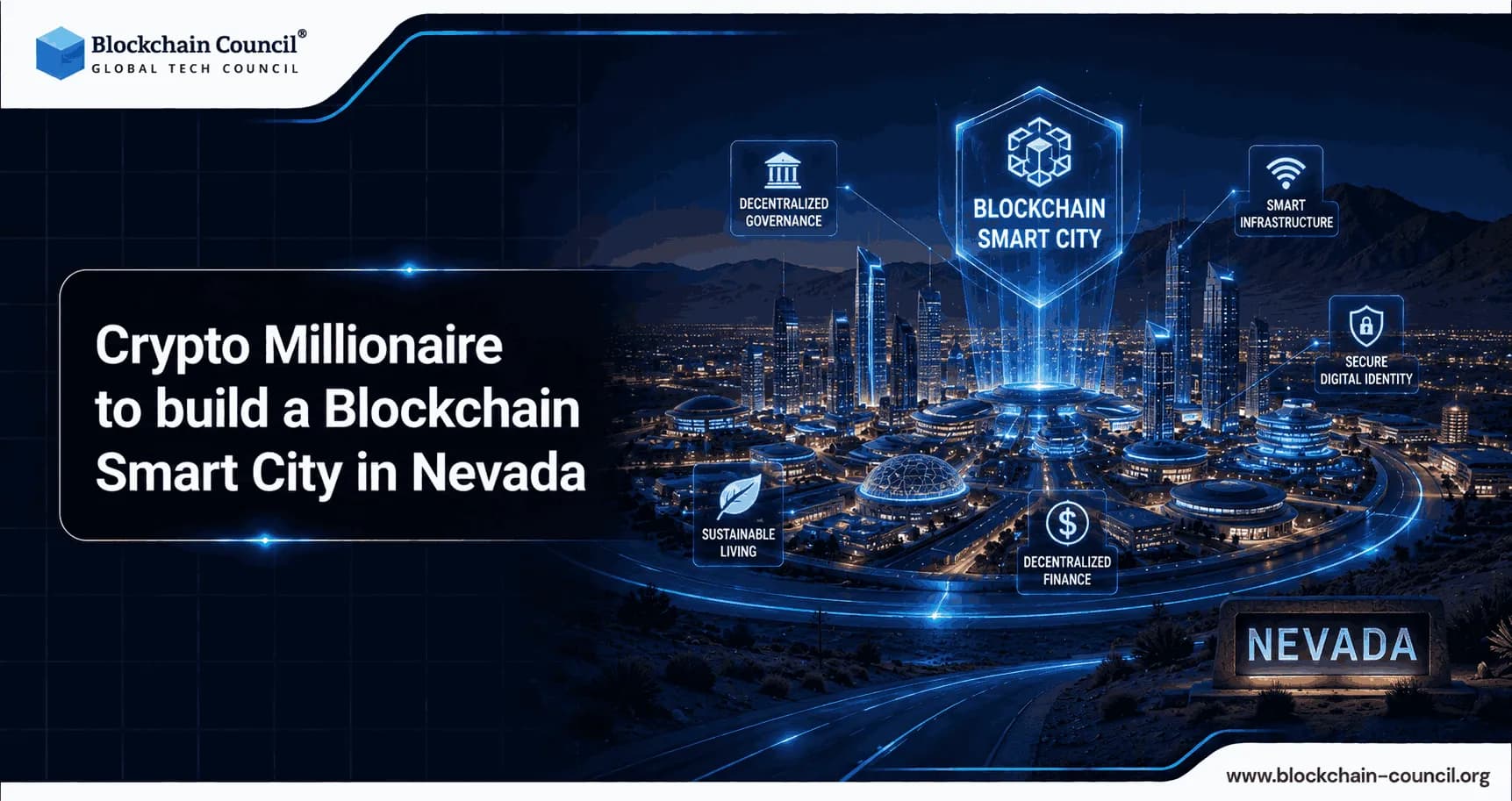
The idea of building a blockchain-powered smart city has attracted significant attention as blockchain technology moves beyond cryptocurrencies and financial applications. Nevada, known for its technology-friendly business environment and rapidly developing innovation ecosystem, has emerged as a location for ambitious technology projects. One notable vision involves a crypto millionaire seeking to develop a smart city that incorporates blockchain into aspects of urban infrastructure and governance.
Understanding the technology behind such projects requires knowledge of decentralized networks, digital assets, and blockchain applications. A Certified Blockchain Expert can help professionals understand how blockchain works and how distributed ledger technology can be applied beyond cryptocurrency.

What Is a Blockchain Smart City?
A blockchain smart city is an urban development concept that uses connected technologies and blockchain infrastructure to improve how certain services, transactions, and records are managed.
Traditional smart cities already use technologies such as sensors, cloud computing, artificial intelligence, and the Internet of Things. Blockchain can complement these technologies by providing a shared and tamper-resistant system for recording selected types of information.
Potential applications could include:
Digital identity systems
Property and land records
Smart contracts
Digital payments
Utility management
Business registrations
Secure data sharing
Automated administrative processes
The exact technologies used would depend on the project's design, regulatory environment, and partnerships.
Why Nevada Is Attracting Blockchain Development
Nevada has become an interesting destination for technology and blockchain initiatives because of its large technology sector, business infrastructure, and proximity to established innovation hubs in the western United States.
A blockchain smart city could potentially create opportunities for technology companies, entrepreneurs, investors, and developers while introducing new approaches to urban services.
A New Model for Digital Infrastructure
The concept goes beyond simply accepting cryptocurrency for payments. A blockchain-based city could integrate decentralized technologies into multiple layers of its digital infrastructure.
For example, smart contracts could automate certain agreements, while blockchain-based records could provide authorized parties with a consistent source of information.
The Role of Cryptocurrency in the Smart City
Cryptocurrency could potentially play a role in a blockchain smart city by supporting digital payments, token-based services, or other blockchain-enabled financial applications.
However, cryptocurrency and blockchain are not the same thing. Blockchain is the underlying technology used by many cryptocurrencies, but it can also support applications that do not involve digital currencies.
Anyone exploring the relationship between cryptocurrencies and blockchain technology can benefit from specialized knowledge such as a Certified Cryptocurrency Expert qualification, particularly when examining digital assets, cryptocurrency ecosystems, and their practical applications.
How Blockchain Could Transform Urban Services
A blockchain smart city could potentially use distributed ledger technology in several areas.
Digital Identity
Residents could potentially use secure digital identities to access selected public or private services. A well-designed identity system could reduce repetitive verification processes while giving users greater control over certain credentials.
Smart Contracts
Smart contracts are programs that execute predefined actions when specified conditions are met. In an urban environment, they could potentially automate agreements involving property, utilities, services, or business transactions.
Property Records
Blockchain could provide a transparent and traceable method for recording property-related information. Authorized participants could access a synchronized record, potentially reducing administrative complexity.
Digital Payments
Blockchain-based payment infrastructure could support faster digital transactions in selected use cases. Depending on regulations and implementation, residents and businesses could potentially interact with digital payment systems connected to blockchain networks.
Challenges Behind Building a Blockchain Smart City
Creating a blockchain smart city is considerably more complex than launching a cryptocurrency project. It requires physical infrastructure, digital infrastructure, regulatory approvals, financing, cybersecurity, and long-term participation from residents and businesses.
Regulatory Requirements
A city must operate within federal, state, and local laws. Blockchain applications involving financial services, digital assets, identity, property, and data management may face different regulatory requirements.
Scalability and Performance
Urban infrastructure may involve thousands or millions of transactions and data points. Blockchain networks need to deliver appropriate performance, reliability, and scalability before they can support large-scale public applications.
Privacy and Cybersecurity
A smart city would handle sensitive information. Blockchain solutions therefore need carefully designed access controls, encryption, identity management, and data governance.
Public Adoption
Technology alone cannot make a city successful. Residents need services that are simple, useful, affordable, and trustworthy. If blockchain creates unnecessary complexity, adoption could become difficult.
What Could This Mean for Technology Professionals?
Projects combining blockchain with urban infrastructure could increase demand for professionals who understand emerging technologies and their practical business applications.
Developers, cybersecurity specialists, data professionals, blockchain architects, project managers, and business strategists may all have roles to play in technology-driven urban development.
A broader Tech Certification can complement specialized blockchain knowledge by helping professionals develop technology skills relevant to rapidly changing digital environments.
Future-Ready Skills
As technology becomes increasingly important across industries, students need opportunities to develop future-ready skills early in their education. A World Tech Olympiad can introduce students to areas such as artificial intelligence, coding, cybersecurity, robotics, and computational thinking while encouraging curiosity and continuous learning.
Could Blockchain Cities Become the Future?
The blockchain smart city concept reflects a broader shift toward digitally connected communities. Instead of treating blockchain as a technology limited to cryptocurrency, developers are exploring whether distributed ledgers can support real-world infrastructure and services.
The success of such projects will depend on practical execution. Strong governance, regulatory compliance, cybersecurity, scalability, reliable infrastructure, and community participation will be essential.
If successfully implemented, blockchain could become one component of a larger technology ecosystem that also includes artificial intelligence, IoT, cloud computing, automation, and advanced data analytics.
The Business Opportunity Behind Smart Cities
A technology-driven city can also create opportunities for businesses. New infrastructure can attract startups, service providers, technology companies, investors, and entrepreneurs.
Businesses entering such an ecosystem would need to understand both technological capabilities and customer expectations. This makes digital strategy increasingly important for companies operating in emerging technology environments.
Professionals interested in developing business and digital growth skills can also explore a Marketing Certification to complement their understanding of technology-driven markets.
Conclusion
The proposal to develop a blockchain smart city in Nevada represents an ambitious vision for combining blockchain with modern urban infrastructure. Instead of using blockchain solely for cryptocurrency, such a project could explore applications involving digital identity, smart contracts, payments, property records, and other digital services.
However, transforming this vision into a functioning city would require much more than blockchain technology. Regulatory compliance, cybersecurity, scalability, physical infrastructure, financing, and public adoption would all play important roles.
As cities worldwide explore smarter and more connected infrastructure, blockchain could become part of the technological foundation supporting selected digital services. The Nevada concept therefore offers an interesting glimpse into how blockchain might eventually influence the way people live, work, transact, and interact with urban systems.
FAQs
1. Who Was the Crypto Millionaire Behind the Nevada Blockchain Smart City?
The proposed Nevada blockchain smart city was associated with Jeffrey Berns, a lawyer, cryptocurrency investor, and CEO of Blockchains LLC.
In 2018, Blockchains purchased roughly 67,000 acres of land in Storey County, Nevada, for about $170 million in cash. Berns subsequently unveiled plans for an ambitious technology-focused community east of Reno.
The idea attracted international attention because it attempted to take blockchain beyond cryptocurrency and use it as infrastructure for an actual community.
2. What Was the Nevada Blockchain Smart City?
The proposed smart city was envisioned as a large-scale community where blockchain technology would support digital identity, transactions, governance, energy systems, connected devices, and other services.
Early plans included residential areas, schools, businesses, research facilities, entertainment venues, and technology-development infrastructure.
Berns described an ambition to use public blockchain technology throughout the community wherever practical.
In simplified form:
Blockchain + Smart Infrastructure + Digital Identity + Connected Devices + New Governance Models = Blockchain Smart City
3. Where Was the Blockchain Smart City Supposed to Be Built?
The project was planned for Storey County in northern Nevada, east of Reno-Sparks, around land owned by Blockchains near the Tahoe-Reno Industrial Center.
Blockchains controlled approximately 67,000 acres, making the property an unusually large canvas for a private technology-development project.
Nevada was attractive because of its available land, business environment, technology development in the Reno region, and relatively low-tax environment.
4. How Much Land Did Blockchains Buy in Nevada?
Blockchains acquired approximately 67,000 acres of Nevada land in 2018.
The purchase reportedly cost around $170 million in cash.
For perspective, 67,000 acres is roughly 105 square miles.
The extraordinary size of the property allowed Berns to imagine something substantially larger than a conventional corporate technology campus.
5. Why Did Jeffrey Berns Want to Build a Blockchain City?
Berns wanted to demonstrate that blockchain could have applications beyond Bitcoin, cryptocurrency trading, and financial speculation.
The proposed city was intended to function as a real-world testing environment for technologies involving:
Blockchain → Digital Identity → Smart Devices → Energy → Payments → Governance → Data → Connected Infrastructure
Blockchains described its broader mission around developing blockchain-powered applications and creating an environment where emerging technologies could be tested at significant scale.
Essentially, the desert was supposed to become one extremely large technology laboratory.
6. How Would Blockchain Have Been Used in the Smart City?
The proposed city contemplated several blockchain applications.
These included:
Digital Identity: blockchain-based identity and attestations.
Payments: digital payment and cryptocurrency-related infrastructure.
Governance: blockchain-enabled voting and civic participation concepts.
Energy: tracking renewable-energy provenance and energy credits.
IoT: identity systems for connected devices.
Records: tamper-resistant digital information.
Blockchains later described plans involving blockchain-based voting, attestations, real-time tax systems, renewable-energy provenance, and smart-device identity.
7. Would the Nevada Smart City Have Used Cryptocurrency?
Cryptocurrency was part of the original vision.
Planning documents discussed the possibility of developing a stablecoin cryptocurrency that could function as a primary monetary system within the proposed development.
A blockchain-based payment ecosystem could theoretically support:
Resident → Digital Wallet → Merchant → Blockchain Payment → Settlement
However, such a system would still need to operate within applicable financial, tax, consumer-protection, and anti-money-laundering rules.
A city cannot simply declare that its monetary system is innovative and cause several centuries of financial law to evaporate.
8. What Was the Innovation Park in Nevada?
The Innovation Park was conceived as the technology-development component of the broader Blockchains project.
The original vision included research and development involving technologies such as:
Blockchain → Artificial Intelligence → IoT → Autonomous Vehicles → Digital Identity → Renewable Energy → Advanced Computing
The objective was to create an environment where companies could develop and demonstrate emerging technologies.
After abandoning the mixed-use smart-city proposal, Blockchains said it would continue focusing on an advanced technology park and experiments involving autonomous vehicles, renewable-energy provenance, and smart-device identity.
9. How Many People Were Supposed to Live in the Nevada Blockchain City?
Planning documents contemplated a substantial new community.
One economic-impact document described a proposed development containing more than 36,000 permanent residents, approximately 15,000 housing units, 11 million square feet of commercial space, and more than 22 million square feet of industrial development.
This was therefore not envisioned as a small blockchain village or technology campus.
It was closer to an attempt to build an entirely new technology-oriented city from desert land.
10. What Were Nevada Innovation Zones?
The proposed Innovation Zones were a controversial governance concept that would have allowed qualifying technology developments to obtain substantial governmental powers.
The proposed framework contemplated powers involving areas such as:
Zoning → Taxation → Government Services → Courts → Infrastructure → Local Administration
Blockchains argued that such a framework was necessary to develop its experimental smart-city vision at the desired scale. Storey County disagreed, arguing that development could occur through the existing county government.
That disagreement became one of the project's biggest political obstacles.
11. Would a Private Blockchain Company Have Governed the Smart City?
The Innovation Zone proposal could eventually have created a county-like governmental entity associated with qualifying private development.
That raised substantial concerns about whether a private technology company should receive governmental authority over taxation, zoning, public services, courts, and other civic functions.
Storey County supported technology development and residential growth but opposed separating the project into an independent government.
The controversy therefore became about much more than blockchain.
It became a debate about technology, democracy, corporate power, and local government.
12. How Could Blockchain Have Been Used for Voting and Governance?
Blockchains proposed concepts involving blockchain-based voting, attestations, and forms of direct participation in discretionary spending decisions.
A blockchain voting architecture could theoretically provide:
Verified Identity → Digital Vote → Cryptographic Record → Auditable Results
Potential benefits include transparency and tamper evidence.
However, electronic voting also introduces serious issues involving privacy, coercion, device security, identity, accessibility, secret ballots, cybersecurity, and election law.
Blockchain solves the ledger problem. Elections contain rather more problems than ledgers.
13. How Could Blockchain Have Been Used for Renewable Energy?
Blockchains described an energy system using blockchain to verify the provenance of renewable energy from generation onward and track tradable energy credits.
A simplified system could operate as:
Solar/Energy Generation → Meter/Data Source → Blockchain Record → Energy Certificate → Consumer/Market
Such infrastructure could potentially make it easier to verify where renewable energy originated and track associated certificates.
Residents or businesses generating electricity might also participate in energy marketplaces where permitted.
14. How Could Blockchain Have Been Used With Smart Devices and IoT?
Connected cities contain enormous numbers of devices:
Cars → Sensors → Buildings → Energy Meters → Cameras → Appliances → Infrastructure
Blockchains proposed using blockchain-based identity and attestation systems for connected devices.
Instead of trusting every connected device automatically, each device could potentially possess a verifiable digital identity.
The basic concept is:
Device → Cryptographic Identity → Verified Interaction → Blockchain Record
This can be useful for machine-to-machine communication, autonomous vehicles, energy systems, and smart infrastructure.
15. Were Autonomous Vehicles Part of the Blockchain City Vision?
Yes. After stepping away from the residential smart-city proposal, Blockchains said it intended to develop an autonomous-vehicle testing site within its technology park.
The company proposed combining wireless spectrum with blockchain-based identity and attestation to improve the security and transparency of interactions involving connected vehicles.
For example:
Vehicle A → Verified Identity → Vehicle B → Verified Communication → Trusted Data
This illustrates how blockchain can potentially function as a trust layer for IoT systems rather than merely as cryptocurrency infrastructure.
16. What Economic Impact Was the Nevada Blockchain City Expected to Have?
The project's economic projections were extremely ambitious.
A planning document projected that development of the Painted Rock Smart City and Innovation Park could generate more than $16 billion in economic impacts, approximately $7 billion in wages and salaries, and substantial employment over the project's lengthy development period.
These were projections associated with the proposed development, not realized economic results.
That distinction matters enormously. A spreadsheet forecasting a futuristic city is still a spreadsheet, even when blockchain is mentioned several hundred times.
17. What Problems Did the Nevada Blockchain Smart City Face?
The project encountered several major obstacles.
These included:
Political Opposition → Governance Concerns → Local Government Disagreement → Infrastructure Requirements → Water Issues → Regulatory Complexity → Enormous Development Costs
Water was particularly important because building a city in Nevada's high desert requires a reliable long-term water supply.
Blockchains acquired water rights, but subsequent disputes emerged concerning the chain of title associated with some of those rights.
The episode demonstrated an important smart-city lesson: blockchain may modernize records, but cities still require extremely physical things such as water, roads, electricity, and sewage systems.
18. Was the Nevada Blockchain Smart City Actually Built?
No. The original mixed-use blockchain smart city was not built as proposed.
In September 2021, Blockchains informed Nevada officials that it would not pursue the mixed-use smart city in the Painted Rock area because it lacked sufficient state support for the Innovation Zone framework.
The company also withdrew its push for the controversial Innovation Zone governance proposal.
Therefore, articles from 2018 describing Berns as someone who "will build" a blockchain smart city should now be understood as reporting an ambitious proposal, not a completed development.
19. Did the Entire Blockchain Technology Project in Nevada End?
Not necessarily. The abandonment of the residential smart-city proposal did not mean every technology-development idea disappeared.
When Blockchains withdrew the smart-city plan, it said it intended to continue developing its advanced technology park and pursue projects involving:
Autonomous Vehicles → Blockchain Identity → Renewable Energy → Energy Credits → Smart Devices
The company's September 2021 letter specifically distinguished the abandoned mixed-use residential city from its continuing technology-park ambitions.
This makes the historical outcome more nuanced than simply saying the entire project failed.
20. What Can Future Blockchain Smart Cities Learn From the Nevada Project?
The Nevada experiment provides an unusually useful case study because it shows that building a blockchain smart city involves much more than blockchain.
A successful smart city would need:
Blockchain Infrastructure → Digital Identity → Cybersecurity → Payments → Smart Contracts → IoT → Energy → Transportation
But it would also need:
Land → Water → Housing → Roads → Schools → Utilities → Financing → Regulation → Democratic Governance → Public Support
The Nevada project demonstrated that technological ambition cannot substitute for physical infrastructure, political legitimacy, and workable governance.
Its original vision was undeniably ambitious: tens of thousands of residents, blockchain-powered services, digital identity, new payment systems, renewable-energy tracking, autonomous vehicles, and experimental governance on approximately 67,000 acres.
But the Innovation Zone proposal generated significant opposition, and Blockchains withdrew the residential smart-city plan in 2021.
The broader lesson is therefore:
Smart City = Technology + Infrastructure + Economics + Law + Governance + Public Trust
Blockchain can provide a digital trust layer for payments, identity, energy, devices, and records. It cannot by itself create a functioning city.
The Nevada proposal tried to put government, money, identity, energy, vehicles, and civic infrastructure onto blockchain. In the end, one of the hardest technologies to decentralize turned out to be local politics.
Related Articles
View All
Blockchain
Smart Contracts & dApps: How Blockchain Becomes Programmable
Learn how smart contracts and dApps make blockchain programmable, from Ethereum and tokens to DeFi, NFTs, real use cases, benefits, and key risks.

Blockchain
Agile for Blockchain Teams: Managing Sprints, Smart Contracts, and Decentralized Roadmaps
Learn how agile for blockchain teams works when sprints, smart contracts, audits, governance, and decentralized roadmaps are planned around risk.

Blockchain
Blockchain vs Smart Contracts: Key Differences, Benefits, and Real-World Applications
Blockchain vs smart contracts explained: learn how distributed ledgers and self-executing code differ, work together, and power DeFi, NFTs, DAOs, and enterprise workflows.
Trending Articles
The Role of Blockchain in Ethical AI Development
How blockchain technology is being used to promote transparency and accountability in artificial intelligence systems.
AWS Career Roadmap
A step-by-step guide to building a successful career in Amazon Web Services cloud computing.

Can DeFi 2.0 Bridge the Gap Between Traditional and Decentralized Finance?
The next generation of DeFi protocols aims to connect traditional banking with decentralized finance ecosystems.