

Countries to Implement Blockchain for Digital Driver’s License
 Toshendra Kumar Sharma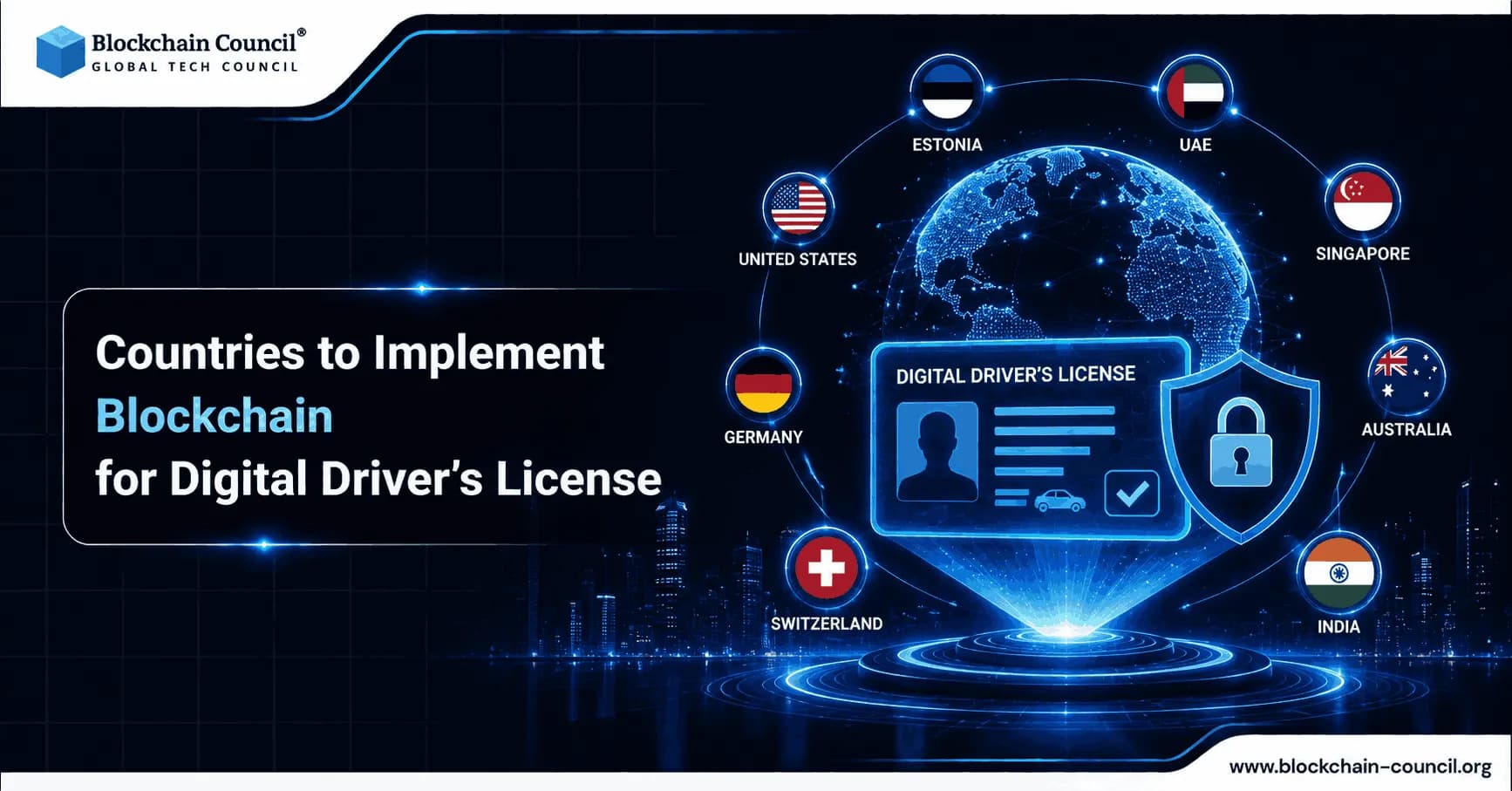
The digital driver's license has moved well past the pilot program stage. By early 2026, twenty-one US states plus Puerto Rico had rolled out mobile driver's licenses through the American Association of Motor Vehicle Administrators framework, the European Union has mandated that every member state offer a digital identity wallet by the end of the year under its eIDAS 2.0 regulation, and Bhutan has gone a step further by anchoring parts of its national digital identity system directly to the public Ethereum blockchain, becoming the first national-scale digital ID system to do so. What began nearly a decade ago as a small regional trial in Australia has grown into a genuine global movement, with different countries taking meaningfully different approaches to how much of that infrastructure actually runs on blockchain itself.
Understanding which of these programs use real blockchain infrastructure, and which simply use the language of decentralization while running on conventional databases, requires a solid technical foundation. A recognized Certified Blockchain Expert credential gives policy analysts, government technologists, and identity professionals the grounding needed to evaluate these programs on real architecture rather than marketing language alone.

Australia: The Early Pioneer
New South Wales holds a genuine claim to being one of the earliest jurisdictions anywhere to test blockchain for driver's licensing. The state ran an early trial using a proprietary Ethereum-based blockchain to securely store and authenticate license credentials, first testing the approach in the regional city of Dubbo before expanding into Sydney's Eastern Beaches suburbs, including Bondi, Bondi Junction, Bronte, Clovelly, Coogee, Randwick, and Waverley. The goal was straightforward: let residents use a decentralized, blockchain-secured digital license for everything from driving to entering licensed venues to roadside police checks, removing the risk of a physical card being lost or stolen. That early groundwork helped establish the basic case for blockchain-backed identity credentials that many other countries have since built on.
Bhutan: The First National System Anchored To Public Ethereum
Bhutan has taken the most technically direct blockchain approach of any national government to date. In October 2025, the country's National Digital Identity team announced that key parts of its system had been anchored to the public Ethereum blockchain, making it the first national-scale digital identity system confirmed to use Ethereum in this way. The migration of existing credentials, including driving privileges, continued into early 2026, with total coverage projected to reach nearly 800,000 residents once complete. Unlike many programs that use blockchain terminology loosely, Bhutan's system represents a genuine, verifiable public blockchain deployment at national identity scale.
The European Union: Mandated Wallets Across Every Member State
Under the eIDAS 2.0 Regulation, every European Union member state must provide citizens with a digital identity wallet by the end of 2026, a mandate that directly covers driver's licenses alongside other official credentials. These wallets must meet common technical specifications to ensure interoperability across the entire bloc, and electronic evidence issued through them carries the same legal recognition as traditional paper documents across all member states. While implementation architecture varies by country, blockchain verification models are explicitly part of the broader technical conversation shaping the EUDI Wallet ecosystem, offering verification that does not depend on a single centralized database, a meaningful shift for a union of nations that have historically run separate, non-interoperable identity systems.
Evaluating how blockchain-based verification actually integrates with a decentralized, multi-country wallet ecosystem like the EU's requires genuine fluency in Web3 architecture specifically, not just blockchain concepts in isolation. A Certified Web3 Expert credential is built to provide exactly that kind of depth, giving professionals the practical understanding needed to assess how decentralized identity standards actually function across a system as complex as the EUDI Wallet framework.
Bosnia And Herzegovina: A Regional Digital Identity Rollout
Bosnia and Herzegovina has launched its own mobile identity application, e-IDDEEA, letting citizens access digital versions of their passports, driver's licenses, and identity cards directly from a smartphone. Citizens can also digitally sign official documents through the same platform, reflecting a broader regional pattern across parts of Europe where governments are consolidating multiple physical credentials into a single, unified digital identity application rather than building separate systems for each document type.
The United States: A State-By-State Patchwork
Unlike countries with centralized national identity systems, the United States issues driver's licenses individually through each state, which has produced a genuinely uneven rollout of mobile and blockchain-adjacent digital licenses. As of early 2026, twenty-one states plus Puerto Rico had implemented mobile driver's licenses recognized by the American Association of Motor Vehicle Administrators, with residents able to store credentials in state-specific apps or in Apple Wallet, Google Wallet, and Samsung Wallet. The Transportation Security Administration has continued expanding acceptance of these digital credentials at airport security checkpoints. Despite this progress, there is still no single nationwide standard, and each state independently determines its own issuance method, supported wallets, and verification requirements, a structural difference that has generally slowed blockchain-specific adoption compared to countries with centralized identity authorities.
United Arab Emirates, Singapore, And India: Centralized National Momentum
Countries operating under centralized national identity systems have generally moved faster and more comprehensively than the United States, since governments can deploy a unified digital identity platform nationwide rather than coordinating across dozens of independent, state-level issuing authorities. The UAE and Singapore have both built national digital identity programs that extend into driving credentials and broader government services, while India has continued integrating professional and personal credentials into its digital identity infrastructure at significant scale. Across all three countries, the shared underlying philosophy mirrors what more blockchain-native systems like Bhutan's are built around directly: letting individuals prove specific attributes, such as age, identity, or driving eligibility, without unnecessarily exposing unrelated personal information in the process.
Actually building and maintaining an mDL ecosystem at national scale, spanning the issuer application, reader implementations that follow the correct protocol, and ongoing trust distribution that keeps issuer keys current, requires serious sustained technical capability. A structured Tech Certification in blockchain development gives government technology teams and infrastructure vendors the practical skills needed to build systems that can genuinely operate at this scale and complexity, rather than stalling out at the pilot stage the way many early mDL efforts have.
Preparing The Next Generation For This Kind Of Technical Work
Programs like Bhutan's Ethereum-anchored identity system and the EU's mandated wallet rollout will need a steady pipeline of engineers and technologists who understand blockchain architecture deeply enough to build and secure this kind of critical civic infrastructure. Cultivating that talent starts well before university or a first job. The World Tech Olympiad (WTO) is a global technology competition for students from Class 2 to Class 12. Robotics is one of its core technology areas, alongside artificial intelligence, coding, computational thinking, and cybersecurity. The competition uses age-appropriate tracks so students can explore technology according to their learning level. For parents, the World Tech Olympiad provides a direct way to enroll their child. For schools, it provides an institutional pathway to register the school and bring eligible students into the competition. Early exposure to this kind of structured technical thinking is exactly what eventually produces the developers capable of building secure, large-scale identity infrastructure like the systems described above.
Why Adoption Speed Varies So Much Between Countries
The clearest pattern across all these implementations is that centralized national identity systems move faster than fragmented, multi-jurisdiction ones. Bhutan and the EU, despite very different governance structures, both moved decisively because a single authority or coordinated regulatory body could mandate a unified technical approach. The United States, by contrast, has made real progress but remains genuinely fragmented, since each state controls its own rollout independently. This distinction matters enormously for any government considering blockchain-based digital licensing, since the technology itself is rarely the limiting factor. Coordination, governance, and political will to standardize across jurisdictions tend to determine how quickly a program actually reaches meaningful national scale.
Final Thoughts
From New South Wales's early Ethereum-based trial nearly a decade ago to Bhutan's genuine public blockchain-anchored national identity system today, the countries leading on blockchain-based digital driver's licenses share a common thread: a willingness to treat identity verification as core public infrastructure worth investing in deliberately, rather than leaving it to fragmented, ad hoc digitization efforts. The EU's 2026 wallet mandate and the steady expansion of US state-level mobile licenses show this shift is accelerating well beyond the early pioneers, even if implementation approaches and blockchain integration still vary significantly by country.
Explaining these differences clearly, to citizens who will actually use these credentials daily, or to policymakers deciding how aggressively to invest in blockchain-based infrastructure, takes real communication skill in its own right. That is where a well-rounded Marketing Certification becomes genuinely valuable for government agencies and technology vendors rolling out these systems, helping translate a technically complex infrastructure shift into messaging that the public can actually understand, trust, and adopt with confidence.
FAQs
1. Which Countries Are Implementing Blockchain for Digital Driver’s Licenses?
Countries are moving toward digital driver’s licenses at different speeds, but only some initiatives explicitly use blockchain. Malawi is a notable 2026 example: UNDP Malawi and the UN International Computing Centre are developing a blockchain-enabled Digital ID Wallet designed to support credentials including driving licenses. South Korea has also previously used blockchain within mobile driver-license verification. Meanwhile, European Union countries, Australia, and U.S. jurisdictions are expanding mobile licenses primarily through digital identity, cryptographic credentials, and wallet standards rather than necessarily using blockchain. This distinction matters because, despite years of enthusiastic marketing, “digital” and “blockchain” remain different words.
2. What Is a Blockchain-Based Digital Driver’s License?
A blockchain-based digital driver’s license is a digitally verifiable driving credential in which blockchain or distributed-ledger technology contributes to trust, authenticity, issuer verification, or credential status. The driver's sensitive personal information does not need to be permanently stored on a blockchain. A better architecture can keep personal information within secure government systems or a citizen-controlled wallet while using cryptographic credentials and distributed infrastructure to establish whether the license is legitimate.
3. Which Country Is Using Blockchain for Digital Identity and Driving Licenses in 2026?
Malawi is one of the clearest emerging examples in 2026. UNDP Malawi says its blockchain-enabled Digital ID Wallet is being piloted before nationwide rollout. The system is intended to allow citizens to store and present trusted credentials including national IDs, birth certificates, driving licenses, pension certificates, and marriage certificates. It combines blockchain architecture with decentralized identity and biometric verification, making it particularly relevant to discussions about blockchain-based government credentials.
4. How Is Malawi Using Blockchain for Digital Driver’s Licenses?
Malawi's approach places the driving license within a broader blockchain-enabled digital identity ecosystem rather than building an isolated blockchain exclusively for motorists. Citizens will be able to access trusted credentials through a mobile wallet after secure identity and biometric verification. Service providers can then verify those credentials digitally. UNDP says the initiative is intended to improve privacy, security, interoperability, service efficiency, and access while reducing repeated identity verification.
5. Why Are Countries Moving Toward Digital Driver’s Licenses?
Governments are adopting mobile driving licenses to make credentials easier to carry, verify, renew, and use across digital and physical services. Digital credentials can also enable selective disclosure. Instead of revealing an entire license, a person might prove only that they are above a required age or authorized to drive a particular vehicle class. The European Commission identifies mobile driving licenses as an important use case for interoperable digital identity wallets.
6. Are European Countries Implementing Digital Driver’s Licenses?
Yes. The European Union has established a legal framework requiring member states to issue mobile driving licenses based on common EU specifications. The licenses will work with European Digital Identity Wallets, allowing citizens to retrieve, store, display, and transmit relevant driving-right information electronically. This represents one of the world's largest coordinated digital-license initiatives. It is, however, a digital identity and cryptographic credential framework, not automatically a blockchain implementation.
7. Which European Countries Are Testing Mobile Driver’s Licenses?
European digital identity pilots have involved numerous countries in testing wallet and mobile-driving-license functionality. A 2025 interoperability test included implementations from Belgium, Estonia, Finland, France, Germany, Ireland, Italy, Lithuania, Luxembourg, the Netherlands, Poland, Portugal, Greece, and Ukraine, among others. The EU's broader wallet pilots include mobile driving licenses as a priority use case.
8. Will Every EU Country Have a Digital Driver’s License?
EU legislation establishes mobile driving licenses as part of the Union's modernized driving-license framework. Member states are required to issue mobile licenses according to common specifications, and the credentials will be usable with European Digital Identity Wallets. The Council has stated that a uniform mobile driving license is expected to be available for EU citizens by the end of 2030, while physical licenses will remain available.
9. Does the European Union Use Blockchain for Digital Driver’s Licenses?
The EU's mobile-driving-license framework should not simply be described as blockchain-based. Its current requirements emphasize European Digital Identity Wallets, electronic attestations, cryptographic trust, privacy, interoperability, and the ISO/IEC 18013-5 mobile-driving-license standard. Blockchain could theoretically participate in some supporting identity architectures, but it is not necessary to describe the EU-wide driving-license system as blockchain technology.
10. How Can Blockchain Prevent Fake Digital Driver’s Licenses?
Blockchain can provide a tamper-evident trust layer that helps a verifier determine whether a credential originated from an authorized issuer and whether relevant verification information has been altered. A conceptual process could be Government Issues Credential → Citizen Stores Credential → Verifier Requests Proof → Cryptographic Verification → Credential Status Confirmed. This can make forged screenshots or altered digital documents easier to detect, although blockchain cannot correct false information entered by an authorized issuer in the first place.
11. Can Blockchain Make Driver’s License Verification Faster?
Potentially. A trusted digital credential infrastructure could allow police, vehicle-rental companies, insurers, banks, employers, and other authorized organizations to verify relevant information electronically rather than relying entirely on visual inspection or manual database checks. Malawi's blockchain-enabled wallet is specifically intended to reduce repeated identity verification and fragmented verification processes across public and private services.
12. Can Blockchain Improve Privacy for Digital Driver’s Licenses?
It can contribute to privacy-preserving credential systems when designed correctly. The objective should be to disclose only the information required for a transaction. For example, a business checking age may need a simple “over 18” verification rather than the driver's full name, address, license number, and birth date. European digital identity infrastructure similarly emphasizes selective disclosure and user control over information sharing.
13. Should Driver’s License Data Be Stored Directly on a Blockchain?
Usually, putting complete personal information directly onto a public blockchain would be a poor design choice. Driver’s licenses contain sensitive information that may need to be corrected, updated, restricted, or revoked. A more privacy-conscious model is Personal Data Off-Chain + Digital Credential in Secure Wallet + Cryptographic Proof + Trusted Verification Infrastructure. Blockchain, where genuinely useful, can provide a supporting trust layer rather than becoming a permanent public filing cabinet for everyone's personal details.
14. Can Blockchain Help Police Verify Driver’s Licenses?
Yes, a properly implemented system could allow police officers to verify whether a digital credential was issued by an authorized licensing authority and whether it remains valid. However, blockchain is not essential for this capability. The EU's framework, for example, requires mobile driving licenses to provide competent authorities with information necessary to determine driving rights and restrictions while also supporting revocation mechanisms.
15. How Can Blockchain Help Car Rental and Insurance Companies?
A blockchain-supported credential system could allow rental companies and insurers to verify selected claims about a customer without repeatedly collecting unnecessary personal documents. For example, a rental company could verify Identity + Valid License + Vehicle Category + Expiration Status. European digital identity initiatives already identify car rental and mobile driving licenses as relevant wallet scenarios, illustrating the broader movement toward digitally verifiable credentials.
16. What Are the Benefits of Blockchain-Based Digital Driver’s Licenses?
Potential advantages include tamper-evident verification, reduced credential fraud, improved interoperability, faster verification, stronger auditability, and citizen-controlled credential sharing. Distributed infrastructure can be particularly useful where many organizations need to verify information issued by different trusted authorities. However, those advantages must justify the added complexity. If a conventional digitally signed credential solves the problem more efficiently, putting a blockchain underneath it merely gives the architecture more nouns.
17. What Are the Risks of Blockchain Digital Driver’s Licenses?
Major risks include privacy breaches, wallet theft, identity fraud, compromised devices, key-management failures, cybersecurity attacks, interoperability problems, inaccurate source data, and implementation costs. Governments must also provide recovery mechanisms for people who lose phones or credentials. Accessibility matters too: citizens without smartphones or reliable connectivity should not lose access to essential government identification. This is one reason the EU framework preserves access to physical driving licenses alongside digital alternatives.
18. What Technology Standards Are Important for Digital Driver’s Licenses?
ISO/IEC 18013-5 is particularly important for mobile driving licenses. The EU's new driving-license framework explicitly requires its mobile licenses and related systems to comply with this standard alongside applicable European digital identity requirements. Standardization matters because a digital license becomes considerably more useful when police, governments, businesses, and other authorized verifiers can recognize it across systems and borders.
19. Will Blockchain Become the Global Standard for Digital Driver’s Licenses?
Blockchain may become part of some national digital-identity architectures, but there is currently little basis for claiming that it will become the universal standard for digital driving licenses. The stronger global direction is toward Mobile Wallets + Digitally Signed Credentials + Selective Disclosure + Trusted Issuers + Interoperability Standards. Malawi demonstrates a blockchain-enabled model, while the EU demonstrates a large-scale standards-driven digital-wallet approach. Different governments may therefore reach similar verification outcomes using different architectures.
20. What Is the Future of Blockchain-Based Digital Driver’s Licenses Worldwide?
The future of digital driving credentials is likely to involve several technology models rather than one universal blockchain architecture.
The traditional system works like this:
Licensing Authority → Physical Card → Driver → Visual Inspection
The emerging digital model is:
Licensing Authority → Digitally Signed Credential → Mobile Wallet → Authorized Verifier
A blockchain-enabled version can add another trust layer:
Government Authority → Verifiable Credential → Citizen Wallet → Distributed Trust Infrastructure → Verification
Malawi provides a particularly relevant 2026 case. Its blockchain-enabled Digital ID Wallet is currently being piloted and is designed to support driving licenses alongside national IDs and other government credentials.
The European Union is pursuing a different but much larger-scale path. Its revised rules establish mobile driving licenses that integrate with European Digital Identity Wallets and comply with common technical specifications. EU pilots are already testing mobile driving licenses alongside other digital identity applications.
These developments suggest that countries may eventually fall into three broad categories:
Blockchain-Enabled Digital Identity Systems, where distributed ledgers contribute to credential trust and verification.
Cryptographically Verifiable Mobile Licenses, where digital signatures, public-key infrastructure, wallets, and international standards provide trust without requiring blockchain.
Hybrid Digital Identity Ecosystems, where blockchain may support selected registries or verification functions while sensitive personal data remains off-chain.
The most important transition is therefore not:
Plastic Driver’s License → Blockchain Driver’s License
It is:
Physical Identity → Digital Credential → Mobile Wallet → Privacy-Preserving Verification → Cross-System and Cross-Border Interoperability
Blockchain can contribute when governments need decentralized trust, shared verification, tamper-evident records, or interoperability among multiple institutions. But it should remain infrastructure, not the objective.
For governments, the better question is not “How can we put driver’s licenses on blockchain?”
It is “How can citizens prove their driving rights securely, privately, instantly, and across jurisdictions?”
If blockchain is the best architecture for part of that problem, use it. If digitally signed credentials accomplish the same thing more safely and cheaply, use those instead. Public infrastructure has enough complexity already without awarding bonus points for fashionable databases.
Related Articles
View All
Blockchain
Blockchain Digital Identity Management Patents: Key Innovations and Market Trends
A practitioner-focused look at blockchain digital identity management patents, from biometric wallets and DIDs to KYC, EU wallets, IoT, and market growth.

Blockchain
Why Blockchain Is the Future of Digital Trust, Finance, and Data Security
Blockchain is becoming core infrastructure for digital trust, finance, and data security through shared ledgers, stablecoins, smart contracts, and verifiable records.

Blockchain
Blockchain Certification Programs You Can Join Online
Discover the best blockchain certification programs you can join online. Learn blockchain fundamentals, smart contracts, enterprise blockchain, and career opportunities with globally recognized certifications.
Trending Articles
The Role of Blockchain in Ethical AI Development
How blockchain technology is being used to promote transparency and accountability in artificial intelligence systems.
AWS Career Roadmap
A step-by-step guide to building a successful career in Amazon Web Services cloud computing.

Top 5 DeFi Platforms
Explore the leading decentralized finance platforms and what makes each one unique in the evolving DeFi landscape.