

Can Blockchain Replace Your Password and Make it More Secure
 Toshendra Kumar Sharma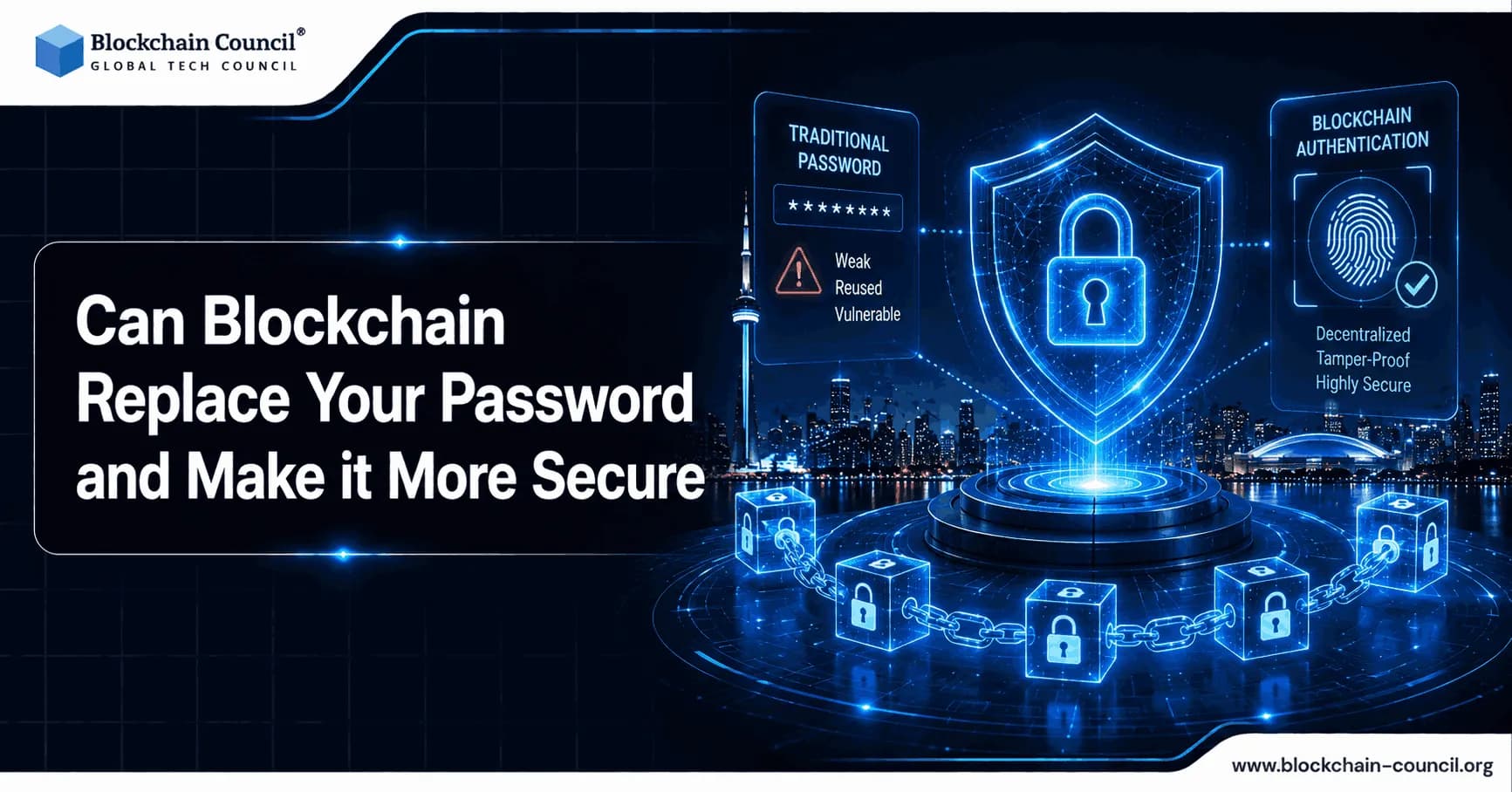
More than 16 billion passwords have been exposed in breaches since the beginning of 2025 alone, a number larger than the entire human population, and it keeps climbing. Despite this, 87 percent of organizations still rely on password-based authentication for customer-facing applications, even though only 2 percent of security professionals actually believe passwords strike a reasonable balance between security and usability. Industry researchers are now warning that 2026 marks a genuine inflection point, one where automated AI agents are expected to leak more credentials than humans do, shifting identity risk from individual human error toward industrial-scale, machine-driven attacks. Blockchain-based identity systems have emerged as one of the more credible answers to this crisis, not by making passwords stronger, but by removing the centralized password database that makes large-scale breaches possible in the first place.
Understanding exactly how blockchain accomplishes this, and where its real limits sit, starts with genuine technical grounding. Blockchain Council's Certified Blockchain Expert credential gives security professionals and technologists the foundation needed to evaluate blockchain-based authentication on real architecture rather than marketing promises alone.

Why Passwords Are Fundamentally Broken As A Security Model
Passwords fail for a structural reason that better password policies cannot fix. They depend on a centralized database somewhere holding either the password itself or a hash of it, and that database becomes an irresistible target for attackers, since compromising it once can expose millions of credentials simultaneously. Passwords are also inherently phishable, reusable across services, and dependent entirely on human memory and discipline, all weaknesses that scale badly as the number of accounts a typical person manages keeps growing. Passkeys have addressed part of this problem already, using cryptographic key pairs tied to a specific device so there is nothing transmittable to phish and nothing meaningful for a server-side breach to expose. Blockchain-based identity extends this same core idea considerably further.
How Blockchain-Based Authentication Actually Works
Decentralized Identifiers And Self-Sovereign Identity
Decentralized identifiers, commonly called DIDs, represent the core building block of blockchain-based authentication. Rather than an organization storing your identity data in its own vulnerable database, you hold cryptographic proofs of your identity attributes directly, proofs you can selectively share and have verified without exposing the underlying personal information itself. This model, often described as self-sovereign identity, eliminates the centralized identity provider as a single point of failure entirely, since there is no longer one central database an attacker can breach to compromise everyone's credentials at once.
Verifiable Credentials Instead Of Stored Secrets
Under this model, your digital wallet can hold credentials, a university degree, an employment verification, a driver's license, or a login credential, each cryptographically signed and independently verifiable on a blockchain. Authentication becomes proving possession of a valid, signed credential rather than transmitting a shared secret like a password that a server has to store and protect indefinitely.
zkLogin And Privacy-Preserving Verification
Newer research has pushed this further still. zkLogin, a privacy-preserving blockchain authentication approach, lets users authenticate using credentials they already have, like an existing Google or social login, while proving that authentication cryptographically on-chain without exposing the underlying account details themselves. This kind of zero-knowledge approach lets someone prove they are who they claim to be without revealing more information than absolutely necessary, addressing a genuine privacy gap that even many passwordless systems still have.
Designing systems this cryptographically sophisticated, ones that must resist both technical attacks and social engineering while operating flawlessly at consumer scale, requires genuinely specialized security expertise. Blockchain Council's Certified Blockchain Security Professional credential is built specifically for this challenge, giving professionals the security-focused skill set needed to build and audit blockchain-based authentication systems that can actually be trusted with real identity data.
Is Blockchain Actually More Secure Than A Password
The Genuine Advantages
Blockchain-based authentication removes the single centralized database that makes large-scale credential breaches possible, since there is no honeypot of millions of hashed passwords sitting in one place for attackers to target. It also shifts identity verification away from something you have to remember and can forget, reuse, or have phished, toward something cryptographically tied to a device or credential you actually possess. Combined with biometric verification and continuous, AI-driven behavioral monitoring during a session, typing patterns, mouse movement, location context, this creates a genuinely layered security model that static passwords simply cannot replicate on their own.
The Real Limitations Worth Understanding
Blockchain-based identity is not a flawless solution. Losing the private key or device tied to your decentralized identity can be considerably harder to recover from than resetting a forgotten password, since there is no central authority to appeal to for account recovery in a truly decentralized system. Adoption also depends heavily on interoperability between different platforms and services actually agreeing to support the same underlying standards, a coordination challenge that has slowed rollout even as the underlying technology has matured. And while blockchain removes the centralized password database, the devices and biometric sensors authenticating a user still represent their own security surface that needs genuine protection.
Real-World Momentum Behind This Shift
This is not a purely theoretical direction. Major technology companies including Apple, Google, and Microsoft have already backed the widespread adoption of passkeys, and industry analysts expect passwordless authentication to become the default user experience during 2026 specifically, relegating traditional passwords to legacy systems still catching up. Security researchers similarly predict that self-sovereign identity and decentralized identifiers will move well beyond the cryptocurrency community and into mainstream enterprise adoption, with companies increasingly issuing verifiable credentials that simplify onboarding while meaningfully reducing the data storage risk organizations currently carry by holding password databases at all.
Building and maintaining infrastructure capable of handling this shift reliably, at real consumer and enterprise scale, requires serious, sustained technical capability. A Tech Certification in blockchain development gives engineering teams the practical skills needed to design authentication systems robust enough for production use, rather than systems that only function cleanly in a controlled pilot environment.
Roles, Skills, And Careers Emerging From The Passwordless Shift
Decentralized Identity Architects
As organizations move away from centralized password databases, demand is growing for architects who understand how to design decentralized identifier systems, verifiable credential schemas, and the underlying blockchain infrastructure that supports them at genuine enterprise scale.
Blockchain Security Auditors
Because authentication systems handle some of an organization's most sensitive data, security auditors with genuine blockchain-specific expertise, capable of identifying vulnerabilities in smart contracts, key management systems, and cryptographic implementations, are becoming an increasingly essential and well-compensated specialization.
Identity And Access Management Specialists
Traditional identity and access management professionals are increasingly expected to understand blockchain-based credentials alongside conventional systems, creating strong demand for specialists who can bridge legacy enterprise identity infrastructure with newer, decentralized authentication models during this transition period.
Privacy Engineering Roles
As techniques like zero-knowledge proofs become more central to privacy-preserving authentication, demand is rising for privacy engineers who understand both the cryptographic theory and the practical implementation challenges of building systems that verify identity without exposing unnecessary personal data.
Building Future-Ready Skills
As technology becomes increasingly important across industries, students need opportunities to develop future-ready skills early in their education. A Tech Olympiad can introduce students to areas such as artificial intelligence, coding, cybersecurity, robotics, and computational thinking while encouraging curiosity and continuous learning. Early, structured exposure to fields like cybersecurity and cryptography is exactly what tends to produce the confident, technically capable professionals who go on to build and secure the authentication systems replacing passwords across the next generation of digital infrastructure.
Turning This Shift Into A Genuine Career Or Business Advantage
Understanding blockchain-based authentication deeply enough to build, audit, or advocate for it is only part of the equation. Professionals and organizations navigating this transition also need to communicate its real value clearly, to security teams evaluating new infrastructure, to executives weighing implementation costs, or to everyday users skeptical of yet another new login method promising to be different. A Marketing Certification rounds out that capability well, helping technically skilled professionals translate blockchain-based authentication's genuine security advantages into messaging that non-technical stakeholders can actually understand and trust before adopting it.
Final Thoughts
Blockchain will not make passwords stronger, and that is precisely the point. It offers a genuinely different model built on decentralized identifiers, verifiable credentials, and cryptographic proof instead of shared secrets sitting in a centralized database waiting to be breached. With billions of passwords already compromised and AI-driven attacks accelerating the threat landscape further in 2026, this shift looks less like a speculative improvement and more like a necessary evolution, one already being backed by major technology companies and increasingly demanded by security professionals who no longer believe passwords can keep pace with the threats facing them.
FAQs
1. Can blockchain replace passwords?
Blockchain can support passwordless authentication, but blockchain itself does not automatically replace passwords. Passwordless systems can use cryptographic keys, decentralized identity, passkeys, or verifiable credentials to authenticate users without requiring them to remember a traditional password.
2. How can blockchain be used for passwordless authentication?
Blockchain can provide infrastructure for decentralized identity and verifiable credentials. Instead of storing a traditional password, a user can prove control of a cryptographic identity or credential. The blockchain can be used to verify identity-related information without necessarily storing sensitive personal information directly on-chain.
3. Is blockchain authentication more secure than passwords?
It can be, depending on the implementation. Traditional passwords can be vulnerable to phishing, credential stuffing, password reuse, and database breaches. Cryptographic authentication can eliminate the need to transmit or store reusable passwords, reducing several common attack vectors.
However, blockchain-based authentication can introduce other risks, such as private-key theft, wallet compromise, phishing of signing requests, and poor key-recovery mechanisms.
4. What is decentralized identity?
Decentralized identity (DID) is an approach that allows individuals or organizations to control digital identities without depending entirely on a centralized identity provider. Blockchain or distributed-ledger technology can be used as part of the infrastructure supporting decentralized identifiers and verifiable credentials.
5. How does blockchain authentication work?
A simplified blockchain-based authentication process can look like this:
A user creates a cryptographic identity.
The user controls a private key.
A service requests proof of identity or authorization.
The user's device creates a cryptographic signature.
The service verifies the signature.
Access is granted if the proof is valid.
The private key does not need to be revealed to the website.
6. What is the role of a private key in blockchain authentication?
A private key is a secret cryptographic value used to prove control over an associated public identity or blockchain account. In an authentication system, the user can sign a challenge with the private key, while the service verifies the signature using the corresponding public key.
Protecting the private key is therefore critical.
7. Can blockchain eliminate the need to remember passwords?
Potentially, yes. A blockchain-enabled identity system can use cryptographic signatures instead of memorized passwords. Users could authenticate through a wallet, hardware-backed key, biometric-protected device, or another secure credential mechanism.
In practice, many passwordless systems today use technologies such as passkeys and WebAuthn, which do not require blockchain.
8. What are the benefits of blockchain-based authentication?
Potential benefits include:
Reduced password reuse
Less dependence on centralized password databases
Cryptographic identity verification
Greater user control over credentials
Potentially improved portability of identity
Reduced exposure to credential-stuffing attacks
Verifiable digital credentials
Support for decentralized identity models
The security benefits depend heavily on system architecture and key management.
9. Does blockchain store passwords?
No. Blockchain networks do not need to store users' traditional passwords. In fact, passwords and other sensitive personal information should generally not be placed directly on a public blockchain because blockchain data can be difficult or impossible to permanently remove.
A better architecture keeps sensitive information off-chain and uses cryptographic proofs or references where appropriate.
10. Can blockchain prevent phishing attacks?
Blockchain does not automatically prevent phishing. However, authentication based on cryptographic signatures or hardware-backed credentials can make certain credential-theft attacks more difficult because there is no reusable password for an attacker to steal.
Users can still be tricked into approving a malicious transaction or signing an unintended authentication request, so user-interface security remains important.
11. What is blockchain-based digital identity?
Blockchain-based digital identity uses blockchain or distributed-ledger infrastructure to support identity verification, credential management, authentication, and decentralized identity systems.
Rather than maintaining every identity attribute on a centralized database, a system may allow users to hold credentials and selectively prove specific information to services.
12. Can blockchain protect personal information?
Blockchain can help create systems where users have greater control over how identity credentials are presented and verified, but storing personal information directly on a public blockchain can create privacy problems.
A privacy-conscious architecture generally keeps sensitive information off-chain and uses cryptographic techniques to verify claims without exposing unnecessary information.
13. What are the risks of using blockchain instead of passwords?
Important risks include:
Private-key theft
Lost credentials
Poor account recovery
Wallet phishing
Malicious signing requests
Device compromise
Smart-contract vulnerabilities
Privacy leakage
Irreversible transactions
Complex user experiences
Therefore, replacing passwords with blockchain requires careful security and recovery design.
14. What happens if a user loses their blockchain private key?
This depends on the authentication system. In a simple self-custody model, losing the private key can mean losing access to the associated account.
More sophisticated identity systems can implement social recovery, backup credentials, hardware security, multi-party authorization, or other recovery mechanisms. The recovery model should be designed before deploying a blockchain identity system.
15. Can blockchain authentication be used for businesses?
Yes. Businesses can explore blockchain-based identity for applications such as employee authentication, customer identity, digital credentials, supply-chain access, financial services, and enterprise authorization.
Organizations should evaluate whether blockchain actually solves a business requirement better than conventional passwordless authentication.
16. Is blockchain better than traditional password managers?
Not necessarily. A password manager and blockchain-based authentication solve related but different problems.
Password managers securely generate and store passwords, while cryptographic authentication can eliminate passwords altogether. For many websites, passkeys may provide a simpler passwordless alternative without requiring blockchain.
17. Can blockchain work with biometrics for authentication?
Yes. Biometrics can be used to unlock a device or secure a cryptographic credential, while blockchain infrastructure can be used for identity verification or credential management.
A well-designed system should avoid putting raw biometric data on a public blockchain. Instead, biometric authentication can remain locally protected on the user's device.
18. Will blockchain completely replace passwords?
It is unlikely that blockchain alone will completely replace passwords. The broader move toward passwordless authentication is more likely to involve a combination of passkeys, hardware security, biometrics, cryptographic credentials, decentralized identity, and other technologies.
Blockchain may be useful for specific identity and credential-management use cases rather than every authentication scenario.
19. What is the future of blockchain-based authentication?
The future could involve greater adoption of decentralized identity, verifiable credentials, cryptographic authentication, portable digital identities, and privacy-preserving identity systems.
Blockchain may become one component of these systems, particularly when multiple organizations need a shared verification infrastructure without relying on a single centralized database.
20. Can blockchain make digital identity more secure?
Blockchain can contribute to more secure digital identity systems, particularly when cryptographic authentication replaces reusable passwords and sensitive information is kept off-chain.
However, blockchain is not a security guarantee. The overall security of an identity system depends on cryptography, key management, device security, privacy architecture, recovery mechanisms, smart contracts, and user experience.
Related Articles
View All
Blockchain
User Experience in Blockchain Products: How to Make Web3 Apps Easier to Use
Learn how to improve user experience in blockchain products with simpler onboarding, clearer transaction flows, safer wallet UX, and better Web3 metrics.

Blockchain
Will AI replace blockchain? A Practical View for 2026 and Beyond
Will AI replace blockchain? No. AI and blockchain solve different problems and are increasingly combined for security, auditability, identity, and automation.

Blockchain
Blockchain Mechanism Design and Game Theory: How Incentives Secure Web3
Learn how Blockchain Mechanism Design and Game Theory shape consensus, DeFi, validator incentives, PBFT systems, and Web3 governance.
Trending Articles
AWS Career Roadmap
A step-by-step guide to building a successful career in Amazon Web Services cloud computing.
What is AWS? A Beginner's Guide to Cloud Computing
Everything you need to know about Amazon Web Services, cloud computing fundamentals, and career opportunities.

Can DeFi 2.0 Bridge the Gap Between Traditional and Decentralized Finance?
The next generation of DeFi protocols aims to connect traditional banking with decentralized finance ecosystems.