

Can Blockchain Cut Foreign Exchange Transaction Time?
 Toshendra Kumar Sharma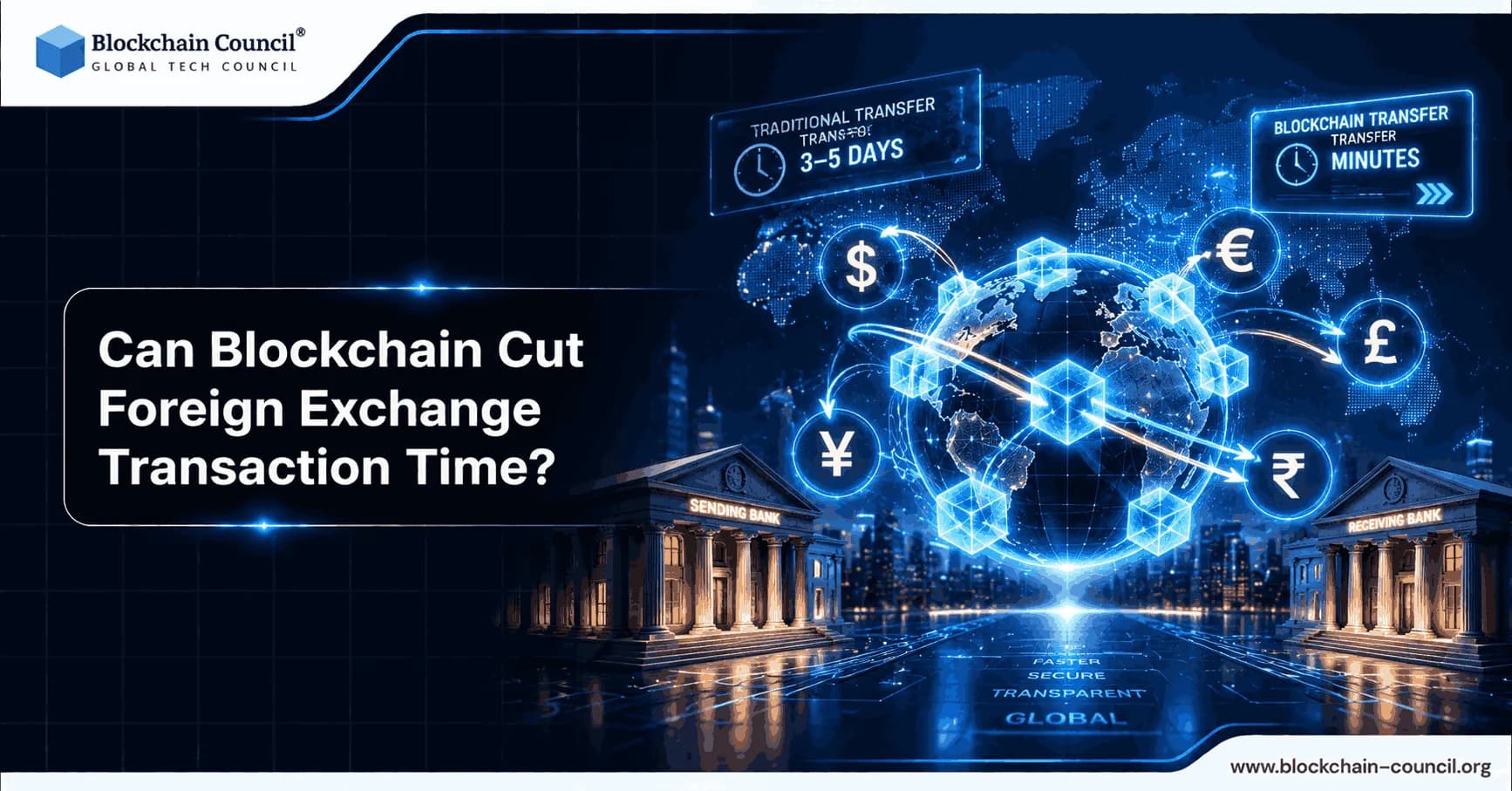
Introduction: The Long Wait Behind Every Cross-Border Payment
Anyone who has sent money internationally knows the frustration of waiting several business days for a transfer to clear, often with little visibility into where the payment sits along the way. Foreign exchange transactions have historically depended on a chain of correspondent banks passing funds from one institution to another, a process that was never designed for the speed modern businesses and individuals expect. Blockchain technology is now being deployed at scale to compress that timeline dramatically, and the results are already reshaping how money moves across borders. For professionals who want to understand the mechanics behind this shift, a Certified Blockchain Expert credential provides the technical foundation needed to evaluate how distributed ledgers are transforming currency settlement.
Traditional cross-border payments typically take between three and five business days to settle, weighed down by intermediary banks, foreign exchange conversions, and manual reconciliation at each step. Blockchain-based settlement can complete the same transaction in seconds to minutes, operating continuously rather than pausing for weekends or banking holidays.

Why Traditional Foreign Exchange Settlement Takes So Long
The root cause of slow forex settlement often has less to do with messaging technology and more to do with how liquidity is managed across borders. Banks typically rely on nostro and vostro accounts, pre-funded currency reserves held in foreign banks specifically to cover anticipated international payments. Approximately twenty-seven trillion dollars currently sits locked in these accounts globally, representing capital that could otherwise be put to productive use, and analysts estimate this creates an annual liquidity tax exceeding a trillion dollars across the financial system.
Delays frequently occur when liquidity is unavailable in a particular currency corridor or when exchange rates need to be recalculated mid-transaction, a problem that disproportionately affects smaller institutions that cannot maintain large reserves across every currency they transact in. This dependency on intermediaries and pre-funded accounts is precisely what blockchain-based settlement is designed to eliminate. Professionals seeking deeper expertise in the tokenized instruments now replacing these older systems often pursue a Certified Digital Assets Expert credential to better understand how stablecoins and tokenized currencies function within modern settlement infrastructure.
How Blockchain Removes the Bottleneck
Blockchain-based settlement bypasses the traditional correspondent banking chain entirely by enabling peer-to-peer value transfer, often using stablecoins or tokenized fiat currency as a bridge between two national currencies. Instead of waiting for funds to pass through multiple intermediary banks, a payment can move directly across a blockchain network and settle into the recipient's local account, typically within ten seconds to five minutes depending on the network used. This stands in sharp contrast to the three to five business days most traditional international transfers require.
Some payment providers now use digital assets as a bridge currency specifically to facilitate this kind of instant settlement without requiring pre-funded nostro accounts. One major example has secured dozens of global licenses and now partners with hundreds of financial institutions worldwide, illustrating how quickly this infrastructure has moved from experimental to operational at scale.
Smart Contracts and Real-Time Currency Conversion
One of the more significant technical advantages blockchain brings to foreign exchange is the ability to embed currency conversion rules directly into smart contracts. Rather than relying on manual intervention to apply exchange rates at the moment a transaction executes, smart contracts can pull real-time rate data and apply it automatically, eliminating the reconciliation delays that often stretch out traditional forex processing.
This automation extends beyond simple currency conversion. Smart contracts can also handle compliance checks, release funds only once predefined conditions are met, and reconcile transaction records across multiple parties without manual oversight. For businesses handling high volumes of cross-border payments, this level of automation translates directly into faster settlement and reduced exposure to currency fluctuations during the transaction window. Building and maintaining these kinds of automated financial systems requires a broad technical skill set beyond blockchain alone. A well-rounded Tech Certification helps professionals develop that wider foundation, covering the software architecture and systems integration knowledge needed to support real-time financial infrastructure at scale.
Future-Ready Skills
As technology becomes increasingly important across industries, students need opportunities to develop future-ready skills early in their education. A World Tech Olympiad can introduce students to areas such as artificial intelligence, coding, cybersecurity, robotics, and computational thinking while encouraging curiosity and continuous learning. Building this kind of technical foundation early helps prepare future professionals to design the next generation of faster, more transparent financial settlement systems.
The Cost Savings Behind Faster Settlement
Speed is not the only benefit blockchain brings to foreign exchange transactions. Removing intermediary banks from the settlement process also lowers transaction costs significantly, with some estimates showing processing fees dropping from the two to seven percent range typical of traditional wire transfer networks down to a fraction of a percent on blockchain-based rails. For businesses moving large volumes of international payments, this combination of speed and reduced fees represents a meaningful improvement to cash flow and treasury management.
Public blockchain networks also add a layer of transparency that traditional forex settlement rarely offers, allowing participants to track transfers in real time and verify settlement independently rather than waiting for confirmation from an intermediary bank.
Building Trust in Blockchain-Based Currency Settlement
Despite these advantages, widespread adoption of blockchain for foreign exchange still depends on more than technical performance. Businesses and financial institutions accustomed to decades-old correspondent banking relationships need clear evidence and communication before shifting significant transaction volume to newer infrastructure. Regulatory clarity around stablecoins and tokenized currencies also plays a major role in determining how quickly this transition unfolds across different regions.
Financial technology companies building these faster settlement platforms need strong strategies to communicate their value clearly to treasury teams, banks, and everyday consumers who may still associate blockchain primarily with speculative crypto trading. A Marketing Certification equips professionals with the skills needed to translate these technical advantages into messaging that builds trust among audiences who care more about reliability and cost savings than the underlying technology itself.
Blockchain's ability to cut foreign exchange transaction time from days to minutes is no longer theoretical. As stablecoin settlement volumes climb and more financial institutions integrate blockchain rails alongside traditional systems, the technology is steadily becoming a standard part of how global currency transactions are processed, offering businesses and individuals alike a faster, more transparent alternative to the correspondent banking model that has dominated cross-border finance for decades.
FAQs
1. Can blockchain reduce foreign exchange transaction time?
Yes. Blockchain and related distributed ledger technologies can reduce FX settlement time by allowing participating institutions to share a synchronized ledger and settle transactions more directly. BIS experiments have demonstrated FX settlement in seconds or minutes under specific test conditions, compared with traditional settlement processes that can take days.
2. How does blockchain speed up foreign exchange transactions?
Blockchain can combine transaction recording, clearing, and settlement into a more integrated process. Smart contracts and shared ledgers can also automate steps that traditionally require multiple intermediaries, reconciliations, and manual processing.
3. How long do traditional foreign exchange transactions take?
The time varies depending on the currencies, institutions, payment rails, settlement arrangements, and compliance requirements. Traditional cross-border settlement can take several days, while some DLT-based experiments have demonstrated settlement in seconds or minutes.
4. What is blockchain-based FX settlement?
Blockchain-based FX settlement uses distributed ledger technology to record and settle currency transactions across participating institutions. A key concept is payment-versus-payment (PvP), where one currency is transferred only when the corresponding currency transfer occurs, reducing settlement risk.
5. Can blockchain enable real-time foreign exchange settlement?
Potentially, yes. Distributed ledgers can support near-real-time or real-time settlement when the required currencies, digital assets, payment systems, governance, and infrastructure are connected. However, real-time settlement is not automatically achieved simply by using blockchain.
6. How does blockchain reduce intermediaries in FX transactions?
Traditional cross-border transactions can pass through correspondent banks and multiple settlement systems. A shared ledger can allow participating institutions to interact more directly, potentially reducing reconciliation steps, intermediary dependencies, and settlement delays.
7. What is atomic settlement in foreign exchange?
Atomic settlement means that linked parts of a transaction are completed together on an all-or-nothing basis. In FX, this can mean one currency is exchanged only when the other currency is simultaneously delivered, helping reduce settlement and counterparty risk.
8. Can smart contracts make FX transactions faster?
Yes. Smart contracts can automatically execute predefined transaction rules when required conditions are satisfied. They can potentially automate compliance checks, payment triggers, settlement instructions, and other workflow steps, reducing manual intervention.
9. Can blockchain reduce the cost of foreign exchange transactions?
Blockchain may reduce costs by lowering reconciliation requirements, reducing some intermediary processes, and enabling more automated settlement. However, the overall cost depends on network design, liquidity, compliance, integration, governance, and the currencies involved.
10. Can blockchain make international currency transfers available 24/7?
Potentially. Unlike traditional systems that can depend on banking hours and settlement windows, distributed ledger platforms can operate continuously. BIS Project Agorá demonstrated a prototype capable of supporting multi-currency settlement that could operate around the clock if implemented.
11. How does blockchain reduce FX settlement risk?
Blockchain can support payment-versus-payment settlement, where both sides of an FX transaction are linked. This reduces the possibility that one party delivers its currency while the counterparty fails to deliver the other currency.
12. Can blockchain improve transparency in foreign exchange transactions?
Yes. A shared ledger can provide participating parties with a consistent record of transaction status and settlement events. This can improve visibility and reduce the need for separate organizations to reconcile different records.
13. What role do tokenized currencies play in faster FX settlement?
Tokenized central bank money, commercial bank deposits, stablecoins, or other tokenized assets can act as digital settlement instruments on shared platforms. Their use can allow currency movements and settlement instructions to be processed in a more integrated manner.
14. Can blockchain improve cross-border remittances and FX?
Blockchain-based infrastructure can potentially make cross-border remittances faster and more transparent by simplifying payment and settlement processes. BIS Project Rialto, for example, explored instant cross-border payments combined with automated FX and tokenized central bank money.
15. What is the role of distributed ledger technology in FX?
Distributed ledger technology can provide a synchronized transaction and settlement environment for participating institutions. It can support faster settlement, automated workflows, payment-versus-payment mechanisms, and interoperability between different financial infrastructures.
16. Are blockchain-based FX transactions already widely used?
Not universally. Much of the evidence for faster blockchain-based FX settlement comes from controlled pilots, prototypes, and specialized financial infrastructure projects. These experiments demonstrate technical feasibility, but widespread adoption also requires regulatory approval, interoperability, liquidity, governance, and integration with existing banking systems.
17. What are the challenges of using blockchain for FX transactions?
Major challenges include regulatory compliance, interoperability between jurisdictions, privacy, cybersecurity, governance, liquidity, scalability, integration with existing payment systems, and legal recognition of digital settlement assets. Financial institutions must also manage operational and systemic risks when introducing new infrastructure.
18. Can blockchain completely eliminate FX transaction delays?
No. Blockchain can address technological and settlement-related delays, but FX transactions also involve compliance checks, liquidity management, market hours, regulatory requirements, currency controls, and institutional processes. Faster settlement therefore requires improvements across the entire payment ecosystem.
19. What are recent examples of blockchain improving FX settlement?
Several financial infrastructure experiments demonstrate the potential. BIS Project Meridian FX showed that distributed ledger technology can synchronize FX settlement across different wholesale payment infrastructures, while Project Agorá demonstrated atomic multi-currency settlement using tokenized commercial bank deposits and central bank reserves.
20. What is the future of blockchain in foreign exchange?
The future may involve tokenized currencies, shared programmable platforms, smart contracts, automated FX, and interoperable payment systems that operate continuously. Current BIS and IMF research suggests tokenisation could make settlement faster and more integrated, but regulatory and infrastructure choices will determine how broadly these systems are adopted.
Related Articles
View All
Blockchain
Blockchain Certification Programs You Can Join Online
Discover the best blockchain certification programs you can join online. Learn blockchain fundamentals, smart contracts, enterprise blockchain, and career opportunities with globally recognized certifications.

Blockchain
Agile for Blockchain Teams: Managing Sprints, Smart Contracts, and Decentralized Roadmaps
Learn how agile for blockchain teams works when sprints, smart contracts, audits, governance, and decentralized roadmaps are planned around risk.

Blockchain
How to Write a PRD for Blockchain Products: Key Sections, Examples, and Best Practices
Learn how to write a PRD for blockchain products with key sections, practical examples, tokenomics, security, governance, and success metrics.
Trending Articles
The Role of Blockchain in Ethical AI Development
How blockchain technology is being used to promote transparency and accountability in artificial intelligence systems.
Claude AI Tools for Productivity
Discover Claude AI tools for productivity to streamline tasks, manage workflows, and improve efficiency.
Blockchain in Supply Chain Provenance Tracking
Supply chains are under pressure to prove not just efficiency, but also authenticity, sustainability, and fairness. Customers want to know if their coffee really is fair trade, if the diamonds are con