

Can AI and Blockchain Help to Improve the Air Quality Index?
 Toshendra Kumar Sharma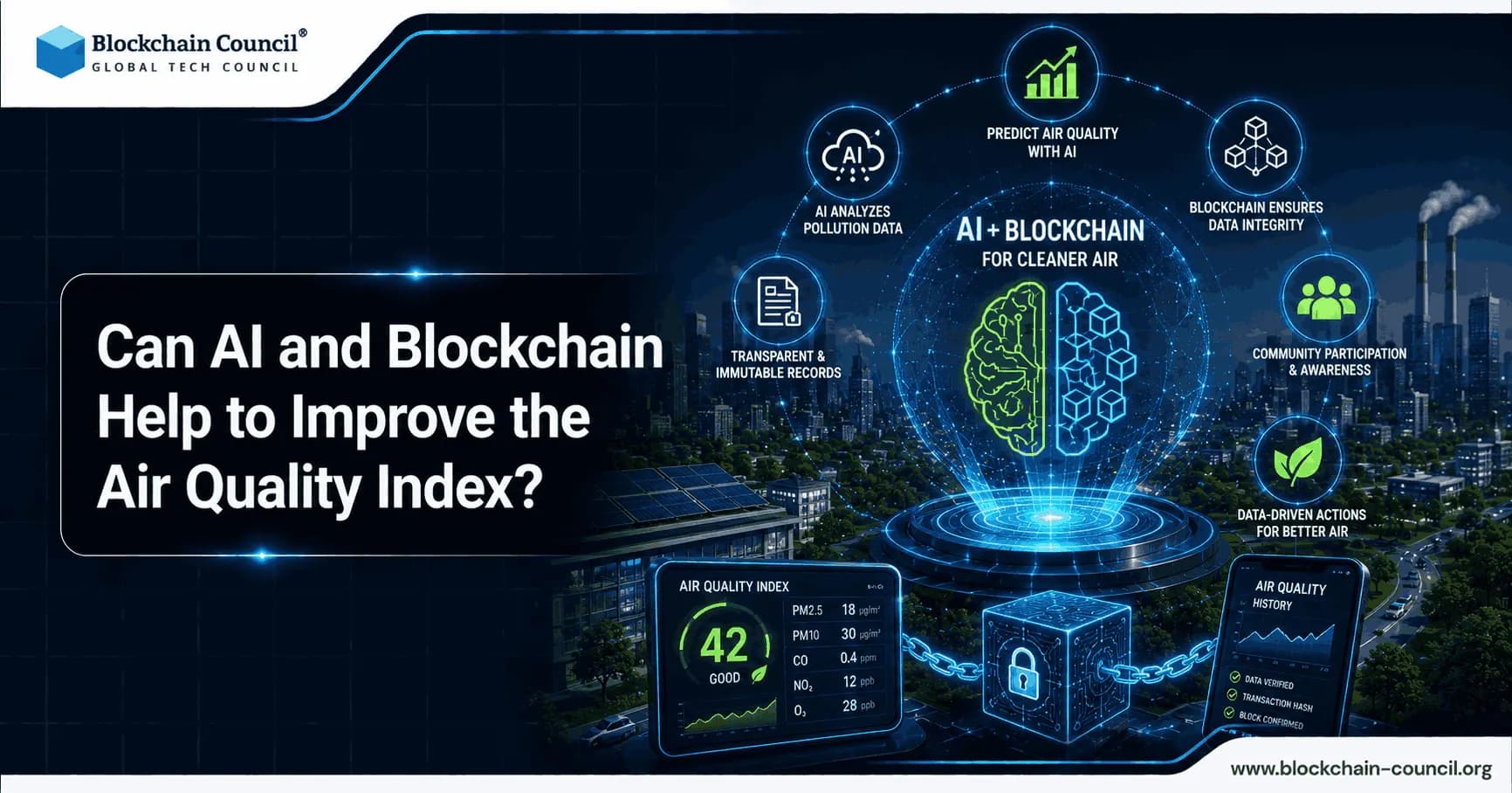
Introduction: Two Technologies Tackling One Growing Problem
Air pollution remains one of the most persistent environmental challenges facing cities around the world, and traditional monitoring systems often struggle to deliver data that is both accurate and trustworthy. Artificial intelligence and blockchain, two technologies usually discussed in separate conversations, are increasingly being paired together to change that. Professionals looking to understand how distributed ledgers can support environmental monitoring often start by earning a Certified Blockchain Expert credential, which builds the foundation needed to evaluate how tamper-proof data systems actually work in practice.
The Air Quality Index, or AQI, depends heavily on the reliability of the sensors and networks feeding it information. When that data can be manipulated, delayed, or simply lost, the entire system loses public trust. Combining AI's predictive power with blockchain's data integrity offers a practical path toward AQI systems that people and governments can actually rely on.

How AI Improves Air Quality Prediction
Artificial intelligence brings pattern recognition and forecasting capabilities that traditional statistical models often cannot match. Machine learning models trained on historical pollution data, weather patterns, and traffic flow can predict AQI levels hours or even days in advance, giving cities time to issue warnings or adjust regulations before pollution spikes affect public health.
Neural network models have already shown strong results in this space, with some research demonstrating significant improvements in short-term prediction accuracy when AI is layered onto sensor networks. These models continuously learn from new data, refining their forecasts as conditions change across different seasons and regions. For professionals eager to build expertise specifically in this domain, pursuing a Certified Artificial Intelligence (AI) Expert certification provides structured knowledge of the machine learning techniques that power these environmental prediction systems.
Federated Learning and Decentralized Sensor Networks
One of the more advanced applications combines federated learning with distributed sensor networks, allowing multiple devices across a city or industrial zone to train a shared prediction model without sending raw data to a central server. This approach preserves privacy while still improving the accuracy of pollution forecasts across a wide geographic area. Research in this space has shown that combining swarm intelligence with federated learning can reduce communication overhead even as more devices join the network, making the approach realistic for large-scale deployment.
Why Blockchain Adds Trust to Air Quality Data
Sensor tampering and data manipulation remain real risks in air quality monitoring, particularly in industrial zones where polluting entities may have an incentive to alter readings. Blockchain addresses this by creating an immutable record of every data point collected from air quality sensors. Once information is written to the chain, it cannot be quietly changed or deleted, giving regulators and the public confidence in the numbers they see.
Several research projects have already tested this concept in real conditions. Systems built around blockchain-secured Internet of Things networks have demonstrated the ability to detect and reject the vast majority of unauthorized data updates, proving that decentralized ledgers can meaningfully strengthen environmental monitoring infrastructure. Smart contracts can also automate responses when pollution crosses certain thresholds, triggering alerts or regulatory actions without waiting for manual review.
Combining the Two Technologies
When AI and blockchain work together, the result is a system that is both predictive and verifiable. AI models generate forecasts and identify pollution trends, while blockchain ensures the underlying data feeding those models has not been altered. This combination is particularly valuable for smart city initiatives, where multiple agencies, businesses, and citizens all need to trust the same shared data source.
Building and maintaining these hybrid systems requires professionals who understand more than one technical discipline. A broad-based Tech Certification helps bridge that gap, giving learners exposure to the wider set of skills, from IoT architecture to data science, that underpin modern environmental technology projects.
Future-Ready Skills
As technology becomes increasingly important across industries, students need opportunities to develop future-ready skills early in their education. A World Tech Olympiad can introduce students to areas such as artificial intelligence, coding, cybersecurity, robotics, and computational thinking while encouraging curiosity and continuous learning. Early exposure of this kind can inspire the next generation of engineers who may one day build the environmental monitoring systems cities depend on.
Challenges and the Road Ahead
Despite promising research results, widespread adoption of AI and blockchain for air quality monitoring still faces obstacles. Blockchain networks can be expensive to scale, and running continuous AI inference on distributed sensor networks requires significant computing resources. Regulatory bodies also need time to trust and standardize around these new systems before they can be used for official policy decisions.
Public awareness plays a role in overcoming these barriers as well. Cities and technology providers rolling out these systems need to explain their value clearly to residents, businesses, and policymakers who may not be familiar with either blockchain or AI. A solid Marketing Certification can help professionals communicate the benefits of these environmental technologies in terms that resonate with everyday audiences, building the public support needed for wider adoption.
The combination of artificial intelligence and blockchain will not solve air pollution on its own, but it offers a meaningful upgrade to how cities measure, forecast, and respond to changing air quality. As more pilot projects move from research papers into real deployments, this pairing could become a standard part of how smart cities protect public health.
FAQs
1. Can AI and blockchain help improve the Air Quality Index?
Yes, AI and blockchain can contribute to better air-quality monitoring and management, especially when combined with IoT sensors. AI can analyze pollution data and predict trends, while blockchain can help maintain transparent and tamper-resistant records of environmental measurements.
2. How can AI help monitor air quality?
AI can analyze large amounts of data collected from air-quality sensors, weather systems, traffic networks, and other sources. Machine learning models can identify patterns in pollutants such as PM2.5, PM10, carbon monoxide, nitrogen dioxide, and ozone and use those patterns to forecast potential pollution changes.
3. How does blockchain help with air-quality monitoring?
Blockchain can create a distributed and tamper-resistant record of air-quality measurements. This can improve confidence in environmental data by making historical records more difficult to alter without detection.
4. What role does IoT play in AI and blockchain-based air-quality systems?
IoT sensors can continuously collect environmental information from different locations. AI can analyze that data for patterns and predictions, while blockchain can provide a secure record of selected measurements and transactions within the monitoring ecosystem.
5. Can AI predict future air pollution levels?
Yes. Machine learning and deep learning models can use historical pollution, weather, traffic, and environmental data to forecast future pollution levels. Research has demonstrated AI-based approaches for short-term air-pollution prediction and early detection.
6. How can blockchain improve the accuracy of air-quality data?
Blockchain itself does not make a sensor more accurate. Instead, it can help protect collected data from unauthorized alteration and provide a transparent history of recorded measurements. Sensor calibration, data validation, and quality-control processes are still essential for accurate AQI information.
7. Can AI and blockchain detect pollution hotspots?
They can help identify and map pollution hotspots when connected to sufficiently dense sensor networks. AI can analyze spatial and temporal patterns, while blockchain can help maintain trustworthy records of the underlying measurements.
8. Can blockchain make air-quality information more transparent?
Yes. A blockchain-based system can provide a shared record of environmental measurements that authorized stakeholders can independently verify. This can be useful when governments, researchers, industries, and communities need confidence in the integrity of pollution data.
9. How can AI help reduce air pollution rather than just measure it?
AI can support proactive pollution management by forecasting pollution spikes and identifying factors associated with deteriorating air quality. These insights can help authorities and organizations plan responses involving traffic management, industrial controls, public warnings, or other pollution-reduction measures.
10. Can smart contracts help respond to poor air quality?
Potentially, yes. Smart contracts can be programmed to trigger predefined actions when verified environmental data crosses specified thresholds. Recent research has explored blockchain-based smart contracts for automated alerts and responses to air-pollution events.
11. How can AI and blockchain support smart cities?
In a smart-city environment, IoT sensors can continuously collect pollution information across different areas. AI can process the data and forecast pollution conditions, while blockchain can provide a secure and transparent data layer for participating organizations.
12. Can blockchain help prevent manipulation of air-quality data?
Blockchain can reduce the risk of unauthorized modification of recorded data because transactions added to the ledger are designed to be tamper-resistant. However, blockchain cannot guarantee that the original sensor reading was correct, so trusted sensors, validation procedures, and governance remain necessary.
13. How can AI improve air-quality forecasting?
AI models can combine historical pollution measurements with variables such as temperature, humidity, weather conditions, traffic, and industrial activity. By learning relationships within these datasets, AI can generate forecasts that may help identify pollution risks before they become severe.
14. Can AI and blockchain improve industrial pollution monitoring?
Yes. AI can analyze industrial emissions and predict exposure or pollution patterns, while blockchain can protect monitoring records and model-related information. A 2025 study combining IoT, federated learning, and blockchain reported improved short-term pollution prediction performance while using blockchain to identify unauthorized model updates.
15. How can blockchain support environmental accountability?
Blockchain can create an auditable record of environmental measurements, emissions data, or compliance-related events. This could help organizations and regulators establish clearer data trails, provided the data sources and verification mechanisms are reliable.
16. Can AI and blockchain help governments manage air pollution?
They can provide governments with more timely information for environmental monitoring and decision-making. AI-generated forecasts can help identify emerging pollution risks, while blockchain can support trustworthy data sharing between agencies, monitoring organizations, industries, and other stakeholders.
17. Can blockchain-based air-quality monitoring work in real time?
Yes, blockchain can be incorporated into real-time monitoring architectures, although storing every high-frequency sensor reading directly on-chain may not always be practical. Recent research has explored combining IoT, edge computing, and blockchain to reduce latency and improve the scalability of real-time urban monitoring.
18. What are the challenges of using AI and blockchain for air-quality monitoring?
Challenges include sensor reliability, data quality, computational requirements, blockchain latency, scalability, infrastructure costs, privacy, interoperability, and maintenance. Research also notes that blockchain integration can increase computational and implementation costs, particularly when large volumes of real-time sensor data are involved.
19. Can AI and blockchain completely solve air pollution?
No. These technologies can improve monitoring, prediction, transparency, and response, but they cannot eliminate the underlying sources of pollution by themselves. Effective air-quality improvement still requires emission controls, clean-energy adoption, transportation policies, industrial regulation, urban planning, and public participation.
20. What is the future of AI and blockchain for air-quality management?
The combination of AI, IoT, edge computing, and blockchain could enable more predictive, transparent, and responsive environmental-monitoring systems. Recent research published in 2026 continues to explore integrated AI-IoT-blockchain frameworks for cleaner production, while earlier studies have demonstrated their potential for real-time air-quality monitoring and pollution prediction.
Related Articles
View All
Blockchain
How Certification Can Help You Become a Blockchain Product Manager
Learn how certification builds blockchain knowledge, credibility, and practical product skills for aspiring blockchain product managers.

Blockchain
Beyond Cryptocurrency: How Blockchain Is Transforming Real-World Industries
Explore how blockchain works beyond cryptocurrency in banking, supply chains, healthcare, tokenisation, CBDCs, and government, plus key challenges and career paths.

Blockchain
Smart Contracts & dApps: How Blockchain Becomes Programmable
Learn how smart contracts and dApps make blockchain programmable, from Ethereum and tokens to DeFi, NFTs, real use cases, benefits, and key risks.
Trending Articles
The Role of Blockchain in Ethical AI Development
How blockchain technology is being used to promote transparency and accountability in artificial intelligence systems.
Top 5 DeFi Platforms
Explore the leading decentralized finance platforms and what makes each one unique in the evolving DeFi landscape.
How Blockchain Secures AI Data
Understand how blockchain technology is being applied to protect the integrity and security of AI training data.