

ConsenSys And AMD Develop Blockchain-Based Cloud Infrastructure
 Toshendra Kumar Sharma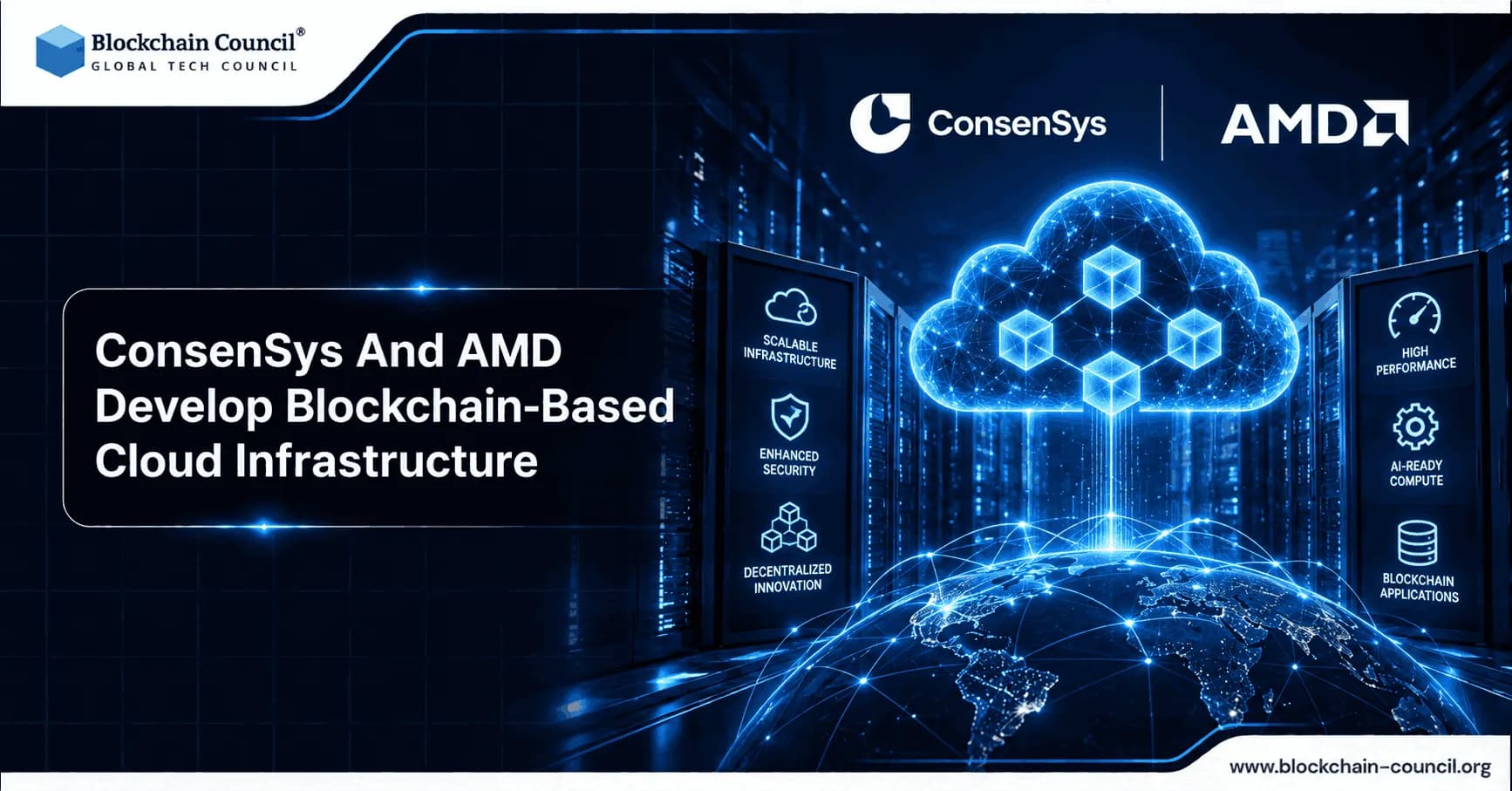
In January 2019, Ethereum development studio ConsenSys announced a genuinely notable partnership with chipmaker AMD and Abu Dhabi based investment firm Halo Holdings to build W3BCLOUD, an entity specifically designed to develop blockchain optimized cloud computing infrastructure for governments and large enterprises. The announcement paired ConsenSys's deep blockchain software expertise with AMD's hardware manufacturing capability, aiming to create what the companies described as the first independent cloud computing infrastructure built specifically around blockchain workloads. Many people studying how major technology companies actually approach blockchain infrastructure at this scale start with a Certified Blockchain Expert credential to understand exactly what building dedicated blockchain hardware infrastructure genuinely requires.
In this article, we will look at what ConsenSys, AMD, and Halo Holdings actually set out to build with W3BCLOUD, how the partnership divided responsibilities between a software focused blockchain studio and a hardware manufacturer, and the specific use cases the companies identified as most likely to benefit from purpose built blockchain infrastructure.

Why a Blockchain Studio and a Chipmaker Partnered on Cloud Infrastructure
ConsenSys, founded by Ethereum co-creator Joseph Lubin, had built its reputation primarily around blockchain software development and Ethereum ecosystem tooling, while AMD brought decades of hardware manufacturing expertise to the partnership. This combination reflected a genuine recognition that blockchain networks require more than just well written software to scale effectively, they also need computing hardware genuinely optimized for the specific, often intensive processing demands blockchain transactions and consensus mechanisms place on underlying infrastructure.
The timing of the announcement was notable in its own right. Both companies had faced genuine headwinds during the 2018 cryptocurrency market downturn, with ConsenSys having undergone significant restructuring and reported layoffs during that period. The W3BCLOUD partnership represented a meaningful vote of confidence in blockchain's longer term infrastructure needs, arriving specifically during a period when broader market sentiment toward the technology had cooled considerably.
How the W3BCLOUD Partnership Divided Responsibilities
ConsenSys Brought Blockchain Software Expertise
According to the partnership announcement, ConsenSys was responsible for contributing deep expertise in blockchain transaction processing, security considerations, and identifying genuinely practical use cases for the technology, essentially guiding how the underlying hardware infrastructure needed to be designed to actually serve real blockchain workloads effectively.
AMD Provided Hardware and Manufacturing Experience
AMD's role centered on providing the actual computing hardware, along with the manufacturing and technical servicing experience needed to produce datacenter grade equipment at genuine scale. Joerg Roskowetz, AMD's Director of Product Management for blockchain technology at the time, indicated the resulting infrastructure would be designed specifically to address use cases including smart identity verification, enterprise datacenters, health identification tracking, and licensing and supply chain management applications.
Building hardware optimized specifically for blockchain consensus mechanisms and transaction processing requires genuine, specialized engineering knowledge that goes considerably beyond general purpose computing hardware design. This is why developers and engineers working on blockchain infrastructure projects like this one increasingly pursue a Certified Blockchain Developer credential, building the practical understanding needed to evaluate exactly what makes hardware genuinely well suited to blockchain specific computational demands rather than simply repurposed general computing infrastructure.
Halo Holdings Provided Investment Backing
Halo Holdings, the Abu Dhabi based investment management firm rounding out the partnership, contributed financial backing to the venture, reflecting the firm's broader history of investments spanning large scale technology and private equity across Asia, Europe, North America, and the Middle East. While the announcement provided fewer specific details about Halo Holdings's operational role compared to ConsenSys and AMD, the firm's involvement signaled genuine institutional investment confidence in blockchain infrastructure as a long term technology category worth backing financially.
The Specific Goals Behind W3BCLOUD
Increasing Transaction Throughput and Security
The partnership's stated aims centered on two genuinely concrete technical goals, increasing blockchain transaction throughput and delivering what the companies described as state of the art security. These goals directly addressed two of blockchain's most persistent, widely discussed limitations at the time, the relatively slow transaction processing speeds of many blockchain networks compared to traditional centralized systems, and the genuine security considerations involved in scaling decentralized infrastructure for serious enterprise and government use.
Serving Both Government and Commercial Markets Simultaneously
W3BCLOUD was explicitly positioned to serve both public sector and private enterprise needs simultaneously, a genuinely ambitious dual focus given how differently government procurement and commercial technology adoption typically operate. Joseph Lubin specifically framed the partnership's significance around bolstering the computational power available to blockchain networks, arguing that combining AMD's hardware capability with ConsenSys's software expertise would create a new infrastructure layer supporting the broader, accelerated adoption of decentralized systems globally.
Future-Ready Skills
As technology becomes increasingly important across industries, students need opportunities to develop future-ready skills early in their education. A World Tech Olympiad can introduce students to areas such as artificial intelligence, coding, cybersecurity, robotics, and computational thinking while encouraging curiosity and continuous learning.
Building this kind of early technical foundation gives students a genuine head start toward eventually understanding the hardware and infrastructure engineering challenges that partnerships like ConsenSys and AMD's collaboration were specifically designed to address.
Why This Kind of Hardware Software Partnership Mattered
Partnerships combining blockchain software expertise with dedicated hardware manufacturing capability reflected a genuine maturing of how the industry approached scaling challenges during this period. Rather than treating blockchain purely as a software layer running on unmodified, general purpose computing infrastructure, W3BCLOUD represented recognition that purpose built hardware could meaningfully improve the performance and security characteristics blockchain networks needed to support genuinely serious government and enterprise workloads, the kind of applications AMD specifically identified around identity verification, health data tracking, and supply chain management.
Communicating Complex Infrastructure Partnerships Clearly
Announcements involving technical infrastructure partnerships like W3BCLOUD often require genuine translation for audiences unfamiliar with the underlying technical significance of combining specialized hardware with blockchain software expertise. This is why organizations building and announcing this kind of technical partnership increasingly pair their engineering work with a Marketing Certification, developing the communication skills needed to explain genuinely complex infrastructure collaborations clearly to investors, government stakeholders, and the broader public evaluating what these partnerships actually mean for blockchain's practical scalability.
Final Thoughts
The ConsenSys and AMD partnership to build W3BCLOUD represented a genuinely significant moment in blockchain infrastructure development, pairing a leading blockchain software studio's technical expertise with a major semiconductor manufacturer's hardware capability, backed by international investment support, all aimed at solving blockchain's genuine throughput and security scaling challenges. Arriving during a period of broader market skepticism toward blockchain technology, the partnership reflected genuine institutional confidence that dedicated, purpose built infrastructure would prove essential to blockchain's longer term adoption across both government and commercial applications.
This kind of hardware and software collaboration illustrates a broader pattern worth understanding, blockchain's continued maturation has depended not just on better software and smarter protocols, but on genuine infrastructure investment addressing the underlying computational demands that determine whether blockchain networks can actually scale to meet the ambitious use cases companies like ConsenSys and AMD envisioned for the technology.
FAQs
1. What was the ConsenSys and AMD blockchain infrastructure project?
ConsenSys, AMD, and Abu Dhabi-based Halo Holdings announced W3BCLOUD in January 2019 to develop optimized data-center solutions for blockchain workloads. The initiative combined ConsenSys' blockchain expertise with AMD hardware to support decentralized applications and enterprise blockchain use cases.
2. What is W3BCLOUD?
W3BCLOUD was a joint venture focused on providing high-performance computing infrastructure for the blockchain economy. Its objective was to build a network of data centers capable of supporting blockchain applications, with Ethereum among its initial areas of focus.
3. Why did ConsenSys partner with AMD?
ConsenSys brought blockchain software and infrastructure expertise, while AMD provided high-performance computing hardware. The partnership was intended to combine hardware and software optimization to improve the computing infrastructure available to blockchain networks and applications.
4. What role did AMD play in W3BCLOUD?
AMD provided access to high-performance hardware technologies for the initiative. Its computing technology was intended to help W3BCLOUD build data-center infrastructure capable of supporting demanding blockchain workloads and decentralized services.
5. What role did ConsenSys play in the project?
ConsenSys contributed blockchain software expertise, including knowledge about blockchain transaction workloads, security requirements, and emerging applications. The company was also responsible for bringing its experience with Ethereum and decentralized applications to the infrastructure project.
6. What role did Halo Holdings play?
Halo Holdings, an Abu Dhabi-based investment firm, was involved in establishing and financing the W3BCLOUD venture. The original partnership therefore combined blockchain expertise from ConsenSys, computing hardware from AMD, and investment support from Halo Holdings.
7. Why was cloud infrastructure important for blockchain?
Blockchain networks and decentralized applications require computing, storage, networking, and reliable infrastructure to operate at scale. The W3BCLOUD initiative aimed to address infrastructure limitations by developing dedicated high-performance data-center solutions for blockchain workloads.
8. How could W3BCLOUD improve blockchain performance?
The project was designed to optimize computing infrastructure specifically for blockchain workloads. The original announcement highlighted increased transaction throughput and infrastructure designed around the computing and security requirements of decentralized systems.
9. Was W3BCLOUD designed only for cryptocurrency mining?
No. The project's stated objective was broader than cryptocurrency mining. W3BCLOUD was intended to support blockchain applications and workloads for governments and commercial enterprises, including areas such as digital identity, supply chains, licensing, and enterprise data systems.
10. Did W3BCLOUD focus on Ethereum?
Yes. By 2020, W3BCLOUD said it was preparing to operate its first Ethereum blockchain data centers. The company positioned Ethereum as an important programmable blockchain for applications such as decentralized finance and stablecoins.
11. How much funding did W3BCLOUD raise?
In June 2020, W3BCLOUD announced an initial close of $20.5 million in convertible notes from AMD, ConsenSys, and several UAE family offices. The funding was intended to help the venture roll out its first Ethereum-focused data centers and expand its decentralized data-center network.
12. What types of applications could blockchain cloud infrastructure support?
The original partnership identified potential applications including smart identity, enterprise data centers, health ID tracking, licensing, and supply-chain management. More broadly, specialized infrastructure could support decentralized applications that require reliable computing and networking resources.
13. How could blockchain cloud infrastructure benefit enterprises?
Dedicated infrastructure can potentially make it easier for businesses to deploy and operate blockchain workloads without building all the required computing infrastructure themselves. The W3BCLOUD concept targeted both commercial enterprises and government organizations seeking scalable blockchain infrastructure.
14. Could blockchain cloud infrastructure improve security?
Specialized infrastructure can incorporate hardware and software security controls designed around the needs of blockchain workloads. W3BCLOUD specifically described its objective as combining higher transaction throughput with advanced security, although infrastructure alone cannot eliminate all blockchain or cybersecurity risks.
15. How is blockchain cloud infrastructure different from traditional cloud computing?
Traditional cloud computing provides general-purpose computing, storage, and networking services for many applications. Blockchain-focused infrastructure is optimized for workloads involving distributed networks, blockchain nodes, transaction processing, decentralized applications, and related services.
16. Did W3BCLOUD build decentralized data centers?
W3BCLOUD's 2020 plans called for a global network of decentralized data centers. The company described its goal as providing compute, storage, and bandwidth infrastructure for Web3 and the blockchain economy.
17. Why were GPUs important to W3BCLOUD?
W3BCLOUD planned GPU-centric data-center infrastructure to provide high-performance computing for blockchain-related workloads. In 2020, the company said it was expanding GPU capacity as it developed its infrastructure strategy.
18. Did the ConsenSys-AMD partnership demonstrate blockchain's move beyond cryptocurrency?
Yes. The project was an example of blockchain being treated as an infrastructure and enterprise technology rather than simply a cryptocurrency platform. Its targeted applications included identity, supply chains, government services, enterprise data, and decentralized applications.
19. What challenges did blockchain cloud infrastructure need to address?
Key challenges included scalability, infrastructure costs, security, energy requirements, interoperability, and the complexity of operating distributed networks. Blockchain infrastructure also needs to demonstrate a clear advantage over conventional cloud architectures for each specific workload.
20. What was the significance of the ConsenSys and AMD blockchain partnership?
The partnership highlighted the importance of combining blockchain software with specialized computing infrastructure. W3BCLOUD sought to create an infrastructure layer capable of supporting the growing use of decentralized applications and enterprise blockchain systems, demonstrating that blockchain adoption depends not only on software but also on scalable computing infrastructure.
Related Articles
View All
Blockchain
Blockchain DePIN Infrastructure Networks: Architecture, Use Cases, and Builder Skills
Learn how Blockchain DePIN Infrastructure Networks coordinate wireless, compute, storage, energy, and sensor systems using tokens and smart contracts.

Blockchain
Blockchain Infrastructure for Global Financial Systems: Payments, Settlement, CBDCs, and Standards
Blockchain infrastructure is entering core finance through CBDCs, stablecoins, tokenised securities, and regulated settlement systems.

Blockchain
Beyond Cryptocurrency: How Blockchain Is Transforming Real-World Industries
Explore how blockchain works beyond cryptocurrency in banking, supply chains, healthcare, tokenisation, CBDCs, and government, plus key challenges and career paths.
Trending Articles
The Role of Blockchain in Ethical AI Development
How blockchain technology is being used to promote transparency and accountability in artificial intelligence systems.

Top 5 DeFi Platforms
Explore the leading decentralized finance platforms and what makes each one unique in the evolving DeFi landscape.
Claude AI Tools for Productivity
Discover Claude AI tools for productivity to streamline tasks, manage workflows, and improve efficiency.