

Blockchaining Identities
 Toshendra Kumar Sharma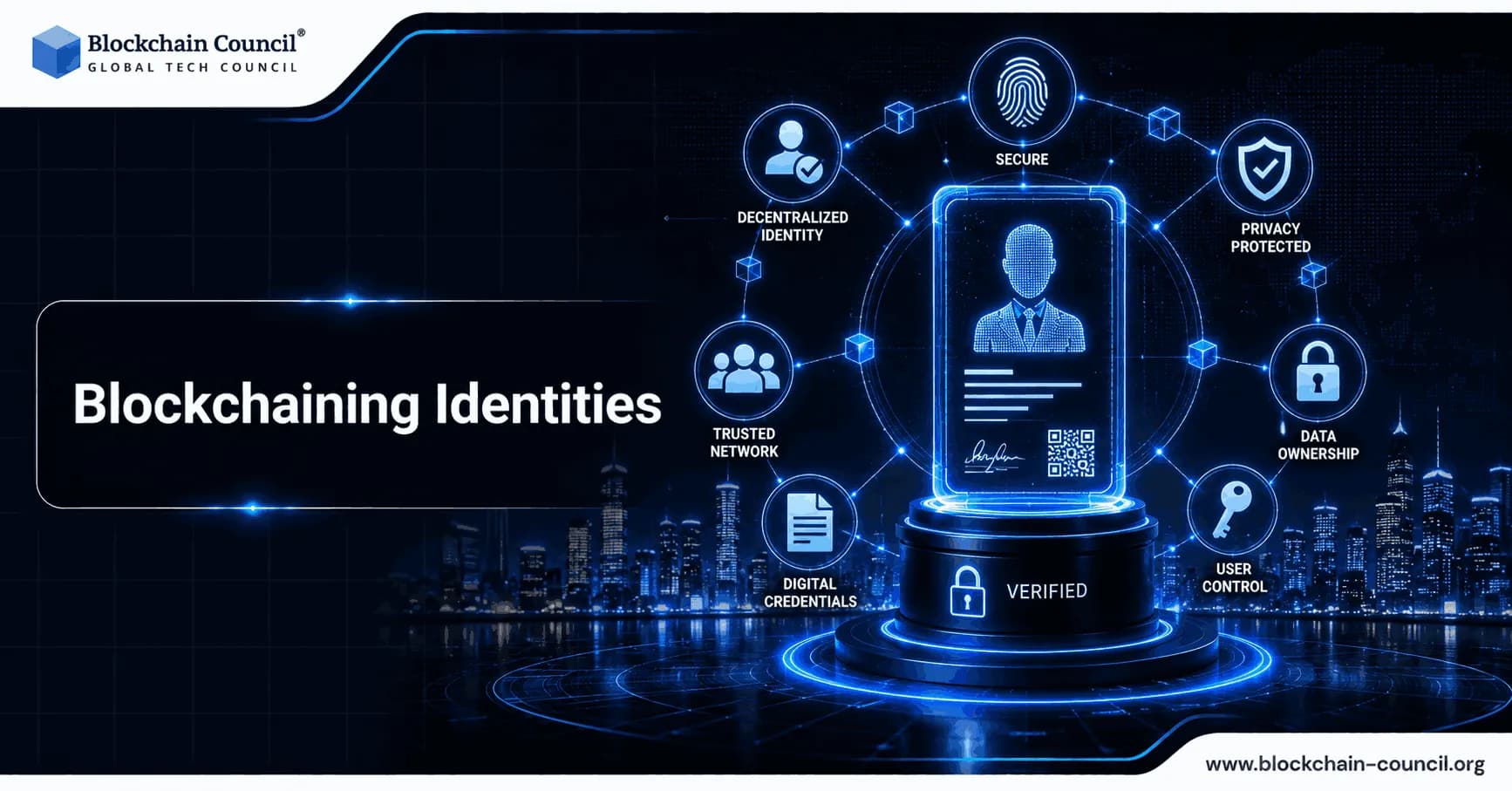
Few technologies have reshaped modern infrastructure as quickly as blockchain, and one of its most consequential applications isn't finance at all it's identity. While blockchain first made headlines as the technology tracking Bitcoin ownership, it has since expanded into a genuinely useful tool for proving who someone is online, without handing that proof to a single centralized authority. By 2026, "blockchaining identities" has moved from an interesting concept to real, government-mandated infrastructure across parts of the world. Anyone looking to understand how this shift actually works at a technical level will find a Certified Blockchain Expert credential a useful foundation before diving into the specific systems below.
What Is Blockchain?
Blockchain is a secure, distributed ledger technology originally developed to track Bitcoin ownership, but its underlying properties decentralization, transparency, and tamper-resistance have since been applied far beyond cryptocurrency, including to real-world assets like diamonds, real estate, and, increasingly, personal identity itself. Because a blockchain-based record is visible to and verifiable by every participant in its network, it's inherently more resistant to fraud than the siloed, password-protected databases most identity systems still rely on today.

Blockchaining Identities How and For Whom?
The core promise behind blockchain-based identity is straightforward: give individuals real control over their own personal information, including exactly who gets to access it and when. Rather than storing scanned passports and identity documents in dozens of separate company databases each one a potential breach target a blockchain-based digital identity lets a person hold verifiable, cryptographically signed credentials themselves and selectively share only what's needed for a given transaction. This approach, often called self-sovereign identity (SSI), has moved well past the pilot stage. Understanding exactly how these cryptographic credentials are issued, verified, and revoked is the kind of practical knowledge a Certified Cryptocurrency Expert program covers alongside broader blockchain fundamentals, since identity systems and cryptocurrency wallets increasingly share the same underlying cryptographic building blocks.
Blockchain Identity Use Cases
Blockchain-based identity systems are now being applied or actively piloted at national scale across areas including:
Digital identities and government-issued credentials
E-residency programs
Education and professional credentials
Cross-border travel documentation
Login and account authentication
Age and proof-of-personhood verification
Why Organizations Actually Need Digital Identity
Traditional identity verification is expensive, slow, and fundamentally fragile: every company that verifies your identity typically stores its own copy of your documents, creating dozens of duplicate records that are each a potential data breach. Digital identity built on blockchain principles addresses both problems at once it reduces the number of places sensitive documents are duplicated, and it gives individuals a reusable, verifiable credential rather than forcing them to repeat identity checks from scratch with every new organization. This isn't a hypothetical benefit anymore: the global digital identity market is projected to reach roughly $49.5 billion in 2026 alone, driven in large part by regulatory mandates rather than speculative interest. Grasping the deeper mechanics behind Decentralized Identifiers (DIDs) and Verifiable Credentials the actual W3C standards most modern systems are built on is exactly the kind of specialized knowledge a Tech Certification in blockchain infrastructure is designed to provide, going well beyond a surface-level understanding of "digital ID."
Who's Actually Building This in 2026
The blockchain identity landscape looks quite different today than it did in the sector's early years some pioneering projects have scaled back, while government-backed infrastructure has taken the lead:
EU Digital Identity Wallet (EUDI Wallet)- Under the eIDAS 2.0 regulation, every EU member state must offer a certified digital identity wallet to citizens and businesses by November 2026, covering roughly 450 million people across 27 countries. The system is built on self-sovereign identity principles and W3C Decentralized Identifiers, partly underpinned by the European Blockchain Services Infrastructure (EBSI).
World ID (formerly Worldcoin)- Uses iris-scanning hardware called the Orb to issue a "proof of personhood" credential, aimed at distinguishing real humans from bots online. It has scaled to tens of millions of registered users globally, but has also faced real regulatory pushback, including restrictions or bans in several countries over biometric privacy concerns.
Civic- One of the earlier blockchain identity management platforms, Civic has evolved its product toward reusable, privacy-preserving credentials across multiple blockchain networks, though industry analysts note the company has been scaling back some of its original identity offerings as the competitive landscape shifts.
Polygon ID- A newer entrant built on zero-knowledge proof technology, enabling privacy-preserving identity verification for use cases like sybil-resistant voting and decentralized credit scoring.
Microsoft Entra Verified ID- Microsoft's enterprise identity platform has incorporated decentralized identity standards, giving organizations a way to issue and verify credentials without relying on Microsoft as the sole authority.
Notably, several identity projects that made headlines in the technology's earlier years including some ambitious governance and "blockchain passport" concepts have not achieved lasting mainstream adoption, a reminder that this space has consolidated around interoperable standards (like W3C Verifiable Credentials) rather than any single company's proprietary system.
Future-Ready Skills
As technology becomes increasingly important across industries, students need opportunities to develop future-ready skills early in their education. A World Tech Olympiad can introduce students to areas such as artificial intelligence, coding, cybersecurity, robotics, and computational thinking while encouraging curiosity and continuous learning.
The Final Word
Identity authentication now touches nearly every part of daily life, from banking and healthcare to national security, education, and something as simple as verifying your age at checkout. Traditional password-based systems remain a weak point precisely because they concentrate sensitive data in databases that are attractive, high-value targets for attackers. Blockchain-based identity increasingly standardized around Decentralized Identifiers and Verifiable Credentials rather than any single vendor's proprietary tool offers a fundamentally different security model, one where individuals hold and selectively share their own credentials instead of trusting dozens of companies to each protect a copy. As governments and enterprises roll these systems out at scale, there's also a growing need for professionals who can explain what these systems actually do to non-technical audiences and decision-makers, which is exactly where pairing technical blockchain knowledge with a Marketing Certification becomes a genuinely valuable combination for anyone working in this space.
Frequently Asked Questions
1. What is blockchain identity?
Blockchain identity, also known as decentralized digital identity, is a system that allows individuals and organizations to create, manage, and verify digital identities using blockchain technology. Instead of relying entirely on centralized databases, users can control how and when their personal information is shared.
2. Why is blockchain identity important?
Blockchain identity can improve privacy, security, and user control over personal data. It helps reduce identity theft, simplifies verification processes, minimizes duplicate identity records, and enables trusted digital interactions without requiring organizations to store excessive personal information.
3. How does blockchain identity work?
A blockchain identity system typically combines decentralized identifiers (DIDs), cryptographic keys, and verifiable credentials. Personal information is generally stored off-chain, while the blockchain records identifiers, public keys, or proofs that enable secure verification without exposing sensitive data.
4. What are Decentralized Identifiers (DIDs)?
Decentralized Identifiers (DIDs) are globally unique digital identifiers that are owned and controlled by users rather than centralized organizations. They allow individuals to prove their identity securely across multiple services without depending on a single identity provider.
5. What are Verifiable Credentials?
Verifiable Credentials are digitally signed documents that confirm information such as education, employment, professional licenses, or government-issued identity. They can be verified cryptographically without requiring direct contact with the issuing organization every time.
6. What is Self-Sovereign Identity (SSI)?
Self-Sovereign Identity (SSI) is a digital identity model that gives individuals control over their identity information. Users decide which credentials to share, with whom, and for what purpose, reducing dependence on centralized identity databases.
7. Does blockchain store personal information?
In most blockchain identity systems, sensitive personal information is not stored directly on the blockchain. Instead, the blockchain stores cryptographic proofs, identifiers, or references, while personal data remains securely stored off-chain under the user's control or with trusted providers.
8. How does blockchain improve identity security?
Blockchain identity systems use cryptography, digital signatures, decentralized verification, and tamper-resistant records to reduce unauthorized modifications and improve trust in identity verification processes. However, users must still protect their private keys and credentials.
9. What industries use blockchain identity?
Blockchain identity has applications in banking, healthcare, education, government services, travel, telecommunications, finance, insurance, supply chain management, and online authentication.
10. How can blockchain identity reduce fraud?
By enabling secure credential verification and reducing reliance on easily forged paper documents, blockchain identity systems can help organizations detect fake identities, prevent duplicate records, and reduce certain forms of identity fraud.
11. Can blockchain identity replace passwords?
Some blockchain identity solutions support passwordless authentication using cryptographic keys, digital wallets, or biometric verification. While promising, passwordless identity systems are still evolving and may coexist with traditional authentication methods for some time.
12. How is blockchain identity used in healthcare?
Healthcare providers can use blockchain identity systems to verify patient identities, securely share medical credentials, manage consent, and improve interoperability between healthcare organizations while protecting patient privacy.
13. How does blockchain identity benefit businesses?
Businesses can reduce identity verification costs, improve customer onboarding, strengthen regulatory compliance, simplify access management, reduce fraud, and enhance customer privacy through decentralized identity solutions.
14. What are the challenges of blockchain identity?
Challenges include interoperability between identity systems, regulatory compliance, user education, key management, scalability, privacy considerations, technical complexity, and achieving widespread adoption across industries.
15. Which blockchain platforms support decentralized identity?
Several blockchain ecosystems support decentralized identity initiatives, including Ethereum, Hyperledger Indy, Hyperledger Aries, Polygon, Solana, Hedera, Cosmos-based networks, and other platforms implementing W3C Decentralized Identifier (DID) standards.
16. What common mistakes should organizations avoid?
Common mistakes include storing sensitive personal information directly on public blockchains, neglecting user privacy, implementing weak key management practices, ignoring regulatory requirements, and adopting blockchain without a clear business need.
17. What are best practices for implementing blockchain identity?
Best practices include using Decentralized Identifiers (DIDs), storing sensitive information off-chain, implementing strong encryption, conducting security audits, following W3C identity standards, protecting private keys, ensuring regulatory compliance, and providing users with clear control over their data.
18. How does blockchain identity fit into Web3?
Blockchain identity is a foundational component of Web3, enabling users to authenticate across decentralized applications (dApps), manage digital credentials, control personal data, and interact securely with decentralized finance (DeFi), gaming, DAOs, and digital asset ecosystems.
19. What trends are shaping blockchain identity in 2025-2026?
Major trends include widespread adoption of Self-Sovereign Identity (SSI), AI-assisted identity verification, zero-knowledge proofs (ZKPs), decentralized identity wallets, reusable digital credentials, government-backed digital identity initiatives, cross-border identity interoperability, and enterprise identity management integration.
20. What is the future of blockchain identity?
Blockchain identity is expected to play a significant role in the future of digital trust by giving individuals greater control over their personal information while improving security and reducing identity fraud. As standards mature and adoption grows, decentralized identity systems may become an important part of banking, healthcare, education, government services, online authentication, and the broader Web3 ecosystem. The goal is not to replace identity itself, but to replace the surprisingly common habit of handing copies of your personal documents to half the internet just to prove you exist.
Related Articles
View All
Blockchain
Beyond Cryptocurrency: How Blockchain Is Transforming Real-World Industries
Explore how blockchain works beyond cryptocurrency in banking, supply chains, healthcare, tokenisation, CBDCs, and government, plus key challenges and career paths.
Blockchain
Smart Contracts & dApps: How Blockchain Becomes Programmable
Learn how smart contracts and dApps make blockchain programmable, from Ethereum and tokens to DeFi, NFTs, real use cases, benefits, and key risks.

Blockchain
Public, Private & Consortium Blockchains: Which Network Fits the Use Case?
Compare public, private, and consortium blockchains by security, speed, privacy, and control, with real examples and a simple guide to choosing the right network.
Trending Articles

Can DeFi 2.0 Bridge the Gap Between Traditional and Decentralized Finance?
The next generation of DeFi protocols aims to connect traditional banking with decentralized finance ecosystems.
How to Install Claude Code
Learn how to install Claude Code on macOS, Linux, and Windows using the native installer, plus verification, authentication, and troubleshooting tips.
Blockchain in Supply Chain Provenance Tracking
Supply chains are under pressure to prove not just efficiency, but also authenticity, sustainability, and fairness. Customers want to know if their coffee really is fair trade, if the diamonds are con